Wednesday, January 15, 2020

The advanced toolmakers of Olduvai Gorge

Olduvai Gorge is one of the world's most important sites for human origins research.
Credit: NOEL FEANS / FLICKR

As far back as the Early Stone Age people were engineering stone tools in complex ways to ensure they were right for the job, according to new research in Tanzania’s famous Olduvai Gorge.

Mechanical testing of raw materials and artefacts by British and Spanish scientists has revealed that Palaeolithic hominins selected different raw materials for different tools based on how sharp, durable and efficient they were.

They made these decisions in conjunction with information about the length of time the tools would be used for and the force with which they could be applied.

This, the researchers say, reveals previously unseen complexity in the design and production of stone tools during this period.

The research, which employed experimental methods more commonly used in modern engineering, was led by anthropologist Alastair Key from the University of Kent, UK, and is described in the journal Royal Society Interface.

Read the rest of this article...

Divers to retrieve Bronze Age artefacts from Swiss lake

Erosion is causing the piles to topple and wash away 
[Credit: Archaologischer Dienst des Kantons Bern, Daniel Steffen]

Archaeologists are diving into Switzerland’s Lake Thun to rescue the remains of Bronze Age pile dwellings before they wash away.

According to canton Bern’s education and culture authorities, the 3,500-year-old settlement is endangered by erosion and likely to disappear soon. From January through March, the divers will be working in front of Schadau Castle.

Initial investigations revealed that the northern area of the site was in a worrying condition. The last remains of the pile dwellings now lie unprotected at the bottom of the lake. The erosion, which washes away up to 50cm of sediment per year, is caused by the strong natural current of the Aare river as well as boat traffic.

Read the rest of this article...

How 3,500-year-old ‘entrance to another world' was uncovered near Peterborough

Archaeologist made a bizarre discovery (Image: YOUTUBE)

AN ARCHAEOLOGIST was stunned when he uncovered a 3,500-year-old “entrance to another world” while excavating what he believed to be an old Roman road in Peterborough.

Dr Francis Pryor was working at Flag Fen, which has now been identified as a Bronze Age site, when he noticed timber wood buried in the ground. The leading archaeologist quickly called in a team to excavate the area, who exposed more than 60,000 timbers arranged in a very long row. Experts determined that they were part of a wooden causeway across the wet fenland, but Dr Pryor believes they represent much more.

Read the rest of this article...

DÉCOUVERTE D'UNE AGGLOMÉRATION ET D'UN IMPORTANT SANCTUAIRE GAULOIS DANS LE MAINE-ET-LOIRE


À Allonnes, les archéologues de l'Inrap ont découvert une importante agglomération gauloise du IIe-Ier siècle avant notre ère, et son sanctuaire, une découverte exceptionnelle à l'échelle de l'Europe celtique.

Suite à une prescription de la Drac ​Pays de la Loire, une importante fouille d’archéologie préventive vient de s’achever à Allonnes (Maine-et-Loire), rue Charles Baudelaire, au lieu-dit Le Tertre. Les archéologues de l’Inrap ont mis au jour de nombreux vestiges d’une agglomération gauloise fondée au IIe siècle avant notre ère et de son complexe cultuel, une découverte remarquable, non seulement à l’échelle de la région mais aussi à l’échelle de l’Europe celtique. L’opération qui a exigé onze mois d’étude et un arrêté de découverte exceptionnelle de la Drac Pays de la Loire a livré un nombre considérable d’informations sur le passé de la commune.

Read the rest of this article...

Notre Dame in Paris: 3D-Daten für den Wiederaufbau

Ausschnitt des Südportals am Querhaus der Kathedrale von Notre Dame als CAD-Umzeichnung. Quelle: Angel Menargues/Ruth Tenschert/Universität Bamberg

Universität Bamberg hat mit französischer Forschungsorganisation einen umfangreichen Kooperationsvertrag unterzeichnet

Die Otto-Friedrich-Universität Bamberg, die französische Forschungsorganisation »Centre national de la recherche scientifique« (CNRS) und das französische Ministerium für Kultur haben einen Vertrag über die Beteiligung der Bamberger Kunstgeschichte in der Initiative »Chantier Notre-Dame« unterzeichnet. In dieser Initiative bringt das CNRS Expertinnen und Experten aus verschiedenen Fachbereichen zusammen, um eine wissenschaftliche Grundlage für den Wiederaufbau der Kathedrale Notre Dame zu schaffen. Das Wahrzeichen von Paris war am 15. April 2019 in Brand geraten und teilweise zerstört worden.

Read the rest of this article...

1,000 ancient woodlands at risk of destruction by projects like HS2, conservationists warn


A fallen Silver Birch tree at Moseley Bog, an ancient woodland in Birmingham ( Getty )

More than 1,000 ancient woodlands are at risk of damage or destruction from development, the Woodland Trust has warned.

Figures from the charity show it is aware of 1,064 ancient woods at risk from housing, infrastructure and other developments.

It is the highest number of woods at risk since the Trust started compiling data in 1999, and the first time it has topped the 1,000 mark.

Of the cases the Trust has identified, 801 are live planning applications, while the remaining 263 are included in council site allocation plans for areas outlined for future development such as housing or business.

The Woodland Trust says the rise in threatened woods is down to a growing number of road and rail infrastructure projects such as HS2, as well as a lack of awareness over changes to planning rules that strengthen protection for ancient woodlands and trees against inappropriate development.

It also warns that ancient woods – those where woodland has been in existence since at least 1600 in England and Wales and 1750 in Scotland – face other threats alongside development. 

Read the rest of this article...

Monday, January 13, 2020

Unexpected Cemetery Found in Central Trondheim

One of the fourteen individual graves. Photo: NIKU

During the archaeological excavations in Kjøpmannsgata in the summer, somewhat unexpected traces of a large cemetery from the Middle Ages appeared.

Throughout 2019, excavation work has been taking place in connection with new construction projects in Kjøpmannsgata. As with all new builds in Norway, an archaeological examination of the site in central Trondheim has taken place.

The surprising finds continue
An unelected cemetery has been the highlight of the work so far. It’s surprising not only for its location, but for its size. To date, 15 individual graves and three pit graves have been found.

Heads were turned last summer when one of these pits was uncovered. It contained the human remains of an estimated 200 people. It is believed these remains were excavated from other cemeteries and reburied here during development work sometime in the 17th century. Two more pit graves have since been found.

Read the rest of this article...

Oldest known city view of Venice discovered

Image of Venice supplied by the Florence, Biblioteca Nazionale Centrale, II.IV.101, fol. 1v. 
With permission of the Ministero per i beni e le attività culturali e per il turismo 
[Credit: Biblioteca Nazionale Centrale, Florence]

A researcher from the University of St Andrews has unearthed the oldest known city view of Venice, dating from the 14th century.

The discovery, by Dr. Sandra Toffolo from the School of History, was made during research for her monograph “Describing the City, Describing the State. Representations of Venice and the Venetian Terraferma in the Renaissance,” which will be published in early 2020.

The image is part of a manuscript containing the travel account of Niccolò da Poggibonsi, an Italian pilgrim who traveled to Jerusalem in 1346-1350. The manuscript was likely made shortly after he returned to Italy in 1350. During his pilgrimage, Niccolò passed through Venice and his description of the city is accompanied by a pen drawing of Venice.

Read the rest of this article...

Sunday, January 12, 2020

New evidence reveals what inspired ancient stone circles on Isle of Lewis

The Callanish Standing Stones on the Isle of Lewis. Picture: Contributed

A massive lightning strike which hit the Isle of Lewis more than 3,000 years ago may have inspired ancient civilisations to build stone circles, academics believe.
Scientists studying a prehistoric stone circle on the Outer Hebrides island discovered evidence of a lightning strike on a nearby site where a circle had been hidden beneath a peat bog.

Just one stone remained standing at the site, known as Site XI or Airigh na Beinne Bige, which overlooks the main stone circle, Tursachan Chalanais, at Calanais on the Isle of Lewis.

But it is believed that the single stone was once part of a circle of standing stones, and that a massive star-shaped 'magnetic anomaly' in the centre signified where it had been struck by lightning.

Scientists from the University of St Andrews and the University of Bradford plan to extend their research to surrounding areas which have been flooded by rising sea levels.

Read the rest of this article...

Medieval and Roman artefacts discovered in ancient port city of Caesarea

Aerial view of the Caesarea dig site [Credit: Vanderbilt University]

Over the past two years, Vanderbilt researchers and students working at the ancient port city of Caesarea, on the north coast of modern-day Israel, have unearthed tantalizing clues to life in the city during the medieval Islamic period as well as the best-preserved remains yet discovered of Herod the Great’s Temple of Rome and Augustus. These finds shed light on an oft-overlooked period in Mediterranean history and give scholars a fresh look at a world-famous monument destroyed long ago.

Under the direction of Joseph Rife, director and associate professor of classical and Mediterranean studies, and Phillip Lieberman, associate professor of Jewish Studies and Classical and Mediterranean Studies, an international team of Vanderbilt students, staff, faculty and archaeological specialists have been excavating a 900-square-meter section of the ancient and medieval port city during the Maymester sessions of 2018 and 2019. They work at the site, which is a national park, in collaboration with the Israel Antiquities Authority.

Home to the mercantile elite

“Caesarea is one of the most important sites in the region, dating back to antiquity,” said Lieberman. “It was a huge, cosmopolitan trading center, on par with medieval Baghdad and Damascus and, before that, ancient Alexandria and Antioch.”

Read the rest of this article...

LE MANOIR DE VOÛTE-COTON ET LE LOGIS DE BELLEBRANCHE SORTENT DE TERRE À ANGERS


À Angers, une équipe de l’Inrap a fouillé les vestiges de deux bâtiments élitaires du second Moyen Âge, qui longeaient à l’origine la rive de la Maine.

Boulevard Anceray, à Angers, en amont de travaux d’aménagement du campus des Arts et Métiers (Ensam) , une équipe de l’Inrap a fouillé une surface de 384 m² et mis au jour les vestiges de deux habitats élitaires, construits entre l’abbaye du Ronceray (XIe siècle) et la rivière. L’un, daté des XIIe-XIIIe siècle, est le manoir de Voûte-Coton, l’autre, daté des XIVe-XVe siècle, est le logis de Bellebranche. Tout en étant représentatifs des grands phénomènes d’urbanisation au Moyen Âge, ces deux édifices imposants témoignent de la colonisation de la rive droite de la Maine et offrent une intéressante fenêtre d’observation sur les habitudes de vie de la population jusqu’à la période moderne.

Read the rest of this article...

Saturday, January 11, 2020

Viking Colonies Collapsed Through Over Hunting Walruses


The mysterious disappearance of Greenland's Norse colonies sometime in the 15th century may have been down to the overexploitation of walrus populations for their tusks, according to a study of medieval artifacts from across Europe.

Founded by Erik the Red around 985 AD after his exile from Iceland (or so the Sagas tell us), Norse communities in Greenland thrived for centuries - even gaining a bishop - before vanishing in the 1400s, leaving only ruins.

An Economy Built on Walrus Ivory

Latest research from the universities of Cambridge, Oslo, and Trondheim has found that, for hundreds of years, almost all ivory traded across Europe came from walruses hunted in seas only accessible via Norse settlements in south-western Greenland.

Walrus ivory was a valuable medieval commodity, used to carve luxury items such as ornate crucifixes or pieces for games like chess and Viking favorite hnefatafl. The famous Lewis chessmen are made of walrus tusk.

Read the rest of this article...

Large scale feasts at ancient capital of Ulster drew crowds from across Iron Age Ireland

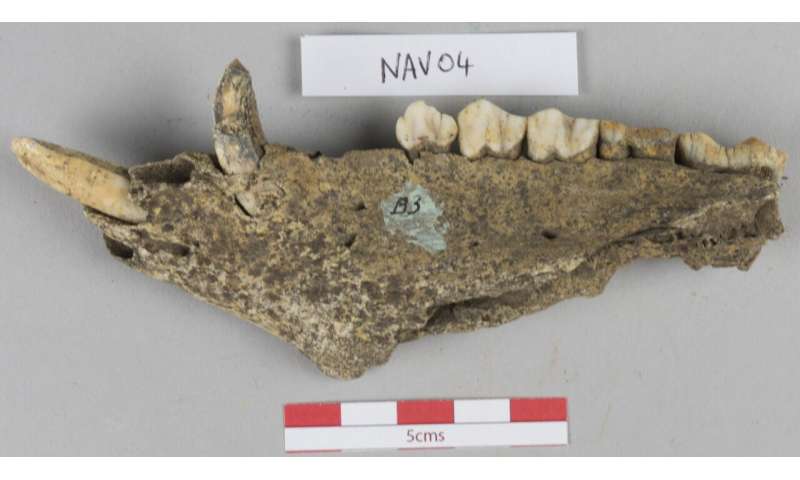
One of the analysed pig jaws for the study. Credit: Dr Richard Madgwick
People transported animals over huge distances for mass gatherings at one of Ireland's most iconic archaeological sites, research concludes.

Dr. Richard Madgwick of Cardiff University led the study, which analysed the bones of 35 animals excavated from Navan Fort, the legendary capital of Ulster. Researchers from Queen's University Belfast, Memorial University Newfoundland and the British Geological Survey were also involved in the research.

The site had long been considered a centre for ritual gatherings, as excavations found a huge 40m diameter building and a barbary ape cranium, likely from at least as far as Iberia. Results suggest the pigs, cattle and sheep were brought from across Ireland, perhaps being reared as far afield as Galway, Donegal, Down, Tyrone and Antrim. Evidence suggests some were brought over more than 100 miles.

Dr. Madgwick, based in Cardiff University's School of History, Archaeology and Religion, said: "Our results provide clear evidence that communities in Iron Age Ireland were very mobile and that livestock were also moved over greater distances than was previously thought.

Read the rest of this article...

Viking runestone linked to fears of climate change: study

Credit: University of Gothenburg

One of the world's most famous runestones is now believed to have been erected by Vikings fearing a repeat of a previous cold climate crisis in Scandinavia, a new study said Wednesday.

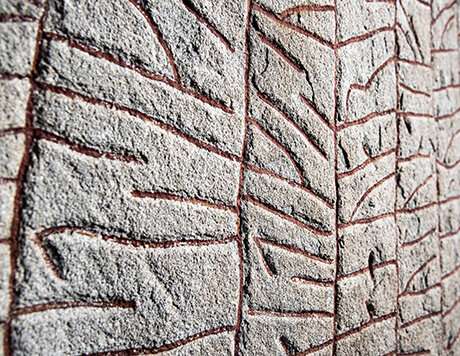
The Rok stone, raised in the ninth century near the lake Vattern in south central Sweden, bears the longest runic inscription in the world with more than 700 runes covering its five sides.

It is believed to have been erected as a memorial to a dead son, but the exact meaning of the text has remained elusive, as parts are missing and it contains different writing forms.

The stone refers to the heroic acts of "Theodoric," which some scholars believe refers to Theodoric the Great, a sixth century ruler of the Ostrogoths in what is now Italy.

Researchers at three Swedish universities now suspect the inscriptions are more of an allusion to an impending period of extreme winter, as the person who erected the stone tried to put their child's death into a larger perspective.

Read the rest of this article...

The Vikings erected runestone out of fear of climate catastrophe

Credit: University of Gothenburg

Several passages on the Rok stone – the world’s most famous Viking Age runic monument – suggest that the inscription is about battles and for over a hundred years, researchers have been trying to connect the inscription with heroic deeds in war. Now, thanks to an interdisciplinary research project, a new interpretation of the inscription is being presented. The study shows that the inscription deals with an entirely different kind of battle: the conflict between light and darkness, warmth and cold, life and death.

The Rok runestone, erected in Ostergotland around 800 CE, is the world's most famous runestone from the Viking Age, but has also proven to be one of the most difficult to interpret. This new interpretation is based on a collaboration between researchers from several disciplines and universities.

“The key to unlocking the inscription was the interdisciplinary approach. Without these collaborations between textual analysis, archaeology, history of religions and runology, it would have been impossible to solve the riddles of the Rok runestone,” says Per Holmberg, professor in Swedish at the University of Gothenburg, who led the study.

Read the rest of this article...

Melton Mowbray building site bones date back to 7th Century

The bones were discovered on a building site in Melton Mowbray
NEMM.CO.UK

Human bones found on a building site have been found to date back to the 7th Century.

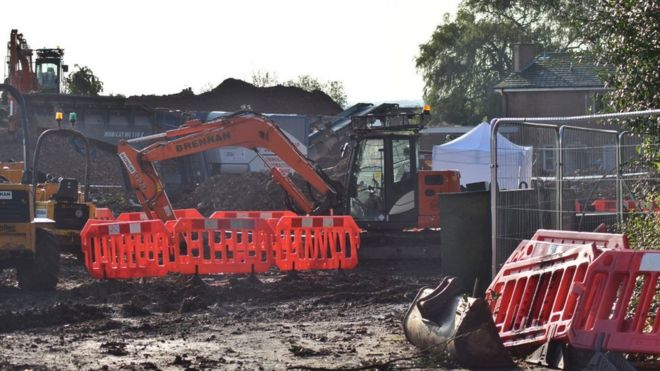
Police were called and construction was stopped when the remains were discovered off Scalford Road in Melton Mowbray, Leicestershire, in October.

A forensic examination was carried out to determine how long the bones had been in the ground.

Carbon dating has dated them to 635 to 685 AD. They have now been handed over to an archaeology firm.

The bones were found at a site during the construction of a new retirement village.

Leicestershire Police said the bones are being passed to Cotswold Archaeology Ltd "for further research to be carried out into the finding".

Read the rest of this article...

Padlock among finds made at Lair of Glenshee Pictish homestead

A reconstruction of the homestead in Glenshee
CHRIS MITCHELL

An early Medieval padlock was among the finds made by archaeologists at a Pictish settlement in Perthshire.

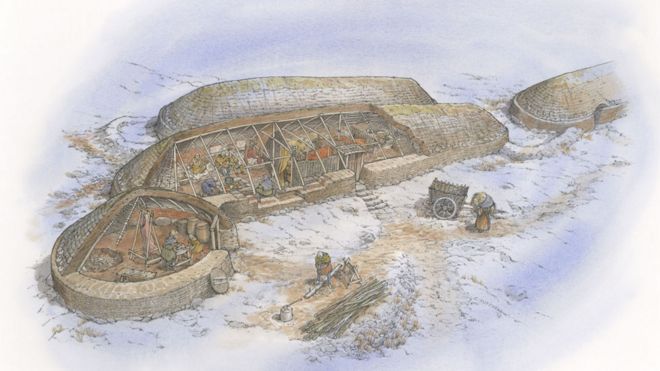
Lair in Glenshee was the location of a Pictish homestead with turf-roofed stone and timber buildings dating to around 500 to 1000 AD.

Perth and Kinross Heritage Trust, supported by other organisations, has spent five years excavating the site.

Archaeologists believe the padlock was used to keep valuables and personal belongings safe.

Read the rest of this article...

Roman cemetery found at Somerton new school site

An adult woman skeleton was unearthed in the excavation
WESSEX ARCHAEOLOGY

The skeletal remains of 50 adults and children from the Roman period have been unearthed in Somerset where a new school is being built.

The graves date from the Roman period 43-410 AD and also include items buried with them such as pottery and brooches.

South West Heritage Trust archaeologist Steve Membery said: "The individuals were evidently of some status in native society."

The new school in Somerton will replace King Ina Junior and Infants' schools.

Read the rest of this article...

Historic England: 10 English archaeological finds of the decade

CAMBRIDGE ARCHAEOLOGICAL UNIT/DAVE WEBB

The remains of a Shakespearean theatre, 17th Century shipwreck and bones of Britain's first rabbit have been named among the top 10 archaeological finds of the last decade in England.

Historic England drew up the list to mark the imminent arrival of 2020.

Chief executive Duncan Wilson said: "This has been a truly remarkable decade of landmark archaeological discoveries.

"The past never ceases to amaze us and there is always more to learn."

Read the rest of this article...
The Iceman from British Columbia

The knife with its sheath

Human remains from the ice have always received a lot of public interest. Almost everyone has heard about Ötzi, the 5200-year-old iceman from the Tyrolean Alps. But have you heard about Kwäday Dän Ts’inchi – the Iceman from British Columbia? If not, you are seriously missing out on one of the most fascinating finds from the ice.

The discovery
August 1999. It had been the hottest year on record in British Columbia, Canada, and the glacial ice was melting fast. Three hunters were looking for Dall’s Sheep in the remote mountains of the Tatshenshini-Alsek Park. On approaching a glacier, they could see something lying on the ice. Closer inspection revealed it to be an animal skin. Near it, they discovered a gruesome sight – a human pelvic bone, with attached legs disappearing into the ice. Checking the ice around the find spot, they also made other discoveries, including a small object with a wooden handle, still in its sheath.

The hunters took along a few of the artifacts for proof of the find, but otherwise had the good sense not to disturb the site. If only Ötzi the Iceman had been treated in such a gentle way (read more here). Once the hunters had hiked out from the park, they immediately contacted the archaeological authorities. The archaeologists naturally became very excited when they heard about the human remains and the artifacts. The small object with a wooden handle, brought along by the hunters, turned out to be a knife.

Read the rest of this article...