Wednesday, November 30, 2016

All That Glittered Was Not Gold In Roman Britain


An in-focus display of artefacts found by archaeologists as part of major project to upgrade the A1 to a motorway in North Yorkshire opens at the iconic Bowes Museum in Barnard Castle on Saturday 26 November 2016.


A carnelian intaglio of Hercules and the Lion, a brass plated boot spur and a 

bronze plated penannular brooch [Credit: The Bowes Museum]

On the opening day, The Bowes Museum and Northern Archaeological Associates will also provide family activities based on archaeological findings on the road scheme. These drop in sessions, which include creating a paper mosaic; salt dough coin making and painting; creating a Roman helmet; pottery handling and viewing animal bones, will run from 11am - 3pm in the Museum’s Education Vaults and are free for children under 16 when accompanied by an adult for whom normal Museum admission applies.

An archaeological team of around 60 people have been working along the A1 between Leeming Bar and Barton for three years as part of a Highways England scheme to install an extra lane in each direction and improve the route to motorway standards.

During that time, archaeologists working on behalf of the Carillion Morgan-Sindall Joint Venture have uncovered more than 200,000 prehistoric and Roman artefacts and sieved more than 86 tonnes of sediment samples.


Read the rest of this article...

Pembroke Castle study uncovers possible Henry VII birthplace


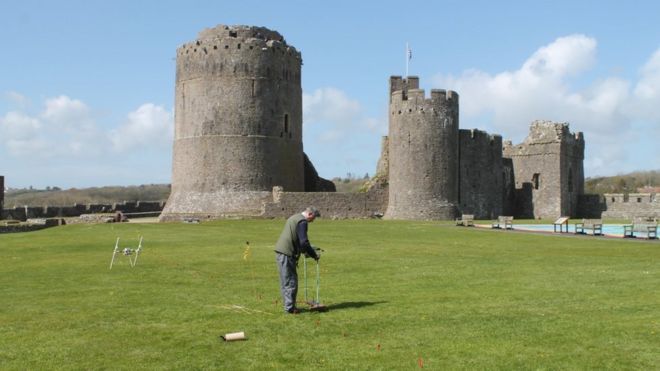
Researchers believe they might have uncovered the location of Henry VII's birthplace at Pembroke Castle.
Aerial photographs from 2013 gave glimpses of what lay beneath the surface, with parch marks revealing possible buildings.
geophysical survey has now confirmed the outline of a late-medieval building in the outer ward, where the king could have been born.
Neil Ludlow, consultant archaeologist, said it shone new light on the castle.
Much of the interior of the castle, which dates from the 11th Century, was destroyed after the Middle Ages.

Read the rest of this article...
Over 82,000 Archaeological Finds Made By Members Of Public In UK


Thousands of archaeological finds, including a huge Bronze Age gold "torc" and a hoard of 17th century silver coin clippings, were made by members of the public last year, a report reveals.


The torc is much larger than usual examples and is regarded as the best found in England in more than a century 

[Credit: Dominic Lipinski/PA]

The 82,272 discoveries were made mostly by people who were metal-detecting, according to the Portable Antiquities Scheme annual report launched at the British Museum.

More than a thousand discoveries of "treasure" - such as gold or silver ornaments or coin collections and prehistoric metalwork - were made in England, Wales and Northern Ireland last year, the report reveals.

The 1,008 finds included a Roman grave in Hertfordshire and a hoard of Viking Age objects and Anglo-Saxon coins in a field near Watlington, Oxfordshire.

Archaeological items, the majority of which were found on cultivated land where items can be at risk of damage from ploughing and corrosion, ranged from thousands of stone flints to a rare Bronze Age shield in Suffolk.


Read the rest of this article...

Black Death burial pit found at site of medieval abbey in Lincolnshire


Carbon dating shows skeletons are from mid-14th century, while DNA tests of teeth find presence of plague bacterium

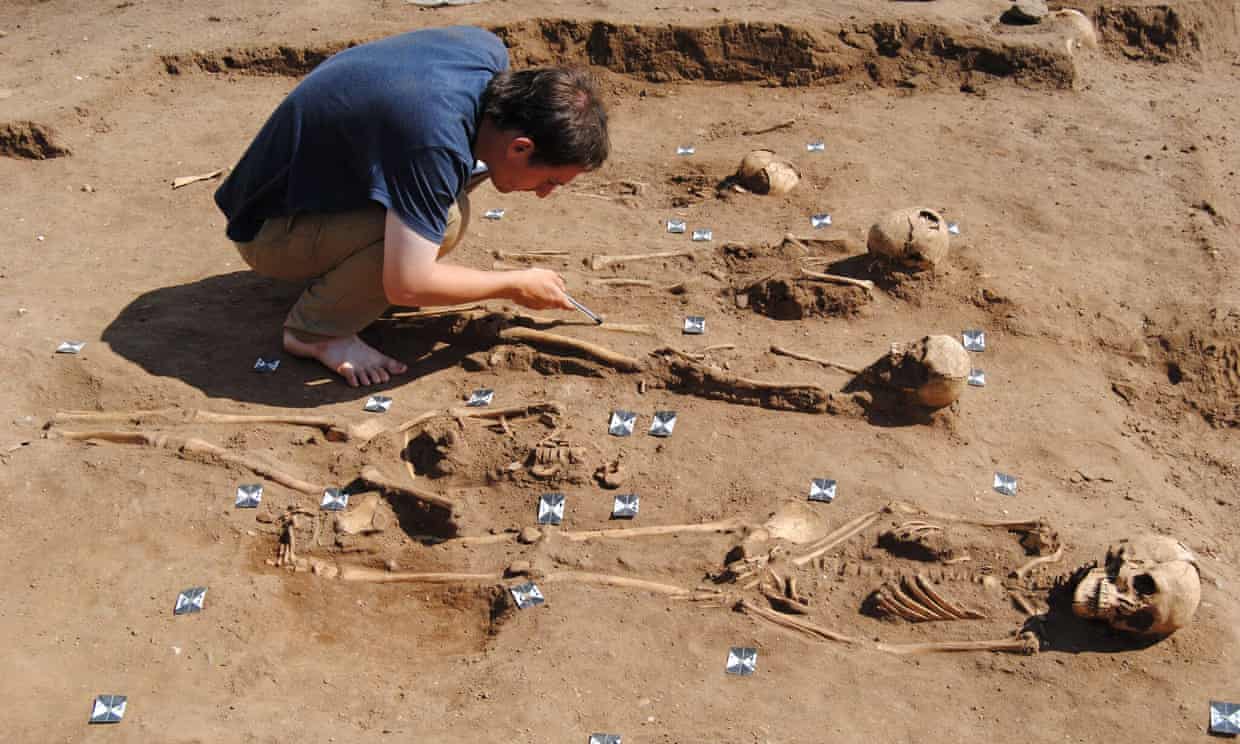
The presence of such a burial site suggests the local community was overwhelmed by the number who died. Photograph: University of Sheffield/PA

A mass burial pit of victims of the Black Death dating back to the 14th century has been discovered near Immingham in Lincolnshire.
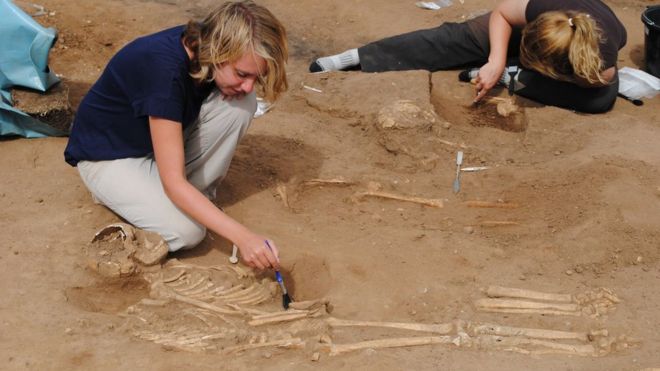
Archaeologists from the University of Sheffield were searching the site of Thornton Abbey, once one of the country’s biggest medieval abbeys, for evidence of a post-medieval building when they came across the grave containing 48 skeletons, 27 of them children.
Carbon dating shows the remains are from the middle of the 14th century, when the Black Death, which was most probably bubonic plague, killed an estimated 75 million to 200 million people across Europe and Asia.
Teeth samples were sent to Canada where DNA was successfully extracted and tested positive for Yersinia pestis, the bacterium responsible for the plague, which is documented to have reached Lincolnshire in the spring of 1349.
Read the rest of this article...
Dr Hugh Willmott said the mass burial was "completely unexpected"

A Black Death burial pit containing 48 skeletons, including the remains of 27 children, has been found at the site of a 14th Century monastery hospital.

The bodies were excavated at Thornton Abbey in North Lincolnshire.

Between 1347 and 1351 the "Great Pestilence" swept westward across Europe killing millions of people. It later became known as the Black Death.

It arrived on Britain's shores in 1348 and is believed to have wiped out up to 60% of the population at the time.

Read the rest of this article...

Monday, November 28, 2016

Altar of Miracle-Making Viking King Discovered in Norway

Archaeologists uncovered the foundations of a wooden church where the body of the Viking king Olaf Haraldsson may have been enshrined after he was declared a saint.
Credit: Norwegian Institute for Cultural Heritage Research (NIKU);
Distributed Under a Creative Commons License

The Norwegian Institute for Cultural Heritage Research (NIKU) announced Nov. 11 that its researchers had discovered the foundations of a wooden church where the body of King Olaf Haraldsson was taken immediately after he was declared a saint in 1031. St. Olaf, as he is now known, conquered and consolidated Norway in 1016 but held on to rule for a little more than a decade before his power was threatened by Canute I, king of Denmark and England. Olaf died in the Battle of Stiklestad in 1030.
Now, archaeologists say they've found a key location in the king's posthumous journey from martyr to Norway's patron saint. [25 Grisly Archaeological Discoveries]
Read the rest of this article...

5,000-Year-Old Hill Fort 'Damaged By Metal Detectors'


Cissbury Ring is the largest hill fort in Sussex [Credit: National Trust]

A 5,000-year-old hill fort is being damaged by the "illicit use of metal detectors", police say. The damage to Cissbury Ring, on the South Downs near Worthing, is irreversible, Sussex Police said.

The use of metal detectors on scheduled monuments is prohibited without a licence.

PCSO Daryl Holter said: "Illicit metal detecting is a shady unscrupulous act, and deliberate damage to this site is irreversible."

He said the site was protected by the Ancient Monuments and Archaeological Areas Act 1979 and managed by the National Trust.

Read the rest of this article...

Wednesday, November 23, 2016

Unsealing of Christ's Reputed Tomb Turns Up New Revelations


For just 60 hours, researchers had the opportunity to examine the holiest site in Christianity. Here's what they found.

Members of the conservation team lift a stone to clean and digitally scan before reinstalling it on the façade of the Edicule, the shrine that houses what is believed to be the tomb of Jesus. 


JERUSALEM Researchers have continued their investigation into the site where the body of Jesus Christ is traditionally believed to have been buried, and their preliminary findings appear to confirm that portions of the tomb are still present today, having survived centuries of damage, destruction, and reconstruction of the surrounding Church of the Holy Sepulchre in Jerusalem's Old City.


The most venerated site in the Christian world, the tomb today consists of a limestone shelf or burial bed that was hewn from the wall of a cave. Since at least 1555, and most likely centuries earlier, the burial bed has been covered in marble cladding, allegedly to prevent eager pilgrims from removing bits of the original rock as souvenirs.

Read the rest of this article...
Vast 5,600-year-old religious centre discovered near Stonehenge


The centre was built more than 1,000 years before the stones of Stonehenge were erected

A reconstruction of part of a Neolithic causewayed enclosure at Windmill Hill, which would have been similar to the complex discovered near Stonehenge Historic England Archive/Judith Dobie

A huge, prehistoric religious and ceremonial complex has been discovered near Britain’s most famous prehistoric temple Stonehenge. 

Its discovery is likely to transform our understanding of the early development of Stonehenge’s ancient landscape.


Built about 5,650 years ago – more than 1,000 years before the great stones of Stonehenge were erected – the 200m-diameter complex is the first major early Neolithic monument to be discovered in the Stonehenge area for more than a century.

Read the rest of this article...

Archaeologists explore the mecca of Roman veterans in Bosnia and Herzegovina

The team during surface survey in unfavourable conditions due to intensive agricultural activity in the fertile valley. Photo by Anna Mech

Roman veterans and other settlers built their homes and villas two thousand years ago, guided by convenience - according to a study of Polish archaeologists in Bosnia and Herzegovina. That is why these structures were built on the edges of river valleys close to the road network.

"During this year's research we were able to find some previously unknown sections of Roman roads, including the Salona-Narona road that was key to the whole Roman province of Dalmatia" - explained the project leader, Tomasz Dziurdzik of the Institute of Archaeology of the University of Warsaw. Research is conducted in partnership with the University of Mostar, represented by Mirko Rašić.

Read the rest of this article...

ARCHAEOLOGISTS FIND 2ND ANTIQUITY FORTRESS AT PREHISTORIC, THRACIAN ROCK SHRINE NEAR BULGARIA’S ANGEL VOYVODA

A second Antiquity fortress has been found at the ancient rock shrine Hasara near Bulgaria’s Mineralni Bani. Photo: Mineralni Bani Municipality

A second previously unknown Antiquity fortress has been found by archaeologists a prehistoric and later Ancient Thracian rock shrine in an area known as Hasara near the town of Angel Voyvoda, Mineralni Bani Municipality, Haskovo District, in Southern Bulgaria.

In May-June 2016, the team of archaeologists led by Assoc. Prof. Zdravko Dimitrov from the National Institute and Museum of Archaeology in Sofia announced the discovery of an Ancient Roman fortress with an Early Christian church at the ancient rock shrine near Bulgaria’s Angel Voyvoda.

The Ancient Thracians were found to have used the Hasara shrine at about the period of the Trojan War.

Read the rest of this article...

Archaeological finds on route of Inverness West Link

Burnt grains and timbers found while excavating a grain-drying kiln at Torvean

Prehistoric and Bronze Age finds have been made during work to construct the new Inverness West Link road.
Pottery fragments and the remains of kilns used for drying grain were among discoveries made at Torvean.
Archaeologists who have been monitoring the building of the West Link displayed some of the items at Lochardil Primary School last week.
The new road is being built for Highland Council to ease traffic flow through Inverness.
Read the rest of this article...
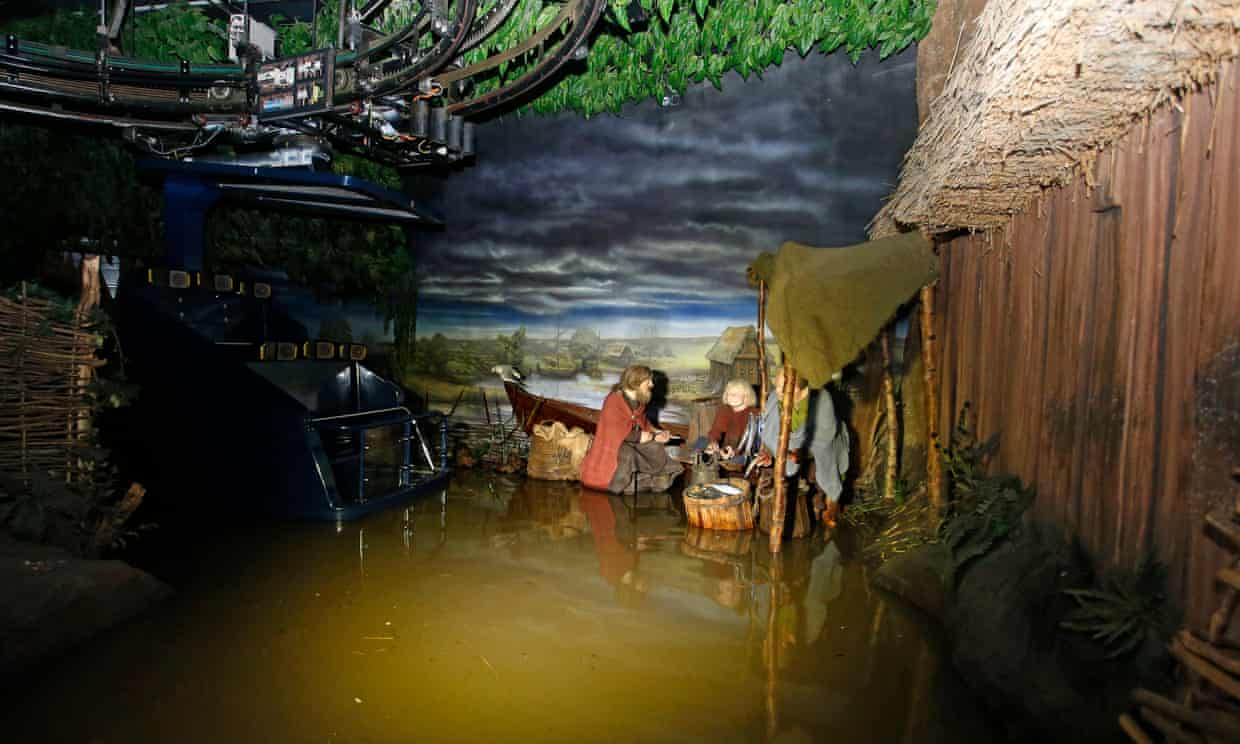
York to reopen Vikings of Jorvik attraction 16 months after floods


The December 2015 floods that forced the Vikings of Jorvik attraction to close. 
Photograph: Peter Byrne/PA

It’s almost a year since Sarah Maltby, sat comfortably at home on her sofa in the sleepy days after Christmas, got a phone call to warn her that the Vikings of Jorvik were up to their waists in water.
“The first I knew of it was a call from the staff on duty saying the centre was open, there were visitors inside, but water was starting to pour in and what should they do,” the director of attractions for York Archaeological Trust said. “There was only one answer. Get the visitors out and close immediately.”
Jorvik, the unique visitor attraction under the streets of York and built on an archaeology site that revealed the real everyday lives of its Viking residents, has been closed ever since. It has only just announced a reopening date in April 2017.
Read the rest of this article...

Friday, November 18, 2016

Built by the Huns? Ancient Stone Monuments Discovered Along Caspian

A massive stone structure, dating back 1,500 years, has been discovered along the Caspian Sea.
Credit: Photo courtesy Evgeniï Bogdanov

A massive, 1,500-year-old stone complex that may have been built by nomad tribes has been discovered near the eastern shore of the Caspian Sea in Kazakhstan.
The complex contains numerous stone structures sprawled over about 300 acres (120 hectares) of land, or more than 200 American football fields, archaeologists reported recently in the journal Ancient Civilizations from Scythia to Siberia.
"When the area was examined in detail, several types of stone structures were identified," archaeologists Andrey Astafiev, of the Mangistaus State Historical and Cultural Reserve; and Evgeniï Bogdanov, of the Russian Academy of Sciences Siberian Department's Institute of Archaeology and Ethnography, wrote in the journal article. The smallest stone structures are only 13 feet by 13 feet (4 by 4 meters), and the biggest are 112 feet by 79 feet (34 by 24 m). [See Photos of the Massive Stone Structure and Artifacts]
Read the rest of this article...

Ancient latrines, a lucky horse: New finds at Circus Maximus (Update)


A general view of Circus Maximus' newly opened archeological site, in Rome, Wednesday, Nov. 16, 2016. Six years of excavations have given Rome a new tourist attraction in Circus Maximus, an open-air archeological ruin that for centuries has been a vast muddy field, lately used mainly by dog-walkers. (AP Photo/Gregorio Borgia)

Six years of excavations have given Rome a new tourist attraction in Circus Maximus , the sprawling valley where chariot races once delighted the ancient city's denizens.
The archaeological ruin has long been a vast muddy, grassy field, lately used largely by dog-walkers and joggers.
But starting Thursday, the public can see ancient latrines, chunks of what was once a triumphal arch honoring the Emperor Titus , and learn about a winning horse dubbed Numitor, which ran on the oval track some 2,000 years ago.
Rome's newest tourist site comes as a counterpoint to Italy's often discouraging cultural developments, like the erosion by pollution or the crumbling of parts of monuments that can't be adequately protected by Italy's chronically lean budget for its enormous catalog of historical and artistic heritage.
Read the rest of this article...

Mysterious Roman remains uncovered in Swiss town

The pot was filled with 22 oil lamps, each containing a coin. Photo: Photo: Aargau canton archeology department

Archaeologists are puzzled over the discovery of a Roman-era earthenware pot filled with oil lamps and bronze coins in the commune of Windisch, in the northern Swiss canton of Aargau
The pot was found under a street in the commune as part of an archaeological examination prior to the construction of a big new development comprising apartment blocks and commercial buildings, Aargau cantonal authorities said in a statement on Monday.
It is thought to have been buried almost 2,000 years ago, dating it from the time of the Roman legion camp Vindonissa, which was located near where Windisch is now.
Read the rest of this article...
Revealing the substandard fate of the Dark Age dead


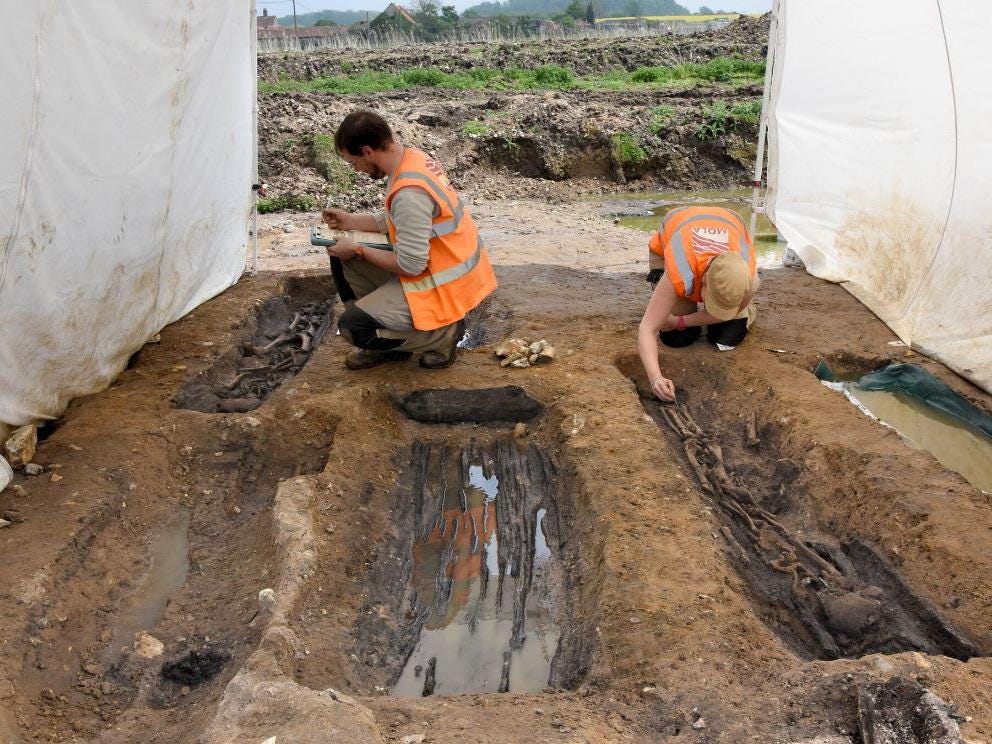
Almost 80 wooden coffins excavated at Great Ryburgh in Norfolk provides fascinating insight into the lives and deaths of Dark Age Anglo-Saxons


Our Dark Age Anglo-Saxon ancestors ended up in coffins made of decidedly substandard timber – according to new archaeological research.
In the first ever group of Dark Age wooden coffins ever unearthed in Britain, investigators have found that they were mostly made of poor quality knotted timber and that some of them were even slightly curved.
It appears that quality wood was so valuable that unknotted straight timber tended to be reserved for making planks and posts for buildings.
Read the rest of this article...

Surprise Find: More Than 80 Anglo-Saxon Coffins Uncovered in England


An ancient Anglo-Saxon cemetery with more than 80 rare wooden coffins containing skeletons has been unearthed in England.
Earlier this year, archaeologists were investigating the ground around a river in the village of Great Ryburgh in eastern England, ahead of the construction of a lake and flood defense system. During an excavation, they started finding graves arranged in rows.
"We had no idea it [the cemetery] was going to be there," James Fairclough, an archaeologist with the Museum of London Archaeology (MOLA), told Live Science. [See Photos of the Rare Wooden Coffins and Cemetery]
Read the rest of this article...

Discovery Of Rare Anglo-Saxon Burials Is Revealed


Archaeologists have uncovered an important Anglo-Saxon cemetery in an excavation in advance of a conservation and fishing lake and flood defence system at Great Ryburgh in Norfolk. The waterlogged conditions of the river valley led to the remarkable preservation of burials that are extremely rare in the archaeological record, including plank-lined graves and tree-trunk coffins dating from the 7th-9th century AD.

It is believed that this may have been the final resting place for a community of early Christians including a timber structure thought to be a church or chapel, of which there are few examples from this period. The wooden grave markers, east-west alignment of the coffins and the evident lack of grave goods all support the Christian origins of the cemetery.

Read the rest of this article...

Friday, November 11, 2016

Prehistoric Greenlanders ate bowhead whales to survive 4,000 years ago

Bowhead whales in the Fram Strait between Svalbard and Greenlandfruchtzwerg's world/Flickr

The first humans to arrive at Greenland feasted on bowhead whales in order to survive, scientists believe. Through DNA analysis, researchers have reconstructed the diets of the first settlers, finding large marine mammals were a bigger part of their diet than previously believed.

How paleo-Eskimo cultures successfully migrated to Greenland is not entirely known. They first arrived around 4,500 years ago and there were several waves of settlement. However, most of our understanding of the culture is based on fossils analysed using traditional techniques. Because of this mostly consists of bones, a skewed picture of their diet emerges.

In a study published in Nature Communications, scientists from the University of Copenhagen looked at the DNA extracted from sediments that dated back to 2000BCE. Samples came from four well-described midden deposits and allowed the team to distinguish organic tissue, including fat, skin and microfossils. From this they could work out which species it belonged to.

Read the rest of this article...