Thursday, February 04, 2016

Rome's lonely Pyramid of Cestius gets a new lease of life


Eternal City’s only surviving pyramid dating from conquest of Egypt looks to attract more visitors after extensive clean-up funded by Japanese patron
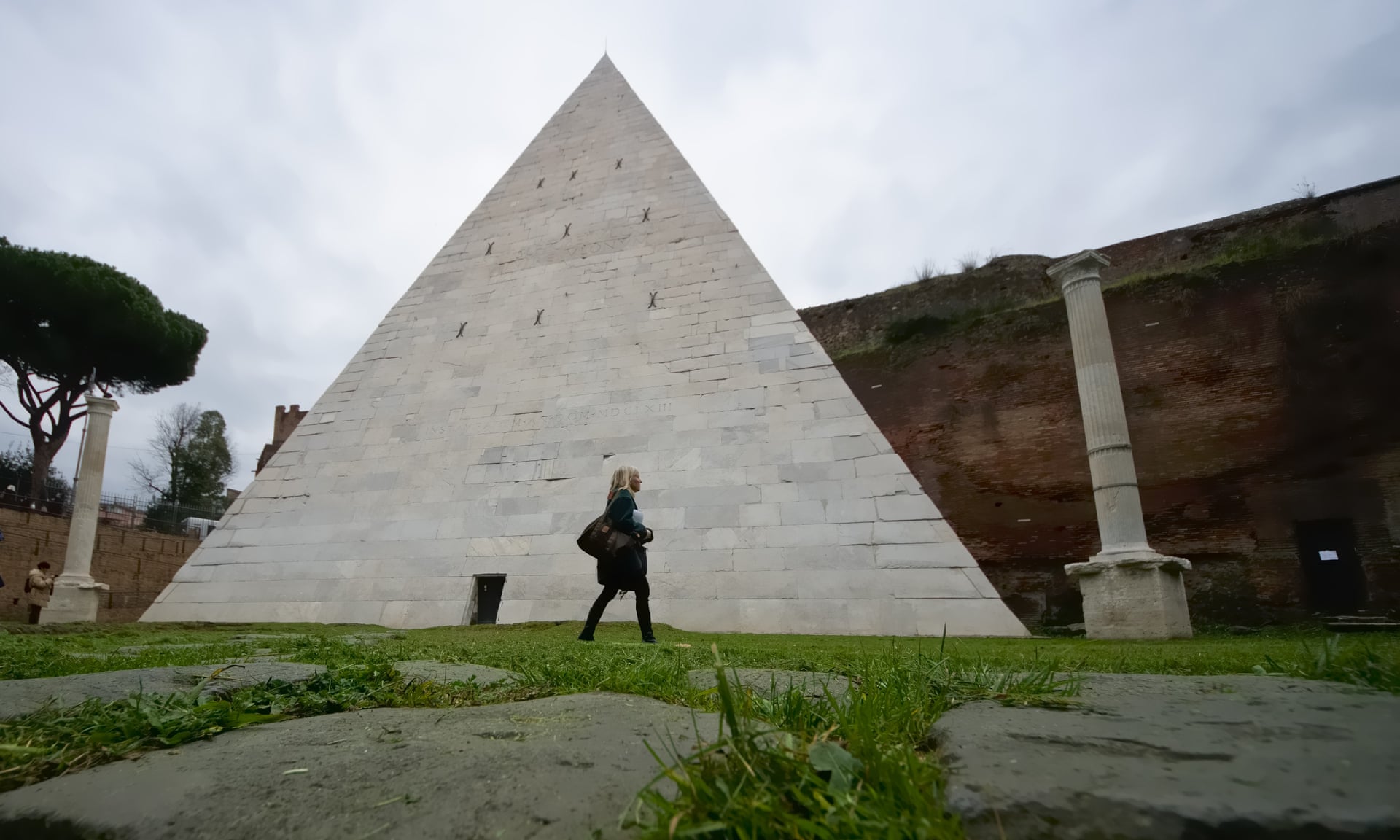
The Pyramid of Cestius in Rome is the city’s only such monument. Photograph: Domenico Stinellis/AP

Rome’s only surviving pyramid from ancient times is being put in the spotlight after a Japanese clothing magnate helped pay for an ambitious cleanup.

Archaeologists are eager to show off the monument, constructed around 2,000 years ago as the burial tomb for a Roman praetor, or magistrate, named Caius Cestius.

Read the rest of this article...

Roman fresco hidden beneath the streets of London uncovered by archaeologists


MOLA archaeological conservator, Luisa Duarte, with one of sixteen sections of a beautifully decorated collapsed Roman wall © MOLA

An ornate fresco that once adorned the residence of a wealthy Roman citizen has been discovered by archaeologists at 21 Lime Street, in London. Archaeologists from MOLA uncovered the fresco six metres below street level, whilst undertaking fieldwork for a new office development. Dating to the late 1st century AD, and the first decades of London, it is one of the earliest surviving frescos from Roman Britain.

Thanks to a huge Roman construction project, the fate of this rare wall painting was literally sealed in the ground. In AD 100, construction of the 2nd Forum Basilica, the main civic centre for the city and the largest Roman building ever built north of the Alps, began. In advance of construction of the Forum the area was flattened. The painted wall was deliberately toppled and the Forum immediately built over it, incredibly preserving the fresco for nearly 2000 years.

Read the rest of this article...

Kilnwood, Vicarage Hill


This report has been reproduced by TimeTeign to help enhance our understanding of the early occupation and history of Kingsteignton during the early/late Bronze Age and into the Roman occupation around this hill-site. The report itself was made in relation to the construction of forty (40) dwellings on the Kilnwood estate, on Vicarage Hill, Kingsteignton, Devon, has been approved and passed by Steve Reed, at Devon County Council. 

The site is situated to the southeast of the historic core of Kingsteignton within an area that was covered by the former mediaeval field systems. Remnants of these survived as parts of the existing field system and as previously-recorded lynchets to east and southeast of the site.
Read the rest of this article...

Bärenkult und Schamanenzauber


Bärenkult und Schamanenzauber: Rituale Früher Jäger
5.12.2015 - 28.3.2016
Archäologische Museum Frankfurt 

Warum hat man Bären feierlich bestattet?
Weshalb tanzten Schamanen mit einem Hirschgeweih auf dem Kopf?
In welchen Zauberwelten weilten sie bei ihren Séancen?
Und wozu dienten Äxte und Stäbe, die wie Köpfe von Elchkühen gestaltet waren?

Bärenzeremoniell, Hirschtanz sowie Ren- und Elchkult waren religiös-schamanische Rituale zahlreicher indigener Jägervölker im Norden Skandinaviens und Sibiriens. Mit Faszination und Abscheu begegneten Geistliche und Reisende des 17. und 18. Jahrhunderts diesen Praktiken. Sie verdammten sie als „erschröcklichen Abgötterej vnnd verehrung der Teuffel". Dahinter stand jedoch eine urtümliche Vorstellungswelt und Religiosität, die in der Lebensform archaischer Jäger-Fischer-Sammler-Kulturen wurzelte.


Staunen erweckt jedoch nicht nur die weite Verbreitung dieser Kulte über die gesamte zirkumpolare Zone, sondern noch mehr ihr unergründliches Alter. Denn die Verehrung von Bären und Geweihträgern, verbunden mit schamanischen Ritualen, ist schon für die Altsteinzeit überliefert, dem Auftreten des modernen Menschen in Europa vor etwa 40 000 Jahren und noch darüber hinaus. In den religiösen Phänomenen neuzeitlicher Ethnien der nördlichen Hemisphäre werden somit Züge einer menschlichen „Urreligion" sichtbar.

Read the rest of this article...

Wednesday, February 03, 2016

The discovery of an ornate Roman fresco revealed


An ornate fresco that once adorned the residence of a wealthy Roman citizen has been discovered by a team of our archaeologists at 21 Lime Street, in London. We uncovered the fresco six metres below street level, whilst undertaking archaeological fieldwork for a new office development. Dating to the late 1st century AD, and the first decades of London, it is one of the earliest surviving frescos from Roman Britain.

Roman building boom

Thanks to a huge Roman construction project, the fate of this rare wall painting was literally sealed in the ground. In AD 100, construction of the 2nd Forum Basilica, the main civic centre for the city and the largest Roman building ever built north of the Alps, began. In advance of construction of the Forum the area was flattened. The painted wall was deliberately toppled and the Forum immediately built over it, incredibly preserving the fresco for nearly 2000 years.


Read the rest of this article...

Stash of Roman coins found at UK building site


A groundwork contractor stumbled across 1,700-year-old Roman coins when he was working in Yeovil. 


Stash of Roman coins found at UK building site Selection of Roman coins discovered at the Yeovil building site [Credit: Central Somerset Gazette] 

Mark Copsey, who had been working on a building site for under a week, went to reverse the bulldozer he was driving and saw something strange in the soil, an inquest heard. 

"I was stripping sub soil and I looked behind and noticed a green cloth," he said. 

Mr Copsey got out of the bulldozer to investigate and discovered a broken pot and some coins on March 20, 2013.

Read the rest of this article...

Tuesday, February 02, 2016

Turtle soup, perchance? Prehistoric humans had a penchant for tortoises

New discovery at excavation of Qesem Cave reveals tortoises played a supplementary role in the diets of early humans 400,000 years ago


Grilled, boiled or salted? Turtles, or tortoises, are rarely consumed today, but a select few cultures, primarily those in East Asia, still consider turtle soup, made from the flesh of the turtle, a delicacy.
According to a new discovery at Qesem Cave near Tel Aviv, the site of many major findings from the late Lower Paleolithic period, they are not alone in their penchant for tortoise. Tel Aviv University researchers, in collaboration with scholars from Spain and Germany, have uncovered evidence of turtle specimens at the 400,000-year-old site, indicating that early man enjoyed eating turtles in addition to large game and vegetal material. 
Read the rest of this article...

Study suggests how modern humans drove Neanderthals to extinction


A study* published in the Proceedings of the National Academy of Sciences (PNAS) suggests how Neanderthals could have been driven to extinction by competition with modern humans. Archaeologists have hypothesized that competition between Neanderthals and modern humans led to the former’s extinction because modern humans had a more advanced culture than Neanderthals, giving modern humans a competitive edge. Marcus Feldman and colleagues tested the plausibility of this hypothesis using a model of interspecies competition that incorporates differences in the competing species’ levels of cultural development. 

Read the rest of this article...

ARCHAEOLOGISTS LONG UNDERESTIMATED EARLY HOMININS


Hominins of the Lower Paleolithic are much more like modern humans than was previously thought. By 300,000 years ago, Homo heidelbergensis in Schöningen used highly sophisticated weapons and tools. The hominins at Schöningen lived in social groups that practiced coordinated group hunting, a division of labor, and were able to communication about the past, present and future. These are cultural traits that archaeologists typically attribute to modern humans. The excavations in the open-cast coal mine in Schöningen running from 1994 until today show that we have long underestimated the cultural capacities of Homo heidelbergensis. Schöningen is a key site for documenting both a high resolution record of past climatic change and how hominins lived in northern Europe during the Ice Age. Since 2008 Professor Nicholas Conard and Dr. Jordi Serangeli of the University of Tübingen have led the excavations with a major international research team in close cooperation with the Cultural Heritage Office of Lower Saxony.

Read the rest of this article...

Monday, February 01, 2016

New Website for the Bayeux Tapestry


As this year is the 950th anniversary of the Battle of Hastings, Archaeology in Europe has created a new website featuring the Bayeux Tapestry.

The Website gives details of the history of the Tapestry and provides detailed images of the entire tapestry.

There is also a section on the Battle of Hastings and the recent work by Time Team to locate the battle site.


You may also be interested in the EMAS Archaeological Site Tour: “Landscape of the Bayeux Tapestry


Decapitated Gladiators Reveal Roman Empire's Genetic Influence


These decapitated remains found in York belonged to a male who may have been a Retiarii gladiator, who fought with a net and spear or trident.

DNA from seven decapitated skeletons thought to be gladiators is helping researchers unravel the gruesome origins of the ancient remains. The new findings suggest that the Roman Empire's genetic impact on Britain may not have been as large as researchers had thought.
The headless skeletons were excavated between 2004 and 2005 from a Roman burial site in Driffield Terrace in York, England, the archaeologists said. Around the time the bodies were buried, between the second and fourth centuries A.D., the area that's now York was the Roman Empire's capital of northern Britain, called Eboracum. The cemetery where the bodies were discovered was located in a prominent area, near a main road that led out of the city, according to the researchers.
Most of the skeletons found at this site were of males younger than 45 who were taller than average and showed evidence of trauma, such as cuts to their arms and fingers, the archaeologists said. Famously, the majority of them had been decapitated. These standout traits led some experts to suggest that this was a burial site for gladiators. However, it is also possible that these men were in the military, which, in Roman times, had a minimum height requirement, the researchers said. [See Photos of the Decapitated Gladiator Skeletons]
Read the rest of this article...

Thursday, January 28, 2016

Digger driver wins share of 3,339 Roman coins he found levelling a hockey pitch


Mark Copsey, 44, is entitled to a third of their worth after they were declared treasure under the Treasure Act

Roman coins found by bulldozer driver Mark Copsey while working on a Yeovil Recreation Ground in Somerset Photo: British Museum/SWNS

A JCB driver who dug up 3,000 rare Roman coins which he put in a carrier bag will be able to keep the cash despite colleagues claiming it was a team find.
Mark Copsey, 44, was levelling a recreation ground for a hockey pitch when he spotted something in the soil.
He found a collection of 3,339 silver coins carrying depictions of an elephant and a hippopotamus buried around 270AD.
Mr Copsey immediately scooped them up and put them in a plastic carrier bag - and an inquest has ruled he will now be entitled to a third of their value.
Read the rest of this article...

Sicily the superpower: British Museum revisits island's golden ages


New exhibition will explore periods under Norman and Greek rule when island was one of Europe’s most enlightened cultures

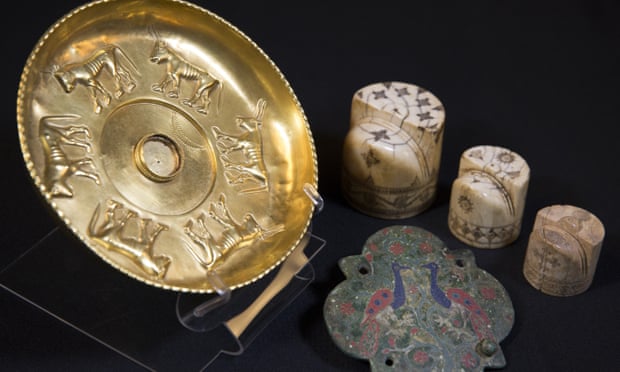
 A gold libation bowl (600-800BC) decorated with bulls, an enamelled casket lid (1250-1300AD) and three ivory chess pieces (1100-1200AD). 
Photograph: Dan Kitwood/Getty Images

In 1066 the Normans were not just conquering grey, cold England. They were also in sunny, fertile Sicily creating what became one of the most enlightened cultures in Europe.
The little known story of the other Norman conquest is to be told in an exhibition exploring 4,000 years of history on the island of Sicily, the British Museumannounced on Thursday.
More than 200 objects will be brought together to prove there is a lot more to Sicily than lemons and the mafia. The show’s main focus will be on two major eras: Greek rule after the 7th century BC and Norman rule from the end of the 11th century.
Read the rest of this article...

Archaeologists uncover surprising secret in Bristol Cathedral’s first dig for more than 150 years


For centuries historians have known the peculiar story of Bristol Cathedral's nave, but now it's been backed up by the first archaeological dig inside the cathedral for 150 years. David Clensy reports
I FIND Dr Kevin Blockley in Bristol Cathedral's north transept, kneeling in the shadow of the great wooden Bishop's throne. His head is lost inside a hole in the floor where a few of the Victorian flagstones have been lifted.
The trowel in his hand is brushing gently at a small stone vault that has been revealed beneath the red-brown earth.
At just a metre in length, it is clearly the grave of a child, but which young soul found his or her final resting place in this prestigious spot, a few yards from the high altar, is likely to forever remain a mystery.
Read the rest of this article...

Excavation Reveals Significant Statuettes at Archaeological Site of Aptera


A very important find was unearthed at the archaeological site of Aptera, Chania on Crete, Greece.
Two small sized sculptures (approx 0.54cm height), one of Artemis made of copper and a second of her brother Apollo made of marble. The statue of Artemis, guardian goddess of Aptera, is in excellent condition and was standing on a square copper base. She is wearing a short chiton, or tunic, and is ready to shoot her arrow. The preservation of the white material used for the iris of her eyes is spectacular.
Read the rest of this article...

Roman-Byzantine grave unearthed on Istanbul’s İstiklal Avenue


Archaeologists have uncovered a Roman-Byzantine grave underneath Istanbul’s famous İstiklal Avenue, providing evidence of human activity in one of the city’s most important areas at a date earlier than previously thought.

The grave was unearthed during the restoration of the historic Casa Garibaldi building on the avenue when a worker discovered a 1,600- to 1800-year-old skull eight meters under the surface. 

Archaeologists from the Istanbul Archeology Museum subsequently arrived and conducted excavations in the area. 


Read the rest of this article...

Discovering a Roman Imperial Winery at Vagnari (Italy)


Vagnari is situated in the Basentello river valley, just east of the Apennines in Puglia (ancient Apulia), and about 12 km west of the Iron Age town of Botromagno (next to modern Gravina).

After the Roman conquest of south-east Italy in the early third century B.C., Rome had direct links to the region by one of its main roads, the Via Appia. Pre-Roman settlements, such as Botromagno, went into decline from this time, and its land may have been confiscated by the Romans. After the conquest, wealthy Romans of the senatorial class appropriated tracts of Apulian land, and emperors later followed suit, acquiring properties and developing imperial business assets here.

Read the rest of this article...

As the Arctic Erodes, Archaeologists Are Racing to Protect Ancient Treasures


Once locked in frozen Alaskan dirt, Iñupiat artifacts are being lost to the sea, sometimes faster than scientists can find them


An arch made from a bowhead whale jaw stands over traditional whaling boats in Barrow, Alaska. (Patrick J. Endres/AlaskaPhotoGraphics/Corbis)

A headless body, stretched out along the beach, appears through the smudged window of our ATV as we sail across the sand. There’s a windy lawlessness up here along the Chukchi Sea; I’m reassured by the rifle lashed to the lead ATV in the caravan. The archaeologist at the helm passes the decaying creature without pause. Anne Jensen has seen many headless walruses before—this one was likely already dead when it washed ashore and was relieved of its tusks. Jensen’s not worried about poachers; the rifle is for polar bears—the Arctic’s fiercest of predators. And Jensen seems entirely capable of staying calm and slamming a bullet into one.

We’re just south of Barrow, Alaska, heading to an archaeological site at a place called Walakpa Bay. It’s a grassy coastline that’s been occupied by semi-nomadic native Alaskans for at least 4,000 years. Their story, told in material remains, is scattered across the landscape we traverse at 60 kilometers per hour, past flocks of ducks and eroding bluffs.

Read the rest of this article...

No fairy tale: Origins of some famous stories go back thousands of years


Statistical analysis of language evolution helps estimate storytelling dates

ONCE UPON A TIME  Some folktales such as “Rumpelstiltskin” (left) and “Beauty and the Beast” (right) may have been told in some form for thousands of years, statistical analysis shows.

“Beauty and the Beast” is practically “a tale as old as time.” So are a few other folktales, new research shows.
Statistical ties between a set of folktales and languages from parts of Europe and Asia have helped researchers date the origins of some stories to thousands of years ago. The roots of the oldest one — a folktale called “The Smith and the Devil” — stretch back to the Bronze Age. The findings, reported January 20 in Royal Society Open Science, may dispel the thought that some well-known folktales such as “Rumpelstiltskin” and “Beauty and the Beast” are recent inventions.
“These stories are far older than the first literary evidence for them,” says coauthor Jamie Tehrani, an anthropologist at Durham University in England.  
When linguists study a language’s evolution, they trace grammatical and phonetical structure through time. “What we were interested in doing is seeing if you could do that for other elements of culture,” Tehrani says.

Read the rest of this article...

Medieval burial ground found under UK car park


Archaeologists have discovered a mass grave containing more than 300 skeletons - under a car park. The first discoveries were made two years ago during routine archaeological surveys as the ground was assessed for development into affordable homes - but it was initially thought there were only 20 bodies buried. 


Human skull discovered during Godalming drainage hole work  [Credit: Surrey History Centre] Work to transform the car park, in Godalming, Surrey, into 14 new-builds was put on hold and the findings were carefully excavated in June 2014. 

They were taken to Surrey History Centre to be examined - where experts discovered the remains of more than 300 individuals.

Read the rest of this article...