Friday, January 17, 2014
Interesting aside from the Virtual Curation Laboratory
Interesting aside from the Virtual Curation Laboratory at Virginia Commonwealth University (Selden and Means)
Recently, a former student of the late Dr. James E. Corbin (Dr. John Hart, now Director of the Research and Collections Division at the New York State Museum) put me in touch with Dr. Bernard K. Means, the Director of the Virtual Curation Laboratory at Virginia Commonwealth University. In what I’m hoping will grow into a long-term collaborative research effort, we have begun to share ideas, methods, and yes – data. Some of you will no doubt recognize the image below as FIN-S7 from the Vanderpool collection. Means used a series of screenshots of the vessel to create this 3D representation.
Read the rest of this article...
Virtually Educating People about the Past
This second week of January 2014 is start of the spring semester at Virginia Commonwealth University (VCU) and we will continue our scanning of archaeological objects and animal bones. Our 3D scanning efforts are designed to help us create virtual type collections, which can be used for identification, analysis, and public education. Toward the last goal, I would like to highlight an article I received in the mail yesterday, written by Ashley McCuistion, our Digital Curation Supervisor and currently an undergraduate student at VCU. Her article, entitled “Promoting the Past: The Educational Applications of 3D Scanning Technology in Archaeology” was published in the Journal of Middle Atlantic Archaeology 29:35-42. From her abstract,
Read the rest of this article...
Charlemagne and Switzerland
Landesmuseum Zürich
Charlemagne and Switzerland
20.09.2013 – 02.02.2014
Who was Charlemagne and what imprint did the great Carolingian king leave on the 8th and 9th centuries? 2014 marks the 1200th anniversary of Charlemagne’s death (*748 – †814), the first European emperor of the Middle Ages. For this occasion the Swiss National Museum is putting on an exhibition that focuses on the era of Charlemagne and his cultural- historical achievements. Numerous splendid exhibits on loan from Switzerland and abroad introduce the viewers to the innovations in art, architecture, education and religion stimulated by Charlemagne.Read the rest of this article...
Thursday, January 16, 2014
RARE GAMING PIECE FOUND AT ANGLO-SAXON ROYAL HALL
University of Reading archaeologists have discovered an ancient and extremely rare Anglo-Saxon board gaming piece while excavating a royal complex at Lyminge, Kent. The piece would have been used for a game similar to that of backgammon or draughts.
The Anglo-Saxon’s had a strong tradition of playing board games. Individual gaming pieces, and sometimes complete sets in burials of the period, have been discovered. However not only is the piece the first of this type to be found since the Victorian period, it is the first ever piece to be discovered in a ‘gaming’ setting, an Anglo-Saxon royal hall.
Royal ceremonial events
Alongside this astonishing discovery, Dr Gabor Thomas and his team have also uncovered items of jewellery, numerous fragments of luxury vessel glass and pits with animal bones, confirming that feasting and social display were integral to Lyminge’s role as a place of royal ceremonial events and gatherings during the late 6th and 7th centuries.
Read the rest of this article...
City of London's grisly decapitated skull mystery solved using state-of-the-art forensic techniques
Just over a quarter of a century ago, 39 skulls and a single leg bone were discovered at the London Wall, right in the heart of the City. With state-of-the-art forensic techniques, the mystery of the heads may have been solved – and the blood-thirsty findings have thrilled archaeologists.
The skulls are believed to have been the victims of Roman soldiers’ practice of “headhunting” – removing the body from the head of enemies as trophies – or even gladiatorial combat, the first discovered in the capital.
“This discovery is hugely exciting,” said Rebecca Redfern, from the Centre for Human Bioarchaeology at the Museum of London. “These remains are completely different from everything else we’ve ever found in Roman London. The levels of violence and the types of violence are very different to what we’ve seen.”
Read the rest of this article...
Earliest use of steel in Britain uncovered
Archaeologists have identified examples of the earliest use of steel in the British Isles from a site in East Lothian. The site, an Iron Age hill fort known as Broxmouth, was excavated in the 1970s, however the discoveries are only now being published.
An aerial photograph of the excavation at Broxmouth, taken before the site was covered over
[Credit: Historic Scotland]
As part of the re-examination of the findings at Broxmouth, new analysis of some iron artefacts has found that they can be dated to 490-375BC. Made from high-carbon steel which had been deliberately heated and quenched in water, the artefacts are the earliest evidence of sophisticated blacksmithing skills in Britain.
Treasure hunters found nearly 1,000 items in 2012
It is thought these coins, minted in the name of Edmund, King of East Anglia, were buried when Vikings attacked Britain in 865#
Amateur archaeologists with metal detectors found 990 items classified as treasure during 2012, according to figures from the British Museum.
All of the rare coins, rings and brooches contain gold or silver, and many date back more than 1,200 years.
The public reported more than 74,000 other historical items to the Portable Antiquities Scheme, which experts say has "revolutionised archaeology".
More than 900,000 objects have been reported since it started in 1997.
The verification process takes several months, which is why the items submitted in 2012 are only being detailed now.
Read the rest of this article...
Wednesday, January 15, 2014
Firefighter's Guildford Stone Age flints lead to major find
William Mills, from Oxford Archaeology, who worked on the dig, said the site was exceptional and one of two or three in England
A firefighter who found Stone Age flints at the fire station he worked at 40 years ago says he is "thrilled" that find has now led to a nationally-important archaeological discovery.
Ron Shettle, 88, first spotted the flints while working there decades ago.
A recent rebuild of the Guildford station has now allowed experts to carry out a dig.
Read the rest of this article...
Storms expose archaeology on Omey island
Destruction wreaked along Connacht’s coastline in the recent storms has exposed archaeology dating back to the Neolithic period on Connemara’s Omey island. Large linear archaeological deposits of up to a metre thick have been exposed on the western and northern shorelines of the tidal island off Claddaghduff.
Archaeologist Michael Gibbons at the area on Omey Island where prehistoric remains were revealed by damage caused by the Atlantic storms [Credit: Joe O’Shaughnessy]
Two sets of medieval burial sites, traces of sunken dwellings and parts of a Neolithic bog, which had been covered over millenniums by shifting sands, have been revealed.
Read the rest of this article...
Ritual burial site older than previously thought
A ritual burial site in Pembrokeshire may have been in use 10,000 years ago - almost twice as far back as expected, said archaeologists.
Marks on the Trefael Stone are now thought to resemble stellar constellations [Credit: BBC] The Trefael Stone near Nevern was reclassified as a Stone Age burial chamber after its capstone was studied.
But a three-year dig has since found beads dating back much further, perhaps to the Neolithic or Mesolithic periods.
Tuesday, January 14, 2014
MANNING THE RAMPARTS: A HILLFORT ON THE EDGE OF EMPIRE
In 2012, a team from Rampart Scotland carried out an archaeological investigation at Sheriffside, a large crop mark site some 20 miles to the east of Edinburgh. Unexpectedly, a ditch measuring over 8m across and up to 2.80m deep was uncovered, which appears to represent the final phase of enclosure of the hillfort. Currently, this is the largest ditch discovered in the region and has produced a C14 date range of AD 211-384.
Archaeologically, this date range and re-cutting of the ditch is extremely interesting, as it falls into a turbulent era in the history of Southern Scotland. After the Romans withdrew behind Hadrian’s Wall in the early 3rd century AD, the Picts carried out frequent raids and may have forced the local tribes such as the Votadini into taking defensive action to protect themselves and their livestock.
A landscape of struggle and societal stress
There is no doubt that weakened military borders were the result of internal politics and competing factions which were beginning to plague the Roman Empire. As a result, people in this largely abandoned region appear to have been living in a landscape of struggle and societal stress for over a century; as Constantius Chlorus’s punitive raids north of theAntonine Wall in AD 305, Theodosius’ reprisals in AD 368-9, Maximus’ conflicts of AD 384 and Stilichos’ Pictish War of AD 400 (Salway 1991, 419) all attest to. A reference to the troubles in Northern Britain in AD 360 by ex-Roman army officer Ammianus Marcellinus paints a grim picture:
Read the rest of this article...
Land by Neolithic site churned up by vehicles
The area around one of the island’s most important archaeological monuments, the Neolithic stone circle at Meayll Hill, Rushen, has been badly churned up by four-wheel vehicles and motorcyclists over the Christmas period.
Damage caused by vehicle use on land at the Meayll Peninsular, Rushen [Credit: IOM Today]
Port Erin resident Philip Maddrell, who walks there several times a week, said something should be done to protect the area.
‘It’s just spoiling it for everybody,’ he said. ‘Also [motor] bike riders were up the top, it’s a public right of way. It’s a damn nuisance. They churn it up.’
Read the rest of this article...
Friday, January 10, 2014
Carolingian-era mass grave discovered in France
The remains of men, women and children thrown into a well during the Carolingian era [© Captair, 2013]
Archaeologists from the Institut de Recherches Archéologiques Préventives in France have discovered a mass grave containing the bodies of between twenty and thirty people.
The discovery was made during the course of a five-month dig of a Gallo-Romano site at the town of Entrains-sur-Nohain in Burgundy, forges, which also revealed a stretch of Roman road, a series of stone houses and baths.
The archaeologists were excavating one of two wells on the site when they chanved upon the remains of dozens of skeletons at a depth of about four metres.
New Iron Age Sites Discovered in Finland
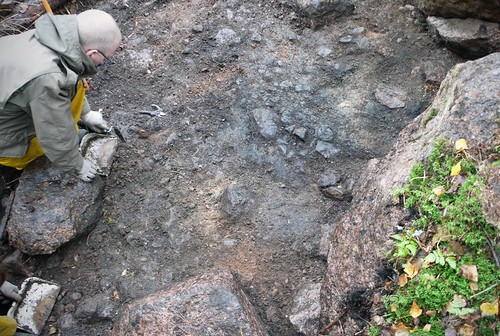
A National Board of Antiquities archaeologist excavates at the Ahvenkoski harbor forge. The furnace was located between two stones, and in the ground one can see dark gray iron slag pieces. Image courtesy Jouni Jäppinen.
It was in the autumn of 2010 when local amateur archaeologists discovered evidence of harbor facilities thought to date from around 1000–1200 AD near Ahvenkoski village at the mouth of the western branch of the Kymi River in southeastern Finland. The findings included a smithy, an iron smelting furnace, and forceps, as well as hundreds of iron objects such as boat rivets similar to those found at Viking settlements in different parts of the Baltic, Scandinavia, Scotland and Iceland. Then, in 2011, a possible 2 x 3-meter-wide cremation grave was uncovered, confirmed later through rescue excavations by archaeologists from the Finnish National Board of Antiquities and through osteological analysis at the University of Helsinki. Artifacts included a battle axe, a knife, and a bronze buckle, all associated with burned human bones, initially thought to be dated to around 1000 - 1200 CE before analysis. Similar objects have been discovered in the Baltic Sea area and in Ladoga Karelia. Identical cape buckles have also been found in Gotland.
Read the rest of this article...
Ancient Greeks Used Portable Grills at Their Picnic
The ancient Mycenaeans have a reputation as palace-builders and warriors, but they were also quite sophisticated cooks. More than 3,000 years ago, they used portable grill pits to make souvlaki and non-stick pans to make bread, new cooking experiments suggest.
The Mycenaean civilization, which was the backdrop for Homer's "Odyssey" and "Iliad," thrived in Greece during the late Bronze Age from around 1700 B.C. until the society mysteriously collapsed around 1200 B.C. The Mycenaeans left behind amazing palaces and gold-littered tombs at sites like Pylos and Mycenae, but in these places, archaeologists also have found less glamorous artifacts, such as souvlaki trays and griddles made from gritty clays.
It wasn't clear how these two types of pans were used, said Julie Hruby of Dartmouth College, presenting her research at the Archaeological Institute of America's annual meeting here on Saturday (Jan. 4). [The 7 Most Mysterious Archaeological Finds on Earth]
Read the rest of this article...
Network theory and the heroes of Icelandic sagas
Egill Skallagrímsson from a 17th-century manuscript [Credit: WikiCommons]
The Icelandic sagas of the Norse people are thousand-year-old chronicles of brave deeds and timeless romances, but how true to Viking life were they? Writing in Significance, Pádraig Mac Carron and Ralph Kenna use a statistical network of associations between characters to find out.
While the stories involve a cast of thousands, recurring characters have emerged as the stories passed into historical legend. A set of recurring characters living within the same fictional world is not restricted to ancient stories, such as the Norse or Greek myths, but remains a popular device in modern comic and film franchises.
By exploring the number of ‘too-good-to-be-true’ interactions between protagonists, the researchers built a network of recurring characters which in turn could help reveal if the stories are invented or if they are based on a real society.
Karl der Große: Macht, Kunst, Schätze
Karl der Große: Macht,
Kunst, Schätze - three major exhibitions which will run in Aachen from 20 June
to 21 September 2014 to mark the 1200th anniversary of the death of
Charlemagne.
The three exhibitions are
listed as:
Places of Power
The exhibition in the town
hall’s coronation hall, the former kings’ hall of the palace, focuses on
Charlemagne’s imperial palaces.
Charles’s Art
At the Centre Charlemagne, a
new exhibition housed in the heart of the imperial palace, the golden age of
culture during the Carolingian period is presented with top-class works of art.
Lost Treasures
In the cathedral’s treasure
chamber next to Carolingian Marienkirche, precious church treasures from the
Carolingian period and the Middle Ages return to their original site once
again.
Go to the exhibition website...
Google Earth Zooms in on Ancient Trade Routes
Using Google Earth software, researchers can track changes in Antioch as the ancient city was absorbed by the Roman Empire.
Read the rest of this article...
Google Earth may be a fun way to bring the far reaches of the present-day globe to people's fingertips, but archaeologists are now using the high-tech software to recreate maps of ancient civilizations. The endeavor is opening a window for researchers to the political and geographical changes that have shaped history.
Kristina Neumann, a doctoral candidate in the department of classics at the University of Cincinnati in Ohio, used Google Earth to track trade around the ancient city of Antioch, located in present-day southeastern Turkey, near the Syrian border, at the beginning of its takeover by the Roman Empire in 64 B.C. Neumann found the use of Antioch's civic coins was more widespread than was previously thought, suggesting the city had developed broad political authority within the region before being absorbed into the Roman Empire.
Looted Viking treasure is discovered in British Museum store
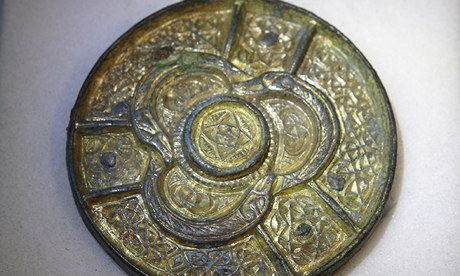
The Celtic brooch looted by the Vikings and discovered in the museum's collection. Photograph: Andy Hall for the Observer
A Celtic treasure looted by the Vikings more than 1,000 years ago has been discovered in the British Museum's storerooms. An ornate, gilded disc brooch dating from the eighth or ninth century was found by chance and is being described as a "staggering find". No-one knew of its existence until now.
It had been concealed in a lump of organic material excavated from a Viking burial site at Lilleberge in Norway by a British archaeologist in the 1880s and acquired by the British Museum in 1891.
Curator Barry Ager, a Vikings specialist, was poring over artefacts before a visit from a Norwegian researching the Viking site when his eye was caught by some metal sticking out of the side of the organic lump.
1,000-year-old loot found in British Museum store
The Celtic brooch looted from the Vikings and discovered in the museum's collection
[Credit: Andy Hall for the Observer]
A Celtic treasure looted by the Vikings more than 1,000 years ago has been discovered in the British Museum's storerooms. An ornate, gilded disc brooch dating from the eighth or ninth century was found by chance and is being described as a "staggering find". No-one knew of its existence until now.
It had been concealed in a lump of organic material excavated from a Viking burial site at Lilleberge in Norway by a British archaeologist in the 1880s and acquired by the British Museum in 1891.
Subscribe to:
Comments (Atom)