Monday, June 24, 2013
Sauvons le Pont des Trous de la destruction!
Le pont des Trous de Tournai est l'un des plus prestigieux vestiges de l'architecture militaire médiévale de Belgique. Il faisait partie de la troisième enceinte de Tournai, appelée seconde enceinte communale, et défendait le cours de l'Escaut dans sa traversée de la ville! La mise à gabarit de le traversée fluviale de Tournai avance et les dernières informations vont dans le sens d'une destruction de l'ouvrage.
Une pétition a également été lancée par l'association "Les Amis de la Citadelle" pour protester contre une destruction programmée - URL : https://www.lapetition.be/en-ligne/Projet-Seine-Escaut-sauver-la-traversee-de-Tournai-9999.html
Une résumé du dossier est également accessible sur Archeologia.be : http://archeologia.be/tournai_pontdestrous.html
Read the rest of this article...
Master Program in Cultural Heritage Management
A limited number of scholarships are available for the Master Program in Cultural Heritage Management at the French University in Egypt in partnership with the IREST Unesco Chair in Cultural Tourism at the University of Paris 1 Pantheon-Sorbonne.
Send us your degrees documents, cv and cover letter with a short description of your activities and added value as a prospective student and why you should be selected for a scholarship.
Email to heritagemaster AT ufe.edu.eg by June the 23rd!
Thursday, June 20, 2013
2013 Festival of Archaeology offers chance to get hands on history
Young archaeologists in York’s Museum Gardens
A MAJOR celebration of the 800,000 years of history beneath our feet is taking place next month with free events across the area.
The 2013 Festival of Archaeology aims to highlight the general public’s role in archaeological discovery, and offers local residents and holidaymakers the chance to get their hands on history between July 13 and 28.
Organised by York-based educational charity the Council for British Archaeology (CBA), the 23rd annual festival has activities arranged by organisations such as York Museums Trust, The Yorkshire Dales National Park, Thackray Medical Museum, English Heritage, community groups and local experts.
Read the rest of this article...
LGBT people existed long before 1967 – as the British Museum reveals
Those who deny same-sex desire is natural and normal should take a tour to see evidence dating back more than 2,500 years
'The Warren cup [at the British Museum], as well as being a sublime objet d’art, may bring a smile to the face of anyone who remembers the dinner scene in the 1996 film The Birdcage.' Photograph: Martin Godwin for the Guardian
Gender variance and same-sex desire has always existed, in all times and in all places.
For many people, me included, this is a given. LGBT people didn't magically shimmy over the rainbow in 1967 when Lord Wolfenden's findings were finally put on the statute books. But for others, the thought of homosexuality and a spectrum of gender identity that is natural is enough to make them clutch feverishly at their pearls.
So let me take them on a tour around the British Museum and explorethe theme of same-sex desire and gender through the objects displayed there, and perhaps buy them a copy of the book A Little Gay History: Desire and Diversity Across the World, by Richard B Parkinson. Those objects date back more than 2,500 years.
Read the rest of this article...
Meet the Mary Rose archer
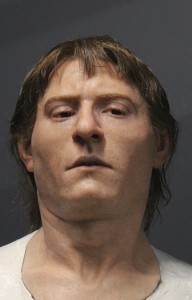
The reconstructed face of the Mary Rose archer.
An interdisciplinary team of scientists have reconstructed the face of a Tudor archer, almost 500 years after he drowned aboard Henry VIII’s flagship, the Mary Rose.
Some 92 skeletons were recovered when the wreck was raised in 1983 (CA 272). Since then, researchers at Swansea University have used cutting-edge motion-capture technology and computer modelling to identify which of these showed signs of repetitive stress injuries to suggest that they had been part of the elite company of longbowmen described in historical accounts of the ship’s crew (CA 276).
The researchers hope to identify what proportion of the crew might have been archers, however there is one skeleton, already identified as an archer, of particular interest.. Analysis of his skeleton suggests that he stood 6’ tall, well above average for the period – though a strong build would have been essential in order to use the powerful 16th-century longbow, which had draw weights of up to 90kgf – while high-status artefacts found on his person, including an ivory wrist guard, a pewter plate and a silver ring, could hint that he held a high rank in the company.
Read the rest of this article...
TrowelBlazers: In search of the female Indiana Jones
TrowelBlazers, a blog and social media project, was created to celebrate women in archaeology, palaeontology.
Leading Women connects you to extraordinary women of our time -- remarkable professionals who have made it to the top in all areas of business, the arts, sport, culture, science and more. Dr Victoria Herridge is a palaeobiologist working as a Scientific Associate at the Natural History Museum, London who co-founded TrowelBlazers, a blog celebrating the contribution of women to archaeology, palaeontology and geology.
(CNN) -- Close your eyes and imagine this. It is the 1930s and, as Nazism starts to flex its muscles in Europe, you are in the Middle East bouncing along a rough road on your way to visit an archaeological dig. The excavation is taking place on Mount Carmel, fabled site of the Prophet Elijah's burning alter, and archaeologists are digging deep to uncover the roots of humanity in the region.
So far, so Indiana Jones. Except that when you arrive and walk through the tented camp to the trenches, you realize that almost every single person -- from the Palestinian excavators and overseers, to the Cambridge University team directing the project -- is a woman. Because this isn't a feminist fantasy -- this is Dorothy Garrod's excavation project at the Carmel Caves, and it's the reality.
Read the rest of this article...
Ancient Toilet Reveals Parasites in Crusader Poop
Waste from this ancient toilet in Paphos contains traces of common parasites.
CREDIT: Anastasiou and Mitchell, International Journal of Paleopathology, http://dx.doi.org/10.1016/j.ijpp.2013.04.003
Researchers from the University of Cambridge dug into the pit of dried-out waste under a latrine in the remains of Saranda Kolones (Greek for "Forty Columns") at Paphos, a city at the southwestern tip of Cyprus and a UNESCO World Heritage site. [Through the Years: A Gallery of the World's Toilets]
Overlooking Paphos harbor, and next to a complex of Roman villas with remarkably intact floor mosaics, Saranda Kolones was long thought to be a temple because of the granite columns that littered its ruins. But excavations in the 1950s revealed that it was actually a short-lived concentric castle.
English King Richard the Lionheart sold the island of Cyprus to the Frankish crusader Guy de Lusignan in May 1192. Archaeologists believe the Franks built Saranda Kolones to defend Paphos harbor soon after their occupation of the island began. But in 1222, the city was rocked by a powerful earthquake thought to be at least 7.0 in magnitude. Much of the fortress was left in ruins, never to be rebuilt, but the latrines on its lower floors survived.
These toilets were carved to fit the human form, with a half moon-shaped hole in the seat leading to a sewer below. Cambridge researchers Evilena Anastasiou and Piers Mitchell, who study ancient parasites, collected samples from one of those cesspools, rehydrated the waste and strained it through a micro-sieve to catch parasite eggs, each smaller than a tenth of a millimeter.
Read the rest of this article...
Snail genes reveals human migration to Ireland
A common garden snail gives insight into human migration to Ireland
A genetic similarity between snail fossils found in Ireland and the Eastern Pyrenees suggests humans migrated from southern Europe to Ireland 8,000 years ago.
The slimy creatures in Ireland today are almost identical to snails in Southern France and Northern Spain.
Whether an accidental visitor on a ship or brought along as a snack, the boat they were carried on did not appear to stop in Britain.
The findings are published in PLOS One.
As Britain emerged from the end of the last Ice Age about 10,000 years ago, sea levels rose and landslides are thought to have triggered a great tsunami. Britain was transformed into an island, separated from mainland Europe and Ireland.
Read the rest of this article...
Tuesday, June 18, 2013
Heritage & Science: Working Together in the CARE of Rock Art
Ancient rock art is under threat due to climate change, and a project has been launched to develop methods to enable everyone to contribute to its protection. The CARE project is a collaboration between heritage and science research interests at Newcastle University and Queen's University Belfast. Its primary objective is to co-produce a user-friendly, non-intrusive Condition Assessment Risk Evaluation (CARE) toolkit for gathering and organising information essential for the long-term safeguarding of ancient rock art that exists out in the open.
Heritage and science working together ensures that heritage management resources and techniques are underpinned by solid scientific research so that conservation and management approaches are more effective. In the case of open-air rock art, or possibly any open-air stone structure, this means that the rock can be analysed in order to discern those environmental factors that are the cause of decay, as well as the influence of factors such as climate change. Scientific research has been carried out to determine the major risk factors for open air rock art and further field work will be undertaken throughout the project's life span to firm up this scientific evidence.
Read the rest of this article...
Archaeologists Unearth Roman Frontier Fort and Settlement in England
Located near the small coastal town of Maryport in northwestern England, remains of the ancient Roman fort of Alauna were first uncovered by amateur archaeologist Joseph Robinson in the late 19th century. Among the finds were an assemblage of no less that 22 stone altars, some bearing inscriptions, that tell a story of successive Roman commanders who commanded this, one of Imperial Rome's northernmost outposts during the height of the Roman Empire's expanse. The altars now grace the nearby Senhouse Museum, which serves as a popular tourist attraction.
Now a team of archaeologists and volunteers have returned to the site where the original stone altars were found to uncover more clues about the layout of the fort and its associated settlement, and about the lives of the military officers and soldiers who manned this remote garrison. Led by Newcastle University's Professor Ian Haynes and site director Tony Wilmott, the archaeologists have been here before.
Says Haynes: "The last two years' excavations focused on the area in which the altars were discovered in 1870.
This year sees some further work at the 1870 site and the start of a three year project focusing on the place where, in 1880, local bank manager and amateur archaeologist Joseph Robinson uncovered further altars and two possible temples.
Photographs and other documents from the 1880s indicate that the antiquarian investigation only unearthed part of the site and it is clear that much remains to be discovered."Read the rest of this article...
Oxfordshire's earliest recorded resident: Roman tombstone goes on display
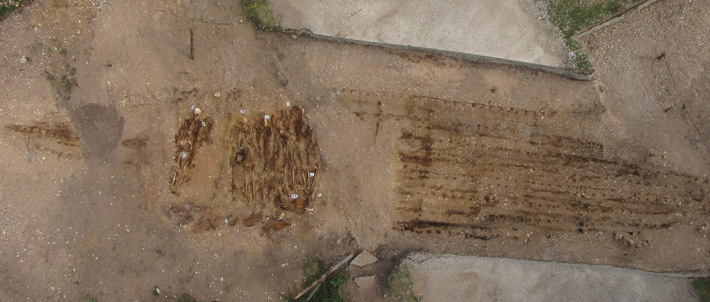
The tombstone had been smashed into pieces to form part of a wall
It is known that in a long lost town in the Oxfordshire of AD 79 an Italian immigrant died.
The discovery of the tombstone of Lucius Valerius Geminus - a veteran of the Second Augustan Legion - has revealed to archaeologists the first known biography of any person to have lived in the county.
It was discovered in fragments in a field, once the bustling Iron Age town of Alchester, near modern day Bicester. It has been reassembled so it can go on public display.
Dr Chris Ferguson, curator of archaeology at Oxfordshire Museum Service, said: "His biography is probably the earliest for a veteran in the entire province of Britannia, and he is certainly the earliest for this region of Roman Britain."
Read the rest of this article...
Large Iron Age houses discovered
The Lofotr Viking Museum in Borg [Credit: MVFram]
Archaeologists from the science museum in Trondheim have located the foundations of two large houses from the Iron Age, close to one of the biggest burial grounds in Hallem, near Stiklestad in Trøndelag.
"This rarely happens in Norway, and it is completely unexpected" says archaeologist Marte Mokkelbost. The archaeologists have discovered two so-called "long houses" that confirm that Stiklestad was an area inhabited by people who were both wealthy and in power during the iron age.
The burial grounds at Stiklestad is one of the largest collection of cemeteries in Norway. The houses were found very close by, and one of the houses is more than 50 meters long and eight meters wide.
Read the rest of this article...
Replica Viking ship takes to the water
A group of history enthusiasts from across the north west have successfully rowed the biggest replica Viking ship in the world.
![]() |
| Replica Viking ship [Credit: ITV] |
Trials are currently underway near the town of Haugesund where she was built. If they are successful, the vessel will embark on a major international voyage that could see her sail as far as New York.The ship was funded by a local businessman to learn more about ancient boat-building techniques and the Vikings themselves. It has been designed using a combination of archaeological evidence, details from folklore and local knowledge handed down over the generations.While it is mainly wind power that will get the Dragon between destinations, organisers need volunteers to row her in to and out of port.
Read the rest of this article...
Monday, June 17, 2013
Cheddar reservoir excavations begin to check for remains
Archaeological investigations are due to begin at the site of a planned £100m reservoir in Cheddar, Somerset.
More than 180 trenches will be dug over eight weeks around Bristol Water's proposed site by expert teams from Wessex Archaeology.
"The programme is part of the environmental assessment to identify areas where archaeology is present," said project spokesman Jeremy Williams.
The results will influence the future design of the proposed development.
The Somerset Levels, where the trenches will be dug, are considered to be one of the richest areas for archaeological remains in Britain.
Read the rest of this article...
The First Vikings
Two remarkable ships may show that the Viking storm was brewing long before their assault on England and the continent
(Courtesy Liina Maldre, University of Tallinn)The carefully stacked remains of 33 men were buried in the ship that brought them from Scandinavia to an Estonian island more than a century before the Vikings are thought to have been able to sail across such distances.
According to historians, the Viking Age began on June 8, A.D. 793, at an island monastery off the coast of northern England. A contemporary chronicle recorded the moment with a brief entry: “The ravages of heathen men miserably destroyed God’s church on Lindisfarne, with plunder and slaughter.” The “heathen men” were Vikings, fierce warriors who sailed from Scandinavia and bore down on their prey in Europe and beyond in sleek, fast-sailing ships. In the centuries that followed, the Vikings’ vessels carried them deep into Russia and as far south as Constantinople, Sicily, and possibly even North Africa. They organized flotillas capable of carrying warriors across vast distances, and terrorized the English, Irish, and French coasts with lightning-fast raids. Exploratory voyages to the west took them all the way to North America.
The Vikings’ explosion across Europe and Asia and into the Americas was the result of the right combination of tools, technology, adventurousness, and ferocity. They came to be known as an unstoppable force capable of raiding and trading on four continents, yet our understanding of what led up to that June day on Lindisfarne is surprisingly shaky. A recent discovery on a remote Baltic island is beginning to change that. Two ships filled with slain warriors uncovered on the Estonian island of Saaremaa may help archaeologists and historians understand how the Vikings’ warships evolved from short-range, rowed craft to sailing ships; where the first warriors came from; and how their battle tactics developed. “We all agree these burials are Scandinavian in origin,” says Marge Konsa, an archaeologist at the University of Tartu. “This is our first taste of the Viking era.”
Read the rest of this article...
Archaeologists Uncover Magnificent Town of Emperor Diocletian in Bulgaria
Good thermal springs are always likely to draw increasing numbers of people who have the means to tap their benefits. More often than not, they become popular resort destinations for the rich and famous. So it was with this location in the outskirts of the Sredna Gora mountain range near the present-day town of Hisarya of central southern Bulgaria.
Archaeological research indicates that this place was inhabited as long ago as 6,000 years BCE, then later by the Thracians. In the 1st century CE it was conquered by the Roman Empire, eventually becoming an affluent 4th century Roman resort, a place that emperor Septimius Severus himself, among others, was recorded to have visited. Today, the archaeological remains bear the unmistakable evidence of palaces, wide stone streets, marble baths, an amphitheater in circus style, and monumental fortification walls. The walls have been preserved in some places up to 14 m in height.
Now, a team of archaeologists and students have returned to the ancient site to uncover more of the remains, hoping to shed additional light on a major Roman settlement that was likely a popular attraction for the wealthy Roman citizenry during the height of the Roma Empire in Late Antiquity.
Read the rest of this article...
Unique gold figurine of naked woman found in Denmark
A small figurine depicting a slim, naked woman was recently found in a Danish field. Strangely, this is the fifth in a series of tiny golden human figurines found recently in the area.
A field on the Danish island of Bornholm has in recent years been the site of many surprising archaeological finds. The most recent one of these was of a golden figurine of a naked woman.
The small, heavily arched figurine is only 4.2 cm tall and weighs 3 grams, has many details and bears the mark of quality craftsmanship.
Stretched arms and sagging breasts
The woman has a long and slender body, which may have been made out of a thin bar of gold. The head is elongated with a protruding jaw and incised hair. The breasts are sagging and below both shoulders are notches, indicating that her arms have been tied around her body.
Exciting rediscovery of lost medieval carved stone!
Whilst enjoying a bank holiday stroll, Royal Commission staff member Nikki Vousden and Dr Roderick Bale (archaeologist at University of Wales TSD Lampeter) came across a long-lost medieval inscribed stone in a stream in Silian!
| Nikki and the rediscovered stone at the find spot |
The lost stone was first noted by Nash-Williams in The Early Christian Monuments of Wales; a cast of its inscribed face was made for the National Museum of Wales. It was tentatively ascribed to Silian because of the label on a photograph, also at the National Museum of Wales. The stone is referred to as ‘Silian 3’ in Nancy Edwards’ Corpus of Early Medieval Inscribed Stones and Stone Sculpture in Wales, Volume II, and its decoration is thought to be ninth/tenth century in date
Read the rest of this article...
Medieval skeletons give clues to leprosy origins
As part of their study, scientists extracted DNA from skeletons that were 1,000 years old
The genetic code of leprosy-causing bacteria from 1,000-year-old skeletons has been laid bare.
Similarities between these old strains of the bug and those prevalent today have given scientists unique insights into the spread of the disease.
It has revealed, for example, the key role played by the medieval Crusades in moving the pathogen across the globe.
The researchers tell Science magazine they hope their study will lead them to the ancient origins of the leprosy.
In medieval times, a sufferer of leprosy was likely to be an outcast, secluded from society in quarantined colonies. Then as now, there was a social stigma with having the disease, but it can be cured if caught early. If left untreated, it can leave sufferers deformed and crippled.
Read the rest of this article...
Subscribe to:
Posts (Atom)