Monday, December 02, 2024
Medieval silver gilt earscoop found in Norfolk
A rare decorated parcel-gilt silver earscoop from the Middle Ages was discovered by a metal detectorist in King’s Lynn, Norfolk, in July. The whole piece is just 1.7 inches long and is composed of a shaft that is square in cross-section with a widened, flattened end hollowed out to form a scoop on one side and a flattened square end on the other. The square end bears some resemblance to a modern cuticle pusher, but if it had a usage in the Middle Ages, it was more likely to have been used to clean under fingernails.
Read the rest of this article...
The Lost Medieval Library Found in a Romanian Church
Hidden away for centuries in a Transylvanian church tower, a forgotten medieval library has come to light, revealing treasures as old as the 9th century. This extraordinary discovery of manuscripts, books, and documents offers a rare glimpse into the intellectual and cultural life of medieval Romania.
Read the rest of this article...
12th c. mass pit burial found at Leicester Cathedral
One of the largest mass burial pits ever discovered in the UK has been unearthed next to Leicester Cathedral. The pit contained the skeletal remains of 123 men, women and children dumped down a narrow vertical shaft in the early 12th century.
Read the rest of this article...
Roman road found under modern Old Kent Road in London
An excavation in southeast London, during utility work has uncovered an important section of one the main Roman roads in Britannia. It was discovered beneath the modern Old Kent Road in Southwark, which was thought to have been built directly on top of the ancient Roman road, but this is the first archaeological evidence confirming it. The section is intact in multiple layers, revealing details of its construction method.
Read the rest of this article...
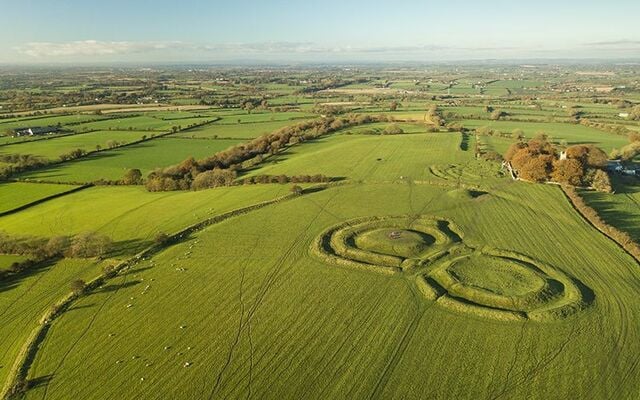
Ancient monument found beneath the Hill of Tara provided more insight into Ireland's prehistoric past
In November 2002, a remarkable discovery was made beneath the Hill of Tara in County Meath, Ireland, unveiling a hidden monument that added new layers of historical significance to this already hallowed site.
Read the rest of this article...
Sunday, December 01, 2024
Rare Viking-age treasure begins international tour
The Galloway hoard is set to be on display in Adelaide in Australia next year
One of the UK's most important archaeological finds this century is set to go on show for the first time outside the UK early next year, as it begins its international tour.
The Viking-age Galloway Hoard - buried about AD 900 - was unearthed in a south of Scotland field by metal detectorist Derek McLennan in 2014.
It contains a variety of objects and materials, including a rare Anglo-Saxon cross, pendants, brooches, bracelets and relics.
Read the rest of this article...
Gainsborough Old Hall in Lincolnshire, once graced by Henry VIII and Catherine Howard, has revealed itself as a hotbed of supernatural defence. Thanks to the eagle-eyed efforts of English Heritage volunteer Rick Berry, this 15th-century manor now boasts the most identified 'witches marks' of any of the charity’s 400 historic properties.
Over two years, Berry uncovered around 20 carvings, with a particular concentration in the servants' wing.
These apotropaic marks – or ‘witches marks’ – designed to ward off evil, include everything from rudimentary circles (believed to trap demons) to intricate overlapping 'V's, or Marian marks, invoking the Virgin Mary’s protection.
Read the rest of this article...
Anglo-Saxons plagiarized a Roman coin — and it's full of typos
An unusual piece of Anglo-Saxon jewelry — a plagiarized pendant rife with typos — that was discovered by a metal detectorist has now been declared treasure in the U.K.
The pendant imitates a Roman coin called a solidus, a type of gold coin introduced by the emperor Constantine in the fourth century A.D. It was discovered in January 2023 near the town of Attleborough in Norfolk, England, and dates to the late fifth to early sixth century. The piece of jewelry copies the imagery and inscriptions found on coins from the time of emperor Honorius, ruler of the Western Roman Empire from A.D. 393 to 423.
Read the rest of this article...
The Royal Palace at Bamberg
After 1007 Bamberg castle was rebuilt as a modern cathedral and palace complex. Likely, it turned out to be an ideal prototype for other similar building projects at Paderborn, Goslar and elsewhere
In 973, Otto II presented his cousin, Heinrich der der Zänker ( Henry the Wrangler), with the keys to Babenberg Castle near the confluence of the rivers Regnitz and the Main. When Heinrich der Zänker was granted Bamberg, the castle on the later Domberg was already impressive. Archaeologists have shown that already in 902, the Babenberg – later Bamberg – was a heavily fortified castle domineering a riverine landscape with a village down to the river. For several years, it was used as a state prison for the Italian king, Berengar II, who died there in 966.
Later, Heinrich II, at that time Duke of Bavaria, presented his wife, Kunegunde, with Bamberg as her matrimonial gift; he granted her a thriving and vital city, which they later transformed into a diocese in 1007, and where they built the first cathedral, consecrated in 1012.
Read the rest of this article...
140-year-old message in a bottle found in Viking burial mound in Norway
Archaeologists excavated the Myklebust ship mound and found a 140-year-old message in a bottle left by the site’s discoverer, photos show. Photo from the University of Bergen
When researchers began reexcavating a Viking burial mound in Norway, they knew they were following the footsteps of an influential archaeologist. What they didn’t know was that he’d left them a note 140 years ago. The Myklebust Ship is the one of the largest Viking ships ever found in Norway, reaching about 100 feet long in its original form. Archaeologist Anders Lorange unearthed the burnt ship in a large burial mound in Nordfjordeid in 1874, according to the Sagastad Viking Center dedicated to the find. The massive treasure-filled grave — likely belonging to a Viking king — was “only halfway excavated” before being filled in, the museum said.
Monday, October 28, 2024
Portage: Will archeologists find proof of Viking ship-hauling in Scotland?
When, in season four of the hit television series Vikings, Ragnar Lothbrok exhorts his fellow Norsemen to pull their ships out of the water and over the hills to attack Paris, it seems like an impossible feat – made for TV.
Certain written records, however, suggest that the act of dragging a ship across land – known as portage – is not so outlandish.
Both the 10th-century Byzantine text De Administrando Imperio and the 12th-century Rus text Nestor Chronicle describe instances of Vikings hauling ships over land. Now, a study taking place in Scotland could be about to provide further confirmation of this seemingly remarkable feat.
Read the rest of this article...
Gjellestad Viking ship in danger of disappearing
Sindre Martinsen-Evje, the mayor of Østfold County Municipality in Norway, has called for urgent action to help preserve the Gjellestad Viking ship burial site.
Although the site was only excavated in 2020 and 2021, time is already ticking as archeologists seek to save the remnants of the first Viking ship burial to be found in Norway in over a century.
Will it be gone forever?
With the help of ground-penetrating radar, Gjellestad was discovered more than 100 years after the Oseberg ship was excavated in 1904.
The Gjellestad dig, which took place near the town of Østfold on the Viksletta Plain, revealed the remains of both a large Viking ship burial and several other interesting finds, including horse teeth, a large amber bead, and a Viking axe.
Read the rest of this article...
Sunday, October 27, 2024
That 800-Year-Old Corpse in the Well? Early Biological Warfare
The Well Man was little more than a myth until 1938, when archaeologists excavated an abandoned well in the ruins of Sverresborg, outside Trondheim in central Norway.
Credit...Norwegian Institute for Cultural Heritage Research
In the dying days of the 12th century, with Norway in the grip of civil wars, the Baglers, a faction aligned with the archbishop, laid siege to Sverresborg, the castle stronghold of King Sverre Sigurdsson. The monarch was away, so the besiegers pillaged the castle, burned down houses and poisoned the water supply by heaving the corpse of one of the king’s men headfirst down the well and filling the shaft with stones.
This early biological warfare is recorded in “Sverris Saga,” a contemporaneous biography of the king, who reigned over much of Norway from 1184 to 1202. Scholars have long debated the chronicle’s reliability as a historical document, but a study published Friday in the journal iScience recounts how researchers unearthed the body of the “Well Man” and, with the help of ancient DNA, have provided fresh details about who he was.
Read the rest of this article...
Monday, October 21, 2024
What archaeologists are learning from the discovery of 50 extremely rare Viking skulls
Skeletons and skulls sit in graves at an excavation site of a 10th century Viking burial ground in Aasum, Denmark (Copyright 2024 The Associated Press. All rights reserved)
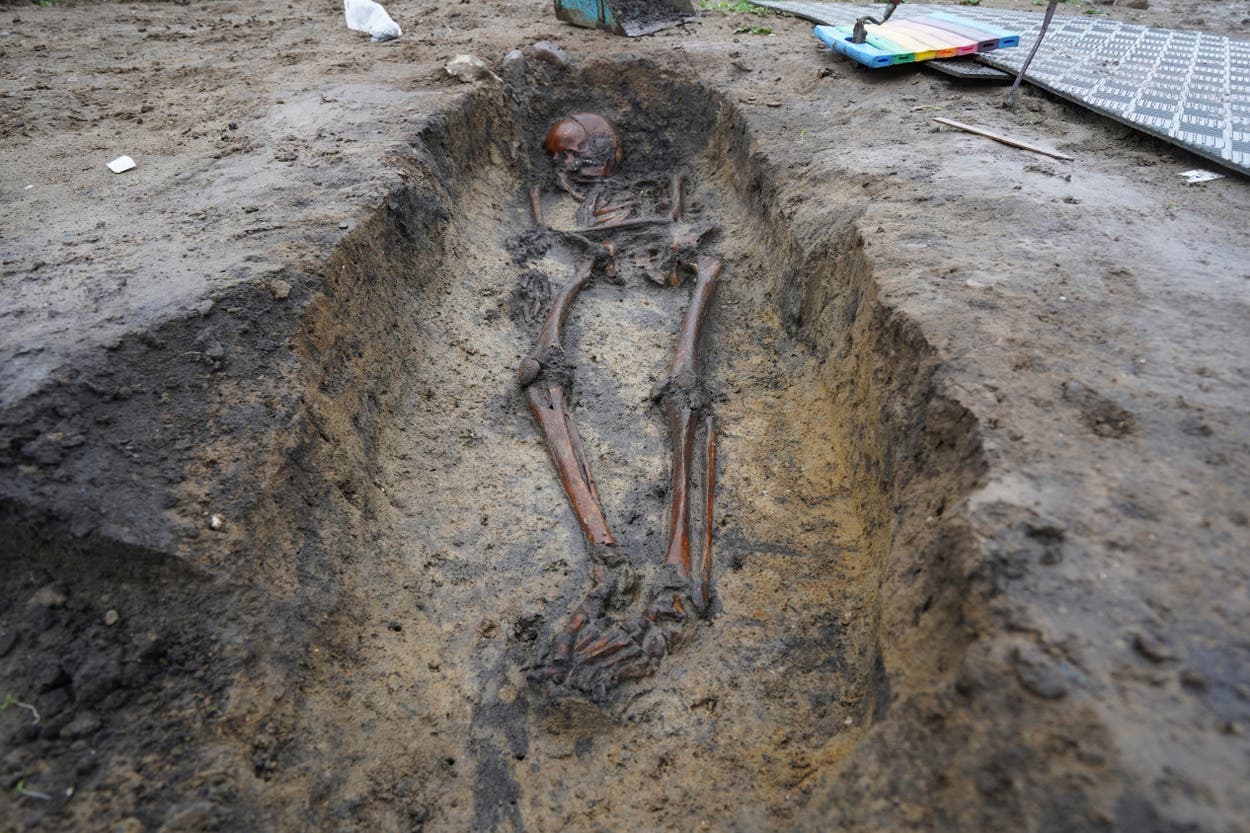
The discovery of 50 “exceptionally well-preserved” skeletons in a village in central Denmark could hold important clues to the Viking era.
Archaeologists made the landmark discovery that included a burial ground and the skeletons.
Experts hope to conduct DNA analyses and possibly reconstruct detailed life histories, as well as looking into social patterns in Viking Age, such as kinship, migration patterns and more.
“This is such an exciting find because we found these skeletons that are so very, very well preserved,” said archeologist Michael Borre Lundø, who led the six-month dig. “Normally, we would be lucky to find a few teeth in the graves, but here we have entire skeletons.”
Read the rest of this article...
Monday, September 30, 2024
Archaeologists Reveal Viking Treasure Left Buried for 1,000 Years: 'Unique'
The Viking treasure discovered in Årdal, Norway. The hoard consists of silver bracelets that are thought to be more than 1,000 years old.
Volker Demuth/Museum of Archaeology, University of Stavanger
"This is undoubtedly the most significant event of my career," Demuth told ScienceNorway.
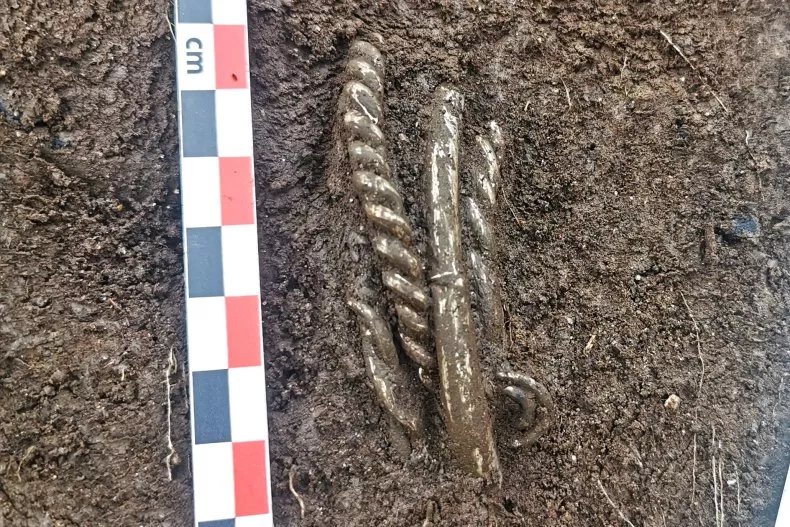
The treasure was first spotted by UiS field archaeologists Mari Krogstad Samuelsen and Ola Tengesdal Lygre. The researchers were part of a team, alongside Demuth, who were brought in to survey the site before the construction of a tractor road on the mountainside by a local farmer, who owns the land.
"At first I thought it was a question of some twisted copper wires that you can often find in agricultural land, but when I saw that there were several lying next to each other and that they were not copper at all, but silver, I realized that we had found something exciting," Lygre said in the press release.
Read the rest of this article...
Excavation of prehistoric tomb expected to start
The excavation of the prehistoric site is expected to start on Monday
An archaeological excavation of a prehistoric tomb in Alderney is due to begin later, Guernsey Ports says.
The site, known as Houguette de la Taille, is located outside the current perimeter of Alderney Airport.
It is one of three historic sites identified by planners as part a wider refurbishment of the airport, which was granted in May.
One of the conditions of that planning approval was written documentation of an investigation into any archaeological remains, before any construction work started.
Read the rest of this article...
Sunday, September 29, 2024
Remote Ancient Mountain Shelter Used by Viking Age Travelers Found
A lake in Hardangervidda National Park, Norway. The shelter used during the Viking Age was found in the Hardanger Plateau, much of which is protected as part of the park.
Pascal Goetzinger/iStock/Getty Images Plus
Archaeologists have found a remote mountain shelter used by travelers during the Viking Age.
The team identified the rock cabin along an ancient transport route across the Hardanger Plateau, a mountain plateau in central southern Norway, ScienceNorway reported.
The historic transport route, known as the Nordmannslepa, was long used to move goods and animals between eastern and western Norway.
In this mountainous landscape, weather conditions are harsh, making it difficult for ancient travelers to find shelter. As a result, people in ancient times constructed stone huts at suitable distances so that travelers could seek shelter and rest after a long day's journey.
Read the rest of this article...
Saturday, September 28, 2024
Danish archaeologists unearth 50 Viking skeletons
The excavation of a large Viking-era burial site in Denmark has unearthed 50 unusually well-preserved skeletons that archaeologists expect will help shed light on the lives of the Nordic people best known for their seafaring exploits in the Middle Ages
Read the rest of this article...

Sunday, August 11, 2024
L’Anse aux Meadows: The Viking Settlement of North America
In the 1960s, Anne and Helge Ingstad discovered an 11th-century Viking settlement in L’Anse aux Meadows, Canada, proving that the Vikings made it to North America.
For years, people passed on their legends orally before eventually writing them down. The Greenlanders’ Saga and The Saga of Erik the Red immortalized the tales of the Vikings’ westward voyages featuring Leif Erikson. Leif, born around 970 CE in Iceland to Erik the Red and Thorhild, led the expeditions. According to the sagas, Erik the Red discovered Greenland, setting the stage for Leif’s own explorations. He assembled a team of thirty men and embarked on the journey. Discovering an environmental paradise with lush meadows, forests, a serene lake, and abundant salmon, Erikson and his crew chose to settle there. They established camp and made it their home. Centuries before Christopher Columbus, the Vikings had reached a New World, if the sagas were accurate. Finally, evidence confirming their arrival was discovered at L’Anse aux Meadows, Canada.
Read the rest of this article...

Wednesday, August 07, 2024
Slavic settlement and burial ground found in Saxony-Anhalt
Image Credit : LDA
Archaeologists from the State Office for Monument Preservation and Archaeology (LDA) of Saxony-Anhalt have discovered a Slavic settlement and associated burial ground near the town of Wettin-Löbejün, Germany.
During the Migration Period and the Early Middle Ages (5th to the 10th century AD), the Early Slavs established control over extensive regions of Central, Eastern, and Southeast Europe, establishing the foundations for the Slavic nations.
The original homeland of the Slavs is uncertain due to a lack of historical records, however, many scholars suggest that they originate from somewhere in Central-Eastern Europe.
Excavations were in preparation for the construction of the SuedOstLink, a planned underground cable connection from Wolmirstedt (Saxony-Anhalt) to Landshut (Bavaria).
Subscribe to:
Posts (Atom)


