Tuesday, March 15, 2016

Roadworks uncover lost medieval Scottish village


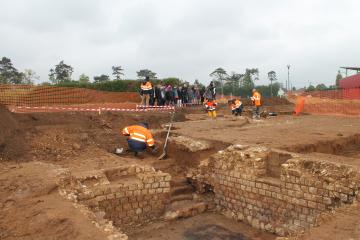
Motorway construction workers have unearthed archaeological artefacts which experts believe may be from a lost medieval Scots village. 


Artists impression of the lost village of Cadzow  [Credit: Transport Scotland] 

The crew made the discovery 18-months ago on the verge of the M74, near J6, opposite Hamilton Services. 

It included two structures, coins and pieces of pottery and smoking pipes. 

Archaeologist believe they may be more than 1,000 years old and could finally identify the location of the lost village of Cadzow. Cadzow was the name given to a community on the edge of the River Clyde at this location until 1445.

Read the rest of this article...

Sunday, March 06, 2016

Cologne celebrates its ancient Roman heritage


Jesus was a toddler gingerly taking his first steps into the wider world when the Romans built the walls of their fortress in Cologne. 2,010 years later it’s still standing, and has just been given a makeover.

 Not only is the six-meter-high wall the oldest stone structure in Germany, it’s the oldest north of the Alps, Markus Trier, director of the Roman-German Museum boasted on Friday.

While the people of the Orkney Islands in Scotland - where the stone walls of Skara Brae date back to 3,100 BC - might have something to say about that claim, the reopening of the wall will provide a welcome boost to Cologne’s tourism after a series of negative headlines for the city in recent months.


Read the rest of this article...

New tools to map, protect underwater treasures


Our seas and oceans are home to a tremendous amount of archaeological sites and artefacts. These invaluable witnesses to history are often difficult to locate, and even then experts are still faced with the question of whether to conserve them in situ or bring them to the surface. The SASMAP project has developed tools and technologies that will help solve both conundrums. 


New tech and tools to map, protect underwater treasures Diver investigating a wreck in the Baltic Sea [Credit: neatorama] 

The value of underwater cultural heritage no longer needs to be proven. According to UNESCO estimates, some 3 million ships wrecks are spread across the world’s ocean floors. And that’s without counting submerged heritage sites: In Denmark alone, where the ‘UNESCO Scientific Colloquium on the Access to Underwater Cultural Heritage’ will take place from 8 to 9 June 2016, around 20 000 sites can be found. It therefore comes as no surprise that the National Museum of Denmark, as coordinator of the SASMAP project, set out to help archaeologists to better map and protect these hidden treasures.
Our seas and oceans are home to a tremendous amount of archaeological sites and artefacts. These invaluable witnesses to history are often difficult to locate, and even then experts are still faced with the question of whether to conserve them in situ or bring them to the surface. The SASMAP project has developed tools and technologies that will help solve both conundrums. New tech and tools to map, protect underwater treasures Diver investigating a wreck in the Baltic Sea [Credit: neatorama] The value of underwater cultural heritage no longer needs to be proven. According to UNESCO estimates, some 3 million ships wrecks are spread across the world’s ocean floors. And that’s without counting submerged heritage sites: In Denmark alone, where the ‘UNESCO Scientific Colloquium on the Access to Underwater Cultural Heritage’ will take place from 8 to 9 June 2016, around 20 000 sites can be found. It therefore comes as no surprise that the National Museum of Denmark, as coordinator of the SASMAP project, set out to help archaeologists to better map and protect these hidden treasures.

Read more at: http://archaeologynewsnetwork.blogspot.de/2016/03/new-tech-and-tools-to-map-protect.html#.VtxhtdCKLVI
Follow us: @ArchaeoNewsNet on Twitter | groups/thearchaeologynewsnetwork/ on Facebook

Read the rest of this article...

Ancient Roman Puzzle Gets New Piece

This is the latest addition to an ancient Roman map puzzle.

A fragment of the world’s oldest and largest unsolved jigsaw puzzle, a 2,200-year-old map of Rome made of thousands of marble fragments, has been finally reunited to the other existing pieces, according to the Rome Cultural Heritage Superintendency.

Connecting to a large piece discovered in 1562, the new fragment bears an inscription that completes the word “Circus Flaminius.”

The map, known as Forma Urbis Romae, was carved into marble slabs between 203 and 211 A.D., during the rule of the emperor Septimius Severus.

Read the rest of this article...

31 intact burials unearthed at large Mycenaean cemetery


An extensive Mycenaean cemetery with 31 undisturbed burials containing numerous items of jewellery and several different types of ceramic vases, including 12 ornate Mycenaean drinking cups or kylikes, has been unearthed by Greek archaeologists at the Loggas site near Elati in Kozani (Macedonia), a short distance from ancient Aiani. 31 intact burials unearthed in large Mycenaean cemetery 

View of the excavation of the Mycenaean cemetery near Elati, Macedonia 
[Credit: Georgia Karamitrou-Mentesidi via Ethnos] 

"The Mycenaean presence in Upper Macedonia is now well established by the discovery of several settlement types throughout the region", says archaeologist Georgia Karamitrou-Mentesidi.

Read the rest of this article...

Did Henry VIII suffer same brain injury as some NFL players?

Detail of portrait of Henry VIII by the workshop of Hans Holbein the Younger. 
(Google Art Project)

Henry VIII may have suffered repeated traumatic brain injuries similar to those experienced by football players and others who receive repeated blows to the head, according to research by a Yale University expert in cognitive neurology.

Traumatic brain injury explains the memory problems, explosive anger, inability to control impulses, headaches, insomnia — and maybe even impotence — that afflicted Henry during the decade before his death in 1547, according to a paper published in the Journal of Clinical Neuroscience on Feb. 5.

“It is intriguing to think that modern European history may have changed forever because of a blow to the head,” said Arash Salardini, behavioral neurologist, co-director of the Yale Memory Clinic and senior author of the study.

Read the rest of this article...
Ancient Roman sites face rat emergency


A ticket desk for the Roman Forum and the Palatine Hill was closed on Wednesday due to a reported rat emergency that has hit the area and the Palazzo Massimo museum near Rome's central Termini station, Archaeology Superintendent Francesco Prosperetti said. 


Ancient Roman sites face rat emergency Roman Forum ticket desk closed by drips of rodent blood [Credit: TANN] 

Prosperetti said it was a "big problem" that the superintendency "cannot address" on its own. "A rat got trapped in a gap on the roof and the staff member who was working there saw blood drip on the desk," Prosperetti said when asked why part of a new ticket office was closed despite long queues.

Read the rest of this article...

Einzigartiges römisches Priesterinnengrab


Archäologische Landesausstellung im LVR-LandesMuseum Bonn zeigt spektakuläre Ausgrabungen der letzten fünf Jahre in NRW 

Es ist einer der archäologischen Sensationsfunde der letzten Jahre: acht künstlerisch sehr hochwertige Reliefdarstellungen von Götterbüsten aus Schildpatt (Schildkrötenpanzer), die ein Kästchen aus dem 2. Jahrhundert n. Chr. zierten. Gemeinsam mit weiteren, teils geheimnisvollen Grabbeigaben wurden sie von einem archäologischen Team des Landschaftverbandes Rheinland (LVR) 2013 in einem Frauengrab auf dem Gelände eines römischen Landguts bei Erkelenz (Erkelenz-Borschemich) freigelegt. Diese und weitere spektakuläre Funde aus den letzten fünf Jahren archäologischer Ausgrabungen und Forschung in Nordrhein-Westfalen sind derzeit in der Archäologischen Landesausstellung NRW nur noch bis zum 3. April im LVR-LandesMuseum Bonn zu sehen.

Read the rest of this article...

Joan of Arc ring returned to France

Joan of Arc is thought to have handed the ring to England's Cardinal Henry Beaufort on the eve of her execution in 1431 Photo: CASCADE NEWS

A ring believed to have belonged to Joan of Arc is being returned to France for the first time in 600 years after being sold at auction for almost £300,000. 
The ring was bought by the Puy du Fou foundation, which runs a historical theme park in France, at auction in London for around 30 times its estimate. 
The Puy foundation said the ring's return to France was highly symbolic.
The news was greeted by those on the Far Right in France, for whom this has become something of a cause célèbre. 
Front National leader Marine le Penn sent a thank you message on Twitter to Philippe de Villiers, the founder of Puy du Fou, for bringing the ring back to France.

Read the rest of this article...
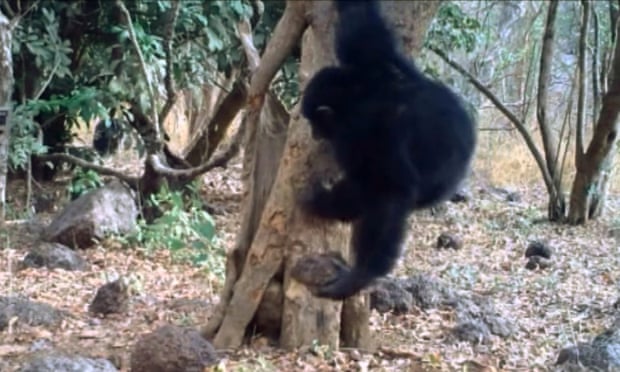
The images of chimps thrilled me: do they show evidence of spirituality in the wild?


A ritual with rocks observed in a study in Guinea has profound implications for our relationship with the animal kingdom 


A young chimp collects rocks in a hollow tree trunk. Photograph: Kühl

A fter more than half a century of scientists studying chimpanzees in the wild, it was easy to think there were no surprises left. But there it was, right before our eyes – a new behaviour in our biological next of kin. We were a group of six on a field mission in the Republic of Guinea, investigating all aspects of a previously unstudied chimp community. These chimps didn’t enjoy the comforts of a protected area, but instead eked out their existence in what little habitat was left between expanding farms and villages.

The day of the discovery began as any other, struggling through the thorny African savannah while swatting away the sweat bees thirsty for our perspiration. We were surveying the area, looking for signs of chimps. We came to a stop at a clearing in the bush. I was relieved. It gave me a chance to untangle the thorns caught in my hair. But why had we stopped?

Read the rest of this article...

Friday, March 04, 2016

Was Viking ruler Rollo Danish or Norwegian?


Norwegian researches opened a tomb containing the remains of descendants of Viking leader Rollo in Normandy, France on Monday with the aim of putting an end to a centuries-long debate: was Rollo Danish or Norwegian? 

Norwegian researchers opened a tomb containing the remains of descendants of Viking leader Rollo in Normandy, France on Monday with the aim of putting an end to a centuries-long debate: was Rollo Danish or Norwegian?
 
“We have worked on investigating this for about seven years, so to finally obtain material that we can test for DNA is huge,” historian Sturla Ellingvåg told NTB.

Read the rest of this article...

Anglo-Saxon 'island' settlement discovered


The remains of an Anglo-Saxon island have been uncovered in one of the most important archaeological finds in decades. 

Anglo-Saxon 'island' settlement discovered Liason officer Adam Daubney and metal detectorist Graham Vickers have discovered a 'significant' archaeological site [Credit: University of Sheffield] 

The island which was home to a Middle Saxon settlement was found at Little Carlton near Louth, Lincolnshire by archaeologists from the University of Sheffield. 

It is thought the site is a previously unknown monastic or trading centre but researchers believe their work has only revealed an enticing glimpse of the settlement so far.

Read the rest of this article...
Travailler aux champs : la panoplie agricole antique de Saint-Clément


Les archéologues de l’Inrap ont découvert une panoplie d’outils agricoles du IIIe siècle, dans la cave incendiée d’une ferme antique à Saint-Clément (Yonne). Fouillé à l’automne 2015, sur prescription de l’État (Drac Bourgogne), dans le cadre de l’aménagement d’un lotissement par Brennus habitat, le site a livré d’intéressants vestiges de l’âge du Bronze et une partie de villa antique dont est issu cet important lot de mobilier métallique. Ce corpus unique livre quantité de renseignements sur l’organisation et le fonctionnement des fermes gallo-romaines.

Read the rest of this article...

Stone-throwing chimps leave scientists stumped by ‘sacred shrine


Chimpanzees in the savannah of Guinea and the forests of Liberia have been captured picking up stones and throwing them at a tree as well as placing them gently at the base 

Chimpanzees in Guinea and the forests of Liberia have been observed picking up stones and throwing them at a tree as well as placing them gently at the base - behaviour that appeared to serve no purpose and could be evidence of "ritualistic behaviour" in animals. 
"What we saw on this camera was exhilarating – a large male chimp approaches our mystery tree and pauses for a second. He then quickly glances around, grabs a huge rock and flings it full force at the tree trunk," said Laura Kehoe, PhD researcher at Humboldt University of Berlin.
Read the rest of this article...

Thursday, March 03, 2016

BULGARIA’S BANYA WAS REBUILT AND USED BY SECOND BULGARIAN EMPIRE IN THE MIDDLE AGES

A poster of the 2015 archaeological excavations of the Early Byzantine and medieval fortress near Bulgaria’s Banya from the exhibition of the Panagyurishte Museum of History. 
Photo: Panagyurishte Museum of History

The first ever archaeological excavations of the Late Antiquity and Early Byzantine fortress known as “Kaleto" near the town of Banya, Panagyurishte Municipality, in Central Bulgaria, have found that the fortress was rebuilt and used in the 12th-14th century by the Second Bulgarian Empire (1186-1396 AD).

The 2015 excavations of the fortress near Banya were conducted by Assoc. Prof. Valeri Grigorov from the National Institute and Museum of Archaeology of the Bulgarian Academy of Sciences, together with Lyubka Todorova, archaeologist from the Pazardzhik Regional Museum of History, Georgi Abdulov, former Director of the Panagyurishte Museum of History, and Vasil Katsarev, curator at the same museum.

The artifacts discovered during the digs have now been showcased in a special exhibition of the Panagyurishte Museum of History entitled “Banya’s Kale – Archaeological Summer 2015", which was opened on March 1 in the Museum’s Archaeology Hall.

Read the rest of this article...

Neanderthals collected manganese dioxide to make fire


Manganese dioxide is abundant in nature, and owing to their colour, these oxides have been used as pigments since the Stone Age. Some of the cave paintings in Lascaux, France, for example, were produced with manganese-based pigments. In a series of compositional analyses, scientists from Leiden University and Delft University of Technology conclude that Neanderthals at Pech-de-l'Azé I in South Western France had a strikingly different use for this mineral 50,000 years ago.

During excavations at several Neanderthal sites in France large numbers of small black 'blocs' where found. The usual interpretation is that these chunks of 'manganese oxides' were used for their colouring properties in body decoration, potentially even for symbolic expression. However Neanderthals habitually used fire and if they needed black material for decoration, soot and charcoal were readily available, whereas manganese oxides would have necessitated a considerably higher investment in both time and energy to obtain.

Read the rest of this article...

Why Did Ancient Europeans Just Disappear 14,500 Years Ago?

The skull of a man who lived between 36,200 and 38,700 years ago in Kostenki in western Russia

Some of Europe's earliest inhabitants mysteriously vanished toward the end of the last ice age and were largely replaced by others, a new genetic analysis finds.
The finds come from an analysis of dozens of ancient fossil remains collected across Europe.
The genetic turnover was likely the result of a rapidly changing climate, which the earlier inhabitants of Europe couldn't adapt to quickly enough, said the study's co-author, Cosimo Posth, an archaeogenetics doctoral candidate at the University of Tübingen in Germany. [Top 10 Mysteries of the First Humans]
The temperature change around that time was "enormous compared to the climactic changes that are happening in our century," Posth told Live Science. "You have to imagine that also the environment changed pretty drastically."
Read the rest of this article...

More "Polish pyramids" - new discoveries of archaeologists


More than a dozen hitherto unknown monumental megalithic tombs, have been discovered near Dolice (Western Pomerania) by archaeologists from Szczecin. They are so-called Kujawy tombs, often referred to as "Polish pyramids" because of their monumental character.
These ground structures were built in the shape of an elongated triangle and surrounded with huge stone blocks. The width of the base ranged from 6 to 15 meters and length reached 150 m. The structures reached a height of 3 m. The mounds usually contained single burials. Tombs were erected by the Funnel Beaker Culture community from the fifth to the third millennium BC According to archaeologists, people buried in these tombs were associated with the elders of the tribe and clan.

Read the rest of this article...

Catacombs of Marcellinus and Peter restored


The culmination of a one year project to restore the paleochristian frescoes that decorate the Roman catacombs of Sts. Marcellinus and Peter "ad duas lauros", was announced by the Vatican this week. 


The restored frescoes of the catacombs of Marcellinus and Peter 
[Credit: Alexey Gotovskiy/CNA] 

This initiative was the result of an agreement signed in June 2012 between the Pontifical Commission of Sacred Archaeology of the Vatican and the Heydar Aliyev Foundation (HAF) of Azerbaijan, which funded the project. 

Among the restored frescoes are those of the cubicle of Susanna and the fossor, the niche of Daniel, the arcosolium of Orpheus, the cubicle of Our Lady with two Magi, and the cubicle of the praying matron.

Read the rest of this article...

Wednesday, March 02, 2016

Remains of Anglo-Saxon island discovered in Lincolnshire village

The site in Lincolnshire (not pictured) is thought to have been a previously unknown monastic or trading centre. Photograph: Jon Boyes/incamerastock/Corbis

The remains of an Anglo-Saxon island have been uncovered in Lincolnshire in a significant find that has yielded an unusually wide array of artefacts. 

The island, once home to a Middle Saxon settlement, was found at Little Carlton near Louth, Lincolnshire, by archaeologists from the University of Sheffield after a discovery by a metal detectorist.

Graham Vickers came across a silver stylus, an ornate writing tool dating back to the 8th century, in a disturbed plough field. He reported his find and subsequently unearthed hundreds more artefacts, recording their placement with GPS, thus enabling archaeologists to build up a picture of the settlement below. 

The artefacts include another 20 styli, about 300 dress pins and a huge number of sceattas – coins from the 7th-8th centuries – as well as a unusual small lead tablet bearing the female Anglo-Saxon name “Cudberg”.

Read the rest of this article...