Sunday, March 23, 2014

Cambridge University archaeologists find 'oldest' Roman irrigation system

It is thought the beds would have been used to grow grapes or asparagus

Excavations at a Cambridge University development have revealed what archaeologists believe is Britain's oldest-known Roman irrigation system.
Planting beds and pit wells were unearthed at the North West Cambridge site near Huntingdon Road.
Chris Evans from the university's archaeological unit said they dated from between 70 AD and 120 AD.
It was an "unparalleled discovery" and "effectively the first irrigation system we've seen", he said.
Read the rest of this article...

Dig at Scottish Abbey yields 600 year old coins


Coins from the rules of Henry III and Edward I and II, minted in London between the 13th and 14th centuries, could have been the spoils of battle swiped from the pockets of the defeated English army at Bannockburn, say archaeologists investigating 17 acres of land around Cambuskenneth Abbey. 


Coins found at Cambuskenneth Abbey could be the spoils of war from the Battle of Bannockburn say archaeologists [Credit: © GUARD Archaeology] 

Working at one of the few places singled out in contemporary accounts of the Battle of Bannockburn, metal detectorists, geophysicists, historians and poets have been exploring the Abbey where Robert the Bruce kept his army’s baggage before the battle. Founded by David I in 1140 the site was originally known as the Abbey of St Mary of Stirling.

Read the rest of this article...

The digital unwrapping of the Egyptian priest Neswaiu

How visitors to Stockholm's Medelhavsmuseet can now digitally unwrap the mummy of an Egyptian priest

In the 19th century and even later, there was no shortage of people eager to watch the unwrapping of an Egyptian mummy.
In 1908 in Manchester, some 500 people gathered in a lecture theatre to see prominent Egyptologist Margaret Murray supervise the unwrapping of a body from the Tomb of the Two Brothers from Manchester Museum's mummy collection.
As Egyptology and archaeology evolved, the destructive practise came to an end, but it didn't mean researchers and the public were any less curious about what lies within a mummy.
Read the rest of this article...

Vatican library plans to digitise 82,000 of its most valuable manuscripts


A 1,600-year-old manuscript featuring the poems of Virgil is among the collection being digitised by the Vatican Apostolic Library with the help of a Japanese IT firm

An illustration of the Dante's Divina Commedia realized by artist Sandro Botticelli in the XV century recently digitalised Photo: Biblioteca Apostolica Vaticana/Reuters

A rare Roman manuscript featuring the poems of Virgil dating back to 400AD is among thousands of historic items the Vatican’s library plans to publish online.
Vatican Apostolic Library, founded in 1451 and considered one of the world’s most important research libraries, is hoping in the next four years to archive its entire collection of 82,000 manuscripts, comprising more than 41 million pages.
Read the rest of this article...

Monday, March 17, 2014

The Staffordshire Hoard - Unveiling the story so far


The Staffordshire Hoard is the largest hoard of Anglo-Saxon gold ever found. In this film we find out about the first stage of conservation work on the artefacts …and what secrets have been revealed.

Watch the video...

Diving into archaeology

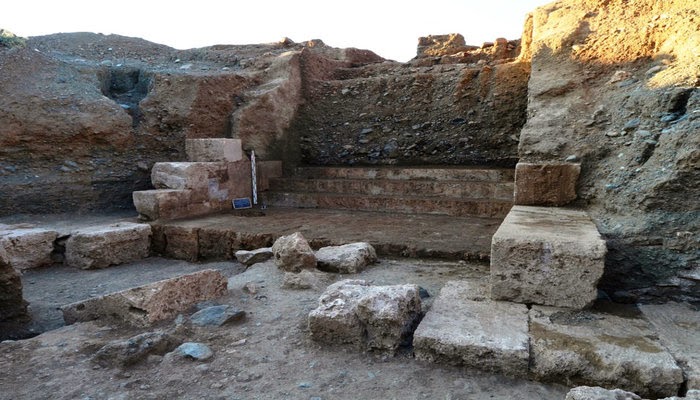
Only the foundations of the former basilica remain under Lake Iznik

The rubble-strewn remains of a 1,600-year-old basilica, dedicated to St Neophytos, have been discovered under Lake Iznik in Turkey’s northwestern Bursa province. Though located only 20 metres from the shore, and at a depth of around 2 metres, the basilica’s existence was unknown until January, when aerial photographs of the area were taken as part of a project to record local historic monuments. A diving team has now investigated the submerged structure and, due to similarities with the Hagia Sophia church in Iznik, experts have dated it to the fourth or fifth centuries. They have suggested it was built on the spot where Roman soldiers martyred St Neophytos in AD303; occurrences of the saint’s name have been found nearby and Medieval engravings show the saint being killed on the edge of a lake. It is thought an earthquake in AD740 caused the basilica to collapse and sink under the lake. The future of the site now rests in the hands of Turkey’s Culture and Tourism Ministry, who can designate it a protected site or open it up to recreational divers.

Read the rest of this article...

Still discovering things about the Ghajn Tuffieha Roman baths


The Roman baths along the road from Mġarr to Gћajn Tuffieћa were unearthed by accident in 1929, but archaeologists and other experts are still discovering things at the site.
So said the deputy leader of excavations, Heritage Malta’s David Caruana, who was speaking at a lecture organised by Din l-Art Ħelwa last week.
The baths were discovered when workers were digging down to pass a conduit to enable the flow of water to water the fields. A certain Mr Rizzo, presumably their foreman, informed Sir Temi Zammit that, under some three feet of soil, they had discovered remains that they thought were archaeological.
Read the rest of this article...

9,000-year-old 'ritual wand' discovered


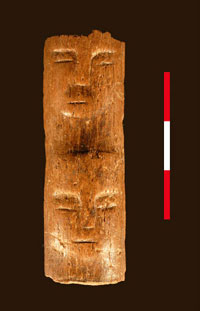
Archaeologists have unearthed an ancient “wand” carved with two realistic human faces in southern Syria, Live Science reported.

The roughly 9,000-year-old artifact was discovered near a graveyard where the bodies of 30 people were buried without their heads, which were found in a nearby area.

"The find is very unusual. It's unique," said study co-author Frank Braemer, an archaeologist at the Centre National de la Recherche Scientifique in France.

Read the rest of this article...

Win a Free App from our Friends at Touch Press


Win The Pyramids for iPad! 

We would like to offer you the exciting chance to win a free copy of the app The Pyramids from our friends at Touch Press

With this stunning and stimulating app, you can explore the incredible pyramids and tombs of ancient Egypt. Fly around the plateau where the pyramids and the Sphinx are located at Giza near Cairo. Enter and wander around the labyrinthine tombs and passageways. Examine stunning wall paintings in incredible detail, rotate royal statues and spin 3D objects. Everything has been painstakingly recreated from ultra high-resolution digital imagery captured on location in Egypt by Sandro Vannini, the world’s greatest photographer of archaeological sites and antiquities.


Read the rest of this article...

More on Burials in Greece linked to Macedonian kings


The director of the 17th Ephorate of Prehistoric and Classical Antiquities Angeliki Kottaridi believes that the five tombs discovered in Vergina could belong to members of the Temenid dynast or even King Cassander himself. Mrs. Kottaridi made the bold revelation at the Thursday afternoon conference at the University of Thessaloniki. 


Funeral mourning representation found after excavations at the Royal Necropolis of Aegae, Vergina [Credit: ΑΠΕ-ΜΠΕ/ΥΠΠΟ/STR] 

Cassander was one of Alexander the Great’s successors and husband to his sister, Thessaloniki, who established the Antipatrid dynasty. King Cassander became known for his hostility towards the memory of Alexander the Great and he is credited with changing the name of Therma to Thessaloniki. 

Read the rest of this article...

Greek Island of Santorini Volcano Erupted in 16th Century


According to a recent international study, the volcano of the island Santorini, Greece, erupted in the 16th century BC and not earlier. The survey characterized a number of research studies that took place in the past and have indicated that Santorini’s volcano may have erupted a century earlier, as unreliable because the method based on tree-ring measurements that they used, could not provide them with accurate results.
An international team of researchers led by Paolo Cherubini from the Swiss Federal Institute for Forest, Snow and Landscape Research (WSL) has demonstrated in the scientific journal Antiquity, that this method cannot provide reliable results. The scientists show that the14C dating of individual pieces of olive wood enveloped by volcanic ash is too unreliable for precise dating.
Read the rest of this article...

Archaeologists in Denmark make smelly discovery


Archaeologists made a stunning, if not stinky discovery during their excavations of I Vilhelm Werners square in Odense on Funen. 


The dig, which is ongoing and one of the largest urban archaeological excavations in Danish history, uncovered a number of barrels containing human excrement [Credit: Facebook/infoboksen] 

The digs revealed numerous latrine barrels dating back to the 1300s and still filled with their intended content, proving – among other things – that human excrement still has a putrid odour even if it is centuries old. 

Many of the barrels, which were found during 2013, are in excellent condition and their contents can provide a unique insight into the dietary habits of people living some seven hundred years ago.

Read the rest of this article...

Africans' ability to digest milk linked to spread of cattle raising

A cattle herder drives his animals in Tanzania. The study linked the spread of pastoralism with the ability to digest milk.  Credit: University of Pennsylvania

Babies are born with the ability to digest lactose, the sugar found in milk, but most humans lose this ability after infancy because of declining levels of the lactose-digesting enzyme lactase. People who maintain high levels of lactase reap the nutritive benefits of milk, however, offering a potential evolutionary advantage to lactase persistence, or what is commonly known as lactose tolerance.

A new study led by University of Pennsylvania researchers -- constituting the largest examination ever of lactase persistence in geographically diverse populations of Africans -- investigated the genetic origins of this trait and offers support to the idea that the ability to digest milk was a powerful selective force in a variety of African populations which raised cattle and consumed the animals' fresh milk.

Read the rest of this article...

Northampton Project Angel reveals town's medieval past


Three "star finds" have been discovered by archaeologists at a dig on the site for Northamptonshire County Council's forthcoming new £43m headquarters. 


The site is being surveyed before building work begins on a new council headquarters [Credit: Mola/NCC] 

The excavation in Fetter Street, Northampton, has revealed the remains of a medieval bread oven, an early 13th Century well shaft and trading tokens. 

Jim Brown, from the Museum of London Archaeology, said the 12th Century oven suggested "a settlement nearby".

Read the rest of this article...

Sunday, March 16, 2014

British Museum's Warren Cup branded a forgery


A Roman silver drinking vessel that depicts two sets of male lovers is one of the most prized jewels in the British Museum, singled out by director Neil MacGregor for his critically acclaimed History of the World in 100 Objects. 


The British Museum says the Warren Cup dates from the 1st century AD 
[Credit:: Martin Godwin/Guardian] 

But on Wednesday, 15 years after the British Museum bought the Warren Cup for £1.8m, a highly respected German archaeologist suggested it could be a forgery. 

At a public debate staged by King's College London, Prof Luca Giuliani challenged the museum's view that it dates from the 1st century AD.

Read the rest of this article...

Natural Selection Led To Different Features In Europeans As Recent As 5,000 Years Ago, According To Researchers


An increasing volume of archaeological research and effort has come to focus particularly on the genetic evolution and development of human beings since the last Ice Age. While the last glacial period ended about 10,000 years ago, promising, new research suggests that substantial evolution of the human species can now be evidenced even in peoples from as recently as 5,000 years ago — a relative blink of an eye in geological terms — thanks to cutting-edge analyses of skeletons unearthed on the European continent.
The new findings are the result of a team of scientists from around the world from different academic disciplines, forming an interdisciplinary research team that has been able to uncover new insights into some of the most recent evolutionary changes to the human species. Anthropologists at Johannes Gutenberg University Mainz (JGU), geneticists at University College London (UCL), and archaeologists from Berlin and Kiev all collaborated in a study recently published in the Proceedings of the National Academy of Sciences revealing that ancient DNA from these European skeletons shows the impact of natural selection on the human genome as “recently” as the past 5,000 years, resulting in a rapid, dramatic change of appearance in people on a continent that is now dominated by a heterogenous mixture of different physical traits in an otherwise small geographical area.
Read the rest of this article...

Laser and radar unveil the secrets of Roman bridges

3D model of the Roman bridge of Segura, on the border between Spain and Portugal.
Credit: Grupo de Geotecnologías Aplicadas (UVigo)

Dscovering hidden arches, visualising the sloped outline characteristic of the medieval period, finding a Renaissance engraving on a Roman arch or detecting restorations: these are some of the results that have been obtained by researchers at the University of Vigo (Spain) in their study of more than 80 Roman and medieval bridges. The assessment was carried out with the help of a ground-penetrating radar, a laser scanner and mathematical models, technology that benefit conservation.

In recent years, UNESCO and other organisations concerned with the conservation of cultural heritage have underlined the importance of using non-destructive methods to document monuments´ characteristics and evaluate their state of conservation.

Read the rest of this article...

Burials in Greece linked to Macedonian kings


A Greek archaeologist says she has discovered 20 new burials near Macedonia's ancient capital in northern Greece, and some could tentatively be associated with the early Macedonian kings. 


Five new royal tombs have come to light during excavations at the royal necropolis of Aegae, in Northern Greece [Credit: Greek Reporter] 

Excavator Angeliki Kottaridi says two of the poorly preserved graves excavated in a cemetery between 2012-2013 "might perhaps be linked" with Alexander I and his son, Perdiccas II. 

Read the rest of this article...

Saturday, March 15, 2014

Architecture That Shook Oxford


Throughout history, new buildings have changed the way Oxford looks and how its residents behave. Whether their aesthetic was met with contempt, their purpose divided opinion, or — in the case of the Cutteslowe Walls — they even physically divided social classes, manmade structures have left a tangible imprint on the city and its inhabitants.

In the final video in the series, Archivist of Christ Church Judith Curthoys discusses Oxford's grandest college, and its unusual foundation – first by a cardinal, then by a King. 

You can find the rest of this article here...

Judith Curthoys will be teaching a course 'Christ Church Revisited – An Archival History' in week five of the Oxford Experience (Sun 3 to Sat 9 Aug 2014) you can find details of the course here...

Tuesday, March 11, 2014

Royal settlement linked to Sutton Hoo treasures


Finds from Rendlesham in Suffolk will go on display for the first time this week at the National Trust's Sutton Hoo visitor centre

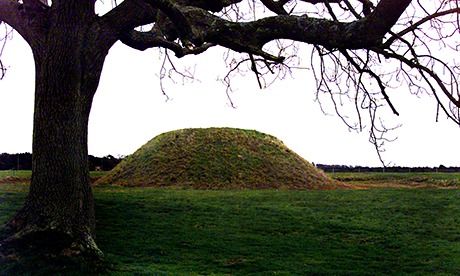
The burial mound at Sutton Hoo, one of Britain's most important archaeological sites, where Anglo-saxon treasures were found. Photograph: Garry Weaser/The Guardian

The home of the Anglo-Saxons who built the world famous burial mounds at Sutton Hoo in Suffolk, where a king was laid with golden treasure heaped around him, has been discovered on nearby farmland a few miles from the site.
The finds from Rendlesham, which will go on display for the first time this week at the National Trust's Sutton Hoo visitor centre, include fragments of exquisite gold jewellery comparable in workmanship, if not in scale, to the Sutton Hoo treasures, pieces of gilt bronze horse harness, Saxon pennies and metal offcuts from a blacksmith's workshop.
The 50-hectare (123.5-acre) site, four miles north-east of Sutton Hoo, was discovered by archaeologists after a local landowner, Sir Michael Bunbury, became concerned about nighthawks – treasure-hunting thieves who use metal detectors. The archaeology unit of Suffolk county council has for five years been surveying his fields, using aerial photography, soil analysis, ground-penetrating radar and metal detecting, eventually pin pointing the 50 hectare Anglo Saxon site within 160 hectares of farmland.
Read the rest of this article...