Wednesday, July 04, 2012

Kingsholm garden dig to reveal Gloucester's past


People in part of Gloucester are being asked to dig up their gardens as part of a local history project. 

Kingsholm has been chosen to take part in History on Your Doorstep, a project run by the archaeology team at Gloucestershire County Council.

It was the site of the first Roman military fort in Gloucester and an important Anglo-Saxon royal palace was also located in the area.

The project is being funded through a Heritage Lottery Fund grant.

At the end of the project there will be an exhibition of the findings, held at Gloucester City Museum during the summer of 2013. 

People from outside the area can also take part in some test digs on Saturday as part of the BBC Great Gloucestershire History Day.

Work begins to uncover Roman mosaics at Chedworth villa


Archaeologists have begun to excavate a mosaic beneath a corridor at Chedworth Roman Villa in Gloucestershire. 

At 35m (115ft) long, it is considered to be one of the longest in-situ corridor mosaics in the country.

Visitors to the villa near Cirencester are able to watch archaeologists at work from suspended walkways which have been installed overlooking the mosaics.

National Trust archaeologist Martin Papworth said: "Hopefully we'll find some exciting things."
Victorian archaeologists uncovered and then reburied the mosaics about 150 years ago.

Wilberforce College's Iron Age finds halt building work


Builders at a college in East Yorkshire have stopped work after finding objects dating back to the Iron Age.

The workers constructing a sports court at Wilberforce College, Hull, have made way for experts from Humber Field Archaeology to inspect the site.

Digs at the site in the east of the city date back to the 1960s and there was archaeological work there in 2010.

David Cooper, vice-principal at the college, said: "This is a really important site."
It is thought the objects found are shards of Iron Age pottery.

Top five Archaeology days


As part of The Festival of British Archaeology, here are five ways to dig up the ancient secrets of Britain and beyond.

1. The Horse Hunters of Cheddar Gorge, Somerset
Our ancestors dwelled in the dark caves of Cheddar Gorge at the end of the Ice Age, hunting wild horses by stampeding them over the edges of cliffs. A reenactment group dressed in deerskins will demonstrate flint knapping and fire making, key skills in surviving the stone age. Also includes a talk about the artefacts and bones excavated from the caves, cave painting and making pinch pots.
2. Walk with an Archaeologist: the Stonehenge Landscape, Wiltshire
Stonehenge remains one of the most mysterious archeological specimens in the world, with huge stones taken from distant counties in a cryptic religious circle. Join Neolithic expert and National Trust archaeologist Dr. Nick Snashall on an exploration of the Stonehenge landscape, find out about the latest discoveries and exciting finds. The walk measures about 8 miles, so it is recommended to bring a packed lunch to enjoy whilst walking.

Read the rest of this article...

Moving 4,000 Tons Using Only the Strength of Humans and Animals: Historians Accompany the Castle Construction in Friesach


Entirely in keeping with medieval construction methods, a castle is being erected in the Austrian town of Friesach. The project, which is scheduled to last 30 years, is being accompanied by a number of historians. On July 5th, the corner stone for the visitors' centre will be laid.

Medieval castles are regarded as buildings of particular stability: Even after 1,000 years, many have successfully withstood the ravages of time. Making the most of a construction site, where a castle is being constructed using medieval methods, historians are critically examining the existing knowledge about tools and materials, in an effort to gain new insights. "For example, a female expert in the history of construction is currently conducting research in Friesach in order to discover the secret of the medieval mortar mixture," Johannes Grabmayer, project leader at the Department of History at the Alpen-Adria-Universität explains. An understanding of this "perfect mortar" could also be of interest to today's manufacturers of construction equipment and materials.

Legendary Viking town unearthed


Danish archaeologists believe they have found the remains of the fabled Viking town Sliasthorp by the Schlei bay in northern Germany, near the Danish border.

According to texts from the 8th century, the town served as the centre of power for the first Scandinavian kings.

But historians have doubted whether Sliasthorp even existed. This doubt is now starting to falter, as archaeologists from Aarhus University are making one amazing discovery after the other in the German soil.
"This is huge. Wherever we dig, we find houses – we reckon there are around 200 of them,” says Andres Dobat, a lecturer in prehistoric archaeology at Aarhus University.

Monday, July 02, 2012

Crossrail archaeology dig gives us a glimpse into old London


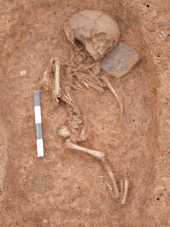
Delicate work: a Crossrail archaeologist brushes around a skeleton during engineering works at Liverpool Street

A skeleton, ancient jewellery, medieval ice-skates and other artifacts unearthed during excavations for Crossrail are to go on show to the public.
Archaeologists say the finds — about 100 of which will go on display — offer a glimpse into ancient London and the capital’s industrial history.
The skeleton is one of up to 4,000 found in a site underneath Liverpool Street that was used for about 200 years from 1569 as the burial ground for local residents and patients from St Bethlehem Hospital — known as Bedlam.

Bulgarian Archaeologists on Struma Hwy Obey PM's Deadline


Bulgarian Archeologists on Struma Hwy Adhere to PM Deadline: Bulgarian Archaeologists on Struma Hwy Obey PM's Deadline
Regional Minister, Lilyana Pavlova (l), and Culture Minister, Vezhdi Rashidov (r) at the ceremony for the transfer of archaeological discoveries from the Struma highway to local museums. Photo by BGNES 
 
Bulgarian archaeologists have adhered to the June 30 deadline issued by Prime Minister, Boyko Borisov, to finish excavations so that construction on the southwestern Struma highway can go on.
After working round-the-clock, they freed the terrain and workers who will build Lot 1 of the highway can now enter with excavators, loaders, and other heavy construction machinery.

Borisov was scheduled to attend in person the transfer of the archaeological discoveries to the museums in the nearby town of Dupnitsa and city of Kyustendil, but other urgent commitments have prevented him from travelling to the location. The cabinet was represented by Regional Minister, Lilyana Pavlova, Transport Minister, Ivaylo Moskovski, and Culture Minister, Vezhdi Rashidov, who became the very first people to see the Roman coins and ceramics, dated from the 4th century AC.

Saturday, June 30, 2012

CSIC recovers part of the genome of 2 hunter-gatherer individuals from 7,000 years ago


A team of scientists, led by researcher Carles Lalueza-Fox from CSIC (Spanish National Research Council), has recovered - for the first time in history - part of the genome of two individuals living in the Mesolithic Period, 7000 years ago. Remains have been found at La Braña-Arintero site, located at Valdelugueros (León), Spain. The study results, published in the Current Biology magazine, indicate that current Iberian populations don't come from these groups genetically. 

The Mesolithic Period, framed between the Paleolithic and Neolithic Periods, is characterized by the advent of agriculture, coming from the Middle East. Therefore, the genome found is the oldest from Prehistory, and exceeds Ötzi, the Iceman, in 1700 years.

Researchers have also recovered the complete mitochondrial DNA of one of these individuals, through which they could determine that European populations from Mesolithic Period were very uniform genetically. Carles Lauleza-Fox, from the Institute of Evolutionary Biology (CSIC-UPF), states: "These hunters-gatherers shared nomadic habits and had a common origin. Despite their geographical distance, individuals from the regions corresponding to the current England, Germany, Lithuania, Poland, and Spain, shared the same mitochondrial lineage".

New technologies help us better understand Ancient Rome


Historians and archaeologists have studied the ruins of the Roman Forum for centuries, employing the tools on hand to add to the knowledge of this center of Roman public life that hosted elections, triumphal processions, speeches, trials, shops and gladiatorial spectacles.

The latest research suggests these structures, which we know as white marble, may have been brightly painted.

Bernard Frischer, a classics and art history professor in the University of Virginia's College of Arts & Sciences, led a team of experts who used cutting-edge technology to find traces of yellow pigment on a bas-relief of a menorah on the forum's Arch of Titus. In its heyday, the yellow pigment would have appeared gold from a distance.

Frischer said the menorah has historical significance. "The menorah on the relief is extremely important to Jews, since it shows the menorah from the Second Temple in Jerusalem, which Titus captured and sacked in A.D. 70."

Bulgaria archaeologists discover underwater settlement during excavations at Akin Cape


Chernomorets. Archaeologists with the team of Associate Professor Dr Ivan Hristov, Deputy Director of the National Museum of History, discovered an underwater residential quarter during the excavations at Cape Akin close to the coastal town of Chernomorets. Bozhidar Dimitrov, Director of the National Museum of History, announced the news exclusively for FOCUS News Agency.

“During the excavations under the Via Pontica government programme at Cape Akin, one of the three capes of the town of Chernomorets, apart from the massive fortified wall with two battle towers at the peninsula itself, archaeologist Dr Ivan Hristov also discovered a continuation of the fortified wall into the sea. The continuation of the wall surrounds a big shoal Southwest of the cape. The fortified wall is preserved to some big height and the team has seen the outlines of a big battle tower of five meters height and three and a half meters width,” Bozhidar Dimitrov explained.

In his words, the archaeologists have already ascertained that this is the early Byzantine fortress Krimna, which was situated there. Due to some circumstances, since the beginning of the WWI until a couple of years ago the fortress was within the area of a military unit and it was impossible for the archaeologists to study it.

Cave in South Wales holds UK's oldest rock art


A reindeer engraved on the wall of a cave in South Wales has been found to date from at least 14,505 years ago – making it the oldest known rock art in the British Isles. 
This photo shows the main part of an engraving of a cervid found by Dr. George Nash of the University of Bristol, UK in Cathole Cave on the Gower Peninsula, South Wales. A new U-series date suggests it could be 14,505 years old -- making it the oldest known rock art in the British Isles [Credit: Dr. George Nash/University of Bristol]
The engraving was discovered in September 2010 by Dr George Nash from the University of Bristol's Department of Archaeology and Anthropology while he was exploring the rear section of Cathole Cave, a limestone cave on the eastern side of an inland valley on the Gower Peninsula, South Wales. 

Found to the rear of the cave on a small vertical limestone niche, the engraved cervid – probably a stylised reindeer – is shown side-on and measures approximately 15 x 11cm. It was carved using a sharp-pointed tool, probably made of flint, by an artist using his or her right hand. The animal's elongated torso has been infilled with irregular-spaced vertical and diagonal lines, whilst the legs and stylised antlers comprise simple lines.

Spanish site yields oldest bow in Europe


Archaeological research carried out at the Neolithic site of La Draga, near the lake of Banyoles, has yielded the discovery of an item which is unique in the western Mediterranean and Europe. The item is a bow which appeared in a context dating from the period between 5400-5200 BCE, corresponding to the earliest period of settlement. It is a unique item given that it is the first bow to be found in tact at the site. According to its date, it can be considered chronologically the most ancient bow of the Neolithic period found in Europe. The study will permit the analysis of aspects of the technology, survival strategies and social organisation of the first farming communities which settled in the Iberian Peninsula. The bow is 108 cm long and presents a plano-convex section. Worth mentioning is the fact that it is made out of yew wood (Taxus baccata) as were the majority of Neolithic bows in Europe. 
The complete bow discovered during this year's campaign [Credit: Universitat Autònoma de Barcelona]
In previous archaeological campaigns, fragments of two bows were found (in 2002 and 2005) also from the same time period, but since they are fragmented it is impossible to analyse the characteristics of these tools. The current discovery opens new perspectives in understanding how these farming communities lived and organised themselves. These bows could have served different purposes, such as hunting, although if one takes into account that this activity was not all that common in the La Draga area, it cannot be ruled out that the bows may have represented elements of prestige or been related to defensive or confrontational activities.


Mit archäologischen Überraschungen hat Haltern am See schon häufiger auf sich aufmerksam gemacht. Jetzt kommen die Archäologen der LWL-Archäologie für Westfalen wieder ins Staunen. In einer unscheinbaren Baustelle trat unverhofft ein dem Hauptgraben vorgelagerter zweiter Stadtgraben aus dem Spätmittelalter zutage. »Damit haben wir den ersten Nachweis dafür, dass Haltern eine gestaffelte Stadtbefestigung hatte«, bewertet LWL-Archäologe Dr. Hans-Werner Peine den Überraschungsfund als kleine Sensation für die Stadt, die insbesondere mit seinem Römerlager von sich Reden macht.

Thursday, June 28, 2012

Early human ancestor chewed bark


An early relative of humans chewed on bark and leaves, according to fossil evidence.

Analysis of food trapped in the teeth of the two-million-year-old "southern ape" suggests it existed on a unique diet of forest fruits and other woodland plants.

The study, in Nature, gives an insight into the evolution of what could have been a direct human ancestor.

Other early African contemporaries had a diet suggesting a grassland habitat.

Tricentenary for steam pioneer Thomas Newcomen


A series of conferences focusing on energy is being held around the UK to mark the 300th anniversary of the world's first steam engine.

In 1712, Devon-born Thomas Newcomen's engine began pumping water from a coal mine in Dudley, West Midlands.

The invention allowed miners to extract previously inaccessible coal.

The latest conference, organised by the Newcomen Society, is being held in Manchester and focuses on the development of the UK's nuclear sector.

Wednesday, June 27, 2012

Iron Age coins discovered in Jersey after 30-year search


An examination of the massive hoard of Iron Age coins found on the island of Jersey.
Photograph: Jersey Heritage/PA

The largest hoard of Iron Age Celtic coins found anywhere in northern Europe has been discovered by two amateur metal detectorists who have been searching in the same field in Jersey for 30 years.

Reg Mead and Richard Miles found up to 50,000 silver and bronze coins, which remain clumped inside a massive block of soil. They had been hunting for buried treasure inspired by legends that a local farmer once turned up silver coins while working on the land. Earlier this year, they finally found 60 silver coins and one gold, dating from the 1st century BC. Every coin, Mead said, gave them the same thrill. "We are talking about searching for 40 to 50 hours to get these coins out, and every one gives you the same buzz."

Expert says Roman and Celtic coins should go on tour


A marketing expert says the record find of Roman and Celtic coins in Jersey is a unique opportunity for the island.

Christopher Journeax, former head of marketing for Jersey Heritage, says the find worth up to £10m could be used as a travelling exhibition.

The coins, dating from about 50BC are thought to weigh about three quarters of a tonne.

Mr Journeax believes many people and not just archaeologists and specialists would want to see the treasure. 

He said the Celtic coins could spark more interest in the island and its history.

Medieval Wombridge priory excavated


Archaeologists are due to return to a Telford church almost a year after a medieval priory was first unearthed.

The remains of the building, thought to date back to the 13th Century, were found in the grounds of Wombridge Church last August.

A team of volunteers are to help archaeologists uncover the medieval floor.

Reverend Kevin Evans said he hoped as much of the original building would be conserved as possible.

Oakington: Life and death in the East Anglian Fens


Anglo-Saxon skeletons have been surfacing for almost a century in the fields of Oakington. Now a new project has laid bare the trials and tragedies of a small 6th-century Fenland community. Duncan Sayer, Richard Mortimer and Faye Simpson bring flesh to the bones.


 In 1926 four early Anglo-Saxon burials, one equipped with a spear, knife and shield boss, were discovered in an Oakington village field, in Cambridgeshire. Described as ‘[south] of the church’, the land had just been bought by Alan Bloom for his nursery garden. His interest piqued, Alan dug dozens more holes, only abandoning the hunt for further bodies when he hit undisturbed subsoil. Yet there were more to find. Construction of a children’s playground in the 1990s brought 26 burials to light, excavated by Cambridgeshire’s Archaeological Field Unit, while 2006 and 2007 saw Oxford Archaeology East recover 17 more. In 2010 and 2011 students and researchers returned to the site, opening new trenches on either side of the playground and revealing 27 further burials – including a pregnant woman, a warrior and, most exceptional of all, a large number of child burials from a period when they are notoriously scarce.

With several seasons left to go, Oakington is fully established as a substantial 6th-century Anglo-Saxon cemetery. But there is more to the site than that. Capitalising on the longer view that a research and community project provides, test pits and whole trenches have been excavated in gardens and open spaces throughout the village. The tantalising results point to an early enclosed community – a Middle Saxon Burh – on the edge of the Cambridgeshire Fen.