Wednesday, January 28, 2015

Anthropology: Ancient skull from Galilee cave offers clues to the first modern Europeans

Interior of the Manot Cave in Israel's Galilee, where a 55,000-year-old skull sheds new light on human migration patterns.

The discovery of a 55,000-year-old partial skull in Northern Israel provides new insights into the migration of modern humans out of Africa. The rare find is reported in the journal Nature this week by an international team of Israeli, North American and European researchers.

A key event in human evolution was the expansion of modern humans of African origin across Eurasia, replacing all other forms of hominin (humans and their predecessors), around 40,000-60,000 years ago. However, due to the scarcity of human fossils from this period, these ancestors of all present-day non-African modern populations have largely remained a mystery.
Now, researchers describe a partial skull that dates to around 55,000, which was found at Manot Cave in Israel's Western Galilee. 
Read the rest of this article...

Skull discovery suggests location where humans first had sex with Neanderthals

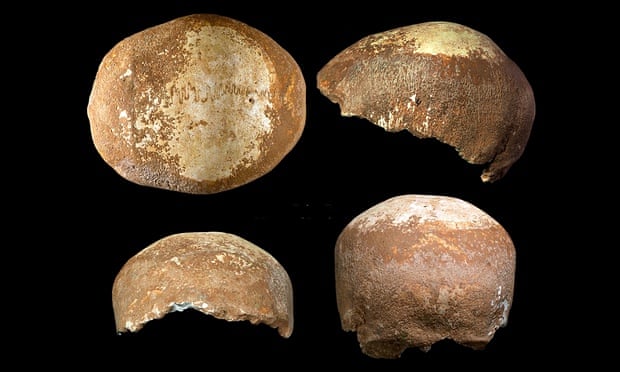
Views of the human skull, with missing jaw, found in western Galilee, northern Isreal and estimated at 55,000 years old. Photograph: Tel Aviv University and University of Vienna

An ancient skull found in a cave in northern Israel has cast light on the migration of modern humans out of Africa and the dawn of humanity’s colonisation of the world.
For most palaeontologists that might be enough for a single fossil, but the braincase has offered much more: a likely location where the first prehistoric trysts resulted in modern humans having sex with their heavy-browed Neanderthal cousins.
Discovered in a cave in western Galilee, the partial skull belonged to an individual, probably a woman, who lived and died in the region about 55,000 years ago, placing modern humans there and then for the first time ever.
Read the rest of this article...

Found in Spain: traces of Hannibal's troops


Spanish archaeology students have discovered a 2,200-year-old moat in what is now the Catalan town of Valls, filled with objects providing evidence of the presence of troops of the Carthaginian general Hannibal in the area.

The moat, which surrounded the Iberian town of Vilar de Vals, contained coins and lead projectiles, researchers said in a statement.

It is estimated the moat could have had a width of 40 metres (131 feet), a depth of five metres, and a length of nearly half a kilometre.

Read the rest of this article...

Up Helly Aa, longship burning festival – in pictures


Hundreds of costumed people carried flaming torches as they took to the streets of Shetland, in Scotland, during the annual Up Helly Aa festival to celebrate the island’s Norse heritage

Read the rest of this article...

Archaeologists Excavate Pre-Roman Burials in Spain


Pintia, Spain—At an archaeological site in north central Spain, an archaeological team has been uncovering prolific finds that testify to a civilization that occupied a region of Spain long before the Romans arrived and conquered. The archaeological area measures about 125 hectares and contains the remains of human occupation spanning more than 1,000 years. Recently, archaeologists have recovered numerous artifacts from 2,500-year-old burials, particularly cremation tombs, that have provided a window on the Vaccean culture, an Iron Age people who lived and thrived in the area for several centuries BC, before the arrival of the Romans.

Read the rest of this article...

Scan finds new tattoos on 5300-year-old Iceman


A new study has used advanced imaging techniques to identify previously unknown tattoos on the ribcage of the 5300-year old man known as Ötzi, bringing his total number of tattoos to 61.
But first, some context
In September of 1991 hikers in the Ötzal Alps along the border of Austria and Italy happened upon the mummified corpse who became an archaeological celebrity. After Ötzi died at the hands of unknown attackers one late spring or early summer around 3500 BC, his body and belongings were left in a small gully where they were entombed beneath an alpine glacier. A combination of glacial meltwater and extreme cold resulted in natural mummification of his body.
Read the rest of this article...

Saturday, January 24, 2015

Scientists use X-rays to decipher charred Vesuvius scrolls

David Blank, professor of Classics from University of California, left, uses his laptop computer as he studies an ancient papyrus at the Naples' National Library, Italy Photo: AP


The contents of hundreds of papyrus scrolls that were turned into charcoal during the eruption of Italy's Mount Vesuvius in 79 AD - one of the great natural disasters of antiquity - have long remained a mystery. That soon may change.
Scientists said on Tuesday a sophisticated form of X-ray technology has enabled them to decipher some of the writing in the charred scrolls from a library once housed in a sumptuous villa in ancient Herculaneum, a city that overlooked the Bay of Naples.
The library was part of what's called the Villa of the Papyri, which may have belonged to Julius Caesar's father-in-law. Other libraries from antiquity have been discovered but this is the only one that had its scrolls still present.
Read the rest of this article...
Friday, January 23, 2015

X-ray technique reads burnt Vesuvius scroll


For the first time, words have been read from a burnt, rolled-up scroll buried by Mount Vesuvius in AD79.
The scrolls of Herculaneum, the only classical library still in existence, were blasted by volcanic gas hotter than 300C and are desperately fragile.
Deep inside one scroll, physicists distinguished the ink from the paper using a 3D X-ray imaging technique sometimes used in breast scans.
They believe that other scrolls could also be deciphered without unrolling.
Read the rest of this article...

Maybe Early Humans Weren't The First To Get A Good Grip

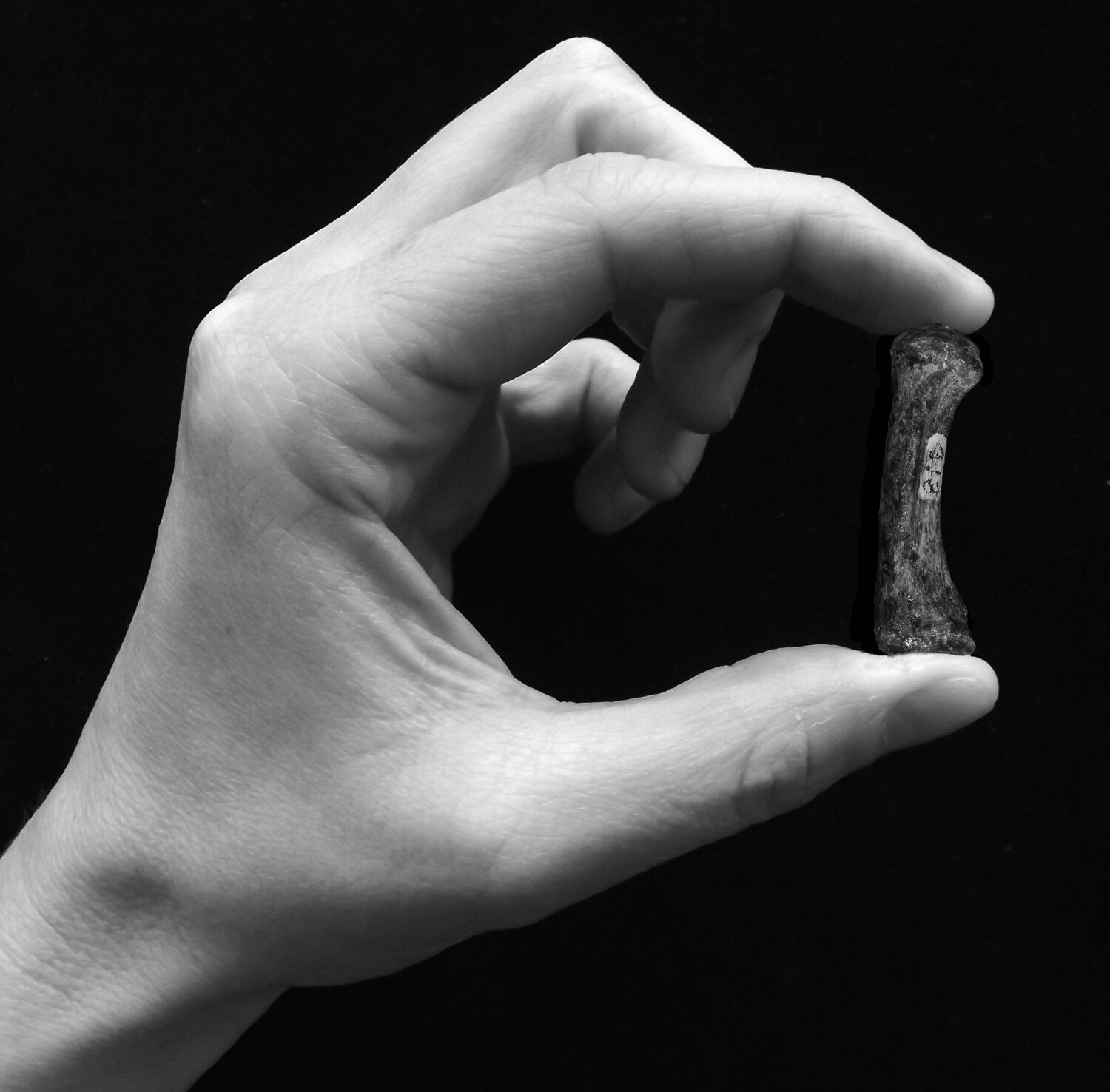
An example of a human precision grip — grasping a first metacarpal from the thumb of a specimen of Australopithecus africanus that's thought to be 2 to 3 million years old.

The special tool-wielding power of human hands may go back further in evolutionary history than scientists have thought.
That's according to a new study of hand bones from an early relative of humans calledAustralopithecus africanus. Researchers used a powerful X-ray technique to scan the interior of the bones, and they detected a telltale structure that's associated with a forceful precision grip.
"It's clear evidence that these australopiths were using their hands and using grips that are very consistent with what modern humans did and what our recent relatives like Neanderthals did," says Matthew Skinner, a paleoanthropologist at the University of Kent, in the United Kingdom. He was part of the team that published the new work online Thursday in Science.
Read the rest of this article...

Monday, January 19, 2015

Hinkley Point C excavations unearth bones from the Dark Ages

The burials date from the 7th Century

A Dark Ages cemetery and more than 100 burials has been unearthed at the site of a new nuclear power station.
The discovery is one of many by archaeologists who have spent years excavating ground where Hinkley Point C is being built in Somerset.
Flint tools dating from the Neolithic and Bronze Age periods and Roman building remains were also found.
All the results of the dig, which began in 2012, are being revealed in an exhibition at the Museum of Somerset.
Read the rest of this article...

Vikings: Raiders, Traders and Settlers (Online Course)


Vikings: Raiders, Traders and Settlers (Online Course)

Mon 26 Jan to Fri 17 Apr 2015

University of Oxford 

Department of Continuing Education

Further details...

Excavation plans for Exeter's Roman Baths


A set of "internationally significant" Roman Baths which lay hidden for almost 2,000 years could be opened to the public in a restoration project announced by Exeter Cathedral. 


The Roman Baths were discovered in 1971 after excavating  a Saxon burial ground [Credit: Exter Cathedral] 

The site was discovered in 1971 but due to a lack of funds was reburied under the cathedral green to protect it. 

A bid for £8.7m has now been submitted to the Heritage Lottery Fund (HLF). 

Roman archaeology specialist Dr Martin Pitts said the site "is of major significance". 

Read the rest of this article...

Stone Age artefacts found in Norway's melting glaciers


Around 7,000 years ago the Earth was enjoying a warm climate. Now glaciers and patches of perennial ice in the high mountains of Southern Norway have started to melt again, revealing ancient layers. 


A small knife with a wooden handle, probably from the Iron Age, was one of the  treasures found by archaeologists at the glacier Lendbreen in Oppland County,  Norway during the 2014 summer season [Credit: Oppland County] 

“Actually we should be slowly approaching a new ice age. But in the past 20 years we have witnessed artefacts turning up in summer from increasingly deeper layers of the glaciers,” says Lars Pilø. 

He is an archaeologist working for Oppland County, and has for many years done fieldwork in glaciers and ice patches, finding things our ancestors discarded or lost.

Read the rest of this article...

Sunday, January 18, 2015

Excavation plans for Exeter's Roman Baths

The Roman Baths were discovered in 1971 after excavating a Saxon burial ground

A set of "internationally significant" Roman Baths which lay hidden for almost 2,000 years could be opened to the public in a restoration project announced by Exeter Cathedral.
The site was discovered in 1971 but due to a lack of funds was reburied under the cathedral green to protect it.
A bid for £8.7m has now been submitted to the Heritage Lottery Fund (HLF).
Roman archaeology specialist Dr Martin Pitts said the site "is of major significance".
Read the rest of this article...

Viking blacksmith found buried with his tools


A well-stocked grave of a blacksmith from the Viking Age is one of the best finds in Norway last year, according to Norwegian archeologists. 


This was one of the tools found in the blacksmith's grave. The archeologists think  his contemporaries wanted to show how talented and versatile the blacksmith  was in his craft [Credit: Howell Roberts/University Museum of Bergen] 

Leif Arne Nordheim, who lives in Sogndalsdalen on Norway’s west coast, decided to do something about some flagstones in his garden that irritatingly refused to lie flat. When he removed the stones he caught sight of something made of iron. 

Brushing some of the objects off, he recognised them as a blacksmith’s hammer and tongs. 

Nordheim contacted the regional culture authorities but had not dreamed that the artefacts dated back to the early Viking Age.

Read the rest of this article...
Mysterious medieval fortifications buried in Poland detected with advanced imaging technology


Archaeologists have discovered evidence of unknown medieval fortifications which may indicate the presence of Hussite clashes near a small village in Poland.
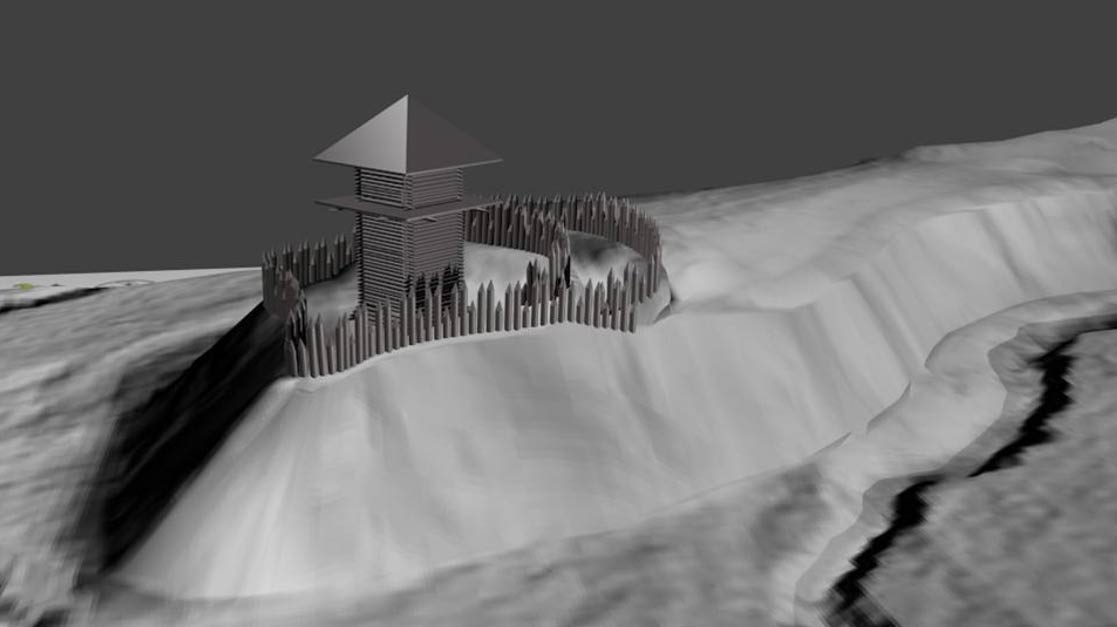
Discovered buried in wooded foothills near the village of Bieździadka in south-eastern Poland, the site was examined by archaeologists Joanna Pilszyk and Piotr Szmyd. Based on the report fromScience and Scholarship in Poland (PAP), the fortifications were discovered underground using sophisticated laser detection and aerial mapping.
The fort is to have sat on top of a plateau with steep sides, the sheer slope and height of over two meters (6.5 feet) naturally protecting the stronghold. Moats were believed to surround the site, and high fences or palisades are likely to have run along the perimeter. The age of the fort is not known, but researchers say it was probably built during the Middle Ages.
Read the rest of this article...

Friday, January 16, 2015

Bronze figure of Silenus found on Danish island


A bronze figure representing the Greek figure Silenus, from the time of Rome's first emperor, Augustus, has been found on the south-eastern Danish island of Falster. 


The 4.5 cm tall Roman bronze figure represents Silenus, a mythological creature based  on the Greek figure of the same name. The bronze figure was found recently on the  island of Falster and can be dated back to the time of the Roman emperor. Augustus. It is unknown how the figure ended up on a Danish island  [Credit: National Museum of Denmark] 

This find suggests that there was close contact between the Roman empire and Scandinavia, before and after the emperor's reign. 

A Roman on Falster 

The tiny bronze figure represents an elderly, bearded, balding man with thick lips and a plump nose. The find, just 4.5 cm tall, was found using a metal detector.

Read the rest of this article...

Stone Age man wasn't necessarily more advanced than the Neanderthals


A multi-purpose bone tool dating from the Neanderthal era has been discovered by University of Montreal researchers, throwing into question our current understanding of the evolution of human behaviour. It was found at an archaeological site in France. "This is the first time a multi-purpose bone tool from this period has been discovered. It proves that Neanderthals were able to understand the mechanical properties of bone and knew how to use it to make tools, abilities usually attributed to our species, Homo sapiens," said Luc Doyon of the university's Department of Anthropology, who participated in the digs. Neanderthals lived in Europe and western Asia in the Middle Paleolithic between around 250,000 to 28,000 years ago. Homo sapiens is the scientific term for modern man.
The production of bone tools by Neanderthals is open to debate. For much of the twentieth century, prehistoric experts were reluctant to recognize the ability of this species to incorporate materials like bone into their technological know-how and likewise their ability to master the techniques needed to work bone. However, over the past two decades, many clues indicate the use of hard materials from animals by Neanderthals. "Our discovery is an additional indicator of bone work by Neanderthals and helps put into question the linear view of the evolution of human behaviour," Doyon said.
Read the rest of this article...

"Extremely lucky" archaeologists find evidence of 15th century settlement near Northern Irish castle


Scientific dating leads archaeologists to "extremely exciting" early settlement near ruined 13th century castle


A post-excavation shot of the late 15th or early 16th century structure found near Dunluce Castle, showing the doorway in the corner
© DOE/NIEA

Archaeologists searching for a lost 17th century town say the remains of a fireplace, found in a field near a medieval Irish coastal castle, was part of a previously unknown settlement which could have been established 200 years earlier.

Radiocarbon dating from the clay floor of a structure, discovered by the Northern Ireland Environment Agency, suggests an earlier community could have lived in Dunluce during the late 15th and 16th centuries.

Read the rest of this article...

Recreating the ancient Greek drinking game Kottabos


Years before beer pong was invented, the ancient Greeks played kottabos to pass the time at symposia (drinking parties) where privileged men reclined on cushion couches and played the game that is found illustrated on ancient artworks. Women of fine society didn’t attend symposia but hetaires (courtesans) played the sloppy game where winners received all sorts of prizes, such as sweets and even sexual favours. 


Banqueter playing the kottabos game; kalos inscription in the name of Leagros.  Side A of the neck of an Attic red-figure neck-amphora, ca. 510 BC. From Vulci  [Credit: Marie-Lan Nguyen/WikiCommons] 

Assistant Art History Professor Heather Sharpe of West Chester University in Pennsylvania tried to recreate the game with her students. It wasn’t as easy as it appears “because we do have these illustrations of it, but they only show one part of the game – where individuals are about to flick some dregs at a target.”

Read the rest of this article...

Parasiteneier aus der Keltenzeit in Basel gefunden

Ei eines Spulwurms (Ascaris sp.) mit der typischen gewellten Membran. Foto: IPNA

In Proben aus der früheren keltischen Siedlung «Basel-Gasfabrik» sind Archäologen der Universität Basel bei Laboranalysen auf Eier von Darmparasiten gestossen – und schliessen damit auf eine mangelhafte Hygiene der damaligen Bevölkerung. Mittels spezieller Methoden der Geoarchäologie fanden sie drei verschiedene Parasitenarten, wie sie in der Fachzeitschrift «Journal of Archaeological Science» berichten.

Read the rest of this article...

Wednesday, January 14, 2015

Viking Artefacts


Viking Artefacts is an interesting blog run by Thomas Kamphaus.

He describes his interest as follows: 

"Why interested in vikings ?"

Well, I guess every man approching it's 40-ies has a right for developing a strange hobby. It thrills me more than the collecting of sugar sackets. 

Seriously: I have always been attached to history, and in general the period from 500 - 1200. The Frankish/merovingian period and then the viking period. Collecting artefacts just have seemed to pop up out of the blue . The viking craftmanship in several to considered styles I find very acctractive. Compared to the number of Roman artefacts p.e. the vikings - although excavated intensively the last 25/35 years - always stayed a sort of elusive and mysterious to us what sets them apart of other cultures.

You can find the blog here...

Monday, January 12, 2015

Mid-Norway Vikings among the first to sail to British Isles

Circular brooch from a woman’s grave in Nes, Bjung municipality. (Photo: Per Fredriksen, NTNU University Museum)

Archaeological findings show that Vikings from mid- and western Norway were among the first to make the trip to the British Isles.


Vikings living in Trøndelag, a region in the middle part of Norway, were among the first in Scandinavia to travel west. A new analysis of burial sites in Trøndelag from the year 800 and later undertaken by researchers at the NTNU University Museum is giving us a clearer image of who decided to stay in Norway, and who left to travel to the British Isles.
The burials sites examined contained a lot more foreign artefacts than previously believed, many of which coincide the first known Viking raids in Lindisfarne, England in 793.
Read the rest of this article...

Ancient Roman fort designed for celestial show


The gateways of an ancient Roman fort in Britain are roughly aligned with the light from the sun during the summer and winter solstices a design that would have resulted in a striking scene on the shortest and longest days of the year, a researcher says. 


The fort was constructed during the rule of Roman Emperor Hadrian (reign A.D. 117-138).  It was part of a system of fortifications that protected the frontier of Roman Britain  [Credit: PHB.cz (Richard Semik) | Shutterstock.com] 

The fort had four gateways facing one another. During the summer solstice, the sun would rise in alignment with the fort's northeastern and southwestern gates, and set in alignment with its northwestern and southeastern gates, the researcher reported in the new study. 

During the winter solstice, the sun would rise in line with the fort's southeastern and northwestern gates, and set in line with the fort's southwestern and northeastern gates.

Read the rest of this article...

Archéologie du château de Rodemack, la place-forte aux trois frontières


Les archéologues de l’Inrap fouillent le château de Rodemack, sur prescription de l’État (Drac Lorraine), dans le cadre de sa réhabilitation par la Communauté de communes de Cattenom et environs. Après une opération de quatre mois en 2013, cette seconde campagne de fouille qui démarre, durera jusqu’en octobre 2014. Elle concerne plusieurs zones du château, rénové au XIXe siècle, notamment son noyau originel des XIIe-XIIIe siècles, sur une emprise de 7 500 m2. Place-forte très convoitée, le château de Rodemack est implanté près de trois frontières, celles du duché du Luxembourg, des pays germaniques et du duché de Lorraine. L’archéologie permet de renouveler son histoire et de retracer notamment son riche passé militaire. 


Read the rest of this article...

THE BRONZE AGE SETTLEMENT OF AKROTIRI

THE BRONZE AGE SETTLEMENT OF AKROTIRI
ON THE ISLAND OF SANTORINI
a Lecture by
Michael Duigan
7.00 pm, Friday, 16th January

Activity Space 1, Clore Learning Centre
Museum of London, London Wall EC2Y 5HN

FREE TO EMAS MEMBERS . . . . . . £3:00 NON-MEMBERS

Would you be beautiful in the ancient world?


In ancient Greece the rules of beauty were all important. Things were good for men who were buff and glossy. And for women, fuller-figured redheads were in favour - but they had to contend with an ominous undercurrent, historian Bettany Hughes explains.
A full-lipped, cheek-chiselled man in Ancient Greece knew two things - that his beauty was a blessing (a gift of the gods no less) and that his perfect exterior hid an inner perfection. For the Greeks a beautiful body was considered direct evidence of a beautiful mind. They even had a word for it - kaloskagathos - which meant being gorgeous to look at, and hence being a good person.
Read the rest of this article...

Wednesday, December 17, 2014

Oldest Danish town possibly older


If you thought Ribe was the oldest town in Denmark, you're still right, but now a new study from Aarhus University shows the town may be almost 100 years older than originally thought.
Archaeologists previously believed that Ribe was established in the late 700s, but new research points to its establishment being in the earlier part of the same century, reports Videnskab.
Ribe, in southwest Jutland, is not only Denmark's oldest town, but is Scandinavia's oldest town as well.
”Ribe is the place urbanisation started in Scandinavia,” Sarah Croix, the study's author, told Videnskab. ”If Ribe began as a city in the early 700s, then it was long before the Vikings and thus casts new light on our understanding of this period.”
Read the rest of this article...

4,000 year old skeleton was likely a 'warrior chief'


A Bronze Age skeleton found buried in West Sussex with one of the earliest bronze daggers in the UK was probably a high-ranking warrior chief who died in combat, experts have said. 


James Kenny, site excavator and planning archaeologist at Chichester District Council,  views the skeleton known as Racton Man at the Novium Museum in Chichester, West Sussex  [Credit: Chichester District Council] 

The virtually-complete skeleton dating back more than 4,000 years was found on farmland in the hamlet of Racton, near Chichester, in 1989. 

Its background has long been a source of intrigue to historians as the skeleton - nicknamed Racton Man - was found with an extremely rare and valuable dagger. 

Read the rest of this article...

Une nécropole antique dans le quartier périphérique occidental de la ville de Saintes : plusieurs individus entravés, dont un enfant


De septembre à novembre 2014, une équipe d’archéologues de l’Inrap a mené, sur prescription de l’État (Drac Poitou-Charentes), une fouille préventive sur un terrain de 613 m2, dans le cadre de la construction d’une maison individuelle dans le quartier ouest de Saintes. Une première campagne de fouille réalisée en 2013 sur une parcelle contigüe avait mis en évidence la vocation funéraire de cet espace au cours de l’Antiquité. L’opération de cette année a permis la découverte d’une centaine de sépultures. 

Read the rest of this article...

Tuesday, December 09, 2014

Think again about the pillaging Viking warriors - it wasn't just the men who raided Britain


Viking colonisations of Europe may have been more like romantic getaways than drunken stag weekends, according to a study of Norse DNA showing the importance of women in the Scandinavian subjugation of the British Isles during the Middle Ages.

Scientists have found that Viking men took significant numbers of women with them in their longboats when they sailed to places such as the Scottish mainland, Shetland, Orkney and Iceland – contradicting the stereotype of male-only raiding parties with an unhealthy appetite for rape and pillage.

Researchers who analysed the genetic material – maternally inherited mitochondrial DNA extracted from 80 Viking skeletons unearthed in Norway – found that Norse women played a central role in the Viking settlements established in Britain and other parts of the North Atlantic.

Read the rest of this article...

Is the future for archaeological site information boards?


I have just watched the TED video by Matt Mills which demonstrates the amazing Aurasma Virtual Reality software.

The free, simple to use software allows a video to be displayed over a ‘target’ image.  For example, a photograph on an information board can be used to trigger a video overlay, allowing detailed, animated information to be bundled with a standard notice board.

You can find out more information, and download the software, at:


Monday, December 08, 2014

Giant Ancient Roman Water Basin Uncovered


Italian archaeologists have unearthed the largest Roman water basin ever found, right in the heart of modern Rome.

Found some 65 feet down near St. John in Lateran Basilica during the excavation of the new metro C line, the huge irrigation basin measures 115 feet by 230 feet.

“It’s so big that it goes beyond the perimeter of the metro work site. It has not been possible to uncover it completely,” Rossella Rea, the dig’s director, said at a news conference in Rome.

Photos: Ancient Water Basin Found in Rome

Rea, who led an all-woman team of archaeologists, noted the basin was lined with hydraulic plaster and most likely extends, still preserved, beyond the work site toward the ancient city walls.

Read the rest of this article...

Beer, Beef and Politics: Findings at Viking Archaeological Site Show Power Trumping Practicality


Vikings are stereotyped as raiders and traders, but those who settled in Iceland centuries ago spent more time producing and consuming booze and beef — in part to achieve political ambitions in an environment very different from their Scandinavian homeland, says a Baylor University archaeologist.

The seafaring warriors wanted to sustain the “big man” society of Scandinavia — a political economy in which chieftains hosted huge feasts of beer and beef served in great halls, says Davide Zori, Ph.D., a Denmark native and archeological field director in Iceland, who conducted National Science Foundation-funded research in archeology and medieval Viking literature.

But instead, what Zori and his team discovered is what happened when the Vikings spent too long living too high on the hog — or, in this case, the bovine.

"It was somewhat like the barbecue here. You wanted a big steak on the grill,” said Zori, assistant professor in the Baylor Interdisciplinary Core, who co-edited the book Viking Archaeology in Iceland: Mosfell Archaelogical Project with Jesse Byock, Ph.D., professor of Old Norse and medieval Scandinavian studies at the University of California, Los Angeles.

Read the rest of this article...
Major Viking Hall Identified in Sweden


A Viking feasting hall measuring almost 50 metres in length has been identified near Vadstena in Sweden. Archaeologists from Stockholm University and Umeå University used ground-penetrating radar, a non-invasive geophysical method, to locate and map the house foundation. The study was published today in the journal Archaeological Prospection.

The Aska barrow, where the hall has been found, was long seen as a burial mound. But archaeologists have now revealed that it is a foundation platform for a large building, most likely dating from the Viking Period. The hall was probably the home of a royal family whose rich graves have previously been excavated nearby.
“Parallels are known from several of the era's elite sites, such as Fornsigtuna near Stockholm and Lejre near Roskilde. The closest similarities are however seen in a recently excavated feasting hall at Old Uppsala near Stockholm. Such close correspondences suggest intensive communication between the two sites”, says Martin Rundkvist of Umeå University
Read the rest of this article...

Solid gold torc hidden in Celtic coin hoard


A Celtic coin hoard discovered on Jersey has been astounding archaeologists with a series of gold treasure finds. 


The Golden torc is bigger than any other ever found on Jersey  [Credit: © Jersey Heritage] 

For the past two weeks, Jersey Heritage's conservation team have been excavating an area known to contain gold jewellery. Late last week, one end of a solid gold torc was uncovered. 

The find comes after the discovery of two other solid gold torcs - one gold-plated and one of an unknown alloy - along with a silver brooch and a crushed sheet gold tube. But the latest artefact is considerably larger than anything previously unearthed on the island.

Read the rest of this article...

Une nécropole antique dans le quartier périphérique occidental de la ville de Saintes : plusieurs individus entravés, dont un enfant


De septembre à novembre 2014, une équipe d’archéologues de l’Inrap a mené, sur prescription de l’État (Drac Poitou-Charentes), une fouille préventive sur un terrain de 613 m2, dans le cadre de la construction d’une maison individuelle dans le quartier ouest de Saintes. Une première campagne de fouille réalisée en 2013 sur une parcelle contigüe avait mis en évidence la vocation funéraire de cet espace au cours de l’Antiquité. L’opération de cette année a permis la découverte d’une centaine de sépultures. 

Read the rest of this article...

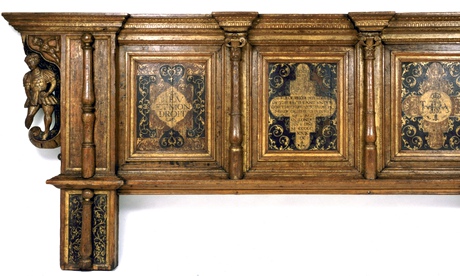
Headboard from bed of Henry VIII and Anne of Cleves on its way to London

Burrell Collection is sending Henry VIII's bedhead from the wedding night with Anne of Cleves to London over Christmas for a pop-up exhibition at Bonhams. Photograph: Guardian
It was a bed made both for lusty sex and for begetting chubby babies like the carved cherubs flying over the heads of the couple depicted on the headboard – a man with bulging codpiece and a woman with meek, downcast eyes holding the phallic symbols of a sword and a serpent.
But if the symbolism was intended to encourage the young Anne of Cleves and the middle-aged Henry VIII to get on with the task in hand on their wedding night in January 1540, it failed miserably.
Anne later said they had played cards in the bed, and told a lady-in-waiting that her husband was a perfect gentleman, giving her a greeting and a chaste kiss each night and before he left her in the morning. The appalled woman told the queen he’d have to do a lot more if they were to conceive the male heir that was the purpose of the marriage.
Read the rest of this article...
Wednesday, December 03, 2014

Gardener unearths Anglo-Saxon carving in job lot of rockery stone


Looking for some natural stone for a rockery in his garden, John Wyatt thought he had found a bargain when he saw a job lot advertised for £50.
He was more right than he knew. For when he took the ton and a half of rock home he discovered that it contained an ancient stone carving worth thousands of pounds.
Mr Wyatt, 32, was cleaning mud and moss off the pieces when he spotted one with a Celtic cross carved on one side and a mythical birdlike beast on the other.
He had the 21 by 15in piece examined by an expert, who told him it dated from Anglo-Saxon times.
Read the rest of this article...

Richard III's DNA throws up infidelity surprise


Analysis of DNA from Richard III has thrown up a surprise: evidence of infidelity in his family tree.
Scientists who studied genetic material from remains found in a Leicester car park say the finding might have profound historical implications.
Depending on where in the family tree it occurred, it could cast doubt on the Tudor claim to the English throne or, indeed, on Richard's.
The study is published in the journal Nature Communications.
Read the rest of this article...

When the body of Richard III was discovered in a car park in Leicester in 2012 archaeologists knew it was a momentous find.
But little did they realise that it might expose the skeletons in the cupboard of the British aristocracy, and even call into question the bloodline of the Royal family.
In order to prove that the skeleton really was Richard III, scientists needed to take a DNA sample and match it to his descendants.
Genetic testing through his maternal DNA proved conclusively that the body was the King. However, when they checked the male line they discovered something odd. The DNA did not match showing that at some point in history an adulterous affair had broken the paternal chain.
Read the rest of this article...

Questions raised over Queen’s ancestry after DNA test on Richard III’s cousins


Kevin Schurer and Turi King of the University of Leicester explain that a DNA analysis and other evidence confirms with almost 100% certainty that the bones are those of King Richard III. Video: University of Leicester
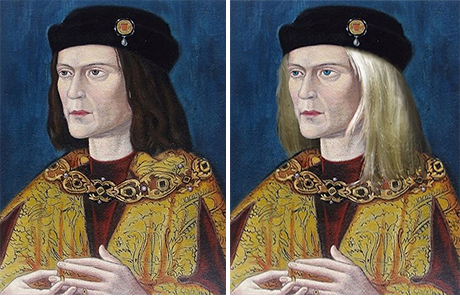
The bones of the king under the car park have delivered further shocks, 527 years after his death and more than two years after his remains were discovered in Leicester: Richard III was a blue-eyed blond, and the present Queen may not be descended from John of Gaunt and Edward III, the lineage on which the Tudor claim to the throne originated.
Five anonymous living donors, all members of the extended family of the present Duke of Beaufort, who claim descent from both the Plantagenets and Tudors through the children of John of Gaunt, gave DNA samples which should have matched Y chromosomes extracted from Richard’s bones. But none did.
Read the rest of this article...

Old Sarum archaeologists reveal plan of medieval city


The inner and outer baileys of the Old Sarum Iron Age fort were surveyed

The latest scanning techniques were used to uncover a network of buildings at the 11th Century Old Sarum near Salisbury in Wiltshire.

The results include a series of large structures, possibly defences, with open areas of ground behind possibly for mustering resources or people.

Old Sarum was the original site of Salisbury, which is two miles away.

Read the rest of this article...