Thursday, April 18, 2013

Mary Rose reveals armour piercing cannonball secret


She was first raised from her underwater resting place more than 30 years ago and has been prized as an archaeological gem, but it appears the she still has some secrets to surrender.
A Mary Rose cannon ball showing a hole in the lead coating where the iron inclusion has oxidised and left a hollow in the centre of the cannon ball
Scientists studying Henry VIII’s naval flagship, which sank 468 years ago off the south coast of England in a battle with the French, are making new discoveries about the vessel that will change our understanding of history.
New finds will be among 19,000 artefacts going on show in a new £23 million museum, built around the skeleton of the vessel, due to open later this year.

Read the rest of this article...

Iron Age warriors point to glories of Gaul

Cecile Paresys stands next to the bones of two Gauls, on a site in Bucheres, near Troyes, on April 11, 2013 (AFP, Francois Nascimbeni)


BUCHERES, France — In a muddy field located between a motorway and a meander of the Seine southeast of Paris, French archaeologists have uncovered an Iron Age graveyard that they believe will shed light on the great yet enigmatic civilisation of Gaul.
The site, earmarked for a warehouse project on the outskirts of Troyes, is yielding a stunning array of finds, including five Celtic warriors, whose weapons and adornments attest to membership of a powerful but long-lost elite.
Archaeologist Emilie Millet is crouched at one of 14 burial sites that have been uncovered in recent weeks.
At her feet are the remains of a tall warrior, complete with a 70-centimetre (28-inch) iron sword still in its scabbard.

Read the rest of this article...

A flair for imperfections

A flair for imperfections


The axe from Hundvåg is damaged by a succession of failed strokes in both edge and body, suggesting that it was sculpted by an unskilled knapper, probably a child. Credit: Terje Tveit, Archeological Museum, UiS 

To most people, a useless flint axe is just that. To archaeologist Sigrid Alræk Dugstad, it is a source of information about Stone Age children.


Whereas arrowheads, axes and other formal tools have traditionally received a lot of attention in research, the archaeologist Sigrid Alræk Dugstad now concentrates on what is at the bottom of the hierarchy, namely the production debris and the unfinished and discarded products. 

In the article "Early child caught knapping: A novice early Mesolithic flintknapper in southwestern Norway," she has turned upside down the hierarchy of objects from the Early Stone Age. 

"A succession of failed strokes, terminating in many hinge and step fractures, indicates that axe was made by a novice flintknapper, probably a child," Dugstad says.

Read the rest of this article...

Archaeologists uncover medieval murder mystery


A 600-year-old body found by archaeologists excavating the crannog site in Co Fermanagh may have been the victim of an ancient murder mystery, it has emerged.
Archaeologists uncover medieval murder mystery
A handout photo of the 600-year-old body found by archaeologists excavating
the crannog site in Co Fermanagh [Credit: PA]
The fact the woman, who was in her late teens when she died, was not buried in either a recognised graveyard or in traditional manner has led archaeologists to consider foul play.

Excavation director Dr Nora Bermingham dated the teenager’s death to around the 15th or 16th centuries.

“The skeleton of a young woman, probably around 18 or 19 with very bad teeth, was found in the upper layers of the crannog,” she said.


Read the rest of this article...

Officials, police inspect Pompeii excavations


The Italian government's anti-mafia directorate and police on Tuesday carried out raids at the world-famous archaeological site of Pompeii, which Rome and the European Union has granted 105 million euros to restore.

Officials, police inspect Pompeii excavations

The checks were ordered by the government's top representative in nearby Naples, Francesco Musolino, to inspect progress on restoration of the House of the Guilt Cupids, the House of the Great Fountain and the Fullonica of Stephanus laundry.

Italian authorities fear that the EU's pricey 'Grand Plan for Pompeii' initiative to prevent the Unesco World Heritage site from crumbling could be infilitrated by organised crime groups and subject to fraud.


Read the rest of this article...

Wednesday, April 17, 2013

Photos from the EMAS Archaeological Study Tour


Photos from the EMAS 2013 Archaeological Study Tour are now online at:

http://archeurope.smugmug.com/Category/Study-Tour-to-Yorkshire-2013/28811407_HfHdDk#!i=2446486475&k=4L4SQbw

You can find out more about EMAS here...

Study backs 'hobbit' island dwarfism theory


How an ancient human species may have shrunk as a result of island dwarfism
A diminutive species of human whose remains were found on the Indonesian island of Flores could have shrunk as a result of island dwarfism as it adapted to its environment.
A study of the remains of the creature, nicknamed the "hobbit", shows that it is possible for it to have been a dwarf version of an early human species.
The hobbit co-existed with our species until 12,000 years ago.
The research has been published in the Royal Society's Proceedings B Journal.
Since its discovery in 2003, researchers have struggled to explain the origins of these metre high, tiny-brained people, known scientifically asHomo floresiensis.

Read the rest of this article...

Monday, April 15, 2013

Gaul warriors unearthed at 2,300-year-old site


French archaeologists have unearthed the graves of several Gaul warriors dating back around 2300 years, at the site of a huge business park development near the city of Troyes in central France.
Gaul warriors unearthed at 2,300-year-old site
One of the 2300 year old graves unearthed near the city of Troyes [Credit: The Local]
Archaeologists from the National Institute for Preventive Archaeological Research (Inrap) have been carrying out excavations at the site near Buchères over the course of recent years.

But even they were surprised by their latest discovery at the 260-hectare site, which is set to become the Aube Logistical Park.

Around 30 graves dating back to between 260 and 325 BC were identified at the site, with around half being excavated, revealing the remains of Gaul warriors, with weapons and shields in hand. Women are buried alongside them.


Read the rest of this article...

Northampton Castle dig reveals Saxon past


A "rare" Saxon brooch, a medieval harness, pottery and animal bones are among items found by archaeologists at Northampton's medieval castle site.A survey of the land is taking place ahead of work to build a new £20m railway station in the town.
Northampton Castle dig reveals Saxon past
Excavation work in Northampton [Credit: ITV News Anglia]
Tim Upson-Smith, from Northamptonshire Archaeology, said the team had discovered elements of the site's Victorian, medieval and Saxon past. He said he hoped the finds could be displayed in the new station.

Archaeologists are expected to remain at the site on Black Lion Hill for eight weeks before West Northamptonshire Development Corporation (WNDC) can begin work on the first phase of the new station.


Read the rest of this article...

Friday, April 12, 2013

'Pompeii of north' being unearthed in London


Archaeologists working on a site in London are calling it "the Pompeii of the north" after they have managed to find Roman artefacts dating back nearly 2,000 years.
Just yards from the River Thames, in what is now the capital's financial district, archaeologists have found coins, pottery, shoes, lucky charms and an amber gladiator amulet.
Sonja Jessup has been finding out the secret to their remarkable survival.

Watch the video...

Unearthed Scots find gives insight into Battle of Flodden


Archaeologists have uncovered a new Scottish find which they hope will give greater insight into one of most important battles in British history.
The crown shaped livery badge
A crown shaped livery badge, thought to have been worn by a soldier in the personal retinue of King James IV, was discovered by archaeologists during a survey of the site of the Battle of Flodden.
The badge, which is believed to have been buried for five centuries, is made of copper alloy and appears to have been snapped off a hat band. Its design includes the Fleur de Lys with jewels and diamonds, elements which were part of the Scottish crown in 1513.
The Battle of Flodden was a turning point in UK history and set the stage for the subsequent Union of the Crowns between Scotland and England.

Murmillo magic


Amber amulet in the shape of a gladiator’s helmet. Amber was an expensive imported material and was thought to have magical powers. The Roman author Pliny describes how amber amulets could protect children from illness and the symbolism of the gladiator may also be protective  Image: MOLA
Amber amulet in the shape of a gladiator’s helmet. Amber was an expensive imported material and was thought to have magical powers. The Roman author Pliny describes how amber amulets could protect children from illness and the symbolism of the gladiator may also be protective
Image: MOLA
A tiny amber amulet shaped like a gladiator’s helmet has been discovered in the Walbrook area by Museum of London Archaeology (MOLA).
Measuring just over 1cm across, the object was found amongst the remains of a demolished Roman building, together with large amounts of pottery and animal bone. It is hoped that analysis of these will narrow down a possible date for the artefact.
Its distinctive visor and high crest marks it out as depicting part of the equipment of a murmillo, who wore a large enclosing helmet with a grille covering the face. Armed with a short sword or gladius and a rectangular shield called a scutum, he was normally paired against a thraex (Thracian).


Read the rest of this article...

Llantwit Major: Celtic crosses' new St Illtud's church home


Stones


Conservation work has been carried out on the stones before they are moved to their new home


Celtic crosses which are more than 1,000 years old are being moved into a new visitor centre in the Vale of Glamorgan.
The ancient stones will be housed in the refurbished 13th Century Galilee chapel at St Illtud's church in Llantwit Major.
It is part of a £750,000 project to tell the story of the church's role in developing Christianity across Wales.
The new visitor centre will open in June.
"We have some very ancient Celtic stone courses here which date from the 8th to 10th Century that need to be displayed properly, as we have many visitors to the church," said the Reverend Huw Butler, the rector at St Illtud.

Read the rest of this article...

The Hangman's Tale: Archaeologists Dig into History of Execution


Photo Gallery: Execution Site Archaeology in Germany
Photos
Ben Behnke/ DER SPIEGEL
For years, few were interested in unearthing what lay beneath old gallows and scaffolds. But, in Germany, growing interest in "execution site archaeology" is throwing much light on how the executed died and the executors lived.

Her interests initially focused on fashion, but then they migrated to murder and decay. Marita Genesis, 42, worked as a runway model for Escada after graduating from secondary school. Later, she studied ancient and early history, and learned about criminal law.

Now, the archaeologist is surrounded by criminals. She is standing in a storeroom belonging to the Thuringia State Office for the Preservation of Monuments and pointing at a number of bones. These are the remains of thieves, sodomites and child murderers.

Read the rest of this article...

Scientists Find Groundbreaking New Surprises in Examination of Early Human Ancestor


Scientists Find Groundbreaking New Surprises in Examination of Early Human Ancestor
It dominated science headlines when the news was first released. The discovery of the remains of a new species of ancient hominin (human ancestor) revealed a candidate that sported a mosaic of features both ape-like and human -- an unprecedented 2-million-year-old hybrid called Australopithecus sediba (Au. sediba). First stumbled upon in 2008 by Professor Lee Berger of the University of the Witwatersrand and his then 9-year-old son Matthew at the fossil bearing site of Malapa in South Africa, the finds, consisting of remarkably complete skeletal remains as well as other well-preserved fauna and flora, instantly became the subject of perhaps the most intense and thoroughly studied hominin fossils ever documented.
The team, led by Berger and composed of South African and international scientists from the Evolutionary Studies Institute (ESI) at the University of the Witwatersrand (Wits) and 16 other global institutions (totalling more than 100 researchers from around the world), recently examined the anatomy of Au. sediba based on its skeletons catalogued as "MH1" (a juvenile skeleton) and "MH2" (an adult female skeleton), as well as an adult isolated tibia catalogued as "MH4". The scientists have now completed what amounts to the second 2-year installment of a series of studies begun approximately four years ago, and the efforts of their research have resulted in additional new surprises. Dispersed among six separate studies, these latest examinations have determined in essence how the hominin walked, chewed and moved:

Read the rest of this article...

Ötzi the Iceman Needed a Dentist


CT Scan of Otzi the Iceman's teeth
Otzi the iceman, an astonishingly preserved Neolithic mummy found in the Alps in 1991, shows evidence of severe gum disease and cavities (shown in red).
CREDIT: UZH

Ötzi the Iceman could have used a dentist. The amazingly preserved Neolithic mummy found in the Italian Alps had tooth decay, gum disease and dental trauma, new research suggests.

The new findings, published Tuesday (April 9) in the European Journal of Oral Sciences, suggest that theIceman mummy's grain-heavy diet took a toll on his dental health.
"It's surprising how bad condition he is in," said study co-author Frank Ruhli, a paleopathologist at the University of Zurich in Switzerland. "We have the whole range of disease pathologies you can imagine." [Album: What Otzi the Iceman Looked Like]


Read the rest of this article...

Pottery reveals Ice Age hunter-gatherers' taste for fish


Hunter-gatherers living in glacial conditions produced pots for cooking fish, according to the findings of a pioneering new study led by the University of York which reports the earliest direct evidence for the use of ceramic vessels.
Pottery reveals Ice Age hunter-gatherers' taste for fish
An Incipient Jomon pot from Kubodera-minami, Niigata Prefecture, Japan
ca. 15,000 years old [Credit: Tokamchi City Museum]
Scientists from the UK, the Netherlands, Sweden and Japan carried out chemical analysis of food residues in pottery up to 15,000 years old from the late glacial period, the oldest pottery so far investigated. It is the first study to directly address the often posed question "why humans made pots?" Theresearch is published in Nature.

The research team was able to determine the use of a range of hunter-gatherer "Jōmon" ceramic vessels through chemical analysis of organic compounds extracted from charred surface deposits. The samples analysed are some of the earliest found in Japan, a country recognised to be one of the first centres for ceramic innovation, and date to the end of the Late Pleistocene -- a time when humans were adjusting to changing climates and new environments.


Read the rest of this article...

'Entire streets' of Roman London uncovered


An archaeological dig in the heart of the City "will transform our understanding" of Roman London, experts claim.

About 10,000 finds have been discovered, including writing tablets and good luck charms.The area has been dubbed the "Pompeii of the north" due to the perfect preservation of organic artefacts such as leather and wood.One expert said: "This is the site that we have been dreaming of for 20 years."
'Entire streets' of Roman London uncovered
The site is providing fresh insight into the religious and mystical practices of London's early residents. Amber was an expensive imported material and was thought to have magical powers and this amulet, in the shape of a gladiator’s helmet, may have been used to protect children from illness [Credit: Museum of London Archseology]
Archaeologists expect the finds, at the three-acre site, to provide the earliest foundation date for Roman London, currently AD 47. The site will house media corporation Bloomberg's European headquarters.

It contains the bed of the Walbrook, one of the "lost" rivers of London, and features built-up soil waterfronts and timber structures, including a complex Roman drainage system used to discharge waste from industrial buildings.

Read the rest of this article...

Team reconstructs 'human ancestor'


Australopithecus sediba


The researchers were able reconstruct the species using bones from three different individuals

The most complete view yet of a possible human ancestor uncovered in South Africa has revealed an intriguing mix of human and ape traits.

The two-million-year-old remains of several partial skeletons belonging to a previously unknown humanlike species were found in 2008 near Johannesburg.

The new analysis shows this species -Australopithecus sediba - had a human-like pelvis, hands and teeth, and a chimpanzee-like foot.

The findings appear in Science journal.

In six separate research reports, scientists probed further into the anatomy of a juvenile male skeleton, commonly referred to as MH1, a female skeleton, known as MH2, and an isolated adult tibia or shinbone, known as MH4.

Northampton Castle dig reveals Saxon past


A "rare" Saxon brooch, a medieval harness, pottery and animal bones are among items found by archaeologists at Northampton's medieval castle site.A survey of the land is taking place ahead of work to build a new £20m railway station in the town.
Northampton Castle dig reveals Saxon past
Excavation work in Northampton [Credit: ITV News Anglia]
Tim Upson-Smith, from Northamptonshire Archaeology, said the team had discovered elements of the site's Victorian, medieval and Saxon past. He said he hoped the finds could be displayed in the new station.

Archaeologists are expected to remain at the site on Black Lion Hill for eight weeks before West Northamptonshire Development Corporation (WNDC) can begin work on the first phase of the new station.


Read the rest of this article...

Grabungen am Danewerk gehen weiter


Ausgrabungen am Danewerk. © ALSH


Das Museum Sønderjylland hat von dem dänischen Fond  A.P. Møller og hustru Chastine Mc-Kinney Møllers Fond til almene Formaal eine großzügige Bewilligung in Höhe von gut 300.000 Euro zur Durchführung eines gemeinsamen deutsch-dänischen Ausgrabungs- und Forschungsprojektes erhalten, das die Untersuchungen, die das Archäologische Landesamt Schleswig–Holstein in den Jahren 2010 und 2011 durchführte, weiterführen und abschließen soll.

Read the rest of this article...

Terahertz scanner reveals hidden fresco at Louvre

Fresco (Trois hommes armes de lances) and terahertz scan

#A technique based on the same kind of technology used in airport scanners has revealed images beneath a fresco held at the Louvre museum in Paris.
Trois Hommes Armes de Lances was known to be a fresco forged by Giampetro Campana on a wall from Roman times.
The new research suggests that under that forgery lies a real Roman fresco.
The discovery was announced at the American Chemical Society meeting by Bianca Jackson of the University of Rochester in the US.
Terahertz waves are known for their ability to penetrate materials without damaging them, and have in recent years been added to the suite of tools used to examine items of cultural heritage.

Read the rest of this article...

Tuesday, April 09, 2013

Robes and Shovels: Medieval Monks Cultivated Wetlands


The excavation of foundations of medieval monastery buildings;
there was no sign of the foundations at the surface.

CREDIT: © Ghent University, Philippe De Smed


A medieval monastery in Belgium went to major effort to drain wetlands on its land, building structures on artificially raised soil, a new study finds.

Archaeologists excavated the Boudelo Abbey, once part of the medieval county of Flanders, in the 1970s. Until now, however, they had no idea that an extensive drained wetland surrounded the site. 

"They placed these abbeys in all sorts of marginal areas to cultivate," said study researcher Philippe De Smedt, a soil scientist at Ghent University in Belgium. In the High Middle Ages between the 12th and 14th centuries, Europe's population was growing, De Smedt told LiveScience. Monk labor provided a solution to the crowding by making the land livable.


Read the rest of this article...

Sunday, April 07, 2013

DigVenturesheader Crowdfunding the past: is this the future of archaeology?


The rise of crowdfunding in the United Kingdom has taken another step forward as UK-based DigVentures launches the world’s first archaeology crowdfunding platform.

DigVentures was started in 2012 as a response to the dwindling of traditional sources of funding for archaeology. The organisation’s ‘social contract archaeology’ model is a whole new way of funding archaeology, which puts the public in the driver’s seat as both the funders, as well as the participants in excavations.

Crowdfunding is an increasingly popular way of funding projects through multiple, often small, ‘grass roots’ investments, helping to finance innovative projects from widgets to movies, music, public spaces and even medical care. This alternative funding model appears to be here to stay, with estimates predicting it to be a $6bn worldwide industry in 2013.

Platform specifically for archaeology and heritage

Crowdfunding has historically been associated with generalist platforms like Kickstarter and Indie-go-go. However, now, for the first time, archaeologists have access to a crowdfunding platform specifically designed to meet not only their funding needs, but also provide consultancy on how to build and sustain a successful crowdfunding campaign.

According to the managing director of  Dig Ventures, Lisa Westcott Wilkins,”Crowdfunding is a perfect solution for archaeological projects that need funding, but that are also committed to sustainability. Raising funds through our platform isn’t just a quick fix – it will put projects directly in touch with an international community of interested consumers.”


Read the rest of this article...

Cologne Archeological Dig Revives Ancient Jewish Heritage


After long being sidelined for Roman excavations, an archaeological dig in western Germany has unearthed myriad traces of daily life in one of Europe's oldest and largest Jewish communities.


From ceramic dishes and tools to toys, animal bones and jewelry, some 250,000 artifacts have so far shed light on various periods in 2,000 years of the city of Cologne's history, the AFP news agency reported.


But plans to display the findings, discovered since 2007 by head archaeologist Sven Schuette's team at the 32,800 square-foot (10,000 square-meter) city centre dig, in a new museum have proved divisive.


Just over 260 miles (400 kilometers) away, Berlin already hosts a large Jewish museum, and critics argue that Cologne cannot afford a new cultural project when its financiers are already in the red.


Read the rest of this article...

Investigating Bronze Age stone ships on Gotland

Ship Stones in Gannarve, Gotland. Image: Jerzy Kociatkiewicz 
(Flickr, used under a CC BY-SA 3.0)


In the middle of the Bronze Age, around 1000 BCE, the quantity of metal artefacts traded in the Baltic Sea region increased dramatically. Around that same time, a new type of monument appeared along the coasts; stones set on edge and arranged in the form of ships, built by the maritime culture involved in that same metal trade.

A wide maritime network

These Bronze Age maritime groups were part of a network that extended across large parts of northern Europe and with links further to the south: a network maintained due to the increasing dependence on bronze and other important raw materials as a means of social status and cultural dependency.

Archaeologists have long assumed that bronze was imported to Scandinavia from the south, and recent analyses has now confirmed this hypothesis. However, the people who conducted the trade and formed the networks are rarely addressed, not to mention the locations of where they met.

‘One reason why the meeting places of the Bronze Age are not discussed very often is that we have been unable to find them. Which is in contrast to the trading centres of the [later] Viking Age, which have been easy to locate due to the wealth of archaeological material that was left behind,’ says the author of the thesis Joakim Wehlin from the University of Gothenburg and Gotland University.


Read the rest of this article...

Ancient monument 'damaged by cattle'


One of the Westcountry's most famous archaeological landmarks is being threatened by grazing cattle permitted by the Government's environment watchdog, campaigners have warned.

The Bronze Age stone monument, known as Men-an-Tol, has stood near Morvah, in West Cornwall, for up to 4,500 years.


It is listed as a scheduled monument with English Heritage describing it as "one of the most famous and mysterious" in Cornwall.

But campaigners fear it is now being damaged by cattle introduced onto the heathland under a Natural England agri-environmental scheme.


Read the rest of this article...

Unmarked grave dug up in hunt for England's King Alfred the Great


Archaeologists dug up an unmarked grave in a quiet English churchyard in search of remains of King Alfred the Great, a ninth century monarch credited with fending off the Vikings.

The exhumation was apparently triggered by fears that interest over the recent discovery of the skeleton of Richard III could lead grave robbers to dig the area for his bones.

Alfred the Great is known to generations of schoolchildren through a popular legend that tells of his scolding by a peasant woman for letting her cakes burn while he watched over them.

He was at the time preoccupied with the problem of how to repel the Danes, who had captured swaths of Anglo-Saxon England.


Read the rest of this article...

First Love Child of Human, Neanderthal Found


The skeletal remains of an individual living in northern Italy 40,000-30,000 years ago are believed to be that of a human/Neanderthal hybrid, according to a paper in PLoS ONE.

If further analysis proves the theory correct, the remains belonged to the first known such hybrid, providing direct evidence that humans and Neanderthals interbred. Prior genetic research determined the DNA of people with European and Asian ancestry is 1 to 4 percent Neanderthal.

The present study focuses on the individual’s jaw, which was unearthed at a rock-shelter called Riparo di Mezzena in the Monti Lessini region of Italy. Both Neanderthals and modern humans inhabited Europe at the time.


Read the rest of this article...

The Vengeance of Ivarr the Boneless


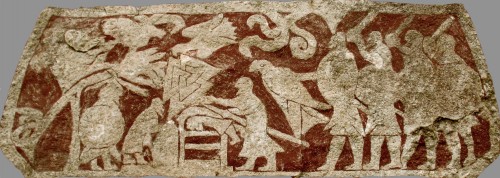
A section from the Stora Hammars I stone, preserved at Gotland in Sweden. The carving seems to show a victim about to be cut open from the back; a bird of prey appears behind him. It has been suggested that this depicts the rite of the blood eagle. Image: Wikicommons.

Ninth-century Scandinavia has had good press in recent years. As late as the 1950s, when Kirk Douglas filmed his notorious clunker The Vikings—a movie that featured lashings of fire and pillage, not to mention Tony Curtis clad in an ahistorical and buttocks-skimming leather jerkin—most popular histories still cast the Denmark and Norway of the Dark Ages as nations overflowing with bloodthirsty warriors who were much given to horned helmets and drunken ax-throwing contests. If they weren’t worshiping the pagan gods of Asgard, these Vikings were sailing their longships up rivers to sack monasteries while ravishing virgins and working themselves into beserker rages.

Since the early 1960s, though—we can date the beginning of the change to the publication of Peter Sawyer’s influential The Age of the Vikings (1962)—rehabilitation has been almost complete. Today, the early Viking age has become the subject of a History Channel drama, and historians are likely to stress that the Vikings were traders and settlers, not rapists and killers. The Scandinavians’ achievements have been lauded—they sailed all the way to America and produced the Lewis Chessmen—and nowadays some scholars go so far as to portray them as agents of economic stimulus, occasional victims of their more numerous enemies, or even (as a recent campaign organized by the University of Cambridge suggested) men who “preferred male grooming to pillaging,” carrying around ear spoons to remove surplus wax. To quote the archaeologist Francis Pryor, they “integrated into community life” and “joined the property-owning classes” in the countries they invaded.


Read the rest of this article...

Bronze warship ram reveals secrets


Analysis of a bronze battering ram from a 2,000 year-old warship sheds light on how such an object would have been made in ancient times.

Known as the Belgammel Ram, the 20kg artefact was discovered by a group of British divers off the coast of Libya near Tobruk in 1964. The ram is from a small Greek or Roman warship – a “tesseraria”. These ships were equipped with massive bronze rams on the bow at the waterline and were used for ramming the side timbers of enemy ships. At 65cm long, the Belgammel Ram is smaller in size and would have been sited on the upper level on the bow. This second ram is known as a proembolion, which strengthened the bow and also served to break the oars of an enemy ship.

Leading marine archaeologist, Dr Nic Flemming a visiting fellow of the National Oceanography Centre, co-ordinated a team of specialists from five institutes to analyse the artefact before it was returned to the National Museum in Tripoli in May 2010. Their results have been published in the International Journal of Nautical Archaeology.

Dr Flemming said: “Casting a large alloy object weighing more than 20kg is not easy. To find out how it was done we needed specialists who could analyse the mix of metals in the alloys; experts who could study the internal crystal structure and the distribution of gas bubbles; and scholars who could examine the classical literature and other known examples of bronze castings.


Read the rest of this article...
Crowdsourcing the search for some missing royalty


Last August, archaeologists raised a goblet of mead in celebration when the skeleton of Richard III was unearthed under a carpark in Leicester. Now, an Irish team of archaeologists are hoping to find an ancestor of Richard III – in a patch of waste ground in Trim, Co Meath, just behind the local supermarket.

Beneath this four-acre rectangle of scrubby grass, bordered by a housing estate, lie the foundations of a 13th-century Dominican blackfriary, and a team of have been excavating the site, which contains many skeletons. They hope that one of these may be skeleton of sir Geoffrey de Geneville, a French nobleman who founded the friary.

Okay, he wasn’t a monarch, but he was well in with both king Henry III and his successor, king Edward I, and was appointed lord of Trim in 1252 and justiciar of Ireland in 1273. He and his wife, Maud de Lacy, the granddaughter of Walter de Lacy, lived at nearby Trim castle and were quite the power couple around medieval Meath. After Maud’s death in 1304, de Geneville retired to the friary, and is believed to have been buried there.


Read the rest of this article...