Friday, April 12, 2013

Terahertz scanner reveals hidden fresco at Louvre

Fresco (Trois hommes armes de lances) and terahertz scan

#A technique based on the same kind of technology used in airport scanners has revealed images beneath a fresco held at the Louvre museum in Paris.
Trois Hommes Armes de Lances was known to be a fresco forged by Giampetro Campana on a wall from Roman times.
The new research suggests that under that forgery lies a real Roman fresco.
The discovery was announced at the American Chemical Society meeting by Bianca Jackson of the University of Rochester in the US.
Terahertz waves are known for their ability to penetrate materials without damaging them, and have in recent years been added to the suite of tools used to examine items of cultural heritage.

Read the rest of this article...

Tuesday, April 09, 2013

Robes and Shovels: Medieval Monks Cultivated Wetlands


The excavation of foundations of medieval monastery buildings;
there was no sign of the foundations at the surface.

CREDIT: © Ghent University, Philippe De Smed


A medieval monastery in Belgium went to major effort to drain wetlands on its land, building structures on artificially raised soil, a new study finds.

Archaeologists excavated the Boudelo Abbey, once part of the medieval county of Flanders, in the 1970s. Until now, however, they had no idea that an extensive drained wetland surrounded the site. 

"They placed these abbeys in all sorts of marginal areas to cultivate," said study researcher Philippe De Smedt, a soil scientist at Ghent University in Belgium. In the High Middle Ages between the 12th and 14th centuries, Europe's population was growing, De Smedt told LiveScience. Monk labor provided a solution to the crowding by making the land livable.


Read the rest of this article...

Sunday, April 07, 2013

DigVenturesheader Crowdfunding the past: is this the future of archaeology?


The rise of crowdfunding in the United Kingdom has taken another step forward as UK-based DigVentures launches the world’s first archaeology crowdfunding platform.

DigVentures was started in 2012 as a response to the dwindling of traditional sources of funding for archaeology. The organisation’s ‘social contract archaeology’ model is a whole new way of funding archaeology, which puts the public in the driver’s seat as both the funders, as well as the participants in excavations.

Crowdfunding is an increasingly popular way of funding projects through multiple, often small, ‘grass roots’ investments, helping to finance innovative projects from widgets to movies, music, public spaces and even medical care. This alternative funding model appears to be here to stay, with estimates predicting it to be a $6bn worldwide industry in 2013.

Platform specifically for archaeology and heritage

Crowdfunding has historically been associated with generalist platforms like Kickstarter and Indie-go-go. However, now, for the first time, archaeologists have access to a crowdfunding platform specifically designed to meet not only their funding needs, but also provide consultancy on how to build and sustain a successful crowdfunding campaign.

According to the managing director of  Dig Ventures, Lisa Westcott Wilkins,”Crowdfunding is a perfect solution for archaeological projects that need funding, but that are also committed to sustainability. Raising funds through our platform isn’t just a quick fix – it will put projects directly in touch with an international community of interested consumers.”


Read the rest of this article...

Cologne Archeological Dig Revives Ancient Jewish Heritage


After long being sidelined for Roman excavations, an archaeological dig in western Germany has unearthed myriad traces of daily life in one of Europe's oldest and largest Jewish communities.


From ceramic dishes and tools to toys, animal bones and jewelry, some 250,000 artifacts have so far shed light on various periods in 2,000 years of the city of Cologne's history, the AFP news agency reported.


But plans to display the findings, discovered since 2007 by head archaeologist Sven Schuette's team at the 32,800 square-foot (10,000 square-meter) city centre dig, in a new museum have proved divisive.


Just over 260 miles (400 kilometers) away, Berlin already hosts a large Jewish museum, and critics argue that Cologne cannot afford a new cultural project when its financiers are already in the red.


Read the rest of this article...

Investigating Bronze Age stone ships on Gotland

Ship Stones in Gannarve, Gotland. Image: Jerzy Kociatkiewicz 
(Flickr, used under a CC BY-SA 3.0)


In the middle of the Bronze Age, around 1000 BCE, the quantity of metal artefacts traded in the Baltic Sea region increased dramatically. Around that same time, a new type of monument appeared along the coasts; stones set on edge and arranged in the form of ships, built by the maritime culture involved in that same metal trade.

A wide maritime network

These Bronze Age maritime groups were part of a network that extended across large parts of northern Europe and with links further to the south: a network maintained due to the increasing dependence on bronze and other important raw materials as a means of social status and cultural dependency.

Archaeologists have long assumed that bronze was imported to Scandinavia from the south, and recent analyses has now confirmed this hypothesis. However, the people who conducted the trade and formed the networks are rarely addressed, not to mention the locations of where they met.

‘One reason why the meeting places of the Bronze Age are not discussed very often is that we have been unable to find them. Which is in contrast to the trading centres of the [later] Viking Age, which have been easy to locate due to the wealth of archaeological material that was left behind,’ says the author of the thesis Joakim Wehlin from the University of Gothenburg and Gotland University.


Read the rest of this article...

Ancient monument 'damaged by cattle'


One of the Westcountry's most famous archaeological landmarks is being threatened by grazing cattle permitted by the Government's environment watchdog, campaigners have warned.

The Bronze Age stone monument, known as Men-an-Tol, has stood near Morvah, in West Cornwall, for up to 4,500 years.


It is listed as a scheduled monument with English Heritage describing it as "one of the most famous and mysterious" in Cornwall.

But campaigners fear it is now being damaged by cattle introduced onto the heathland under a Natural England agri-environmental scheme.


Read the rest of this article...
Unmarked grave dug up in hunt for England's King Alfred the Great


Archaeologists dug up an unmarked grave in a quiet English churchyard in search of remains of King Alfred the Great, a ninth century monarch credited with fending off the Vikings.

The exhumation was apparently triggered by fears that interest over the recent discovery of the skeleton of Richard III could lead grave robbers to dig the area for his bones.

Alfred the Great is known to generations of schoolchildren through a popular legend that tells of his scolding by a peasant woman for letting her cakes burn while he watched over them.

He was at the time preoccupied with the problem of how to repel the Danes, who had captured swaths of Anglo-Saxon England.


Read the rest of this article...

First Love Child of Human, Neanderthal Found


The skeletal remains of an individual living in northern Italy 40,000-30,000 years ago are believed to be that of a human/Neanderthal hybrid, according to a paper in PLoS ONE.

If further analysis proves the theory correct, the remains belonged to the first known such hybrid, providing direct evidence that humans and Neanderthals interbred. Prior genetic research determined the DNA of people with European and Asian ancestry is 1 to 4 percent Neanderthal.

The present study focuses on the individual’s jaw, which was unearthed at a rock-shelter called Riparo di Mezzena in the Monti Lessini region of Italy. Both Neanderthals and modern humans inhabited Europe at the time.


Read the rest of this article...

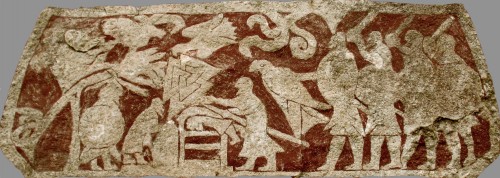
The Vengeance of Ivarr the Boneless


A section from the Stora Hammars I stone, preserved at Gotland in Sweden. The carving seems to show a victim about to be cut open from the back; a bird of prey appears behind him. It has been suggested that this depicts the rite of the blood eagle. Image: Wikicommons.

Ninth-century Scandinavia has had good press in recent years. As late as the 1950s, when Kirk Douglas filmed his notorious clunker The Vikings—a movie that featured lashings of fire and pillage, not to mention Tony Curtis clad in an ahistorical and buttocks-skimming leather jerkin—most popular histories still cast the Denmark and Norway of the Dark Ages as nations overflowing with bloodthirsty warriors who were much given to horned helmets and drunken ax-throwing contests. If they weren’t worshiping the pagan gods of Asgard, these Vikings were sailing their longships up rivers to sack monasteries while ravishing virgins and working themselves into beserker rages.

Since the early 1960s, though—we can date the beginning of the change to the publication of Peter Sawyer’s influential The Age of the Vikings (1962)—rehabilitation has been almost complete. Today, the early Viking age has become the subject of a History Channel drama, and historians are likely to stress that the Vikings were traders and settlers, not rapists and killers. The Scandinavians’ achievements have been lauded—they sailed all the way to America and produced the Lewis Chessmen—and nowadays some scholars go so far as to portray them as agents of economic stimulus, occasional victims of their more numerous enemies, or even (as a recent campaign organized by the University of Cambridge suggested) men who “preferred male grooming to pillaging,” carrying around ear spoons to remove surplus wax. To quote the archaeologist Francis Pryor, they “integrated into community life” and “joined the property-owning classes” in the countries they invaded.


Read the rest of this article...

Bronze warship ram reveals secrets


Analysis of a bronze battering ram from a 2,000 year-old warship sheds light on how such an object would have been made in ancient times.

Known as the Belgammel Ram, the 20kg artefact was discovered by a group of British divers off the coast of Libya near Tobruk in 1964. The ram is from a small Greek or Roman warship – a “tesseraria”. These ships were equipped with massive bronze rams on the bow at the waterline and were used for ramming the side timbers of enemy ships. At 65cm long, the Belgammel Ram is smaller in size and would have been sited on the upper level on the bow. This second ram is known as a proembolion, which strengthened the bow and also served to break the oars of an enemy ship.

Leading marine archaeologist, Dr Nic Flemming a visiting fellow of the National Oceanography Centre, co-ordinated a team of specialists from five institutes to analyse the artefact before it was returned to the National Museum in Tripoli in May 2010. Their results have been published in the International Journal of Nautical Archaeology.

Dr Flemming said: “Casting a large alloy object weighing more than 20kg is not easy. To find out how it was done we needed specialists who could analyse the mix of metals in the alloys; experts who could study the internal crystal structure and the distribution of gas bubbles; and scholars who could examine the classical literature and other known examples of bronze castings.


Read the rest of this article...

Crowdsourcing the search for some missing royalty


Last August, archaeologists raised a goblet of mead in celebration when the skeleton of Richard III was unearthed under a carpark in Leicester. Now, an Irish team of archaeologists are hoping to find an ancestor of Richard III – in a patch of waste ground in Trim, Co Meath, just behind the local supermarket.

Beneath this four-acre rectangle of scrubby grass, bordered by a housing estate, lie the foundations of a 13th-century Dominican blackfriary, and a team of have been excavating the site, which contains many skeletons. They hope that one of these may be skeleton of sir Geoffrey de Geneville, a French nobleman who founded the friary.

Okay, he wasn’t a monarch, but he was well in with both king Henry III and his successor, king Edward I, and was appointed lord of Trim in 1252 and justiciar of Ireland in 1273. He and his wife, Maud de Lacy, the granddaughter of Walter de Lacy, lived at nearby Trim castle and were quite the power couple around medieval Meath. After Maud’s death in 1304, de Geneville retired to the friary, and is believed to have been buried there.


Read the rest of this article...

Saturday, March 23, 2013

Online Viking Course


Vikings: Raiders, Traders and Settlers

University of Oxford Online and Distance Learning

8 May to 21 July 2013

Ravagers, despoilers, pagans, heathens - the Vikings are usually regarded as bloodthirsty seafaring pirates, whose impact on Europe was one of fear and terror. As they plundered the British Isles and the north Atlantic, these pagan invaders were seen by their Christian victims as a visitation from God.

Yet the Vikings were also traders, settlers and farmers with a highly developed artistic culture and legal system. Their network of trade routes stretching from Greenland to Byzantium and their settlements, resulted in the creation of the Duchy of Normandy in France, the foundation of the Kingdom of Russia in Kiev and Novgorod as well as the development of Irish towns including Cork, Dublin and Limerick. 

This course will use recent findings from archaeology together with documentary records, to examine these varied aspects of the Viking world and to give a detailed and balanced view of this fascinating period. 

A wide variety of online resources including Google Maps and Google Earth as well as specific Viking web pages, are used in conjunction with text books and specially designed online interactive media to create an exciting insight into the world of the Vikings.


Further details...

Cambridge dig unearths history from Bronze Age to World War II


An archaeological dig in Cambridge has revealed the site's history from the Bronze Age to its role in World War II.
Excavation of the site in the north-west of the city began in October, ahead of a large-scale University of Cambridge development.
Roman roads and World War II practice trenches were amongst the discoveries.
Christopher Evans of Cambridge Archaeological Unit said: "Something that is going to be vibrant in the future was also vibrant in the past."
Archaeologists believe the site was first colonised for settlement in the Bronze Age and subsequently saw an Iron Age settlement.

Read the rest of this article...

AFTERLIFE OF EARLY NEOLITHIC HOUSES IN THE POLISH LOWLANDS


First farmers on the Polish Lowland


The transition to farming on the Polish Lowland, which is a part of the North European Plain, was a complex process lasting over a millennium. This is partly due to the diversity of the landscapes (Figure 1) from the Pomerania Lakeland to the north with its rolling glacial hills and the south with the flat monotonous Great Poland Lowland Plain. The largest area is covered by a light sandy soil, however, in some regions heavy, fertile mollic gleysols formed over a clay subsoil can be found; comparable to the fertile loess-based soils prevailing in the uplands of southern Poland.


The Early Neolithic long house

The LBK long house is a rectangular post-built dwelling with a pitched roof structure, which rests its weight on three rows of posts along the its axis (Figure 2). The side walls are created by a row of more densely spaced external posts sunk to a shallower depth than the weight bearing posts. In the eastern part of the LBK distribution area, including Kuyavia, there is as yet no record of foundation trenches in the buildings, which is a more common feature to the west.
The length of these long houses varies from 12 to 40 plus metres, though the average is about 20 metres. The width is more standardised, ranging from between 5 to 8 metres.


Read the rest of this article...

Pre-Viking tunic found by glacier as warming aids archaeology


A pre-Viking woollen tunic found beside a thawing glacier in south Norway shows how global warming is proving something of a boon for archaeology, scientists said on Thursday.
The greenish-brown, loose-fitting outer clothing - suitable for a person up to about 176 cms (5 ft 9 inches) tall - was found 2,000 metres (6,560 ft) above sea level on what may have been a Roman-era trade route in south Norway.
Carbon dating showed it was made around 300 AD.
"It's worrying that glaciers are melting but it's exciting for us archaeologists," Lars Piloe, a Danish archaeologist who works on Norway's glaciers, said at the first public showing of the tunic, which has been studied since it was found in 2011.
A Viking mitten dating from 800 AD and an ornate walking stick, a Bronze age leather shoe, ancient bows, and arrow heads used to hunt reindeer are also among 1,600 finds in Norway's southern mountains since thaws accelerated in 2006.

Read the rest of this article...

Stone Ships Show Signs of Maritime Network in Baltic Sea Region 3,000 Years Ago


 In the middle of the Bronze Age, around 1000 BC, the amount of metal objects increased dramatically in the Baltic Sea region. Around the same time, a new type of stone monument, arranged in the form of ships, started to appear along the coasts. New research from the University of Gothenburg, Sweden shows that the stone ships were built by maritime groups.

The maritime groups were part of a network that extended across large parts of northern Europe. The network was maintained largely because of the strong dependence on bronze.
Archaeologists have long assumed that bronze was imported to Scandinavia from the south, and recent analyses have been able to confirm this notion. The distribution of bronze objects has been discussed frequently, with most analyses focusing on the links in the networks. The people behind the networks, however, are only rarely addressed, not to mention their meeting places.

Read the rest of this article...

'Out of Africa' Story Being Rewritten Again


Our early human ancestors may have left Africa more recently than thought, between 62,000 and 95,000 years ago, suggests a new analysis of genetic material from fossil skeletons.

The new findings are in line with earlier estimates, but contradict a more recent study that put humans' first exodus from Africa least 200,000 years ago.

The new results "agree with what we know from archaeology," said study co-author Alissa Mittnik, a biologist at University of Tübingen, in Germany.


Read the rest of this article...

Tuesday, March 19, 2013

Tony saddened over Time Team axing

Tony Robinson admitted he is sad his show Time Team is being axed

Tony Robinson has admitted Channel 4's decision to axe its archaeology series Time Team has left him "frustrated".

The show, which has been exported to more than 36 countries, comes to an end this month after almost 20 years.

Tony, 66, who shot to fame as Baldrick in Blackadder, told the Radio Times: "I'm quite philosophical. They've treated me pretty well." But he later said: "I am a bit frustrated."

He said that, with repeats, more people watch Time Team than ever before, while "the series we've just made is one of the best".

Read the rest of this article...

Roman artefact discovered in Sudeley Castle cupboard

Experts say the sculpture reveals more about the worship of local gods

A Roman sculpture of a Cotswold god has been found in a castle cupboard after being missing for over 100 years.

The artefact, dated 150-350AD, was first found during an archaeological dig on the estate of Sudeley Castle in 1875.

But when historians found records of the discovery in the 1960s, there was no trace of the sculpture.

The Roman altar God has now been found in a basement cupboard during a clear out at the Gloucestershire castle.

The engraved figure, found earlier this month, wears a conical cap, tunic and cloak and holds a bow and arrow. 

It has been identified by historians as Cotswold deity Apollo the Hound Prince or Apollo Cunomaglos.
Experts believe there are only seven other known depictions, four from the Cotswolds and three from London, and say the discovery is a significant find.

Read the rest of this article...

Monday, March 18, 2013

How Beer Gave Us Civilization


HUMAN beings are social animals. But just as important, we are socially constrained as well.
We can probably thank the latter trait for keeping our fledgling species alive at the dawn of man. Five core social instincts, I haveargued, gave structure and strength to our primeval herds. They kept us safely codependent with our fellow clan members, assigned us a rank in the pecking order, made sure we all did our chores, discouraged us from offending others, and removed us from this social coil when we became a drag on shared resources.
Thus could our ancient forebears cooperate, prosper, multiply — and pass along their DNA to later generations.
But then, these same lifesaving social instincts didn’t readily lend themselves to exploration, artistic expression, romance, inventiveness and experimentation — the other human drives that make for a vibrant civilization.

Read the rest of this article...

Ancient Rock Art at Risk, Warn Experts

Chatton. Urgent action is needed to prevent ancient art disappearing, Newcastle University experts have warned. (Credit: Image courtesy of Newcastle University)


Researchers from the International Centre for Cultural and Heritage Studies (ICCHS)  and School of Civil Engineering and Geosciences (CEG) studied the physical underpinnings and condition of Neolithic and Bronze Age rock art panels in Northumberland. They conclude climate change could cause the art to vanish because new evidence suggests stones may deteriorate more rapidly in the future.
Writing in the Journal of Cultural and Heritage Studies, they say action is needed so the art can be preserved for future generations, but they also urge that a deeper understanding is needed of what causes rock art to deteriorate.
David Graham, Professor of Ecosystems Engineering (CEG) said: “We wanted to understand the scientific reasons why these stones may deteriorate. Our findings show that predicted changes to our broader environment  – such as more wind and warmer, wetter weather -  could have a devastating effect on these artworks. If we want to keep them, we need to start looking at how we can preserve them now.”

Read the rest of this article...
Crannog dig team gets one last reprieve


Roads Minister Danny Kennedy says there can't be any more delays to work on the A32 Cherrymount Link Road near Enniskillen which has been held up by the treasure trove of historical artefacts discovered.
Archaeologists are working round the clock to excavate as much material as possible from the Fermanagh site, before the major roads project goes ahead.
Mr Kennedy had previously granted a week's extension to the dig which was due to come to a halt at the end of March. It has now been extended again until April 15.
"I have given this issue very careful consideration and have had to balance my desire to complete the Cherrymount link before the G8 Summit, alongside the historical importance of the crannog," Mr Kennedy said.

Read the rest of this article...

Black Death skeletons unearthed at rail site

A Crossrail archaeologist uncovering a skeleton found in a tunnel shaft in London. Thirteen skeletons thought to be victims of the Black Death plague which swept Britain over 600 years ago have been dug up by workers on the £15 billion Crossrail project in London, archaeologists said Friday [Credit: AFP]

Workers building a new railway in London have unearthed 13 skeletons thought to be victims of the Black Death plague that swept through Europe in the 14th century, archaeologists said on Friday.

The remains were dug up at Charterhouse Square in central London during excavation work for the city's £15 billion ($22.7 billion, 17.4 billion euro) Crossrail project.

Archaeologists believe the site could be the location of a plague cemetery described in medieval records, where up to 50,000 victims of the Black Death were buried. The plague wiped out a third of Europe's population between 1348 and 1353.


Read the rest of this article...

Friday, March 15, 2013

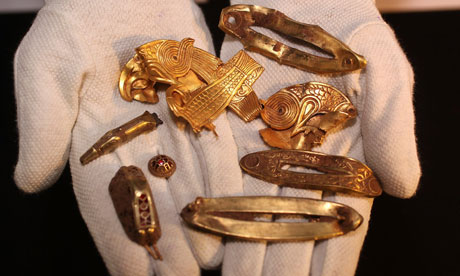
Staffordshire hoard of treasures to be displayed in Birmingham gallery


The Staffordshire hoard, the UK's largest collection of Anglo Saxon treasure, includes sword mounts and fragments of processional crosses. Photograph: Getty Images
The museum in Birmingham where thousands queued for hours to seethe Staffordshire hoard of Anglo Saxon gold is to create a gallery to display some of the most spectacular pieces, helped by a £705,000 grant from the heritage lottery fund.
"The Staffordshire hoard is our Tutankhamun," Simon Cane, director of the Birmingham Museums Trust said.
In 2009 a nondescript field near Lichfield, of no known historical interest, yielded one of the most spectacular hoards of Anglo Saxon gold ever found.

Read the rest of this article...

Failure to Hunt Rabbits Part of Neanderthals' Demise?

Neanderthals did not learn how to hunt small animals such as rabbits (pictured, a group of animals Portugal).


Rabbits are small, fast, and devilishly hard to catch. And that could have had dire consequences for Neanderthals.
A new study suggests that an inability to shift from hunting large mammals to wild rabbits and other small game may have contributed to the downfall of European Neanderthals during the Middle Paleolithic period, about 30,000 years ago.
"There have been some studies that examined the importance of rabbit meat to hominins"—or early human ancestors—"but we give it a new twist," said study lead author John Fa, a biologist at the United Kingdom's Durrell Wildlife Conservation Trust and Imperial College London.

Read the rest of this article...

Cirencester Roman cockerel 'best find' in 40 years

Conservation work on the figurine has taken four months to complete


A restored Roman cockerel figurine is the best result from a Cirencester dig in decades, archaeologists have said.
The enamelled object, which dates back as far as AD100, was unearthed during a dig in 2011 at a Roman burial site in the town.
It has now returned from conservation work and finders Cotswold Archaeology said it "looks absolutely fantastic".
The 12.5cm bronze figure was discovered inside a child's grave and is thought to have been a message to the gods.

Read the rest of this article...

Bronze Age settlement unearthed in SW England

Wick Barrow beakers [Credit: Somerset County Council]


Excavations at the Hinkley C site have revealed the remains of a 3,000-year-old Bronze Age settlement.

Archaeologists have also discovered the first Saxon grub hut to be found in Somerset, and a number of Roman features and artefacts, including a grain drier, quern stones, a stone anchor, fishing net weights, jewellery and graves.

The work was funded by EDF Energy as part of its site preparations and carried out by Somerset County Council.

Read the rest of this article...
Dig to reveal history of Northampton’s castle

The remains of a medieval castle have been discovered on the site of Northampton's new railway station [Credit: BBC]

Archaeological work to unearth the remains of Northampton’s medieval castle will begin later this month.

Work is due to start at the town’s railway station on Monday March 25, ahead of the development of a £20 million new station building.

Test pits dug last year found a range of remains dating back to the Medieval and Saxon period, including a 12th century wall and a Saxon brooch.


Read the rest of this article...

Remains of Medieval knight found under car park

An elaborately decorated sandstone slab with the telltale markings of a member of the nobility [Credit: Scotsman]

The remains of a medieval knight have been discovered underneath a car park that is being demolished at a city-centre building site.

The skeleton was found in Edinburgh’s Old Town after archaeologists uncovered the corner of an elaborately decorated sandstone slab bearing markings of a member of the nobility – the carvings of the Calvary Cross and an ornate sword.

An excavation of the immediate area uncovered the adult skeleton, which archaeologists said is likely to have once occupied the nearby grave.


Read the rest of this article...

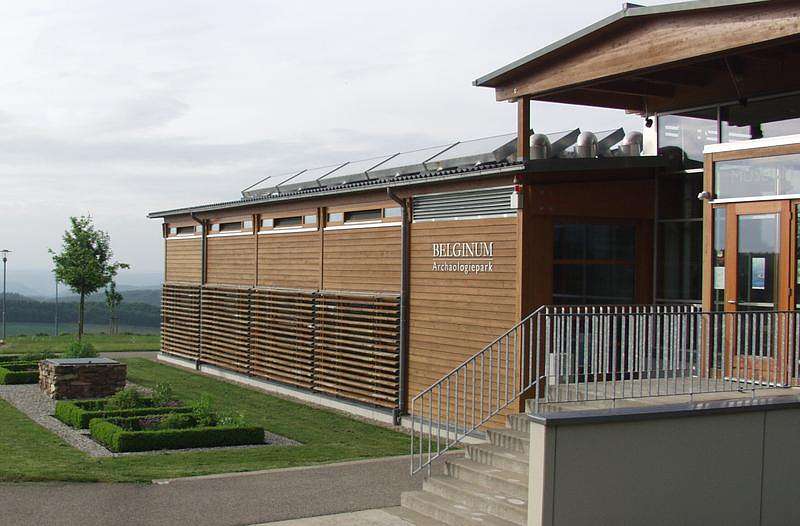
Kooperation zwischen Archäologiepark Belginum und Universität Trier

Der Archäologiepark Belginum (Foto: Uni Trier)

Die Universität Trier kooperiert mit dem Archäologiepark Belginum der Gemeinde Morbach im Hunsrück. Belginum ist bekannt durch sein keltisch-römisches Gräberfeld mit 2.500 Bestattungen und seinem antiken römerzeitlichen Vicus (Kleinstadt) unmittelbar an der heutigen Hunsrückhöhenstraße.

Mit dieser bedeutenden archäologischen Fundstätte eröffnet sich für das Zentrum für Altertumswissenschaften der Universität Trier (ZAT) und das Fach Klassische Archäologie die Möglichkeit, die Attraktivität von Lehre und Forschung zu steigern. Die Archäologin Rosemarie Cordie, die den Archäologiepark leitet, ist seit Januar 2013 als wissenschaftliche Mitarbeiterin am Zentrum für Altertumswissenschaften der Universität Trier (ZAT), Professur für Klassische Archäologie (Prof. Dr. Torsten Mattern), tätig.

Read the rest of this article...

Wednesday, March 13, 2013

Neanderthals' large eyes 'caused their demise'


The eyes have it: The Neanderthal skull (L) has larger eye sockets compared with a modern human skull (R). Consequently, the now extinct species used more of its brain to process visual information
A study of Neanderthal skulls suggests that they became extinct because they had larger eyes than our species.
As a result, more of their brains were devoted to seeing in the long, dark nights in Europe, at the expense of high-level processing.
By contrast, the larger frontal brain regions of Homo sapiens led to the fashioning of warmer clothes and the development larger social networks.
The study is published in Proceedings of the Royal Society B.

Ancient Reindeer Hunters Fished Ice Age Lakes


Archaeologists unearthed six fishhooks that date to 12,300 years ago, with one made from a 19,000-year-old mammoth tusk.  CREDIT: B. Gramsch 


Scientists have unearthed six fishhooks, the oldest of which was made from a 19,000-year-old mammoth tusk.  

Hunters of ice age reindeer around 12,300 years ago likely left the fishhooks, along with mammal and fish bones, in an open field in what is now Wustermark, Germany. The fishhooks, which are the oldest found in Europe, suggests humans developed fishing tools earlier than previously thought, probably to catch fast-moving fish that appeared in lakes as the climate warmed.

"These people had strong ideas to use the new resources of this changing environment," said Robert Sommer, a paleoecologist at the University of Kiel in Germany. The eel, perch and pike that entered lakes are too fast to snag with a harpoon or a spear, Sommer added.


Read the rest of this article...

Tuesday, March 12, 2013

Stonehenge started as graveyard, says new research

New research overturns the belief that Stonehenge was built as an astronomical calendar or observatory [Credit: Associated Press]

British researchers have proposed a new theory for the origins of Stonehenge: it may have started as a giant burial ground for elite families around 3000BC.

New studies of cremated human remains excavated from the site suggest that about 500 years before the Stonehenge we know today was built, a larger stone circle was erected at the same site as a community graveyard, according to researchers.

"These were men, women, children, so presumably family groups," University College London professor Mike Parker Pearson, who led the team, said at the weekend. "We'd thought that maybe it was a place where a dynasty of kings was buried, but this seemed to be much more of a community - a different kind of power structure."

Parker Pearson said archaeologists studied the cremated bones of 63 individuals, and believed that they were buried around 3000BC. The location of many of the cremated bodies was originally marked by bluestones, he said.


Read the rest of this article...

Heart disease present in ancient mummies

The mummified remains had signs of heart disease


Fatty arteries may not just be a curse of modern unhealthy lifestyles, say researchers who used scans to look at the heart health of mummies.
A study in The Lancet of 137 mummies up to 4,000 years old found a third had signs of atherosclerosis.
Most people associate the disease, which leads to heart attacks and strokes, with modern lifestyle factors such as smoking and obesity.
But the findings may suggest a more basic human pre-disposition.
Previous studies have uncovered atherosclerosis in a significant number of Egyptian mummies but it had been speculated that they would have come from a higher social class and may have had luxurious diets high in saturated fat.

Read the rest of this article...
Saturday, March 09, 2013

EMAS Study Tour to Brittany


EMAS Study Tour to Brittany

23 to 30 May 2013


This year's EMAS Spring Archaeological Study Tour is to Brittany.

The area is justly famous for its prehistoric monuments, especially the stunning Carnac alignments, but there are monuments of all periods to be found here. An interesting late medieval local feature is the enclos paroissial, or parish close. These sites are cultic in character. Within the walled churchyard are only buildings and structures designed for worship: the church, the calvary, and sometimes an ossuary or charnel house.

The coach will pick up at London Embankment. We will stay overnight in Rouen on our way to and from Brittany. The rest of the time we will stay in the charming town of Quimper. The major sites that we will visit include the prehistoric sites of Carnac and Locmariaquer; the Celtic and Viking fortification at the Camp de Péran; the abbeys of Mont-St-Michel and Beauport; the castle at Fougères and a selection of the best of the parish closes.

The cost of this trip will be £706 per person sharing a twin room and £835 per person in a single room.. The cost includes travel by coach; Bed & Breakfast in the hotels; entry to all the monuments and an illustrated brochure of the sites. 

You can find full details here...

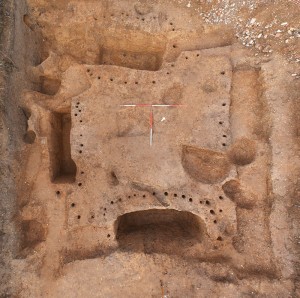
Remarkable ringfenced burials from Roman Colchester


A recently-completed cemetery excavation close to Colchester’s Roman circus has revealed that some of Camulodunum’s citizens marked their grave plots with ditches and wooden fences. It had previously been speculated that, during the Roman period, those unable to afford stone monuments might have used wooden markers or mounds of earth to distinguish individual burials. Now a four-month investigation by Colchester Archaeological Trust has unearthed clusters of inhumations dated by grave goods and other finds  to the 2nd and 3rdcentury and surrounded in some cases by lines of small post-holes up to about 20cm in diameter.
‘This is certainly extremely unusual – I have never seen anything like it before,’ said CAT chief archaeologist Philip Crummy. ‘We have excavated about 400 inhumations and cremations here with much that is unusual. For example, we found areas of fenced burials at either end of the site, 80m apart, and it seems we are dealing not with one great cemetery area but a collection little plots used by different groups or families.’

Read the rest of this article...

Oxford's University Church of St Mary the Virgin reopens


Oxford's 13th Century University Church of St Mary the Virgin has reopened following a £5.5m restoration.
The medieval building - which boasts Oxford's tallest spire - has undergone its biggest renovation since the late 19th Century in a two-year project.
Works included cleaning stonework, restoring the Clore Old Library, chancel and nave including 15th Century stalls, and improving access.
The church, which attracts 300,000 annual visitors, reopened earlier.

Watch the video...