Saturday, March 09, 2013

Stonehenge may have been burial site for Stone Age elite, say archaeologists


Dating cremated bone fragments of men, women and children found at site puts origin of first circle back 500 years to 3,000 BC
Centuries before the first massive sarsen stone was hauled into place at Stonehenge, the world’s most famous prehistoric monument may have begun life as a giant burial ground, according to a theory disclosed on Saturday.
More than 50,000 cremated bone fragments, of 63 individuals buried at Stonehenge, have been excavated and studied for the first time by a team led by archaeologist Professor Mike Parker Pearson, who has been working at the site and on nearby monuments for decades. He now believes the earliest burials long predate the monument in its current form.

Read the rest of this article...

Tooth found in Cave of Orce named earliest human remain


A MILK tooth discovered in Granada has been declared the earliest known human remain ever found in Western Europe.
The infants tooth was unearthed in the Cave of Orce and is believed to be 1.4 million years old.
Archaeologists believe the tooth came from aHomo erectus or Homo habilis which correlates with another discovery in the cave.
In 1983, Catalan archaeologist Josep Gibert visited the cave and found a skull fragment belonging to what he dubbed the Orce Man.

Read the rest of this article...

SCRAP OF WOOL UNRAVELS CHRISTIAN CHURCH FIND

MARYPORT DIG: Site director Tony Wilmott, left, and Professor Ian Haynes last summer


A tiny scrap of wool found during an archaeological dig in Maryport has unlocked a piece of history.

Archaeologists revealed this week that the dig at Camp Farm last summer has unearthed what appears to be a Christian church, dating back to the 5th or 6th century.

Experts believe the possible church, built in an east-west direction, was positioned so it could be seen at Whithorn, the cradle of Christianity in Scotland, on the other side of the Solway Firth.

They revealed their findings exclusively to a Maryport audience crowded into the town’s Senhouse museum on Tuesday night.

Tony Wilmott, site director, said that volunteers on the dig had discovered what appeared to be Christian long cist graves. In one they found fragments of bone and a tooth.


Read the rest of this article...

Friday, March 08, 2013

Could this be Dick Whittington’s privy?


MOLA’s Standing Buildings Team was recently commissioned by the City of London to investigate and record masonry features within the Phene Neal Room of the Guildhall in London. Previous investigations by MOLA showed the masonry to in fact be part of a medieval garderobe, more commonly known as a toilet.

The garderobe would have been constructed during John Croxtone’s renovations of the Guildhall in the early 15th century and therefore, it is believed to have been in use when the fabled Dick (Richard) Whittington was Lord Mayor of London, on no less than four separate occasions between 1397 and 1420. 

Read the rest of this article...

Phil Harding voted Archaeologist of the Year 2013


Wessex Archaeology is proud to congratulate Phil Harding on being voted Archaeologist of the Year at the Current Archaeology Awards 2013.
The Current Archaeology Awards, decided by public vote, celebrate the best of British archaeology. The Archaeologist of the Year Award recognises individuals who have made outstanding contributions to archaeology. This year’s results were announced on 1st March at Current Archaeology Live. Best known for his starring role in Channel 4’s Time Team, Phil is a field archaeologist and flint expert with Wessex Archaeology.


Read the rest of this article...

St Oran's Cross from Iona put back together in Selkirk

Work is being done to reassemble the cross before it is returned to Iona


One of the world's first Celtic High Crosses from the 8th Century is being reassembled in Selkirk in order to be returned to Iona.
St Oran's Cross will be back in place for the celebration of the 1450th anniversary of the arrival of St Columba on the island.
The cross was in five pieces and originally weighed more than one tonne.
It will be put back together inside a special steel structure designed by Borders-based mount-maker Richard West.
St Columba and his followers arrived from Ireland and established a monastery on Iona in 563.

Read the rest of this article...

BRONZE AGE BOAT TRIP – BY ROAD


THE 3,000-year-old Carpow log boat is about to embark on another journey – not by river, but by road.
The waterlogged craft was discovered partially submerged in the mud, sand and gravel of Carpow Bank, at the head of the Tay Estuary, in 2001.
Carved from a single tree trunk, it was an example of one of the first known boats in existence and was radiocarbon dated to 1130-970 BC.

Read the rest of this article...

First evidence of Viking-like 'sunstone' pulled from shipwreck

Researchers say this crystal found at the Alderney shipwreck near the Channel Islands could prove that fabled Viking sunstones really did exist.


Ancient lore has suggested that the Vikings used special crystals to find their way under less-than-sunny skies. Though none of these so-called "sunstones" has ever been found at Viking archaeological sites, a crystal uncovered in a British shipwreck could help prove they did indeed exist.
The crystal was found in the wreckage of the Alderney, an Elizabethan warship that sank near the Channel Islands in 1592. The stone was discovered less than 3 feet (1 meter) from a pair of navigation dividers, suggesting it may have been kept with the ship's other navigational tools, according to the research team headed by scientists at the University of Rennes in France.
A chemical analysis confirmed that the stone was Icelandic Spar, or calcite crystal, believed to be the Vikings' mineral of choice for theirfabled sunstones, mentioned in the 13th-century Viking saga of Saint Olaf.

Read the rest of this article...

Brigg Bronze Age raft back at heritage centre


A Bronze Age raft has returned to a North Lincolnshire town after it was stored away for nearly 40 years.
The 3,000-year-old flat-bottomed oak boat was found in Brigg but has been in storage at a museum in London.
Now the ancient craft is being pieced together like a jigsaw puzzle and will go on display at Brigg Heritage Centre in May.

Watch the video...

Cardigan Castle: Steel supports removal in £11m work


Work has begun in Cardigan to remove the steel framework that has supported the castle walls for almost 40 years.
Yellow steel beams which have propped up the crumbling walls since 1975 are being taken away in an £11m renovation.
After months of work to strengthen and re-point the stone walls, the first piece of steelwork was cut away and removed by a crane on Friday.
A crowd of around 200 people gathered to watch the spectacle, which closed the main road for about 15 minutes.
The mayor of Cardigan, Catrin Miles, lit the oxyacetylene torch to begin the task of cutting down one of the steel supports.

Read the rest of this article...

Human Ancestors Were Fashion Conscious

Keeping up with fashions. A close examination of shell beads from Blombos Cave (top) suggests that ancient humans there started off with one style of jewelry (bottom) and then shifted to another (middle) over the course of 3000 years.


The 2013 Academy Awards were, as always, as much about making appearances as about making films, as red carpet watchers noted fashion trends and faux pas. Both Jessica Chastain and Naomi Watts wore Armani, although fortunately not the same dress. And Best Supporting Actress Anne Hathaway switched from Valentino to a controversial pale pink Prada at the last minute because her original dress looked too much like someone else's. Of course, no actress would be caught dead wearing the same style 2 years in a row. A new study of ancient beaded jewelry from a South African cave finds that ancient humans were no different, avoiding outdated styles as early as 75,000 years ago.
Personal ornaments, often in the form of beads worn as necklaces or bracelets, are considered by archaeologists as a key sign of sophisticated symbolic behavior, communicating either membership in a group or individual identity. Such ornaments are ubiquitous in so-called Upper Paleolithic sites in Europe beginning about 40,000 years ago, where they were made from many different materials—animal and human teeth, bone and ivory, stone, and mollusk shells—and often varied widely among regions and sites.
Read the rest of this article...

Nat Geo is casting for a new show


Calling all Adventurers and Explorers!  
Nat Geo is Now Casting For A New Adventure Series

National Geographic is searching for the most incredible expeditions of 2013 to film and feature in a dynamic new blue chip adventure series that will take viewers to the edge of the world… and back. Every riveting episode will feature a new explorer, a new territory, and a new adventure, which will redefine the limits of possibility. Production has begun, but if you have an expedition happening this year, Nat Geo would love to hear from you and potentially feature you in the series. Missions will ideally combine risk-taking adventure with mind-blowing science.

If you’re planning to break records, conquer the impossible and redefine the limits of human potential, we want to hear from you.  Email Past Preservers at casting@pastpreservers.com and if you are not already signed up on their expert database, register today here. Tell them about you, your upcoming mission, and how far along you are in the planning stage. Make sure to include your name, contact information and photos and/or video links.  (Submissions without photos and/or video WILL NOT be considered.) Expeditions that combine adventure and science especially wanted. Be prepared to inspire a new generation. 

Dogs Domesticated 33,000 Years Ago, Skull Suggests


A canine skull found in the Altai Mountains of Siberia is more closely related to moderndomestic dogs than to wolves, a new DNA analysis reveals.

The findings could indicate thatdogs were domesticatedaround 33,000 years ago. The point at which wolves went from wild to man's best friend is hotly contested, though dogs were well-established in human societies by about 10,000 years ago. Dogs and humans were buried together in Germany about 14,000 years ago, a strong hint of domestication, but genetic studies have pinpointed the origin of dog domestication in both China and the Middle East.


Read the rest of this article...

Thursday, March 07, 2013

'Viking sunstone' found in shipwreck

A clear view of the Sun was not necessary for Vikings to navigate, scientists believe


A crystal found in a shipwreck could be similar to a sunstone - a mythical navigational aid said to have been used by Viking mariners, scientists believe.
The team from France say the transparent crystal may have been used to locate the Sun even on cloudy days.
This could help to explain how the Vikings were able to navigate across large tracts of the sea - well before the invention of the magnetic compass.
However, a number of academics treat the sunstone theory with scepticism.

Read the rest of this article...

ScienceShot: Sunstone Unearthed From Shipwreck


In 1592, a British ship sank near the island of Alderney in the English Channel carrying an odd piece of cargo: a small, angular crystal. Though cloudy and scuffed up from 4 centuries at the bottom of the sea, its precise geometry and proximity to the ship's navigation equipment caught the eye of a diver exploring the wreckage. Once it was brought back to land, a few European scientists began to suspect the mysterious object might be a calcite crystal, which they believe Vikings and other European seafarers used to navigate before the introduction of the magnetic compass. 

A previous study showed that calcite crystals reveal the patterns of polarized light around the sun and, therefore, could have been used to determine its position in the sky even on cloudy days. That led researchers to believe these crystals, which are commonly found in Iceland and other parts of Scandinavia, might have been the powerful "sunstones" referred to in Norse legends, but they had no archaeological evidence to support their hypothesis—until now. 

Read the rest of this article...

Some DNA ancestry services akin to 'genetic astrology'


Some customers want to find Viking ancestry, but almost every Briton has some, say researchers
Scientists have described some services provided by companies tracing ancestry using DNA as akin to astrology.
Some test findings tell people that they have links to groups such as Vikings, to particular migrations of people and sometimes to famous figures such as Napoleon or Cleopatra
But researchers working with a campaign group say DNA tests cannot provide accurate information about ancestry.
Ancestry companies insist they are able to provide a valuable service.

Read the rest of this article...

The man who demolished Shakespeare's house


Britain hasn't always been in love with its heritage. It took some shocking acts of destruction, and some very near misses, to help shape the way it is now treasured and protected.
The UK today has some of the most powerful conservation laws in the world.
This year marks 100 years since the first legislation was passed giving the government power to act directly when a historic site was under threat.
The country's heritage is now treasured and has become big business, but it wasn't always the case. In the 19th Century most historic sites were in private hands and owners could do whatever they liked with them, including raze them to the ground.

Read the rest of this article...

It didn't sink! Full-size, sewn-together replica of a Bronze Age boat launched to trials success


For the first time in almost 3000 years – a full size Bronze Age style sea-going boat has been launched in Britain. Slipping gracefully down a slipway today into Falmouth Harbour, Cornwall, the 15m-long vessel was then paddled by its 18 person crew for two 500m trial trips.

The launch – part of a long-term experimental archaeology investigation into Bronze Age marine technology – is already providing valuable new insights into prehistoric seafaring.

“I’m so happy with the responsiveness of the boat. We always said you had to build the whole boat to understand what Bronze Age people experienced,” said the project’s leader, University of Exeter archaeologist,  Professor Robert Van de Noort, who is working together with the National Maritime Museum Cornwall. 


Read the rest of this article...

Wednesday, March 06, 2013

Vienna Conference on Cultural Heritage and New Technologies


Vienna Conference on Cultural Heritage and New Technologies

11 - 13 November 2013

Urban Archaeology and “Correct” documentation – Documenting the Data


“Beauty is truth, truth beauty,-that is all
Ye know on earth, and all ye need to know.”
(Keats: “Ode on a Grecian Urn”)


Documentation of archaeological and cultural heritage sites is at the heart of the archaeological process and an important component in cultural heritage research and presentation. It is an essential step without which interpretation and analysis are not possible. It is what makes archaeology and cultural heritage “scientific”.


Maybe we are storytellers. If so, the type of story we tell is heavily influenced by our way of collecting and organising our archaeological data.


But can we speak about CORRECT documentation or should we talk only about usable and non-usable documentation?


Visit the website...

Baylham solar farm archaeological study requested

The site would feature 40,000 panels similar to the company's existing solar farms


Archaeologists want a full study of the land before a proposal for a 50 acre (20 hectare) solar panel farm in Suffolk is considered.
Hive Energy wants to put 40,000 solar panels on agricultural land at Hill Farm, Baylham, near Ipswich.
Suffolk County Council's archaeological service said a systematic study of the land was needed first as the area has been inhabited since the Iron Age.
Mid Suffolk District Council is due to look at the application this year.

Read the rest of this article...

Replica Bronze Age boat to set sail


A replica Bronze Age boat which was built using traditional techniques gets ready to make its maiden voyage from Falmouth.
The construction is part of a collaborative effort between the National Maritime Museum and the University of Exeter.
The BBC's Jon Kay takes a close-up look at how the boat has been built, even down to replica bronze tools used to carve the wood.

Watch the video...

FOUR NEOLITHIC HOUSES UNEARTHED AT QUARRY

Reconstruction of a Neolithic house. Image: CEMEX/Wessex Archaeology

Four early Neolithic houses (3700 BC) have been unearthed by archaeologists at CEMEX’s Kingsmead Quarry in Berkshire.  The discovery is unprecedented on a single site in England and challenges our current understanding of how people lived more than 5,700 years ago.
This rare find will give us a unique opportunity to learn more about the earliest permanent settlements in prehistoric Britain and how such sites developed. At this time new practices were being adopted with people switching lifestyle from hunter-gather to settled farmer.

A rare find

Few houses of this date have been found in England and rarely has more than one been found on a single site. These discoveries by excavators from Wessex Archaeology are key to enhancing the knowledge and understanding of this period nationally and at a local level tell us more about the history of the area around the Rivers Colne and Thames near Windsor.
Read the rest of this article...

REFUGIA AND ICE AGE EVOLUTION

Homo neanderthalensis, adult male. Image: John Gurche, artist / Chip Clark, photographer

Although the most drastic evolutionary changes occur over long spans of time, the effects of these changes can be seen relatively recently, argues Dr John Stewart, a Senior Lecturer in Palaeoenvironmental Reconstruction & Environmental Change at Bournemouth University.

Reconstructing environmental effects on evolution

Dr Stewart has made important contributions to a growing body of work that shows how the evolution of ecosystems has to be taken into account when speculating between different geological eras. His work on the location of ice age refugia, the timings of species evolution and how palaeoecological data can be used as evidence of what may happen in the future has far reaching implications for own own species.
Looking back to the time of the dinosaurs or even the single-celled organisms at the very origins of life, it becomes obvious that ecosystems existing more than 65 million years ago and around four billion years ago cannot be deduced from the one that surrounds us today.
Read the rest of this article...

Hi-tech discoveries: archaeology transformed


Physics is breaking new ground in the field of archaeology and human evolution.

So much so that in just a few years the gains in archaeology now equal the gains made from the past 100 years of using traditional methods, explains nuclear physicist and University of Wollongong visiting Professor Claudio Tuniz.

Dr Tuniz, who began his career in the United States using physics to analyse moon rocks and meteorites, has spent almost two decades examining how advanced scientific technology in nuclear physics and X-rays can tell us more about palaeoanthropology and human evolution.

In a lecture last month at the Lucas Heights facility ANSTO, where he worked for 15 years, Tuniz described how the development of transportable instruments based on X-ray techniques and radiography can provide analysis of archaeological and cultural heritage materials in museums and in the field, with little or no disturbance to artefacts.


Read the rest of this article...

Grotesque Mummy Head Reveals Advanced Medieval Science


This anatomical specimen dating to the 1200s is the oldest known in Europe. 
CREDIT: photo courtesy Archives of Medical Scienc


In the second century, an ethnically Greek Roman named Galen became doctor to the gladiators. His glimpses into the human body via these warriors' wounds, combined with much more systematic dissections of animals, became the basis of Islamic and European medicine for centuries.

Galen's texts wouldn't be challenged for anatomical supremacy until the Renaissance, when human dissections — often in public — surged in popularity. But doctors in medieval Europe weren't as idle as it may seem, as a new analysis of the oldest-known preserved human dissection in Europe reveals.


Read the rest of this article...

Temple of Jupiter Stator discovered in Rome

The ruins of the temple identified by Italian archaeologists as the one built by Romulus in 750 BC, after winning the battle against the Sabines [Credit: Archeologia Viva]

The temple built by Romulus to celebrate the hand of Jupiter giving Roman troops their unstoppable force has been found at the foot of the Palatine Hill, Italian archaeologists say. 

The ruins of the shrine to Jupiter Stator (Jupiter the Stayer), believed to date to 750 BC, were found by a Rome University team led by Andrea Carandini. 

"We believe this is the temple that legend says Romulus erected to the king of the gods after the Romans held their ground against the furious Sabines fighting to get their women back after the famous Rape (abduction)," Carandini said in the Archeologia Viva journal


Read the rest of this article...

Tuesday, March 05, 2013


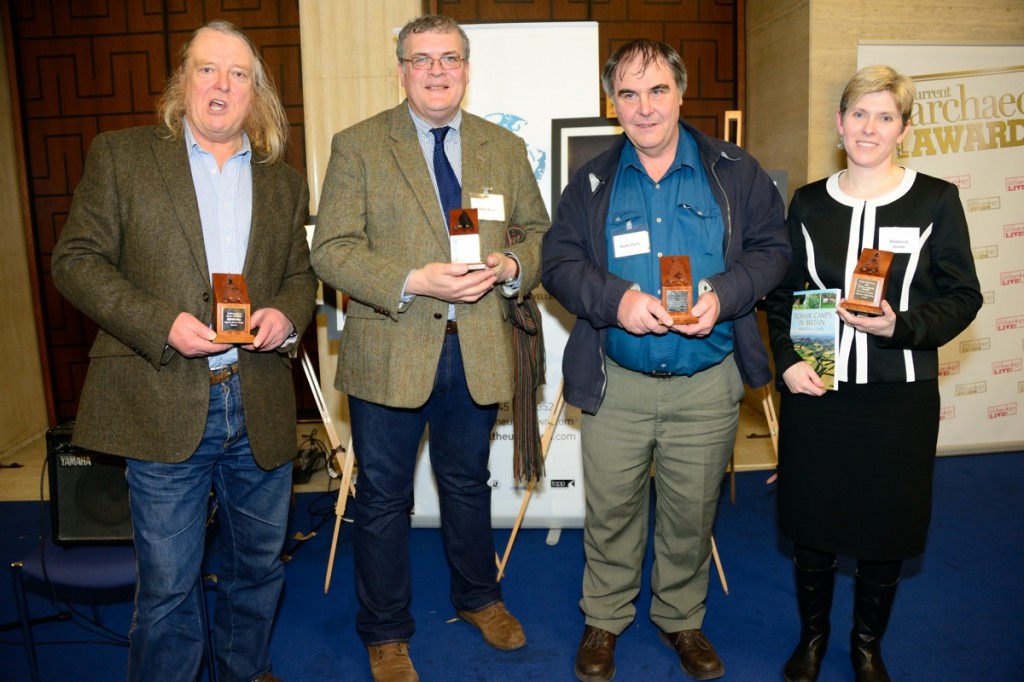
The four winners of this year’s prestigious Current Archaeology Awards. L-R: Phil Harding (Archaeologist of the Year), Richard Buckley (Research Excavation of the Year, for the search for Richard III), Keith Parfitt (Rescue Dig of the Year, presented to Canterbury Archaeological Trust for their work at Folkestone Roman villa), and Rebecca Jones (Book of the Year – Roman Camps in Britain)

Read the rest of this article...

Monday, March 04, 2013

No room for archaeology archive in 27% of British museums

The report found that 70% of British museums did not have a specialist archaeological curator 
[Credit: Museums Journal]

A survey by the Society of Museum Archaeologists (SMA) has exposed a lack of storage space and curatorial expertise in English museums dealing with archaeological archives.

The survey of 134 museums found that 36 could not accept archaeological archives because of lack of space.

It also revealed that museums in 47 local authorities were no longer collecting, while 70% of museums had no specialist archaeology curator.

SMA chairwoman Gail Boyle said: “Many of the museums that responded are local authority museums that have no statutory funding, so they are often targeted [for cuts]. It has become prevalent over time and is getting worse.

“Archaeological field units are having to store their work, as there is nowhere for them to deposit it.


Read the rest of this article...

Treasure found in Pembrokeshire


An Early Bronze Age hoard, which is thought to have been buried around 2000BC (4,000 years ago) has been declared treasure by H.M. Deputy Coroner for Pembrokeshire.
The hoard of two early bronze flat axes, was discovered in the Community of Nevern, Pembrokeshire during early August 2011 by Mr Tom Baxter and Mr Luke Pearce. The axes were found less than 3 metres apart while the finders were metal detecting in a field under pasture.
The discovery was first reported as possible treasure to Mark Lodwick, Portable Antiquities Scheme Co-ordinator for Wales (PAS Cymru) and was subsequently reported on by museum archaeologists at Amgueddfa Cymru – National Museum Wales.

Read the rest of this article...

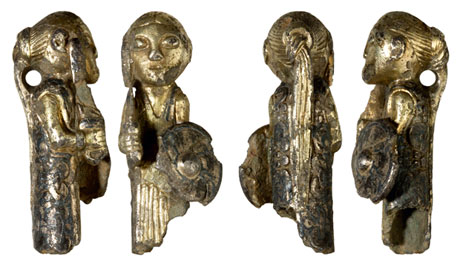
Flight of the valkyrie: the Viking figurine that's heading for Britain

Four views of the valkyrie, the only 3D depiction from the Viking era known to exist 
Photograph: Asger Kjærgaard/Odense Bys Museer

Thumb-sized figurine discovered in Denmark by amateur archaeologist is the only 3D representation of a valkyrie ever found – and will arrive at British Museum in 2014


A little face peering up from a clod of frozen mud in Denmark has proved to be a unique find: the only known 3D Viking representation of a valkyrie.
The figurine, believed to date from about AD800, was found in December and has gone straight from conservation to display in the National Museum in Copenhagen. It will then be included in the exhibition on the Viking age that opens there in June and at the British Museum in 2014.
The legends of the valkyries – the ominous companions of the god Odin who descend on battlefields to choose which warriors will die – have been among the most enduring in Scandinavian folklore and literature. Later images, often inspired by Wagner's music, tend to be romantic creatures with flowing locks and voluptuous bodies.

Read the rest of this article...

Sunday, March 03, 2013

Marmalade for the students?


Recent excavations at Harris Manchester College, Oxford, produced a number of cylindrical marmalade jars, recovered with other debris from a feature interpreted as a store-room. Three jars were kept as a sample. All bear the mark of the Keiller marmalade company of Dundee. 
The origins of Keiller’s marmalade are supposed to lie, possibly apocryphally, in a shipment of over-ripe Seville oranges bought by James Keiller and used by his wife, Janet, to make marmalade. The brand was founded in 1797, as the first commercial marmalade brand, and its defining characteristic from the beginning was the characteristic scraps of rind in the preserve. By the late 19th century it was being exported around the world.

Read the rest of this article...
The hills of north east Wales have long been known for their archaeological importance. However, 2012 has been described as an exceptional year, with a particularly high number of excavations taking place.

View the slide show...

‘Vikings’ Sheds Light On Dark Ages


This Image Released By History Shows Travis Fimmel As Ragnar (Center), In A Scene From ‘Vikings’, Premiering On March 3 On History. (AP)

Series Aims To Smash Some Stereotypes

ASHFORD, Ireland, March 2, (AP): If historical fiction guru Michael Hirst has his way, a legendary Viking raider named Ragnar soon will conquer North America on behalf of the History channel. History’s ambitious Dark Ages drama “Vikings,” debuted Sunday after five months of filming in Ireland, dramatizes the myth-cloaked story of Ragnar Lothbrok, leader of a Viking people typically depicted as horn-helmeted brutes. Here’s one pointed clue that “Vikings” aims to smash a few stereotypes along with English skulls: There’s not a horned head in sight because real Vikings never actually wore them. This lavishly produced nine-parter, the biggest production ever commissioned by History with a reported budget of $40 million, seeks to get viewers rooting for the Norsemen even as they butcher defenseless Christians and loot their way through Europe. With a cast including Gabriel Byrne, the series debuted on History Sunday at 10 pm.

“It’s always been in the background of my mind to do a Viking project,” said Hirst, whose reputation as a master of history-based drama has grown from his days as screenwriter of 1998’s film “Elizabeth” to his creation of the 2007-10 Showtime series “The Tudors” about the life, times and ill-fated brides of Henry VIII.
Speaking to The Associated Press during the final weeks of shooting, in a rain-soaked ash forest in the Wicklow hills south of Dublin, Hirst said he loved poring over the history of an ill-understood person or period, then weaving it into compelling entertainment.

Hirst, the showrunner and executive producer of “Vikings” as well as its sole writer, found working with 8th-century Scandinavian warriors a liberating experience because, while there’s such rich legend in Norse culture, there’s simply no written history from the illiterate Vikings’ point of view. “By definition, not as much is known about the Dark Ages. This is particularly true of the Vikings who were pagans and didn’t write anything down,” he said as, in the distance, actors on horseback worked on a scene of Ragnar taking his son on a mission to a magical tree, one facet of Norse religious belief. “Because not a huge amount is known, that gives me some liberty. But I like working from historical material. I always start projects by reading as much research as possible.”


Read the rest of this article...

So, what did the Romans do for us? New digs reveal truth about Hadrian's Wall


Stretching the breadth of northern England, Hadrian's Wall is a majestic reminder of the ambition and might of the Roman Empire's conquest in Britain. Now, new archaeological evidence has suggested, contrary to previous belief, that the Romans far from co-existing peacefully with the locals, ejected them by force in order to build the 73-mile divide.

The Unesco World Heritage Site stretches from the Solway Firth in the west to Wallsend on the river Tyne in the east. Construction was ordered by the Emperor Hadrian and started in AD122. It was Roman Britain's most ambitious building project, designed primarily to mark the northern limit of the Empire.

For decades, archaeologists struggled to date the indigenous communities around the wall because the site yielded very few artefacts. The only way of dating these Roman and pre-Roman Iron Age settlements was to excavate what little there was. Since the 1970s, when serious excavation began, experts believed the local population living in the shadow of the wall had actually flourished under the Roman invaders. But the new evidence suggests the Roman legions actually cleared a 10-mile stretch in front of the wall by force.


Read the rest of this article...

Did a Comet Really Chill and Kill Clovis Culture?


A 130-foot-meteor created the mile-wide Meteor Crater in Arizona. The comet proposed to have impacted life in North America was significantly larger, but no crater indicating its collision has been found.


A comet crashing into the Earth some 13,000 years ago was thought to have spelled doom to a group of early North American people, and possibly the extinction of ice age beasts in the region.
But the space rock was wrongly accused, according to a group of 16 scientists in fields ranging from archaeology to crystallography to physics, who have offered counterevidence to the existence of such a collision.
"Despite more than four years of trying by many qualified researchers, no unambiguous evidence has been found [of such an event]," Mark Boslough, a physicist at Sandia National Laboratories in New Mexico, told LiveScience.
"That lack of evidence is therefore evidence of absence."


Read the rest of this article...

BARNACLES POINT TO WHALE MEAT CONSUMPTION IN PREHISTORY


The remains of two barnacle species that once lived exclusively on the exterior of whales have been found in a camp fire at the Cueva de Nerja (the Caves of Nerja) in Málaga, Spain. Researchers from the University of Valencia have dated the charcoal from the fire to between 14,500 and 13,500 years ago.


Earliest consumption of whale meat

Scientists at the University, coordinated by Professor Joan Emili Aura Tortosa, analysed stone artefacts, horn and bone found in the fire along with the charcoal to arrive at the date. The scientific results show evidence of human consumption of whale meat during Prehistory in Europe.
The remains of the whale barnacles were found in occupation layers dating to the end of the last glacial maximum and associated with the Upper Palaeolithic Magdalenian period.


Read the rest of this article...

Most Ancient Romans Ate Like Animals


Ancient Romans are known for eating well, with mosaics from the empire portraying sumptuous displays of fruits, vegetables, cakes — and, of course, wine. But the 98 percent of Romans who were non-elite and whose feasts weren't preserved in art may have been stuck eating birdseed.
Common people in ancient Rome ate millet, a grain looked down upon by the wealthy as fit only for livestock, according to a new study published in the March issue of the Journal of Anthropological Archaeology. And consumption of millet may have been linked to overall social status, with relatively poorer suburbanites eating more of the grain than did wealthier city dwellers.
The results come from an analysis of anonymous skeletons in the ancient city's cemeteries.
"We don't know anything about their lives, which is why we're trying to use biochemical analysis to study them," said study leaderKristina Killgrove, an anthropologist at the University of West Florida.


Read the rest of this article...
King's 'lionheart' gets a forensic exam


They called him Lionheart — a name that has become the epitome of courage in battle. More than eight centuries after the death of King Richard I of England, forensic scientists have now revealed the secrets of his most feted organ.
Richard was a warrior king who fought against the Muslim sultan Saladin during the third Crusade in the twelfth century. But domestic difficulties were waiting when he returned to Europe, and he spent the last years of his life trying to suppress revolt in his French territories.
On 25 March 1199, while laying siege to the castle of Châlus-Chabrol in the Limousin region, he was pierced in the left shoulder by an enemy crossbow bolt. Richard I died 12 days later, probably from infection in the wound.

Read the rest of this article...

Homeric epics were written in 762 BCE, give or take

Achilles sacrificing to Zeus, from the Ambrosian Iliad or Ilia Picta, a 5th century illuminated manuscript thought to have been produced in Constantinople [Credit: Wiki Commons]

When were Homer's works written? One of literature's oldest mysteries is a step closer to being solved after a recent study that dates the The Iliad to 762 BCE and adds a quantitative means of testing ideas about history by analyzing the evolution of language.

The epic poem The Iliad, set amid the final year of the Trojan War, is attributed to the ancient Greek poet Homer and is foundational to Western literature, but scholars have not reached a consensus about whether it was written shortly after the war or centuries later. Archaeological and historical evidence have placed the text's origins in the 7th or 8th century BCE, but such records are sparse and often have an uncertain validity.

Read the rest of this article...

Neue Grabungen im Römerlager Haltern

Das Team der Grabungshelfer bereitet die Fläche des Halterner Hauptlagers für die Ausgrabung vor. Vor allem die Holz-Erde-Mauer und die Gräben werden im Fokus der Untersuchungen stehen. (Foto: LWL/Burgemeister)

In Vorbereitung des geplanten "Römerparks Aliso" finden derzeit in Haltern am See neue Ausgrabungen statt. Bis in den Mai hinein nehmen die Archäologen des Landschaftsverbandes Westfalen-Lippe (LWL) Einblick in die Beschaffenheit der Holz-Erde-Mauer des römischen Lagers, um die wissenschaftliche Basis für die geplanten Rekonstruktionen zu fundamentieren.

Read the rest of this article...