Monday, September 10, 2012

Ancient Alaskan hair could reveal insight into climate change


In a scientific first, chemical analysis of ancient Eskimo hair found in Western Alaska could reveal how people in the region lived through times of climate change over the last 1000 years.

It’s hoped the findings by University of Aberdeen archaeologists could provide lessons on how modern societies could cope with climate change now and in the future.

A team of experts from the institution – including Drs Rick Knecht, Charlotta Hillerdal and Kate Britton – returned this week from a three week dig near the modern Yup’ik Eskimo village of Quinhagak – the first large scale archaeological investigation into the prehistory of this region, which is three times the size of Scotland.

Found: the lost church where Richard III was buried


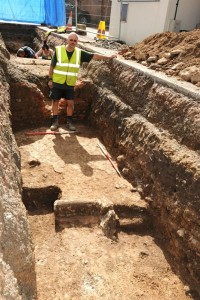
University of Leicester archaeologists have found the lost church where Richard III was buried over 500 years ago – under a City Council carpark.
 
After his defeat at the Battle of Bosworth in 1485, the body of Britain’s last Plantagenet king was brought to Leicester where he was buried in a Franciscan friary. Known as the Church of the Grey Friars, the structure was demolished during the Dissolution of the Monasteries and its location forgotten.
Last week University of Leicester Archaeological Services (ULAS) launched their hunt for the church – the first ever search for the lost grave of an anointed King of England – and today (5 September) announced that they have found the remains of a Medieval building which they are confident are part of the lost friary.

Together with Medieval window tracery, glazed floor tile fragments, a fragment of stained glass window, and roof tiles that were only used on high-status buildings, the investigations have uncovered the floor of a passageway, which archaeologists believe might be part of the cloister, and a section of wall that could have belonged to the church.

Herders, not farmers, built Stonehenge


The ancient builders of Stonehenge may have had a surprisingly meaty diet and mobile way of life. Although farming first reached the British Isles around 6,000 years ago, cultivation had given way to animal raising and herding by the time Stonehenge and other massive stone monuments began to dot the landscape, a new study finds.

Agriculture’s British debut occurred during a mild, wet period that enabled the introduction of Mediterranean crops such as emmer wheat, barley and grapes, say archaeobotanists Chris Stevens of Wessex Archaeology in Salisbury, England, and Dorian Fuller of University College London. Farming existed at first alongside foraging for wild fruits and nuts and limited cattle raising, but the rapid onset of cool, dry conditions in Britain about 5,300 years ago spurred a move to raising cattle, sheep and pigs, Stevens and Fuller propose in the September Antiquity.

With the return of a cultivation-friendly climate about 3,500 years ago, during Britain’s Bronze Age, crop growing came back strong, the scientists contend. Farming villages rapidly replaced a mobile, herding way of life.

Early Cannibalism Tied to Territorial Defense?


The earliest known instance of cannibalism among hominids occurred roughly 800,000 years ago. The victims, mainly children, may have been eaten as part of a strategy to defend territories against neighbors, researchers report online in the Journal of Human Evolution. The new study shows how anthropologists use the behavior of modern humans and primates to make inferences about what hominids did in the past—and demonstrates the limitations of such comparisons.

The cannibalism in question was discovered in the Gran Dolina cave site of Spain’s Atapuerca Mountains. Eudald Carbonell of the University of Rovira and Virgili in Spain and colleagues found evidence of butchering on bones belonging to Homo antecessor, a controversial species that lived in Europe as early as 1.2 million years ago. Because no other hominid species has been found in the region at the same time as the butchered bones, the victims must have been eaten by their own kind, the team concluded in 2010 in the journal Current Anthropology (PDF).

Ipswich waterfront Saxon dig unearths 300 graves


An archaeological dig at Ipswich waterfront has unearthed 300 skeletons and evidence of an old church.

The excavation is taking place before 386 homes are built on Great Whip Street by Genesis Housing Association.

It is believed the Saxons occupied the site in the 7th Century and burials are believed to have taken place there until the 16th Century.

Rubbish pits were also uncovered during the dig, led by Oxford Archaeology and Pre-Construct Archaeology.

Paul Murray, senior project officer with Oxford Archaeology, said: "A certain amount of historical research was done before we got here, so we had a general idea of what to find, but this has exceeded our expectations.

Ale, Caesar! Romans and Caledonian tribes went to pub together


ARCHAEOLOGISTS surveying the world’s most northerly Roman fort have found an ancient pub.

The discovery, outside the walls of the fort at Stracathro, near Brechin, Angus, could challenge the long-held assumption that Caledonian tribes would never have rubbed shoulders with the Roman invaders. 

Indeed, it lends support to the existence of a more complicated and convivial relationship than previously envisaged, akin to that enjoyed with his patrician masters by the wine-swilling slave Lurcio, played by comedy ­legend Frankie Howerd, in the classic late 1970s television show Up Pompeii!.

Stracathro Fort was at the end of the Gask Ridge, a line of forts and watchtowers stretching from Doune, near Stirling.

The system is thought to be the earliest Roman land frontier, built around AD70 – 50 years before Hadrian’s Wall.

How Romans made marble statues 'real'


The Romans have a reputation for being brilliant engineers and soldiers, but what isn't as well known is that they also gave us wonderful artistic treasures. 

The latest scientific techniques suggest that marble statues in the ancient world were not as monochromatic as we may imagine. 

Alastair Sooke looks at the Treu Head in the British Museum, an important and rare marble head from the mid-second century AD, which would have been painted to make her look "like a real person".

More on The search for England's King Richard III


The third trench being cleaned by archaeologists after machining [Credit: University of Leicester]

University of Leicester team confirms it has found medieval Grey Friars Church - the burial place of Richard III.

Archaeologists from the University of Leicester who are leading the search for King Richard III have announced they have overcome the first significant hurdle of their investigation - and made a huge step forward in the search for the King by locating the church where he was buried.

The University of Leicester is leading the archaeological search for the burial place of King Richard III with Leicester City Council, in association with the Richard III Society. 


Buried Roman town mapped by researchers


An image of the theatre at Interamna Lirenas, in Southern Lazio, which emerged from the latest study. The grey background shows the magnetrometry image which revealed that a large building was on that spot. The white square is taken from a Ground Penetrating Radar survey (GPR) which showed the shape and dimensions of the building in more detail. This revealed it to be a Roman theatre, marked in yellow [Credit: University of Cambridge]

An ancient Italian town, which disappeared after its abandonment 1,500 years ago and now lies buried underground, has been mapped by researchers, revealing the location of its theatre, marketplace and other buildings.

Originally founded as a Roman colony in the 4th century BCE, the site of Interamna Lirenas lies in the Liri Valley in Southern Lazio, about 50 miles south of Rome itself. After it was abandoned around the year 500 CE, it was scavenged for building materials and, over time, its remains were completely lost from view. Today, the site is an uninterrupted stretch of farmland, with no recognisable archaeological features.


Roboter arbeiten für die Archäologie


Mit einem in Bremen entwickelten Robotersystem ist es nun möglich, archäologisch relevante Daten durch weitgehend automatisierte Prozesse aufzunehmen. Forscher der Jacobs University Bremen testeten erfolgreich einen mobilen Roboter auf dem Ausgrabungsgelände Ostia Antica bei Rom.

From Oxford with Love


(click on the image to enlarge)

The Oxford Experience summer school has numbers of classes in archaeology, architecture and local history.

The cartoon above was drawn by Magreet de Heer, a graphic artist from Holland, who attended this year's Oxford Experience 'English Country Houses' course.  You can find a number of her cartoons of country houses on here blog here...

You can find out more about the Oxford Experience here...

Thursday, August 23, 2012

GOING PAPERLESS

It’s raining hard here today, so this is a perfect time to write in detail about my rationale for using iPads in the field this year. As I mentioned in a previous post, I’ve wanted to digitally collect primary data from the moment I began volunteering in archaeology nearly 20 years ago. There are a number of reasons for this, including: 1) reducing the transcription (field notes), digital tracing (hand drawn maps), and database entry (catalogues and metric data) time which follows every field season, 2) minimizing errors that can result from transcription, and 3) reducing labour costs associated with digitally recreating handwritten data.
iPads charging after a hard day’s work. The lowest battery level was 89%.

There are a number of archaeologists using tablet computers in “paperless archaeology” projects around the world (please see http://paperlessarchaeology.com/ for an excellent blog on the topic). Many of these projects use mobile database apps or custom web apps to submit data directly to a networked database. These are extremely useful applications that have great potential, especially in locations where internet access is constantly available.

Read the rest of this article...

(My thanks to Mathew Betts for sending me the link to this interesting article)

Monday, August 20, 2012

Archaeological dig unearths rare Beddington find


Susan Giddings on the archealogical dig in Beddington Park 
 
Archaeologists have uncovered a rare find in a dig in Beddington.

The Carshalton and District History and Archaelogy Society is digging up an area of Beddington Park where buildings stood, dating back to the 13th century.

During the course of the excavation last week tiles with a unique design believed to date back to the 16th or 17th centuries were found.

John Phillips, field officer for the archaeological society, said: "They are very interesting pieces, especially as why they are on this site is currently a mystery."

Read the rest of this article...

Move Over Kate Middleton: Ancient Hairpins Found in Turkey Suggest Ancient Women Loved Hair Styling


Archaeologists digging outside the town of Ayvacık in the Çanakkale Province of north-western Turkey have unearthed what they believe are hairpins used by women some 2,200 years ago - to style their hair. 
The pins date back to the second century BC and suggest the idea of style and fashion were very much alive even back then and women of ancient times were as keen on fashion as they are today. Who knows... they might even have had a Kate Middleton-like celebrity back then.

"The hairpins show us that there was a high demand for them in ancient times. Maybe their existence shows us that there was a small atelier for hair pin production here," Professor Nurettin Arslan, of Turkey's Çanakkale Onsekiz Mart University, was quoted as saying by the Hurriyet Daily News.

Archaeology trials iPad for fieldwork study


Peta Bulmer, a Ph.D student from the Department of Archaeology, Classics and Egyptology is carrying out a study on the use of iPads for fieldwork.

In a joint project between the Department of Archaeology, Classics and Egyptology and the Computing Services Department, Peta will explore the use of mobile devices, whilst working ‘in the field’ on a number of sites across Europe, over the summer.

The iPad will be used to take photographs, make notes and sketches, and record data from digs, rather than collate them post trip, as is the norm. It is hoped that the flexible and portable nature of the device will enable speedier, more efficient and accurate recording and analysis of the data gathered onsite.
Peta selected a 64GB iPad 2, one of the most popular tablets in the marketplace, as her chosen mobile device. An additional stylus has been provided to enable sketch work.

Roman 'curse tablet' found in Kent


(Clockwise from top left) The tablet as originally found; after it was unrolled; a close-up of the letter "R" as seen through a microscope; and the tablet transcribed
If you were called Sacratus, Constitutus or Memorianus, and had some bad luck in Roman Kent, archaeologists may have discovered why.

A "curse tablet" made of lead and buried in a Roman farmstead has been unearthed in East Farleigh.
Inscribed in capital letters are the names of 14 people, which experts believe were intended to have bad spells cast upon them.

The tablet is being examined by a specialist from Oxford University.

It was discovered by the Maidstone Area Archaeological Group during a dig and has undergone a detailed series of tests.

Annual dig at Gibraltar's Gorham’s Cave


The annual expert exploration of Gorham’s Cave is well under way, but the access to the potential World Heritage Site is an arduous daily trek for the volunteers, as it was for the local media when they were invited to see what was happening down there. 

No less than 350 steep and broken steps, with a rickety handrail, have to be negotiated, followed by about 100 metres across the rockiest beach imaginable – a ragged mix of boulders, smaller rocks, and fossilised sand, with no clear path through, which now cover the former Governor’s Beach, the rubble having been thrown there during tunnel excavations in the last thirty years 

Our Gibraltar Museum guide, Dr Geraldine Finlayson, told the half-heat-stricken press corps that we were lucky, as the volunteer archaeologists not only have to make the journey twice a day, but they also carry their food, water, equipment, and petrol for the generators down with them, and then lug sacks of samples back up. No wonder they opt to spend their lunch break down there in the shade of the cave’s massive entrance. In fact, all food is eaten outside to avoid contamination of the cave floor.

Devon excavations reveal Roman influence


Excavations are underway to unearth the mysteries of Devon’s newly discovered settlement dating back to Roman times.

Following the recent discovery of over 100 Roman coins in fields several miles west of Exeter, evidence of an extensive settlement including roundhouses, quarry pits and track ways was found from a geophysical survey.  The site covers at least 13 fields and it the first of its kind in Devon which could force us to rewrite the history of the Romans in Britain.

Dr Ioana Oltean and Dr Martin Pitts, the University of Exeter’s Roman archaeology specialists, together with Danielle Wootton, Devon Finds Liaison Officer for the Portable Antiquities Scheme (PAS), Sam Moorhead, National Finds Adviser for Iron Age and Roman coins for the PAS at the British Museum, and Bill Horner, County Archaeologist at Devon County Council are leading the archaeological research which is proving to show the influence of Roman culture to be greater than previously thought.

Sunday, August 19, 2012

Three generations of Roman graves found alongside "miraculous" textiles at Maryport


A child’s grave and pits full of bone shards, tooth enamel, bead necklaces and Roman roofing have been discovered in the massive archaeological dig which has turned Camp Farm, in Maryport, into a hotbed of Roman finds this summer.

The westernmost pit at the Cumbria site has been revealed as a long cist grave. Its stone lining is typical of burials at the end and shortly after the Roman era in the west of Europe and southern Scotland.

“We’re discovering new things on an almost daily basis which are giving us new insights into what happened on this site across hundreds of years,” said Tony Wilmot, the site director.

“What we think we’re looking at is a Christian cemetery close to a sequence of Christian religious buildings.

Read the rest of this article...

Henge found on North Downs from satellite images


Circular earthworks dating back to the stone age have been discovered on the North Downs in Kent.

The henge was found after satellite images were studied by archaeologists.

The circle is about 50m across and archaeologists said bones discovered in the area suggest it was a religious site.

Read the rest of this article...

Bornais finds shed light on Iron Age and Viking life


Animal bones used in games and potentially in rituals to predict the future were found at Bornais

Powerful figures from the late Iron Age through to the end of the Vikings were drawn to a sandy plain on South Uist, according to archaeologists.

Bornais, on the west side of the island, has the remains of a large farmstead and a major Norse settlement.

The area has produced large numbers of finds, including what have been described as exotic items from abroad.

Green marble from Greece, ivory from Greenland and bronze pins from Ireland have been among the finds.

A piece of bone marked with an ogham inscription, an ancient text that arrived in Scotland from Ireland, was also found.

Archaeologists said the items provided a detailed picture of life in the first millennium AD.

Read the rest of this article...

Remains of 'medieval village' found in Herefordshire


Archaeologists believe they have found the remains of a medieval village in Herefordshire. 

Excavation work began a week ago on land in the Brockhampton Estate, near Bromyard and experts say it gives a glimpse of rural 13th Century life.

They believe the remains, on the estate that is managed by the National Trust, includes part of a building that may have been a manor house.

It may be part of a village called Studmarsh, on land known as the Grove.

Read the rest of this article...

Maryport dig reveals more about life on the Roman frontier


The Maryport archaeological excavation site at Camp Farm, next to the Roman fort and settlement, has just closed after a ten week season. It has once again yielded new information about life on the Roman frontier in the north of England.

This is the second year a team of Newcastle University archaeologists and volunteers led by project director Professor Ian Haynes with site director Tony Wilmott has made discoveries which challenge and inform archaeological theories held worldwide.

Roman and early Christian finds

Bone fragments, caps of tooth enamel, a glass bead necklace and a tiny fragment of ancient textile have been found in newly discovered early Christian graves. Other finds include carved Roman stone work and the first complete altar stone to be unearthed at the site since 1870 when the internationally famous cache of 17 was discovered by landowner and antiquarian Humphrey Senhouse and his team.

Read the rest of this article...

Study casts doubt on human-Neanderthal interbreeding theory


Cambridge scientists claim DNA overlap between Neanderthals and modern humans is a remnant of a common ancestor

When scientists discovered a few years ago that modern humans shared swaths of DNA with long-extinct Neanderthals, their best explanation was that at some point the two species must have interbred.

Now a study by scientists at the University of Cambridge has questioned this conclusion, hypothesising instead that the DNA overlap is a remnant of a common ancestor of both Neanderthals and modern humans.

When the genetic sequence of Homo neanderthalensis was published in 2010, one of the headline findings was that most people outside Africa could trace up to 4% of their DNA to Neanderthals. This was widely interpreted as an indication of interbreeding between Neanderthals and early Homo sapiens just as the latter were leaving Africa. The two species would have lived in the same regions around modern-day Europe, until Neanderthals died out about 30,000 years ago.

Monmouth site is Bronze Age - archaeologist in row with minister


A MAN who is leading a dig at a site in Monmouth says he's found evidence to dispute claims by a minister who claimed remains there were not Bronze Age.

Steve Clarke of Monmouth Archaeology says latest scientific results from the Parc Glyndwr site shows the area was teeming with prehistoric activity, especially during the bronze ages.

Mr Clarke claims the development refutes comments by heritage minister Huw Lewis that what had been found at the Rockfield Road site was from a later period.

Read the rest of this article...

Saturday, August 18, 2012

MACABRE FINDS IN THE BOG AT ALKEN ENGE

This is the first skull from the 2012 dig with a mortal wound caused by a spear or an arrow

This is the first skull from the 2012 dig with a mortal wound caused by a spear or an arrow. Credit: Curator Ejvind Hertz, Skanderborg Museum

A FRACTURED SKULL AND A THIGH BONE HACKED IN HALF — FINDS OF DAMAGED HUMAN BONES ALONG WITH AXES, SPEARS, CLUBS AND SHIELDS CONFIRM THAT THE BOG AT ALKEN ENGE WAS THE SITE OF VIOLENT CONFLICT.

‘It’s clear that this must have been a quite far-reaching and dramatic event that must have had profound effect on the society of the time,’ explains Project Manager Mads Kähler Holst, professor of archaeology at Aarhus University.

For almost two months now, Dr Holst and a team of fifteen archaeologists and geologists have been working to excavate the remains of a large army that was sacrificed at the site around the time of the birth of Christ. The skeletal remains of hundreds of warriors lie buried in the Alken Enge wetlands near Lake Mossø in East Jutland, Denmark.

Read the rest of this article...


Switzerland’s past faces an uncertain future

by Scott Capper, swissinfo.ch


Archaeology in Switzerland has been held up as a shining example in other countries, but its future is threatened by a lack of coordination and legislation defining how it should be funded.

Traces of Switzerland's past turn up regularly and unexpectedly, especially in areas where development is underway

Chevenez in canton Jura: it’s here that a well-known watchmaker is building a new factory on a tight schedule. It’s also here that the initial spadework revealed what could be a major archeological site.

The local authorities had to scramble to save what they could find in a few short weeks, after the firm building the factory agreed to put construction on hold. The archaeologists were able to collect around 5,000 artifacts from different periods, but had little time to study them within their context.

There was pressure to act fast, with around 150 new jobs up for grabs at the plant. The deadline for completing construction is the end of October, when machinery will be delivered to the site.

“They had to go over their plans for the construction site, and they came up with another option which meant they would begin some of the construction while we were still excavating,” said Robert Fellner, Jura cantonal archaeologist. “So we were able to find a satisfying solution for both parties even if at the beginning they weren’t too happy.”


Read the rest of the artcile...


Roman amphora full of wine found in Andalusia


Archaeologists in Vélez-Málaga Town Hall have discovered a Roman Amphora, dating from the first century.


The Amphora [Credit: EFE]
The Amphora had been lost for years, but was found again in 1960 before being forgotten once again.

What’s more the experts say it’s still full of wine which they think is in ‘perfect conditions’ because the vessel is hermetically sealed.

The Councillor for Culture and Heritage in Vélez-Málaga, José Antonio Fortes (PP), explain to journalists that the amphora was hermetically ‘sealed with resin and lime, and contains between 25 and 30 litres of a liquid which the municipal technicians think is wine.

Destined to be part of the merchandise going from Hispania to Rome, the Amphora was left forgotten in Vélez-Málaga Town Hall, found in 1960 in the basements of the Beniel Palace, and then forgotten again in the municipal buildings.

The metre-high Amphora will form part of the new museum on Vélez-Málaga History, which will hold Mesopotamian, Greek, Phoenician and Roman items in the old Hospital de San Juan de Dios, which was founded at the end of the 15th century by the Catholic Kings.

The contents are to be analyzed in a few days time, by a specialist laboratory. Seems a bit of a shame, but Cheers!

Read the rest of the article...


Saturday, August 11, 2012

Archaeologists unearth missing piece of jigsaw in Edinburgh’s Cowgate


Cowgate (Highlighted) – the main route for driving cattle to the Grassmarket from the East : Wiki Commons

The final remains of a range of buildings dating back to the 16th Century have been discovered by archaeologists digging in Edinburgh’s Cowgate.


Archaeologists digging in the historic Edinburgh street have discovered a series of buildings dating back to the 16th century and artefacts ranging from combs to a primitive board game.

The last phase of excavation of the site, which is being developed by SoCo, has revealed the street frontages of the 16th-century buildings previously discovered.

Experts have already described the finds as among the most important ever uncovered in the Capital.
The latest findings are the final phase of architectural work which has been going on for the past ten years, following a major fire which raged for more than 52 hours and destroyed 13 buildings in 2002.

Talk: Recent London Archaeology @ Walbrook Building


Have you been along to the Developing City exhibition in the Walbrook Building yet? If not, you really should — it’s a tightly curated show about the history and future of London, including some impressive models and maps…Architecture Porn as Ian Visits describes it.

Another good reason to pop along presents itself on 17 August, when three speakers from Museum of London Archaeology and one from New London Architecture discuss recent archaeological digs in the Square Mile and beyond.
Areas of discussion will include some of the earliest Roman finds around Walbrook and news of the discoveries from the nearby excavations at the site of the Temple of Mithras; recent discoveries from developments along Cheapside, whose contemporary retail focus has strong roots in antiquity; the City’s vital trade links through the Hanseatic League, uncovered through discoveries nearby at Cannon Street; and discoveries from archaeological work in the Lea Valley that illustrate the vital support it provided to post-medieval and industrial development in the centre.

Prof Mick Aston visits archaeological dig at York's Guildhall and Mansion House


ONE of Britain’s most famous archaeologists has visited an excavation uncovering secrets from York’s past. 

Prof Mick Aston, former presenter of Time Team, dropped in at the dig between the Guildhall and Mansion House yesterday to meet staff from York Archaeological Trust and to look around the site. 

Archaeologists have been excavating part of the Guildhall yard, the basements of the Mansion House, and an underground passageway leading to the River Ouse known as Common Hall Lane. 

Prof Aston, who left Time Team after almost two decades earlier this year, said there was a wealth of York’s history to be uncovered.

Roman mosaic found during Toft Green sewer work


ENGINEERS repairing a York sewer found more than they bargained for when they uncovered a Roman mosaic floor. 

A 120-metre section of damaged Victorian sewer in Toft Green was in the process of being replaced when workers spotted the mosaic tiles. 

Work immediately stopped and a team of archaeologists stepped in to carry out a detailed study of the site, confirming that engineers had stumbled upon a Roman mosaic floor, dating back to the 3rd to 4th Centuries AD. 

After two weeks of excavations the floor has been painstakingly removed.

Near-Intact Roman Ship Holds Jars of Food


An almost intact Roman ship has been found in the sea off the town on Varazze, some 18 miles from Genova, Italy.

The ship, a navis oneraria, or merchant vessel, was located at a depth of about 200 feet thanks to a remotely operated vehicle (ROV) following tips from fishermen who had caught some jars in their nets.


The ship sank about 2,000 years ago on her trade route between Spain and central Italy with a full cargo of more than 200 amphorae.

Test on some of the recovered jars revealed they contained pickled fish, grain, wine and oil. The foodstuffs were traded in Spain for other goods.

"There are some broken jars around the wreck, but we believe that most of the amphorae inside the ship are still sealed and food filled," Lt. Col. Francesco Schilardi, who led the Carabinieri Subacquei (police divers), said.

Roman altar found on Maryport dig site

Tony Wilmott and John Murray turn over the altar to read the inscriptions [Credit: ITV Border]


A complete Roman altar, the first to be uncovered since 1870, has been found on Camp Farm in Maryport. 

The altar, discovered by Beckfoot volunteer John Murray, has lain buried for uo to 1,600 years. 

Tony Wilmott, site director of the Maryport excavation, said that it was the most exciting find he had known in 42 years as an archaeologist and 25 years working on Hadrian’s Wall. 


He said: “I bought a bottle of whisky at the Birdoswald dig 25 years ago and offered it to the first person to find something like this. 


“This time, the whisky went to John Murray.”

Friday, August 10, 2012

Lost Viking Military Town Unearthed in Germany?


A battle-scarred, eighth-century town unearthed in northern Germany may be the earliest Viking settlement in the historical record, archaeologists announced recently.
 Ongoing excavations at Füsing (map), near the Danish border, link the site to the "lost" Viking town of Sliasthorp—first recorded in A.D. 804 by royal scribes of the powerful Frankish ruler Charlemagne. Used as a military base by the earliest Scandinavian kings, Sliasthorp's location was unknown until now, said dig leader Andres Dobat, of Aarhus University in Denmark.
 Whether it proves to be the historic town or not, the site offers valuable insights into military organization and town planning in the early Viking era, according to the study team. Some 30 buildings have been uncovered since excavations began in 2010.