Friday, August 10, 2012

Story of mystery Roman "time capsule" burial goes on show at Corbridge Roman Town


Soldiers from re-enactment group the Ermine Street Guard have used the Corbridge Hoard, which is at the centre of a new English Heritage display, as inspiration for their Roman armour© Andrew Heptinstall Photography
 

In 1964, a hoard found at Corbridge, in the thick of Hadrian’s Wall Country, astonished curators thanks to its well-preserved set of tools, weaponry, wax writing tablets, papyrus and other items essential to the 2nd century Roman soldier.

Almost 50 years on, an interactive display in the Roman Town aims to give the public an entirely new picture of the contents of the iron-bound, leather-covered wooden chest, bringing together the work of Roman specialists still debating precisely why the collection was buried.

“When the hoard was first discovered, it was like finding a time capsule from the past,” says Kevin Booth, a senior curator at site owners English Heritage.

'Special' find at Cumbrian dig


Archaeologists excavating a field near the Senhouse museum in Maryport have discovered a Roman military altar.

Seventeen altar stones were originally found on the site in 1870.This latest addition comes after three months of digging on the site.

Volunteer John Murray, a Maryport resident, made the find. He told ITV Border:
"I decided to come back and do this year's dig as I knew there was something to find.
"I was drawn to this pit in particular and I couldn't believe it when we realised it was an altar stone. It is a very special find."
– John Murray

Please help us keep Vale treasure hoard in area


AN urgent fund-raising appeal has been launched to keep the largest haul of treasure found in Worcestershire in the county. 

Museums Worcestershire has just four months to raise the £40,000 needed to acquire and conserve nearly 4,000 Roman coins found on Bredon Hill last October. 

The discovery of the coins, thought to be once owned by a Roman soldier, was made by metal detector enthusiasts Jethro Carpenter and Mark Gilmore, and revealed a previously undiscovered Roman site. 

If enough money is raised it is hoped that the coins, which are currently held in the British Museum, can be displayed at a number of venues across the county.

Neolithic Man: The First Lumberjack?


A polished axe from the PPNB period. American Friends of Tel Aviv University

Transition from hunting to agricultural society parallels development of woodworking tools, TAU research reveals

During the Neolithic Age (approximately 10000–6000 BCE), early man evolved from hunter-gatherer to farmer and agriculturalist, living in larger, permanent settlements with a variety of domesticated animals and plant life. This transition brought about significant changes in terms of the economy, architecture, man’s relationship to the environment, and more.

Now Dr. Ran Barkai of Tel Aviv University‘s Department of Archaeology and Ancient Near Eastern Civilizations has shed new light on this milestone in human evolution, demonstrating a direct connection between the development of an agricultural society and the development of woodworking tools.

Fossils point to a big family for human ancestors


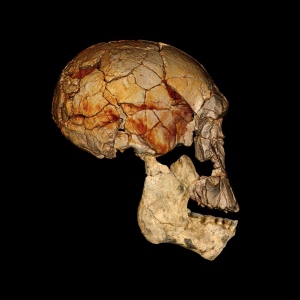
An upper skull found in 1972 and a newly discovered lower jaw are both thought to belong to the enigmatic hominin species Homo rudolfensis.

Fossilized skulls show that at least three distinct species belonging to the genus Homo existed between 1.7 million and 2 million years ago, settling a long-standing debate in palaeoanthropology.

A study published this week in Nature1 focuses on Homo rudolfensis, a hominin with a relatively flat face, which was first identified from a single large skull in 1972. Several other big-skulled fossils have been attributed to the species since then, but none has included both a face and a lower jaw. This has been problematic: in palaeoanthropology, faces and jaws function like fingerprints for identifying a specimen as a particular species (which is indicated by the second word in a Linnaean title, such as 'rudolfensis'), as opposed to the broader grouping of genus (the first word, as in'Homo').

Without complete skulls, it has been difficult to reach a consensus on whether specimens attributed to H. rudolfensis are genuinely members of a distinct species, or actually belong to other Homo species that lived around the same time, such as Homo habilis or Homo erectus. Understanding how many different Homo species there were, and whether they lived concurrently, would help to determine whether the history of the human lineage saw fierce competition between multiple hominins, or a steady succession from one species to another.

Fresh water piping system found at Roman fort


An archaeologist in Northumberland has uncovered more of a Roman water system first found by his grandfather. 


Aerial view of Vindolanda Fort  [Credit: Vindolanda Trust]  

Dr Andrew Birley and a team of volunteers have been excavating land surrounding Vindolanda fort just south of Hadrian's Wall. 

The project to discover and record the pipework at the fort near Hexham was started 82 years ago. The team has identified the spring-head and piping system used thousands of years ago. 


During an excavation in 1930, led by Prof Eric Birley, an area of the Vindolanda site became flooded and not suitable for further investigation.


Neue Zweige im Stammbaum des Menschen


Zwei weitere Frühmenschen-Arten in Kenia gefunden


Montage des neu entdeckten Unterkiefer KNM-ER 60000 mit dem Schädel KNM-ER 1470; man nimmt an, dass beide zur selben Art gehören. © Foto: Fred Spoor

Neue Fossilien, die im Osten des Turkana-Sees in Kenia entdeckt wurden, bestätigen nun, dass dort vor zwei Millionen Jahren neben unserem direkten Vorfahren Homo erectus zwei weitere Arten der Gattung Homo lebten.

Die Funde - ein Gesichtsschädel, ein bemerkenswert vollständiger Unterkiefer und der Teil eines zweiten Unterkiefers - werden in der renommierten Fachzeitschrift Nature am 9. August 2012 beschrieben. Ausgegraben wurden die Fossilien zwischen 2007 und 2009 im Rahmen des von Meave und Louise Leakey geleiteten Koobi Fora Forschungsprojekts (Koobi Fora Research Project, KFRP). Fred Spoor, KFRP-Mitglied und Wissenschaftler der Abteilung Humanevolution am Max-Planck-Institut für evolutionäre Anthropologie koordinierte die wissenschaftlichen Untersuchungen der Fossilien. Zahlreiche Analysen wurden in Leipzig durchgeführt, darunter auch die virtuelle Rekonstruktion der neuen Funde mittels modernster Computertechnologie. 

Wednesday, August 08, 2012

A Roman shipwreck in the ancient port of Antibes


Remains of a Roman shipwreck found by archaeologists at Antibes, southern France. 
Image: © Rémi Bénali, Inrap

 A team of archaeologists from Inrap have uncovered a Roman shipwreck in southern France, in what was once part of the bustling ancient port of Antibes.

Ancient Antipolis

Antibes was known as Antipolis – a Greek colony – and situated on the coast of Provence, it occupied a privileged position on the sea routes linking Marseilles to the Italian coast and contained a natural harbour – Anse Saint-Roch – which protected shipping from prevailing winds.

The harbour

The archaeologists have been exploring the ancient harbour basin that had progressively silted up in antiquity. The basin contains a wealth of objects and information from the third century BC to the sixth century AD. Tens of thousands of objects have already been excavated from the bay of Saint-Roch, including goods from the Mediterranean basin, illustrating the vitality of the ancient port and trade in this part of the world.

Soldiers injured in Afghanistan make surprise find on UK archaeology dig


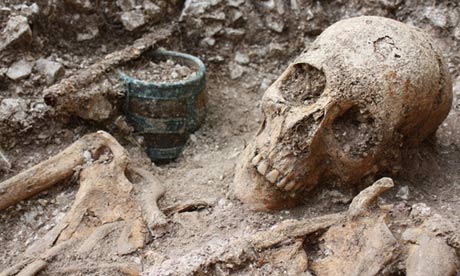
Remains of an Anglo Saxon warrior, buried with his spear and a bronze-bound drinking cup, after he was was discovered by modern soldiers on a rehabilitation programme. Photograph: Ministry of Defence
 
An excavation on Salisbury plain has proved an unusually emotional experience for the volunteer archaeologists, as soldiers recovering from injuries received in Afghanistan have made a surprise discovery: the remains of warriors who died more than 1,400 years ago.

Led by the Defence Infrastructure Organisation (DIO) and the Army, partners from Wessex Archaeology were astonished by the haul. Operation Nightingale is an award-winning project to give soldiers new skills and interests as part of their rehabilitation. The excavation was expected to produce modest results after earlier digs had turned up empty army ration packs and spent ammunition. Instead, they revealed their ancient counterparts, including an Anglo Saxon soldier buried with his spear and what must have been a treasured possession, a small wooden drinking cup decorated with bronze bands.

London’s volcanic winter


Mass graves were needed all too often in the Medieval world, but establishing the specific tragedy behind any given set is difficult. Now Don Walker believes that a group in Spitalfields cemetery can be linked to a massive volcanic eruption, as he told Matthew Symonds.

The destructive force unleashed by Vesuvius, Krakatoa and Mount St Helensmade those volcanoes household names. Yet all three are dwarfed by the largest eruption of the last millennium. Probably occurring in early 1258 AD, it violently ejected between 200 and 600 megatons of sulphate into the Earth’s atmosphere. Around eight times the yield from Krakatoa, this was an eruption on a cataclysmic scale.

Sea gives up a portrait of ancient Rome


Residents knew riches lay beneath because local fishermen had been collecting artefacts in their nets.
 
FOR 2000 years the ancient and decomposing hulk lay buried in deep, muddy waters, off the Italian coast.

Everybody knew it was down there because for more than 80 years local fishermen had been collecting bits of Roman artefacts and pots in their nets.

Finds of this nature are not unusual in Italian waters, which are littered with treasures going back thousands of years.

But these artefacts told a different story, and it was good enough to attract the interest of the archaeological community and a police commander who heads an expert diving squad in the city of Genoa.
 

Mass grave in London result of cataclysmic event


The East Smithfield mass grave site in London [Credit: British Museum]

When archaeologists discovered thousands of medieval skeletons in a mass burial pit in east London in the 1990s, they assumed they were 14th-century victims of the Black Death or the Great Famine of 1315-17. Now they have been astonished by a more explosive explanation – a cataclysmic volcano that had erupted a century earlier, thousands of miles away in the tropics, and wrought havoc on medieval Britons. 

Scientific evidence – including radiocarbon dating of the bones and geological data from across the globe – shows for the first time that mass fatalities in the 13th century were caused by one of the largest volcanic eruptions of the past 10,000 years. 

Such was the size of the eruption that its sulphurous gases would have released a stratospheric aerosol veil or dry fog that blocked out sunlight, altered atmospheric circulation patterns and cooled the Earth's surface. It caused crops to wither, bringing famine, pestilence and death.


Monday, August 06, 2012

Mass grave in London reveals how volcano caused global catastrophe


Mahameru volcano erupting on the island Java July 11 2004

When archaeologists discovered thousands of medieval skeletons in a mass burial pit in east London in the 1990s, they assumed they were 14th-century victims of the Black Death or the Great Famine of 1315-17. Now they have been astonished by a more explosive explanation – a cataclysmic volcano that had erupted a century earlier, thousands of miles away in the tropics, and wrought havoc on medieval Britons.

Scientific evidence – including radiocarbon dating of the bones and geological data from across the globe – shows for the first time that mass fatalities in the 13th century were caused by one of the largest volcanic eruptions of the past 10,000 years.

Such was the size of the eruption that its sulphurous gases would have released a stratospheric aerosol veil or dry fog that blocked out sunlight, altered atmospheric circulation patterns and cooled the Earth’s surface. It caused crops to wither, bringing famine, pestilence and death.

London’s volcanic winter


Mass graves were needed all too often in the Medieval world, but establishing the specific tragedy behind any given set is difficult. Now Don Walker believes that a group in Spitalfields cemetery can be linked to a massive volcanic eruption, as he told Matthew Symonds.

The destructive force unleashed by Vesuvius, Krakatoa and Mount St Helensmade those volcanoes household names. Yet all three are dwarfed by the largest eruption of the last millennium. Probably occurring in early 1258 AD, it violently ejected between 200 and 600 megatons of sulphate into the Earth’s atmosphere. Around eight times the yield from Krakatoa, this was an eruption on a cataclysmic scale.

Volcanic cryptotephra gives clues to Neanderthal demise

Invisible to the human eye, cryptotephra is a fine volcanic glass that is blasted out of erupting volcanoes along with ash. It leaves behind a hidden layer, in the earth, which has now been detected, giving clues about why the Neanderthals died out.

About 40,000 years ago, a layer of cryptotephra particles carpeted a huge area of Central and Eastern Europe after a massive volcanic eruption in Italy called the Campanian Ignimbrite (CI). This eruption, and the resulting environmental and climatic disruption, has been suggested as a factor in the extinction of the Neanderthals.

Interaction with us, modern humans, is one of the other possibilities. Neanderthals, who were our closest relatives, had been living in Europe for hundreds of thousands of years. But all physical evidence of them disappears after about 30,000 years ago. Early modern humans were known to have arrived in Europe at least 35,000 years ago, having originated in Africa, but precise dates, and the length of time they overlapped with the last Neanderthals, are unclear.

Soldiers uncover 27 ancient bodies on Salisbury Plain


All the burials at the mound, which was under attack from burrowing badgers, were excavated by soldiers from The Rifles

Soldiers have unearthed 27 bodies during an archaeological dig on Salisbury Plain.

Troops from The Rifles, injured in Afghanistan, were excavating the 6th Century burial site at Barrow Clump, as part of a programme of rehabilitation.

The bodies, including Anglo-Saxon warriors, had been buried with a range of personal possessions.
Rifleman Mike Kelly said: "As a modern day warrior, unearthing the remains... fills me with overwhelming respect."

Sunday, August 05, 2012

Silchester Iron Age finds reveal secrets of pre-Roman Britain


By the gap in a hedge bordering the entrance off a muddy lane in Hampshire, the young diggers on one of the most fascinating archaeological sites in Britain have made a herb garden: four small square plots. The sudden blast of sunshine after months of heavy rain has brought everything into bloom, and there’s a heady scent of curry plant and dill, marigold and mint.

Many of the plant seeds are familiar from Roman sites across Britain, as the invaders brought the flavours and the medical remedies of the Mediterranean to their wind-blasted and sodden new territory, but there is something extraordinary about the seeds from the abandoned Iron Age and Roman town of Silchester.

The excavation run every summer by Dr Amanda Clarke and Professor Michael Fulford of the archaeology department at Reading University, using hundreds of volunteer students, amateurs and professionals, now in its 15th season, is rewriting British history.

The banal seeds are astonishing because many came from a level dating to a century before the Romans. More evidence is emerging every day, and it is clear that from around 50BC the Iron Age Atrebates tribe, whose name survived in the Latin Calleva Atrebatum, the wooded place of the Atrebates, enjoyed a lifestyle that would have been completely familiar to the Romans when they arrived in AD43.

Medieval silver treasure found on Gotland


A silver treasure from the 12th century has been found on the Baltic island Gotland, where over 600 pieces of silver coins have been unearthed, according to reports in local media.

"This is an amazing find. It’s unbelievable that treasures of this scale exist here on Gotland,” Marie Louise Hellquist of Gotland’s County Administrative Board (Länsstyrelsen) told local newspaper Hela Gotland.

The medieval treasure was uncovered last Monday, as the landowner was moving soil. Some 500 pieces of coin were discovered in the field, and following further searches conducted once archaeologists arrived on Wednesday, that figure has swollen considerably.


“In total we’ve reached 650 pieces, so far,” Hellquist said.


Silver coins were not the only items discovered, as both jewellery and a raw silver artefact, which archaeologists believe to be part of an ancient axe, have been found at the site.

Greed wasn’t good in the Middle Ages – historian looks at medieval business ethics


With business and financial scandals common in today’s new headlines, the axiom ‘Greed is good’ often seems to be the working philosophy of many wealthy executives and businessmen. But greed hasn’t always been popular in Western societies.

Stanford historian Laura Stokes is uncovering how attitudes toward “acceptable greed” have done a turnaround in the past 500 years. Self-serving behavior deemed necessary on Wall Street today might have been despised in medieval Europe. One might even have been murdered for using wealth as a justification for circumventing societal norms.

Capitalism, Stokes has found, managed to flourish in the intensely community-conscious culture of medieval times. Men of business successfully built financial empires based on trade and credit, even though unbridled greed was universally condemned.

The question that perplexes Stokes, an assistant professor of history, is how such men could be admired by their peers, when greed was frowned upon.

UK news London Mass grave in London reveals how volcano caused global catastrophe


Scientists search for the explosive source of a disaster that wiped out almost a third of Londoners in 1258

When archaeologists discovered thousands of medieval skeletons in a mass burial pit in east London in the 1990s, they assumed they were 14th-century victims of the Black Death or the Great Famine of 1315-17. Now they have been astonished by a more explosive explanation – a cataclysmic volcano that had erupted a century earlier, thousands of miles away in the tropics, and wrought havoc on medieval Britons.

Scientific evidence – including radiocarbon dating of the bones and geological data from across the globe – shows for the first time that mass fatalities in the 13th century were caused by one of the largest volcanic eruptions of the past 10,000 years.

Such was the size of the eruption that its sulphurous gases would have released a stratospheric aerosol veil or dry fog that blocked out sunlight, altered atmospheric circulation patterns and cooled the Earth's surface. It caused crops to wither, bringing famine, pestilence and death.

Roman dig reveals early Christian graves


Early Christian graves recently unearthed by archaeologists are to be the highlight of daily tours of Maryport Roman fort. 

Visitors to Senhouse Roman Museum, which is at the fort, will find out what happens during excavations.
They will also be able to see recently unearthed evidence of Christian graves during the daily tours until 14 August. 

A spokesman for the museum said the discovery of the graves was exciting and shed "new light" on the Dark Ages. 

Remnants from the grave include bone fragments, caps of tooth enamel, and a thumbnail-sized piece of textiles. 

Peter Greggains, of the Senhouse Museum Trust, said: "The Maryport site's importance as a unique and valuable resource capable of providing information about the remote past has been established beyond doubt, and we now have new light on the Dark Ages."

Archäologie und Recht: Workshop-Premiere in Paderborn


Am Montag, den 30.7., trafen sich in Paderborn Nachwuchs-Archäologen und Experten um Wissenschaft und praktische Archäologie näher zusammenzurücken.

Junge Nachwuchswissenschaftler haben für eine Premiere im historischen Gebäude der Paderborner Stadtarchäologie am Busdorfwall gesorgt und einen halbtägigen Workshop zum Thema »Archäologie und Recht« auf die Beine gestellt. Am Montag (30.07.) waren 25 Nachwuchsarchäologen und Experten zu Gast bei den Paderborner LWL-Archäologen. 

Call for Papers: Digital Classicist Seminar Berlin


Die Seminarreihe "Digital Classicist", nach dem Vorbild einer Veranstaltungsreihe in London, soll die Anwendung moderner digitaler Methoden, Ressourcen und Techniken in den Altertumswissenschaften thematisieren. Sie wird unter anderem von dem Deutschen Archäologischen Institut (DAI) und dem Excellenzcluster TOPOI in Berlin veranstaltet und soll erstmals im Wintersemester 2012/13 stattfinden.

Friday, August 03, 2012

Dig Reveals Early Christian Cemetery


Early Christian graves have been found in the archaeological dig at Camp Farm, Maryport, next to the foundations for a large building identified in the 2011 excavation season.  The site overlooks a nearby Roman fort and settlement.

Said Newcastle University’s Professor Ian Haynes, project director for the excavation,: “We still haven’t resolved the full plan of the site, and this will be our focus for the remaining weeks of the excavation. As far as the structures are concerned, it’s looking as if there are at least two phases of construction.  Meanwhile, the graves that have been discovered indicate sustained use of the cemetery site.”

Painstaking excavation has revealed bone fragments, caps of tooth enamel, a glass bead necklace and a tiny fragment, about the size of a thumbnail, of ancient textile.

Archeologists unearth Celtic artifacts, plus ancient Roman and Greek silver coins on future track of Romanian highway


Several metal archeological objects and over 280 silver coins were discovered by archeologists on the track of the future Sibiu – Nadlac highway in Romania. One of the discoveries, a small iron replica of a chariot was deemed unique in the region. The objects discovered in the nine archeological sites, dating from the early Neolithic to the Medieval Ages, will most likely be restored within a year. A first exhibition including some of the objects will be open in May 2013.

A team of 40 Romanian and foreign archeologists searched around 40 kilometers on the future highway track in three counties, Sibiu, Alba and Hunedoara. This was one of the biggest archeological digs ever undertaken in Romania, according to Sabin Luca, director of the Brukenthal National Museum.

Researchers discovered a Bronze age settlement and “the first level of colonization which could be connected to our ancestors dates from the Celtic era, in the 3rd and 2nd centuries BC,” according to Sabin Luca. The small iron chariot discovered will most likely be unique, he went on to say. In Celtic areas, the iron chariot is usually buried with the full size chariot, but in this case it was buried separately. The piece was in 80 pieces and its restoration took three weeks.

Read the rest of this article...

Restoration of Apollo Temple at Didyma begins


Restoration works have begun at the Apollo Temple in the Aegean province of Aydın’s Didim district. The excavation work that has been conducted in the temple for 106 years by the German Archaeology Institute was canceled this year for the storage and restoration of materials unearthed during this process.

Now the work is being carried out under the leadership of Austrian Bond University member Dr. Ulf Weber. Speaking to the press, the German Archaeology Institute Apollo Temple Restorations official Helga Bumke said she had been working on the excavations since 1994 and had found thousands of pieces during the Apollo Temple and Holy Road excavations.

She said six people were working in the temple and 12 people were working in the storage unit, adding that two committees would come to the district in September to support their work. 

Roman aqueduct found under store in Rome


The Roman aqueduct discovered beneath the former Rinascente building [Credit: Wanted in Rome]

Ruins of the Vergine Aqueduct, one of the most important in ancient Rome, have been discovered under the former Rinascente building off Via del Corso, now the home of Spanish retail giant Zara. 

Archaeologists came across the aqueduct under the intersection of Via del Tritone as excavations began to enlarge the retail premises. However the expansion plan – scheduled to take two and a half years – continues, with the intention of opening a larger store in 2015. 

Plans are in place to preserve the ruins and make them visible to visitors, similar to other archaeological discoveries under the capital's shops such as the Ikea store at Anagnina.

Wednesday, August 01, 2012

Denmark’s past viewed from above

This field once housed a large Viking settlement. The centre of the picture shows vestiges of a Viking Age house with long curved walls. Other remnant houses are also visible in the cornfield, along with vestiges of pit houses.

There’s a lot to learn about the past by studying the land from high above. See a series of stunning aerial archaeology photos here.


Since 2009 archaeologists have been using small aircraft to map nine areas in Denmark that are of particular interest to archaeologists and historians.

The project is called 'The past as viewed from the sky – air archaeology in Denmark' and will initially run until 2013.

But what can aerial photos possibly tell us about the past?

Colosseum in Rome is leaning, officials say


The ancient Colosseum in Rome is slanting about 40cm lower on the south side than on the north, and authorities are investigating whether it needs urgent repairs.

Experts first noticed the incline about a year ago and have been monitoring it for the past few months, Rossella Rea, director at the 2,000-year-old monument, said in the Italian daily Corriere della Sera.

The Leaning Tower of Pisa, another of Italy's most popular attractions, was reopened in 2001 after being shut for more than a decade as engineers worked to prevent it from falling over and to make it safe for visitors.
Rea has asked La Sapienza University and the environmental geology institute IGAG to study the problem and report back in a year.

What Vikings really looked like


Were Vikings really dirty savages who wore horned helmets, or did they look like we do today? Here’s what the experts say.

There’s no shortage of myths about the appearance of our notorious Viking ancestors.

To find out more about these myths, ScienceNordic’s Danish partner site, videnskab.dk, asked its Facebook readers to list their favourite myths about what the Vikings looked like.

We have picked out five myths from the resulting debate and asked researchers to help us confirm or bust these myths.
Armed with this information, our graphic designer then took a shot at drawing some examples of our infamous forefathers, which you can see in our picture gallery.

Read the rest of this article...

Brewing Stone Age beer


Jørn Kragtorp (left) and Manfred Heun brew beer from the primitive wheat known as einkorn. Here they are adding a malt of einkorn, ready to start the brewing process. (Photo: Asle Rønning)

Beer enthusiasts are using a barn in Norway’s Akershus County to brew a special ale which has scientific pretensions and roots back to the dawn of human culture.

The beer is made from einkorn wheat, a single-grain species that has followed humankind since we first started tilling the soil, but which has been neglected for the last 2,500 years.

“This is fun − really thrilling. It’s hard to say whether this has ever been tried before in Norway,” says Jørn Kragtorp.

He started brewing as a hobby four years ago. He represents the fourth generation on the family farm of Nedre Kragtorp in Aurskog-Høland, Akershus County.

Later Stone Age got earlier start in South Africa than thought


New research led by CU-Boulder on South Africa's Border Cave shows the Later Stone Age emerged more than 20,000 years than previously thought [Credit: Courtesy Paola Villa, University of Colorado] 

The Later Stone Age emerged in South Africa more than 20,000 years earlier than previously believed -- about the same time humans were migrating from Africa to the European continent, says a new international study led by the University of Colorado Boulder. 

The study shows the onset of the Later Stone Age in South Africa likely began some 44,000 to 42,000 years ago, said Paola Villa, a curator at the University of Colorado Museum of Natural History and lead study author.  The new dates are based on the use of precisely calibrated radiocarbon dates linked to organic artifacts found at Border Cave in the Lebombo Mountains on the border of South Africa and Swaziland containing evidence of hominid occupation going back 200,000 years. 

The Later Stone Age is synonymous to many archaeologists with the Upper Paleolithic Period, when modern humans moved from Africa into Europe roughly 45,000 years ago and spread rapidly, displacing and eventually driving Neanderthals to extinction. The timing of the technological innovations and changes in the Later Stone Age in South Africa are comparable to that of the Upper Paleolithic, said Villa.

Giant Neo-Hittite sculpture unearthed in Turkey


Side view of the Suppiluliuma statue [Credit: Jennifer Jackson]

A beautiful and colossal human sculpture is one of the latest cultural treasures unearthed by an international team at the Tayinat Archaeological Project (TAP) excavation site in southeastern Turkey. A large semi-circular column base, ornately decorated on one side, was also discovered. Both pieces are from a monumental gate complex that provided access to the upper citadel of Kunulua, capital of the Neo-Hittite Kingdom of Patina (ca. 1000-738 BC). 

"These newly discovered Tayinat sculptures are the product of a vibrant local Neo-Hittite sculptural tradition," said Professor Tim Harrison, the Tayinat Project director and professor of Near Eastern Archaeology in the University of Toronto's Department of Near and Middle Eastern Civilizations. "They provide a vivid glimpse into the innovative character and sophistication of the Iron Age cultures that emerged in the eastern Mediterranean following the collapse of the great imperial powers of the Bronze Age at the end of the second millennium BC."

Fant 1500 år gammelt hus som trolig tilhørte høvding

Det er oppdaget seks flatmarksgraver i området som skal graves ut i ukene som kommer. Det mørke feltet i bakken viser en av dem.
FOTO: Cato Guhnfeldt

Det 1500 år gamle jernalderhuset hadde et monumentalt inngangsparti med stor trapp. Dette ble i forrige uke gravd frem av arkeologer.

Bygningen er den største som er avdekket i Rogaland i løpet av de siste tiårene, i et område hvor det har stått i alt 30-35 bygninger og bodd mennesker i minst 1000 år. De levde av jordbruk, dernest fangst og fiske foruten handel.

Minst ni innganger

- Da vi hadde avdekket høvdingbygningen i en lengde av 50 meter, steg pulsen. Da vi passerte 60 meter, begynte vi å se på hverandre. Hva i all verden var dette? forteller utgravningsleder Even Bjørdal fra Arkeologisk museum/Universitetet i Stavanger.
Den avdekkede kjempebygningen er et såkalt treskipet stolpehus. 65 meter langt, 7 meter bredt, med minst ni innganger, kanskje flere, har bygningen vært brukt som bolig, til fest og matlaging, trolig også til produksjon av metallgjenstander som bronsesmykker og redskaper/våpen.

Sunday, July 29, 2012

17,500-Year-Old Ceramic Figures Unearthed in Croatia


36 ceramics artifacts found at the archaeological site of Vela Spila, Croatia (Rebecca Farbstein / PLoS ONE)

An international team of archaeologists has uncovered the first evidence of ceramic figurative art in late Upper Paleolithic Europe – from about 17,500 years ago, thousands of years before pottery was commonly used.

The evidence of a community of prehistoric artists and craftspeople who ‘invented’ ceramics during the last Ice Age has been found at the archaeological site of Vela Spila, Croatia.

The finds consist of 36 fragments, most of them apparently the broken-off remnants of modeled animals, and come from the site on the Adriatic coast. The archaeologists believe that they were the products of an artistic culture which sprang up in the region about 17,500 years ago. Their ceramic art flourished for about 2,500 years, but then disappeared.

31 early Christian tombs discovered in Serbia


The remains of 31 early Christian tombs have been discovered during archaeological excavations in Nis, Serbia's third largest city in the southern part of the country. 

"These are the most important excavations carried out so far on the site of the early Christian necropolis of Jagodin-mala", said Toni Cerskov, who heads the team of 45 archaeologists, architects, anthropologists, photographers and workers at the site. The tombs are located under the former textile factory Niteks, the Tanjug news agency reports.

Saturday, July 28, 2012

Christian Vikings


Christian burials in Ribe in Denmark have been dated to mid 9th century

Danish Archaeologists have been busy digging around the old Cathedral in Ribe for several years. Here lies a cemetery, which was abandoned about 1050. The sensational character of the find has however more to do with the fact, that the earliest graves have been dated to around 850 – more than a 100 years before Denmark was officially Christianised according to the famous rune-stone of Harold Bluetooth in Jellinge.

All in all the archaeologists believe there were between 1500 -2000 graves in the cemetery of which at least 60 (and probably 75) belong to the earliest phase. The dead persons have been buried in a number of different types of caskets made of wood, one of which may even have been a small boat. However, the graves are all pointing towards East and no grave-goods have been found. Strontium analysis has shown that the buried persons grew up locally.

Flying Lasers Reveal Buried Historical Structures


Archaeology is being revolutionized by remote-scanning techniques that use lasers to detect otherwise invisible ground features. The technology digitally extracts vegetation for a clean image of the earth's surface. Archaeologists in Germany have already discovered thousands of new sites. 

The Glauberg is a hot spot for archaeologists. For decades, researchers have been studying the hill in the central German state of Hesse, where people settled some 7,000 years ago. 

Over the millennia, the plateau was inhabited by Celts and Alemanni and, in the Middle Ages, people there built castles that reached for the sky. Accordingly, researchers have found plenty of artifacts. In 1996, they made the sensational discovery of an almost perfectly preserved statue of a Celtic warrior, which is now known as the Celtic Prince of Glauberg.

'Perplexing' find at Alderney Roman dig


Archaeologists have found something "interesting" and "perplexing" at a Roman dig in Alderney.

A team from the island, the UK and Guernsey are excavating land at the fort of the nunnery at Longy Common.

The dig is focusing on a gateway and wall but the team said they were "not expecting" the way it was laid out.

Dr Jason Monaghan said: "We've found something interesting, but we don't actually know what it is until we take a bit more dirt out." 

Dr Monaghan, Director of Guernsey Museums, said the team had dug a trench to examine the gateway.
"It's a bit perplexing, the nunnery always throws little surprises at us and the wall has changed below the ground level and we weren't expecting that to happen so we need to know why it's changed," he said.

Viking boat bid for Barrow Dock Museum funds


"Vikings" are taking to the water to raise money for a south Cumbria museum hoping to house a newly-acquired treasure hoard.

A metal detector enthusiast found Viking silver coins and ingots near Stainton, Dalton, in 2010.

Barrow Dock Museum raised £50,000 to buy the hoard, and now wants to build a special Viking gallery.
Re-enactor warriors are rowing a replica longboat around Derwent Water to raise the cash.

The team, from Herlid Vikings group, will set off from Lodore to the Keswick boat landing, where they will hold a combat display.

Discovery of early medieval royal stronghold in southwest Scotland

Trusty's Hill Pictish carving. Image: Galloway Picts Project

A recent Heritage Lottery funded archaeological excavation has discovered a hitherto forgotten early medieval royal stronghold in Scotland.

Pictish symbols

Trusty’s Hill, near Gatehouse of Fleet in Dumfries and Galloway, is best known for the Pictish Symbols carved into a natural rock outcrop at the fort’s entrance.  However, in recent years, many historians have begun to doubt whether these carvings were genuine, some even suggesting that the carvings are forgeries. The Galloway Picts Excavation, led by the Dumfriesshire and Galloway Natural History and Antiquarian Society and funded in part by the Heritage Lottery Fund, sought to find out why there are Pictish Carvings here, so far from the Pictish heartlands in the north-east of Scotland, and if the carvings are indeed genuine.

Under the direction of two members of the Society, over 60 local volunteers, assisted by professional archaeologists from GUARD Archaeology Ltd, spent two weeks discovering new archaeological evidence that establishes a clear archaeological context for the Pictish Symbols at this vitrified fort.

Nit combs are 'nothing new'

Proof that even ancient folk needed the nit comb

It's official ... even ancient folk needed a nit comb.

A fine tooth comb is among treasures uncovered at an excavation site near Enniskillen, County Fermanagh.
Arrow heads, pottery and ancient human remains have been found at the crannog - a kind of artificial island - that could date back more than 1,000 years.

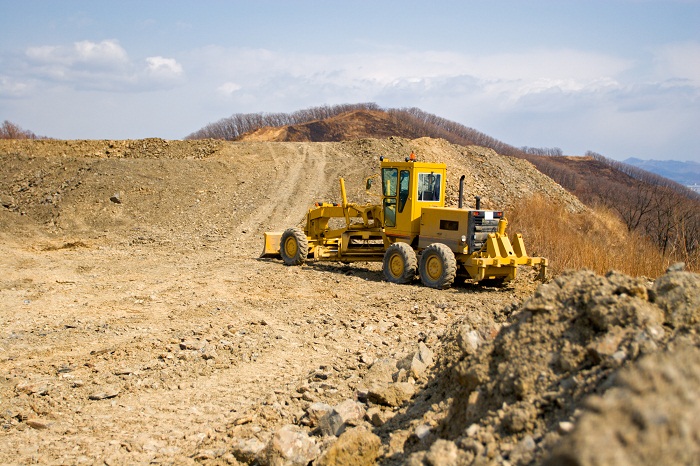
The site is being cleared to allow for a new road, but archaeologists have been given some time to glean all they can before the bulldozers move in.

"The Cherrymount link crannog was thought initially to date back to the 14th century but now evidence suggests it went back to early medieval times," said archaeologist Declan Hurl.