Monday, May 07, 2018

Scientists Confirm Earliest Use of Fire and Oldest Stone Handaxe in Europe


In a recently published paper* in the journal, Historical Biology, researchers report confirmation that sediments bearing early human cultural remains in the Cueva Negra del Estrecho del Río Quípar rockshelter in southeastern Spain are dated to over 800,000 years ago. The sediments include an Acheulean style stone handaxe and evidence for the use of fire within the rockshelter.

“We regard its age as quite likely between 865,000 and 810,000 years ago,” said Michael Walker of Spain’s Murcia University, a lead researcher on Cueva Negra.

“[Arguably] Until now hand-axes in Europe have not been recorded from before 500,000 years ago,” said Walker. Moreover, he adds, “the evidence of combustion [use of fire] is also the oldest anywhere outside Africa.”

Read the rest of this article...

Roman relics found in Rhine region show evidence of bloody uprising


One of the ancient Roman helmets found in the recent excavation in Krefeld. Photo: DPA

In the North Rhine-Westphalian town of Krefeld, a recent archaeological dig revealed thousands of ancient relics. These finds tell the story of the region’s turbulent Roman history.
Tens of thousands of artefacts were dug out of sand and clay near the Rhine, archaeologists in Krefeld announced in April.

A recent 10-month excavation along the Rhine revealed a wealth of previously-unseen Roman ruins, including hundreds of coins, weapons, horse skeletons, jewellery, helmets, and the artfully decorated belt buckle of a soldier. Packed in boxes, the relics span over 75 cubic metres. 

In the small town just outside Düsseldorf, nearly 6,500 graves were found dating from between 800 BC and 800 AD, which often contained valuable burial objects. It is one of the largest ancient cemeteries north of the Alps. 

Read the rest of this article...

Stone Age settlement found in the middle of Copenhagen


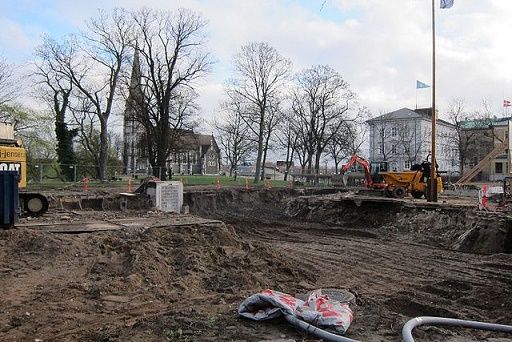
Traces of Copenhagen’s Stone Age past were found under the resistance museum just opposite the Anglican church (photo: Henrik Lundbak, Nationalmuseet)

Archaeologists from the Museum of Copenhagen have made a rather sensational discovery: evidence of a settlement estimated to be around 7,000 years old.

During the building work for the new museum of Danish resistance at Kastellet, flint arrowheads, animal bones and even a couple of human bones have come to light, a municipal press release reveals.

“Finding a Stone Age settlement is special because it reveals the history of the area long before it became Copenhagen,” said the deputy mayor for culture and leisure, Niko Grünfeld.

Read the rest of this article...

Iron Age finds to go on display in Alderney


A display of Iron Age finds that were dug up in Alderney are going on display in the island.

Guernsey Museums is also heading back to the island in July to carry out three archaeological excavations at the Nunnery, a Roman gate and a cemetery.
Dr Jason Monaghan, head of heritage services at Guernsey Museums, said the Iron Age finds were of a "really high quality for such a small place".

"This must mean it was an important place - we think the trade routes may have come right past Alderney," he added.

Read the rest of this article...

Beowulf: The enduring appeal of an Anglo-Saxon 'superhero story'

Beowulf is the oldest surviving epic poem in the English language

As the cold sting of winter finally starts to fade, so the literary festival season edges closer. An addition to the line-up this year is a five-day celebration of the legendary saga of Beowulf. How is it that a story written by an unknown author more than 1,000 years ago still captures the imagination?

The eponymous hero of this 3,182-line poem battles fierce monsters, rips off his enemy's arm, fights a fire-breathing dragon and defends a nation.

It could be the plot of Hollywood's latest blockbuster movie.

But this is the story of Beowulf, a poem once told in timber-framed barns in Anglo-Saxon England, to the raucous noise of the mead-swilling crowd.

Described by historian and broadcaster Michael Wood as "being at the very root of English literature", the author and the exact date of composition remain a mystery.

Read the rest of this article...

Meet the ancestors… the two brothers creating lifelike figures of early man


Compare and contrast (l-r): Homo sapiens and a Neanderthal man. Photograph: Kevin Webb/
The Natural History Museum, London 


Dutch twins Adrie and Alfons Kennis are showing their uncanny models in museums all over Europe. Adrie discusses how their creations are realised and the extreme reactions they can provoke
Identical twins with a combined age of 102, Adrie and Alfons Kennis are among Europe’s most sought-after – and controversial – hominid palaeo-artists: sculptors of lifesize reconstructions of early humans.

Working from a studio in their home town of Arnhem in the Netherlands, the brothers bring a surplus of exuberance to their creations, which are richly animated, expressive and – how better to put it? – human, even when they aren’t quite human. “If we have to make a reconstruction,” says Adrie, “we always want it to be a fascinating one, not some dull white dummy that’s just come out of the shower.”
In the 10 or so full-sized reconstructions completed during their career they have run the gamut of human history, from “Lucy” – the earliest known hominin fossil – to Homo erectus, Neanderthal man and, of course, Homo sapiens. Just last week, they put the finishing touches to a model for St Fagans National Museum of History in Wales. Due to be unveiled in October, it will be the third Kennis & Kennis work on display in the UK.

The process is exhausting. First, they rebuild the skeleton, sometimes using fossils from several different sites, with the help of computer scans and 3D printing. The skeleton is suspended with wire cables and the spine is made flexible using silicone cartilage between the vertebrae. “We use a kind of paraffin wax clay to sculpt the muscles,” says Adrie, “and we make arteries using small ropes which lie over the muscles.” Layers of another clay are then wrapped around the sculpture as skin, and a mould is made to replicate the sculpture in silicone. “We do five layers of silicone to make the skin colour,” explains Adrie, “because real skin is translucent.”

Read the rest of this article...

Thursday, April 26, 2018

12th century castle moat unearthed during Newark sewer work

The moat uncovered during work by Severn Trent in Newark

A 12th century castle moat has been unearthed during work on a £60m project on Newark's serwers.

Archaeologists working as part of Severn Trent’s water and waste improvement scheme in the town made the discovery recently.

Severn Trent Programme Engineer Nick Wallace said: ‘It’s really exciting we’ve been able to reveal these glimpses of Newark’s hidden heritage during our work.

"We’re unveiling new information which adds to the already rich story of the development of this historic town.”

Severn Trent is working in Newark until 2020, and has a resident archaeologist on hand to oversee the work to make sure that the heritage remains undisturbed.

Read the rest of this article...

Skeleton of child trying to shelter from Vesuvius eruption uncovered in Pompeii

The skeleton of the child, thought to be aged seven or eight, found at Pompeii

Archeologists in Pompeii have discovered the skeleton of a child who tried in vain to hide from the cataclysmic eruption of Mt Vesuvius nearly 2,000 years ago.

It is the first time in about 50 years that a child’s skeleton has been found in the remains of the ancient Roman city, which lies just south of Naples and was destroyed in AD79.

The child, believed to be seven or eight years old, apparently took refuge in a public baths complex after the volcano erupted and started spewing ash and pumice into the air.

But the building could not save the terrified youngster from the effects of the eruption, which was witnessed by Pliny the Younger.

It is believed that he or she was not killed by falling debris, but instead suffocated by the clouds of scorching ash that enveloped the city, a thriving port on the Bay of Naples.

Read the rest of this article...

The biggest status symbol in the Nordic Iron Age was a goose

A woman buried with a sheep is typical of the graves throughout the Roman Iron Age (in the Nordic countries). Other animal species (including sheep) are found in younger periods and demonstrate Roman influence. (Photo: Kroppedal Museum)

Forget about Gucci bags, gold jewellery, and fast cars. In the Nordic Roman Iron Age, the best status symbol was a goose. Alternatively a hen.

That is the conclusion made by Danish scientists after studying almost 100 graves from the Early and Late Roman Iron Age (1-375 CE).

They further posit that the Roman influence led to a significant shift in the way in which Scandinavians buried their dead.

One of the changes was the custom of burying people with different species of animals – and the newly introduced hens and geese were especially high-ranking status symbols.

“We don’t have these kinds of poultry before Christ, so it is clearly associated with the Roman life and Roman status. In the Roman Empire, hens and geese were a common burial gift, while in Denmark they were new and exotic species,” says Anne Birgitte Gotfredsen from the Natural History Museum of Denmark at the University of Copenhagen.

Read the rest of this article...

Ash from destructive hill fort fire 'preserved in peat'

Dun Deardail was built 2,500 years ago
NEVIS LANDSCAPE PARTNERSHIP

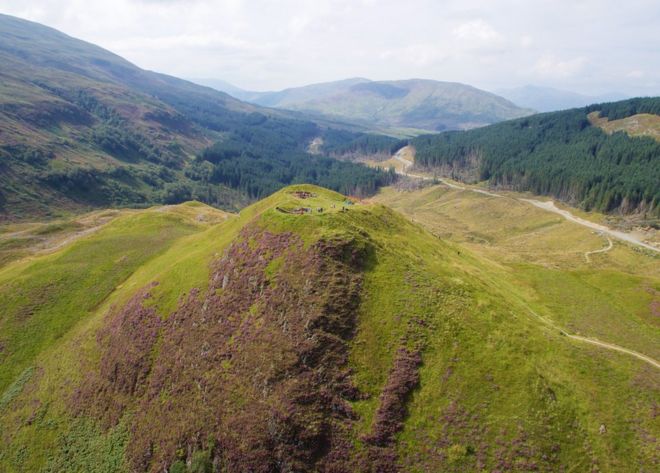
Archaeologists believe they have found, preserved in peat, charcoal from a fire that destroyed an ancient hillfort.

Dun Deardail was built about 2,500 years ago on a prominent knoll on Sgorr Chalum, a hill overlooking the River Nevis in Glen Nevis.

Charcoal found in surrounding peatbog has been analysed.

Four "significant fire events" were identified as layers of charcoal or soot. One, from around 310BC, is thought to be the fort's burning.

Archaeologists said the fire that destroyed Dun Deardail would have "created towering plumes of smoke rising up from the fort, expelling ash and charcoal into the air".

Read the rest of this article...

Megalithic Malta : Prehistoric but far from Primitive


If the Neolithic (New Stone Age) seems remote, primitive and ‘Just a load of old stones’, take a visit to Malta.   Here you can go back in time over 5,000 years; the remains of the amazing temples and the figurines and artefacts that folk left behind here are sophisticated and imaginative.  As far back as 4,000 BC, the sites here bear witness to a culture and a civilisation that was full of art, architecture and spirituality; society here was vibrant and the island is still littered with impressive structures that, even now, fill us with awe.
Unique and, oh, SO Ancient
The megalithic (‘huge stones’) temples in Malta are unique.  Nowhere else can you find structures quite like these.  Huge stones were not that unusual in the Neolithic; explore Orkney’s stone circles and Maes Howe tomb, wander along the long lines of standing stones at Carnac in France or gaze at the massive blocks at Stonehenge and you will see large and heavy stones used for monumental effect.
Read the rest of this article...

Swedish Archaeologists Uncover Brutal 5th-Century Massacre


Excavations from an Iron Age fort in modern-day Sweden revealed brutalized human remains and other macabre traces of a massacre that stopped a small Scandinavian community in its tracks some 1,500 years ago.

Six years after the archaeological investigations began, the team has published a report of their findings in the journal Antiquity. Although only 6 percent of the site has been unearthed and analyzed, the evidence gathered thus far paints an unprecedently vivid picture of life – and death – in late 5th-century Europe, a turbulent period following the fall of the Western Roman Empire.

Located on the island of Öland off the coast of southeast Sweden, the Sandby Borg ringfort resembled a large oval-shaped mound of grass and dirt encircled by crumbling stone before the archaeologists arrived. Hoping to preserve the contents of the site from recently spotted treasure hunters, the team slowly but surely revealed that the unassuming ruins belonged to a 5,000-square-meter (54,000-square-foot) village, containing 53 dwellings, enclosed by stone walls that once stood 4-5 meters (13-16 feet) high.

Read the rest of this article...

Swedish archaeologists reveal 5th Century massacre at Sandby borg

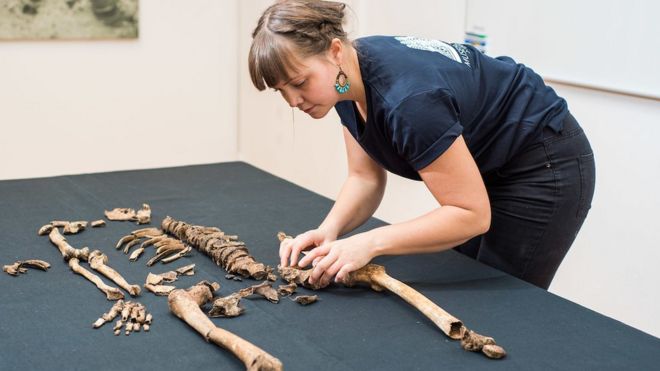
Team member Clara Alfsdotter arranges the remains of one victim

Swedish archaeologists have found evidence of a 5th century massacre on the south-eastern island of Oland.

In a paper published in the journal Antiquity, the team writes about the 1,500 year old attack at Sandby borg.

Dozens of corpses have been found in the walled fort, their bodies left to rot where they fell.

All of the victims were killed with "brutal force", team leader Helena Victor said. Some victims were found inside houses, others in the streets.

The archaeologists discovered decapitated bodies, blunt force trauma wounds to victims' heads, and even one person who seemed to have fallen into a fireplace in his final moments.

Even the corpse of a newborn was found among the dead, suggesting nobody was spared, the authors say.

Read the rest of this article...

Monday, April 23, 2018

Skeletons of first Copenhageners discovered under City Hall Square

Secret dig yields startling find (photo: Copenhagen Museum)

Since December, a team of archaeologists from the Museum of Copenhagen have secretly been excavating 20 skeletons discovered under City Hall Square.

The skeletons belong to men, women and children who are believed to have lived around 1,000 years ago, and which archaeologists believe were the first Copenhageners.

“It’s amazing. The graves with the skeletons in good condition are lying just a metre under the asphalt on the busiest square in Denmark,” Jane Jark Jensen, an archaeologist and curator with Copenhagen Museum, told Politiken newspaper.

The archaeologists believe that there are two additional layers of skeletons underneath the layer they are currently excavating.

Read the rest of this article...

Archaeologists may have found Copenhagen’s oldest church

The City Hall Square excavation site has yielded some interesting results 
(photo: Museum of Copenhagen)

When it emerged in February that a team of archaeologists had been secretly excavating 20 skeletons under City Hall Square, it was believed they belonged to the first Copenhageners who lived some 1,000 years ago.

Now, the archaeologists have discovered the remains of a foundation that they think could stem from the first church in the Danish capital – a find that would help confirm that the Danish capital was an established city earlier than believed.

“If it is a church, it would further prove that Copenhagen was an established city at the start of the Middle Ages,” Lars Ewald Jensen, the archaeological head of the Museum of Copenhagen, told Videnskab.dk.

“You can have a burial site without an established city, because there needs to be more elements present before one can call it a city. But then again, you can’t have a city without having a church.”

Read the rest of this article...

Neolithic Surgeons May Have Practiced on Animals


PARIS, FRANCE—Paleontologists Alain Froment and Fernando Ramirez Rozzi of the French National Center for Scientific Research suggest a hole in a cow skull uncovered at the Neolithic site of Champ-Durand in southwestern France could be evidence of a surgical procedure. According to a Gizmodo report, their analysis of the hole found no trace of fracturing or splintering, indicating it was not caused by goring from another cow, or a puncture from a powerful blow with a stone tool. 

Read the rest of this article...
Colourful past of Scotland's Roman wall

THE HUNTERIAN/ UNIVERSITY OF GLASGOW
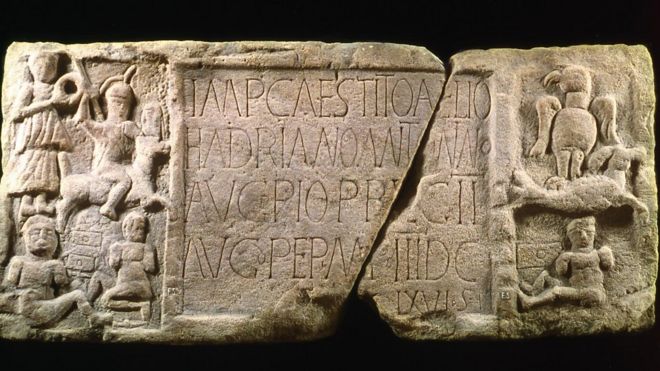
The Summerston distance stone from the Antonine Wall, which was found near Bearsden, was one artefact successfully tested for pigment

Parts of the Roman Empire's most north western frontier were likely to have been painted in bright colours, new research has found.

The Antonine Wall was built across central Scotland from Old Kilpatrick in the west to Bridgeness in the east.

Now an expert at Glasgow University has used cutting edge technology to examine the remnants of the structure.

And archaeologist Louisa Campbell has found that "distance stones" were painted vibrant red and yellow.

She said the coloured stones were used by the Romans to demonstrate their power over local people.

"The public are accustomed to seeing these sculptures in bland greys, creams, white (for marble) and don't get the full impact that they would have had on the Roman and indigenous audiences 2,.000 years ago," she added.

Read the rest of this article...

Stonehenge archaeology 'under threat' from Highways England diggers

Stonehenge Alliance said using heavy machinery on wet ground could "devastate any fragile archaeological deposits"

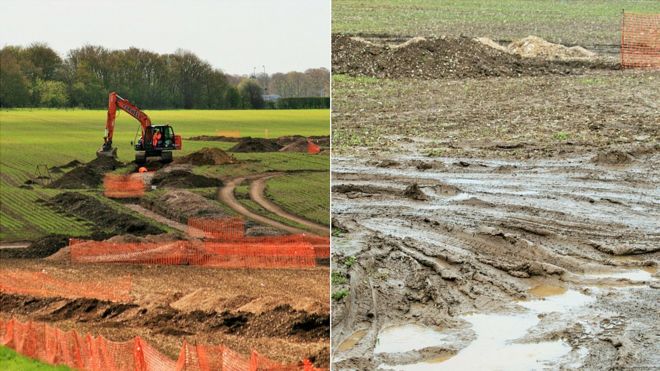
Heavy diggers being used by Highways England near Stonehenge are threatening its "fragile archaeology", campaigners have warned.

The agency has been surveying the proposed site of a controversial tunnel near the monument since January.

Stonehenge Alliance said archaeological evidence may be lost due to heavy machinery being used on wet ground.

Highways England said the claims were "alarmist and untrue" and "due care" was being "exercised at all times".

Plans for 1.8-mile (2.9km) underground dual carriageway as part of a £1.6bn upgrade of the A303, were unveiled by the government in January.

But Dr Kate Fielden, from Stonehenge Alliance - a campaign group which includes archaeologists and environmental campaigners - said what Highways England were doing in the area "beggars belief".

Read the rest of this article...

DES OCCUPATIONS DU NÉOLITHIQUE À L’ÂGE DU FER SUR LE CONTOURNEMENT OUEST DE STRASBOURG


Une équipe d’archéologues de l’Inrap mène actuellement une fouille archéologique à Berstett (Bas-Rhin), sur prescription de l’Etat (Drac Grand Est), en amont de la construction de l’autoroute du Contournement Ouest de Strasbourg portée par le Groupe Vinci Autoroutes. Les archéologues mettent principalement au jour des vestiges des périodes du Néolithique jusqu’à l’âge du Fer.

Read the rest of this article...
Thursday, April 19, 2018

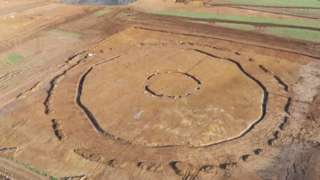
Raunds henge 'discovered' by Warth Park building work


An archaeological site thought to be 4,000 years old has been fully unearthed by work to extend an industrial estate.

Builders have uncovered the henge, which is 100m (330ft) in diameter, at Warth Park in Raunds, Northamptonshire.

An aerial photo showing the scale of the Neolithic monument first emerged on Twitter on Tuesday, but was deleted.

However, archaeologists say that site, known as Cotton Henge, has previously been investigated twice before.

Oxford Archaeology East, working on behalf of developer Roxhill, said the henge was first identified by aerial photography in the 1970s.

They added that it was likely to date from the late Neolithic period (circa 3000BC -2500BC) and forms part of a larger group of ceremonial landscape features located and excavated as part of the Raunds Area Project.

Read the rest of this article...