Thursday, June 21, 2012

To sue or not to sue? Parthenon Marbles activists debate


The British Museum says it can display the sculptures "in the context of world history"
Activists from around the world seeking the return of the Parthenon sculptures to Athens have met in London to discuss their strategy as Greece faces troubled times.

"The Olympics are a four-yearly reminder to the world of all we owe to Greece," said former MP Eddie O'Hara - who chairs the British Committee for the Reunification of the Parthenon Marbles.

The meeting, he added, "ought to remind people in London and throughout the world that there's one debt to Greece that will never be repaid until those sculptures in the British Museum are returned."

But he said there was a "hiatus" in the campaign because economic woes meant not much action could be expected from the Greek authorities.

Mammoth field found at Serbia coal mine 'great find for Ice Age knowledge'


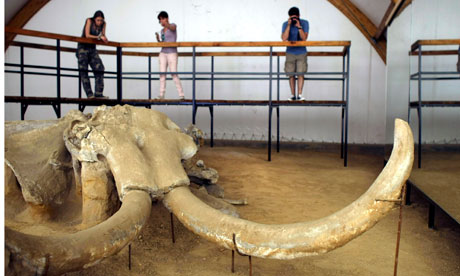
A mammoth recovered from the 'mass grave' at the Kostolac open-pit coal mine about 50 miles east of Belgrade. Photograph: Marko Drobnjakovic/AP

Archaeologists say bones of five woolly mammoths at Kostolac coal pit may reveal more about Balkans several millennia ago
 
FArchaeologists have unearthed at least five mammoths at a site in Serbia. The discovery last week at Kostolac coal mine, east of the Serbian capital of Belgrade, is the first of its kind in the region and could offer important insights into how the ice age affected the area now known as the Balkans. Miomir Korac, of Serbia's Archaeology Institute, said: "There are millions of mammoth fragments in the world, but they are rarely so accessible for exploration."

"A mammoth field can offer incredible information and shed light on what life looked like in these areas during the ice age." The remains were found during coal excavations about 20 metres below ground. Korac said the mammoth field stretched over nearly nine hectares (20 acres) of sandy terrain. In 2009 a well-preserved skeleton of a much older mammoth was found at the same site. The female skeleton, nicknamed Vika, is up to a million years old and belonged to the southern mammoth type which lacked dense fur.

Welsh people could be most ancient in UK, DNA suggests

A depiction of early man for The Story of Wales series

Welsh people could lay claim to be the most ancient Britons, according to scientists who have drawn up a genetic map of the British Isles.

Research suggests the Welsh are genetically distinct from the rest of mainland Britain.

Professor Peter Donnelly, of Oxford University, said the Welsh carry DNA which could be traced back to the last Ice Age, 10,000 years ago.

The project surveyed 2,000 people in rural areas across Britain.

Participants, as well as their parents and grandparents, had to be born in those areas to be included in the study.

Serbian archaeologists discover mammoth field containing at least five of the giant beasts

Miomir Korac, left, the director of the Viminacium archaeological park, and fellow archaeologists, work on a mammoth tusk at an open pit coal mine in Kostolac, 80 kilometers (50 miles) east of Belgrade, Serbia. Archaeologists in Serbia say they have discovered a rare mammoth field containing remains of at least five of the giant animals that lived here tens of thousands of years ago. AP Photo/ Marko Drobnjakovic. By: Marko Drobnjakovic, Associated Press KOSTOLAC, SERBIA (AP).- First there was one. Then another. And another. Archaeologists in Serbia say they have discovered a rare mammoth field containing the remains of at least five of the giant beasts that lived here tens of thousands of years ago. The discovery last week at the Kostolac coal mine, east of the Serbian capital of Belgrade, is the first of its kind in the region. It could offer important insight into the ice age in the Balkans, said Miomir Korac from Serbia's Archaeology Institute. "There are millions of mammoth fragments in the world, but they are rarely so accessible for exploration," he told The Associated Press. "A mammoth field can offer incredible information and shed light on what life looked like in these areas during the ice age."

More Information: http://www.artdaily.org/index.asp?int_sec=2&int_new=56063[/url]
Copyright © artdaily.org
Miomir Korac, left, the director of the Viminacium archaeological park, and fellow archaeologists, work on a mammoth tusk at an open pit coal mine in Kostolac, 80 kilometers (50 miles) east of Belgrade, Serbia. Archaeologists in Serbia say they have discovered a rare mammoth field containing remains of at least five of the giant animals that lived here tens of thousands of years ago. AP Photo/ Marko Drobnjakovic. By: Marko Drobnjakovic, Associated Press KOSTOLAC, SERBIA (AP).- First there was one. Then another. And another. Archaeologists in Serbia say they have discovered a rare mammoth field containing the remains of at least five of the giant beasts that lived here tens of thousands of years ago. The discovery last week at the Kostolac coal mine, east of the Serbian capital of Belgrade, is the first of its kind in the region. It could offer important insight into the ice age in the Balkans, said Miomir Korac from Serbia's Archaeology Institute. "There are millions of mammoth fragments in the world, but they are rarely so accessible for exploration," he told The Associated Press. "A mammoth field can offer incredible information and shed light on what life looked like in these areas during the ice age."

More Information: http://www.artdaily.org/index.asp?int_sec=2&int_new=56063[/url]
Copyright © artdaily.org


Miomir Korac, left, the director of the Viminacium archaeological park, and fellow archaeologists, work on a mammoth tusk at an open pit coal mine in Kostolac, 80 kilometers (50 miles) east of Belgrade, Serbia. Archaeologists in Serbia say they have discovered a rare mammoth field containing remains of at least five of the giant animals that lived here tens of thousands of years ago. AP Photo/ Marko Drobnjakovic.


Archaeologists in Serbia say they have discovered a rare mammoth field containing the remains of at least five of the giant beasts that lived here tens of thousands of years ago. 

The discovery last week at the Kostolac coal mine, east of the Serbian capital of Belgrade, is the first of its kind in the region. It could offer important insight into the ice age in the Balkans, said Miomir Korac from Serbia's Archaeology Institute. 

"There are millions of mammoth fragments in the world, but they are rarely so accessible for exploration," he told The Associated Press. 

"A mammoth field can offer incredible information and shed light on what life looked like in these areas during the ice age."
Archaeologists in Serbia say they have discovered a rare mammoth field containing the remains of at least five of the giant beasts that lived here tens of thousands of years ago. The discovery last week at the Kostolac coal mine, east of the Serbian capital of Belgrade, is the first of its kind in the region. It could offer important insight into the ice age in the Balkans, said Miomir Korac from Serbia's Archaeology Institute. "There are millions of mammoth fragments in the world, but they are rarely so accessible for exploration," he told The Associated Press. "A mammoth field can offer incredible information and shed light on what life looked like in these areas during the ice age."

More Information: http://www.artdaily.org/index.asp?int_sec=2&int_new=56063[/url]
Copyright © artdaily.org
Miomir Korac, left, the director of the Viminacium archaeological park, and fellow archaeologists, work on a mammoth tusk at an open pit coal mine in Kostolac, 80 kilometers (50 miles) east of Belgrade, Serbia. Archaeologists in Serbia say they have discovered a rare mammoth field containing remains of at least five of the giant animals that lived here tens of thousands of years ago. AP Photo/ Marko Drobnjakovic.

More Information: http://www.artdaily.org/index.asp?int_sec=2&int_new=56063[/url]
Copyright © artdaily.org


Read the rest of this article...

Tuesday, June 19, 2012

Ten years on - restoration of Newport's medieval ship continues


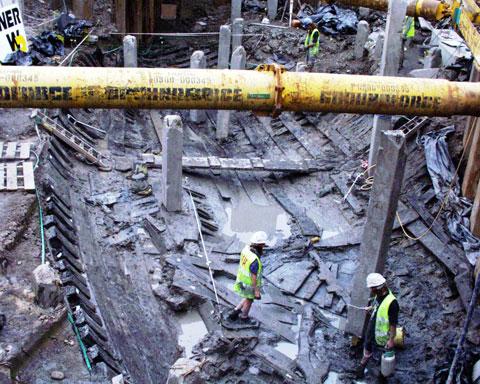
The Newport ship when it was discovered during building work for the Newport Riverfront Theatre

It captured the imagination of Newport when it was found and sparked a campaign that attracted the support of thousands of people.

Ten years on from the discovery of the city’s medieval ship DAVID DEANS investigates progress to conserve it.

IT has been a decade since it was discovered on a bank of the Usk – but a team of specialists are still continuing the work to preserve and eventually rebuild the Newport Medieval Ship.

New Anthropology and Archaeology Resources Published at Sciences Social Network


The Anthropology and Archaeology Sciences are two new key mathematics categories covered by the Sciences Social Network ScienceIndex.com. The users of the website monitor 69 scientific journals and submit the most significant scientific results of these journals for inclusion in these two categories which currently contain a total of 4,843 articles. ScienceIndex.com was established in 1998 to index the very latest news, headlines, references and resources in all fields of biology, business, chemistry, engineering, geography, health, mathematics and society.

ScienceIndex.com is a Anthropology Sciences social network established in 1998 to index the very latest news, headlines, references and resources from science journals, books and websites worldwide. The site covers news in all fields of biology, business, chemistry, engineering, geography, health, mathematics and society. In the field of Society Sciences, the site has now included the two new categories Anthropology and Archaeology. While the Anthropology category covers the origins, physical and cultural development, biological characteristics, and social customs and beliefs of humankind, the Archaeology category covers historic or prehistoric peoples and their cultures by analysis of their artifacts, inscriptions, monuments, and other such remains.

Video News from TAC


The Archaeology Channel now has a monthly video news magazine.

You can find out more here...

Monday, June 18, 2012

Hexham Abbey receives £1.8m to restore medieval buildings


Hexham Abbey in northeast England has been granted £1.8m from the Heritage Lottery Fund for a restoration of the Abbey’s medieval monastery buildings.

The restoration project includes the creation of a state-of-the-art visitor centre and community facilities within the former monastic complex adjoining the 7th century abbey church which dominates the heart of Hexham.

Ivor Crowther, Head of the Heritage Lottery Fund North East, said: “Hexham Abbey has played a pivotal role in the lives of local people and visitors for hundreds of years. This project, that will restore and reunite the Abbey’s monastery buildings, will mean that the heritage of this special place is brought to life and provide a place for everyone to reflect, learn from and enjoy. HLF are incredibly proud to be supporting this project to protect a true heritage gem in the North East.”

DNA bolsters Bulgaria's John the Baptist bones claim

A Bulgarian East-Orthodox priest holds up a box containing bones, believed to be the relics of John the Baptist, in front golden-domed ''Alexander Nevski'' cathedral in Sofia, November 12, 2010. The bones, discovered earlier this year in excavation works in the town of Sozopol on the Black Sea coast, will be displayed in ''Alexander Nevski'' cathedral for several days.  
  
Bulgaria's claim to have unearthed six bones belonging to John the Baptist has received a boost from scientists who have concluded after dating them and analyzing their genetic code that they could indeed be relics of the man who baptized Jesus.


The remains, which include a molar and a piece of cranium, were found in July 2010 in a marble sarcophagus in the ruins of a medieval church on the island of Sveti Ivan, or Saint John, off Bulgaria's Black Sea coast near the resort of Sozopol.

They are on display in a church in Sozopol where thousands of worshippers have flocked to view them, untroubled by questions about their authenticity.

"When I first heard this story in 2010 I thought it was a bit of a joke, to be honest," said Tom Higham of the University of Oxford's Radiocarbon Accelerator Unit, one of the world's top laboratories for carbon dating of archaeological material.


Greek archaeology students: Please send us to Iraq


Greek archaeology students hit by state funding cuts are making an online appeal for donations to join excavations in Iraqi Kurdistan, the state-run Athens News Agency said on Monday.

In a posting on donation site www.indiegogo.com, the group of Athens University students ask for help to cover the 500-euro ($632) plane fare.

"Without wishing to sound like a cliche, everyone knows that times are tough right now," the students said in their posting.

"The university cannot cover the cost of our airplane tickets," they said. "So please donate and send us there."

Roman dig in Maryport


Archaeologist began work on the site last year Credit: ITV
A major excavation is taking place at the Roman Fort in Maryport. It follows on from work done last year, which discovered evidence of a large wooden building.

Up until that point it was thought that 17 altar stones found on the site in the 19th Century had been buried as part of a religious ceremony, but they were found to have been reused in the foundations of the timber framed building.

Die jetzt abgeschlossenen Ausgrabungen am westlichen Stadtrand an der Barkhauser Straße in Paderborn ermöglichen einen Blick in den bäuerlichen Alltag vor 2000 Jahren.


Die Archäologen des Landschaftsverbandes Westfalen-Lippe (LWL) haben hier Zeugnisse einer Siedlung dokumentiert und gesichert, die vom Leben, Arbeiten und den alltäglichsten Bedürfnissen in den ersten Jahrhunderten vor Christus berichten. 

Die Befunde zeugen von einer guten Organisation. Vor über 2000 Jahren lebten die Menschen an der heutigen Barkhauser Straße in großzügigen Häusern. Die Pfosten, die die Dächer der Behausungen getragen haben, wurden von ihren Erbauern tief in den Boden eingegraben. Etwas abseits von den Wohngebäuden errichteten sie kleinere Nebengebäude und eine Grube. "Darin wurden die Vorräte und das Saatgetreide gelagert", schildert LWL-Archäologe Dr. Werner Best die ersten Erkenntnisse nach Abschluss der Ausgrabungen.

C14 bolsters Bulgaria's John the Baptist bones claim


A knucklebone claimed to be of John the Baptist has been dated as first century AD by Oxford researchers. The new dating evidence supports claims that bones found under a church floor in Bulgaria may be of the leading prophet and relative of Jesus Christ as described in the Bible. 
Bones claimed to be of John the Baptist that were analysed by the research team. Clockwise from top left, the knucklebone, ulna, part of cranial bone and molar (together) and rib [Credit: Oxford University]
The research by the Oxford University team will be explored in a documentary 'Head of John the Baptist' to be aired in the UK on National Geographic Channel on Sunday 17 June. 

A team from the Oxford Radiocarbon Accelerator Unit at Oxford University dated a knucklebone from the right hand. The researchers were surprised when they discovered the very early age of the remains adding, however, that dating evidence alone cannot prove the bones to be of John the Baptist.

Read the rest of this article...

Sunday, June 17, 2012

Researchers solve Roman Empire historical mystery


In ancient Roman times A.D., Palmyra was the most important point along the trade route linking the east and west, reaching a population of 100 000 inhabitants. But its history has always been shrouded in mystery: What was a city that size doing in the middle of the desert? How could so many people live in such an inhospitable place nearly 2 000 years ago? Where did their food come from? And why would such an important trade route pass directly through the desert?

Norwegian researchers collaborated with Syrian colleagues for four years to find answers.

“These findings provide a wealth of new insight into Palmyra’s history,” says project manager Jørgen Christian Meyer, a professor at the University of Bergen. The project has received funding of over NOK 9 million from the Research Council of Norway’s comprehensive funding scheme for independent basic research projects (FRIPRO)

Uranium-series dating reveals Iberian paintings are Europe's oldest cave art


The practice of cave art in Europe thus began up to 10,000 years earlier than previously thought, indicating the paintings were created either by the first anatomically modern humans in Europe or, perhaps, by Neanderthals. 

Fifty paintings in 11 caves in Northern Spain, including the UNESCO World Heritage sites of Altamira, El Castillo and Tito Bustillo, were dated by a team of UK, Spanish and Portuguese researchers led by Dr Alistair Pike of the University of Bristol, UK.

As traditional methods such as radiocarbon dating don't work where there is no organic pigment, the team dated the formation of tiny stalactites on top of the paintings using the radioactive decay of uranium. This gave a minimum age for the art. Where larger stalagmites had been painted, maximum ages were also obtained.

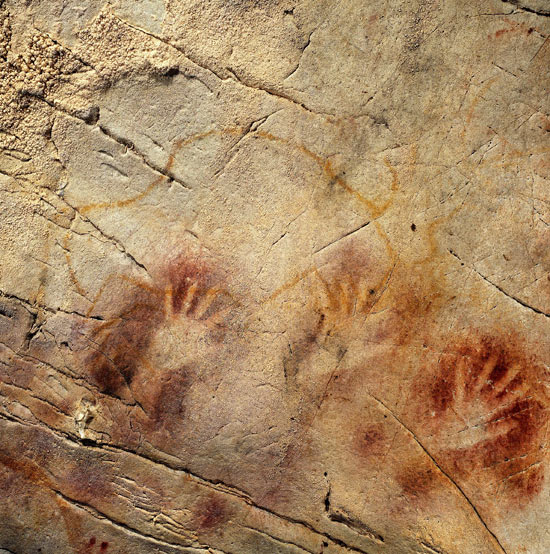
Hand stencils and disks made by blowing paint onto the wall in El Castillo cave were found to date back to at least 40,800 years, making them the oldest known cave art in Europe, 5-10,000 years older than previous examples from France.

Cromwell’s men’s severed heads unearthed


Human remains believed to belong to three of Oliver Cromwell’s soldiers have been unearthed during redevelopment work at James Green. 
Patrick Neary, (left) Archaeologist and Andrzsj Gwozdzik from Poznan, Poland at the excavations in James Green [Credit: Michael Brophy]
The discovery was made in recent days and the remains are now being examined by an archaeologist, Patrick Neary. 

“The heads of seven of Cromwell’s men are believed to be buried there. They were killed near Ballinakill in Co Laois in 1642 and their heads were hung from the Market Cross in Kilkenny on the next market day and later buried. To date we have found what we believe are two severed heads belonging to the soldiers ,” he said.

Illegal digs on the rise in Greece


Prompted by Greece’s severe economic crisis, a growing number of treasure hunters are scouring the country in search of antiquities and other treasures. 

The trend, which is more evident in the country’s northwestern Macedonia region, is not only driven by economic necessity but also by the cash-strapped state’s failure to protect its ancient heritage. 


“Illegal digs have always been carried out around the mountains in this area,” Kavala archaeologist Sofia Doukata told Kathimerini. “But the practice has recently turned into a sport,” she added. 


Mount Paggaio near the city of Kavala appears to have attracted an usually large number of would-be looters. The illicit diggers, Kathimerini understands, are conducting excavations around archaeological sites hoping to find something and sell it.

Friday, June 15, 2012

'Vampire' rites still have bite in Bulgaria

An unearthed skeleton is pictured in the Black Sea town of Sozopol, Bulgaria. Archaeologists have unearthed two skeletons from the Middle Ages pierced through the chest with iron rods to keep them from turning into vampires, according to the head of the history museum.

The ancient skeleton of a man, pinned down in his grave in order not to turn into a vampire, piqued interest in Bulgaria this week, where vampire tales and rites still keep their bite even nowadays.

The 700-year-old skeleton -- unearthed in the necropolis of a church in the Black Sea town of Sozopol earlier in June -- was stabbed in the chest with an iron rod and had his teeth pulled before being put to rest.

Anti-vampirism rituals were behind the find, archaeologists said, making this potential vampire and another one found at his side an instant media hit.

"These were most probably intellectuals who outgrew the moral ideas of their 14th century (...) They were feared and buried outside town walls," their discoverer, archaeologist Dimitar Nedev, told AFP.

Neanderthals may have been first human species to create cave paintings


Several times in the past 10 years scientists have had to rewrite the textbooks on Neanderthals, the latest species of human to go extinct. Once the archetype for primitive, uncivilised behaviour, the species, illuminated through fossil excavations and lately analysis of their genome, has emerged as being not too dissimilar from our own.

Contrary to their dim-witted image Neanderthals have been found to have used tools, to have worn jewellery, and, lastly, to have interbred with our Homo sapiens ancestors to such an extent that 4% of every modern European's genome is traceable to Neanderthal origins.

Now comes what could be the final nail in the coffin of the "unintelligent Neanderthals" myth: they might have been the first human species to paint in caves.

Early printed book contains rare evidence of medieval spectacles


Many scholars rank the invention of eyeglasses among the most important contributions to humankind in the last 2,000 years. Yet, the inventor of this now thoroughly quotidian piece of technology remains anonymous. Indeed the inventor (or inventors) will almost certainly never be known, given the numerous conflicting claims, lack of specificity, and scarcity of surviving documentation.

What scholars do know about the history of eyeglasses is that they were probably invented at the end of the thirteenth century by a craftsman living near Pisa. The evidence originates from a passage by Friar Giordano da Pisa who recounts having met the anonymous craftsman in 1286. A friend of Giordano named Friar Allesandro della Spina learned how to make them shortly thereafter and shared the secret with the public. A number of other possible inventors of eyeglasses have been posited over the centuries, all of which have finally been proven spurious in recent scholarship.

Read the rest of this article...