Monday, June 18, 2018

Possible discovery of prehistoric settlement near Thurso

Archaeologists are to make further investigations of the structures found
ORKNEY RESEARCH CENTRE FOR ARCHAEOLOGY

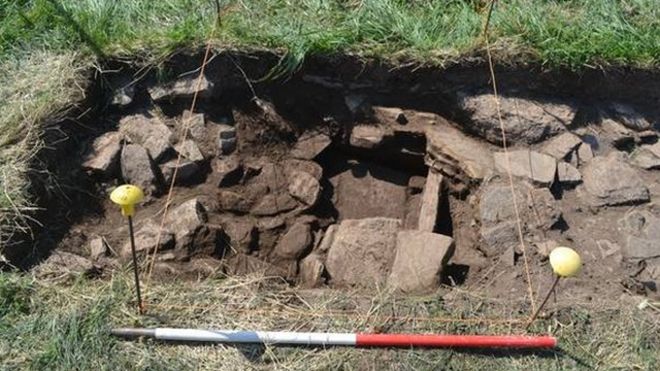
A community archaeology event may have uncovered a previously unknown prehistoric settlement in the Highlands.

Led by a team of archaeologists, more than 40 people, including children, dug a series of trenches at Thusater Burn near Thurso.

A geophysical survey had suggested the remains of a building beneath the soil.

The dig revealed rubble, a hearth constructed from stone slabs, a hammer stone and other tools.

A "wonderfully preserved" pig's tooth was also found. Archaeologists said such a find was usually associated with high status sites.

Read the rest of this article...

Wednesday, June 13, 2018

Imperial Roman villa found near Milvian Bridge

Credit: ANSA

An Imperial Roman villa has been found along the banks of the Tiber near the Milvian Bridge, archaeologists said Tuesday.
Digs have uncovered a large floor area in 'opus sectile', decorated with "extraordinary" multicoloured marble floral motifs, they said.

The beauty of the floor has led experts to believe that the rest of the building was full of precious decorations.

The villa's setting so close to the river is unusual, archaeologists said.

Read the rest of this article...

Detection of invisible elements in ancient rock engravings

Detailed picture of a bovine animal after applying the methodology 
[Credit: Aroa Gutiérrez Alonso]

Two researchers from Universidad Politécnica de Madrid (UPM) in collaboration with a researcher from Czech University of Life Sciences Prague (CULS) have developed a methodology to detect archaeological elements invisible to the naked eye.

Starting from photographs taken with common digital cameras and the range of the visible spectrum, a team of researchers from School of Land Surveying, Geodesy and Mapping Engineering at UPM and Faculty of Environmental Sciences from CULS suggest a new non-invasive methodology of archaeological documentation and analysis to show digital elements that are invisible to the naked eye. The method consists of applying techniques of both remote sensing and spectral treatment in order to uncover hidden elements and later carry out their morphometric analysis.

Mercedes Farjas, Aroa Gutiérrez and José Antonio Domínguez started by studying a limestone mold in the lab. The first goal was to assess the influence of the angle of the light of the photographs.

Later, after studying the effect of diverse filters on the mold, the researchers carried out combination tests of the filters in order to create a protocol of sequential application that allowed them to obtain conclusive results. As a result of these tests, they selected a set of filters and established an order of application.

Read the rest of this article...

MISE AU JOUR D’UNE VILLA DE L’ANTIQUITÉ


À Vire (Calvados), l’Inrap conduit depuis la fin du mois de février 2018 une fouille d’envergure, sur prescription de l’Etat (Drac Normandie). Cette opération s’inscrit dans le cadre de l’extension du Parc d’activités La Papillonnière menée par la communauté de communes Intercom de la Vire au Noireau.

Les recherches d’une équipe d’archéologues ont permis de mettre au jour les vestiges d’une villa gallo-romaine occupée du Ier au IIIe siècle de notre ère. Ils témoignent de la richesse de son propriétaire. À l’ouest de la villa, le site livre également les vestiges d’une occupation plus tardive, entre les VIIe et Xe siècles.

Read the rest of this article...

Hidden writing in ancient desert monastery manuscripts

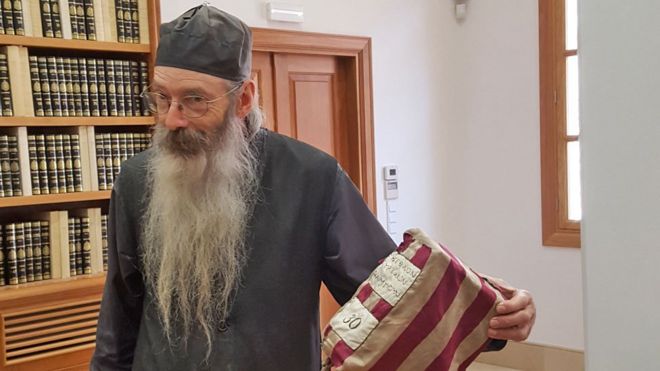
Fr Justin is helping to share online the historic manuscripts in an ancient Sinai monastery

For a monk who lives in the Sinai desert in Egypt, in the world's oldest working monastery, Father Justin replies to emails very speedily.

It should come as no surprise: the Greek Orthodox monk is in charge of hauling the library at St Catherine's into the 21st Century.

This ancient collection of liturgical texts, including some of the earliest Christian writing and second in size only to the Vatican, is going to be made available online for scholars all over the world.

The manuscripts, kept in a newly-renovated building which was opened to the public in December 2017, are now the subject of hi-tech academic detective work.

East meeting West
A team of scientists and photographers working alongside Fr Justin has been using multi-spectral imaging to reveal passages hidden beneath the manuscripts' visible text.

These include early medical guides, obscure ancient languages, and illuminating biblical revisions.

Among the researchers is Michelle P Brown, professor emerita of medieval manuscript studies at the University of London.

Read the rest of this article...

Tuesday, June 12, 2018

Why the next big archaeological discovery may not come out of the ground

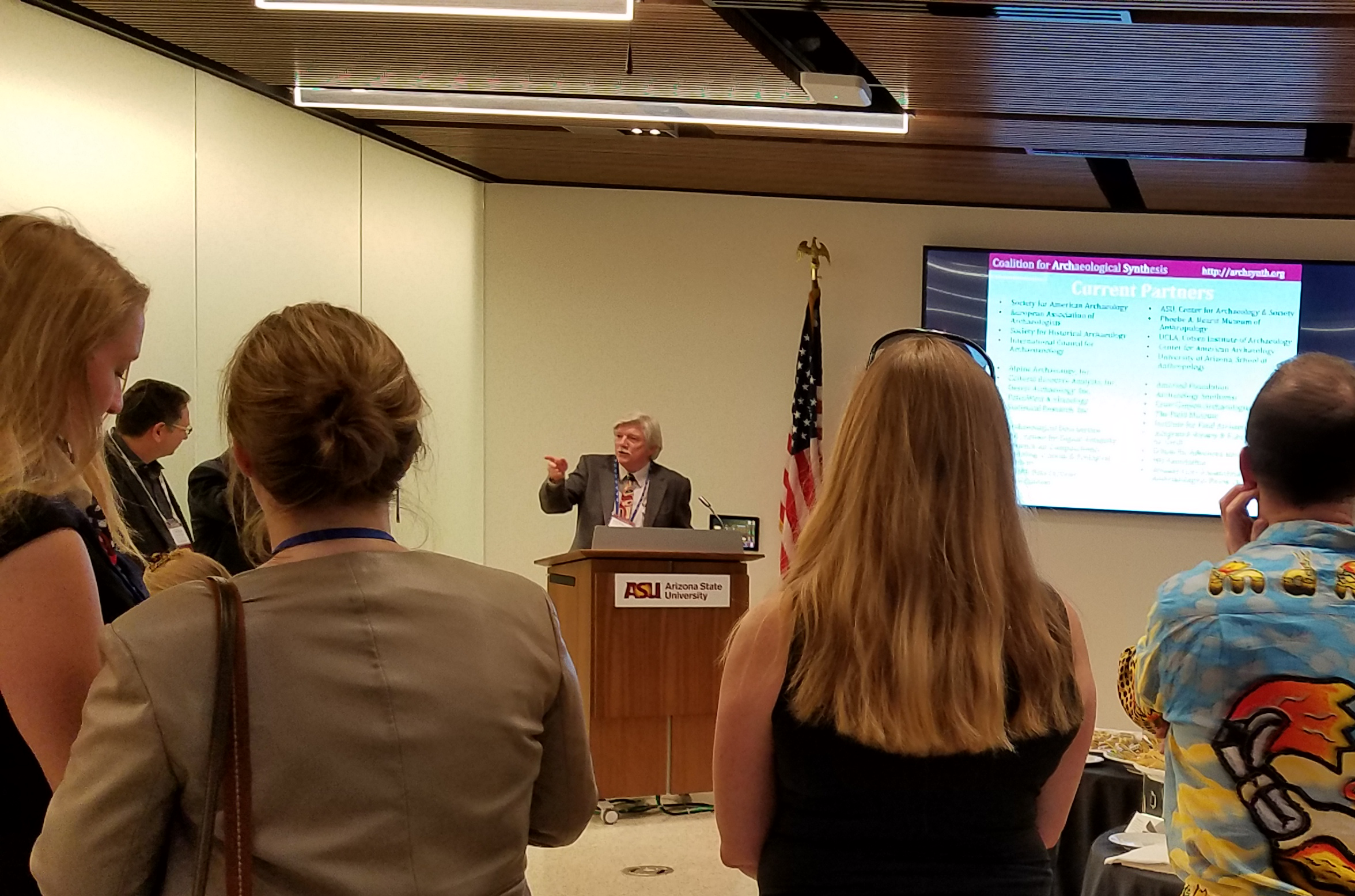
Keith Kintigh speaks at the Coalition for Archaeological Synthesis launch. 
Photo courtesy of Keith Kintigh

Keith Kintigh has seen the future of archaeology — and it’s not what you might expect. His vision includes projects that examine multiple sites together, rather than separately, and a science that answers questions about our present, instead of focusing only on the past.

Kintigh, a professor in the School of Human Evolution and Social Change and the co-director of its Center for Archaeology and Society, studies ancient political organization in the Zuni Pueblo region of New Mexico.

But in recent years, he’s devoted his attention to collecting archaeological data from numerous sites and regions, exploring overarching trends, and making information accessible to other scientists so they can do the same.

This process is known as archaeological synthesis. It first gained Kintigh’s interest nearly 30 years ago, when he and other faculty from the school decided to compare the trajectories of the prehistoric societies each of them studied independently in order to explore the conditions that led to their resilience or collapse.

Read the rest of this article...

South Downs skeleton 'executed 1,000 years ago'

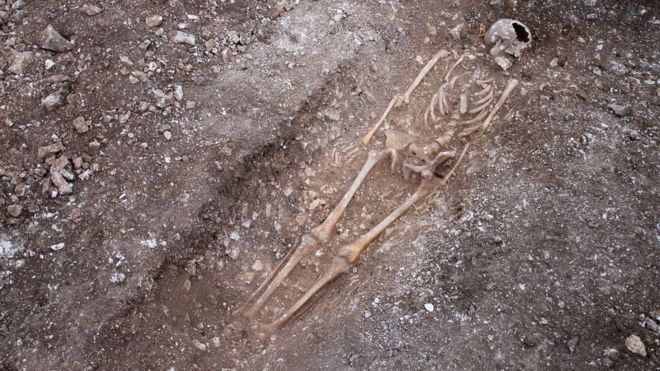
The well-preserved skeleton, thought to be from the 11th Century, was found during excavations in the South Downs

A man whose remains were unearthed by construction workers was executed about 1,000 years ago, archaeologists believe.

The well-preserved skeleton, thought to be from the 11th Century, was found during excavations in the South Downs.

It is thought the man, found in a grave on Truleigh Hill near Shoreham, West Sussex, was aged between 25 and 35.

Bone analysis put the date of his death between 1010 and 1023, while cuts to the neck pointed to a violent end.

The skeleton was found intact, but with no signs of a coffin, with only a few bones missing from his hands and feet in 2015.

Read the rest of this article...

3,000-year-old Bronze Age oak road to be preserved in Co Westmeath

Bronze Age track at Mayne Bog: when Westland Horticulture uncovered it in 2005 the National Monuments Service did not issue a preservation order or record it in the Register of Historic Monuments

Bronze Age track at Mayne Bog: when Westland HoA 3,000-year-old, oak road through Mayne bog, near Coole in Co Westmeath is to be protected following an agreement between peat extraction companies and conservationists.

Under the terms of the agreement approved by the High Court, Westland Horticulture Limited, Westmeath Peat Limited and Cavan Peat Limited have committed to cease milling peat near the bronze-age road and establish a buffer zone around it and associated subterranean structural supports.

The agreement also provides for the development of a “bund” to prevent operations elsewhere from dewatering the area around the oak road and structures.

The discovery of the bog road was made in 2005 and the National Monuments Service established it was a grander and far longer oak road than the previously discovered, Iron Age road at Corlea Bog in Co Longford.rticulture uncovered it in 2005 the National Monuments Service did not issue a preservation order or record it in the Register of Historic Monuments

Read the rest of this article...

When prehistoric man lived around Glasgow

The Cochno Stone at Faifley was excavated in 2015 and 2016 and then reburied to protect it from damage. PIC: John Devlin/TSPL.

Prehistoric man was likely to have lived in a number of settlements scattered around present-day Glasgow, research has found. Analysis of ancient rock art sites has identified a “ring” of probable settlements around the city with the creation of Glasgow likely to have destroyed further evidence of Neolithic life in the area.

People settled close to the River Clyde from at least 3,000BC given the area’s quality farmland and good access to waterways, experts believe. READ MORE: Archaeologists hit jackpot after sun reveals Neolithic markings The findings come as Scotland’s Rock Art Project works with communities across the country to record in detail some 2,000 ancient sites where mysterious cup and ring carvings can be found.

Read the rest of this article...

Oldest Bubonic Plague Genome Decoded

Double burial of the two plague victims in the Samara region, Russia 
[Credit: V.V. Kondrashin and V.A. Tsybin; Spyrou et al. 
Nature Communications, 2018]

The plague, caused by the bacterium Yersinia pestis, was the cause of some of the world's deadliest pandemics, including the Justinian Plague, the Black Death, and the major epidemics that swept through China in the late 1800s. The disease continues to affect populations around the world today. Despite its historical and modern significance, the origin and age of the disease are not well understood. In particular, exactly when and where Y. pestis acquired the virulence profile that allows it to colonize and transmit through the flea vector has been unclear.

Recent studies of ancient Y. pestis genomes identified its earliest known variants, dating to the Late Neolithic and Early Bronze Age, but these genomes did not show the genetic signatures thought to make the plague particularly efficient - namely, adaptation to survival in fleas, which act as the main vectors that transmit the disease to mammals. This study aimed to look at more Bronze Age Y. pestis genomes, in order to investigate when and where these important adaptations occurred.

Read the rest of this article...

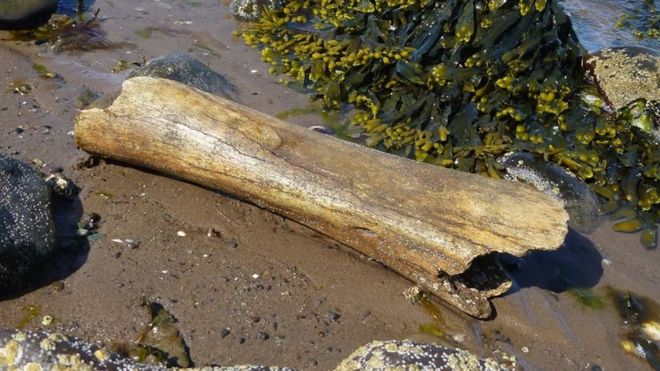
Woolly mammoth bone discovered on shore near Stranraer

The discovery was made on the shore near Stranraer
SOLWAY FIRTH PARTNERSHIP

A bone believed to have come from a woolly mammoth has been discovered on the south of Scotland coastline.

The find was made near Stranraer by Nic Coombey, co-ordinator of the Solway Coastwise project.

He said he realised straight away that it was an "extraordinary thing" due to its size.

It has now been passed to National Museums Scotland to carry out tests in order to find out exactly how old the bone might be.

Read the rest of this article...

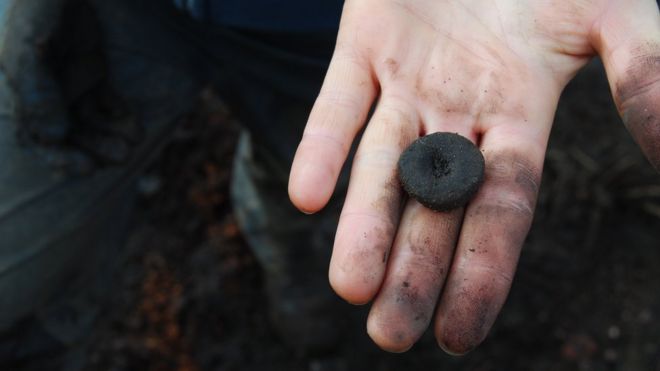
Prehistoric roundhouse excavated at Tore near Inverness

A stone bead or spindle whorl from the excavation
AOC ARCHAEOLOGY

The remains of an ancient roundhouse have been uncovered by archaeologists in the Highlands.

The prehistoric property was excavated ahead of the construction of a new business park at Mullan's Wood at Tore, near Inverness.

Archaeologists said the roundhouse may have been built in the Iron Age 2,000 years ago, or earlier.

The excavation area has been reinstated and the site will be protected during the future building work.

Environmental samples taken during the fieldwork has the potential to provide material for dating the site.

Read the rest of this article...

Tuesday, June 05, 2018

Viking houses from 1070 found in Cork dig at former Beamish & Crawford brewery


Excavations at a former brewery in Cork have uncovered the foundations of 19 wooden Viking age houses from the 11th and 12th centuries.

Some of the structures date back to 1070, making them 30 years older than any housing previously excavated in the city.

The dig at the former Beamish & Crawford factory also found three stone walls and a doorway from St Laurence’s Church, dating back to the 13th century.

Cork’s urban layout as a Viking city dates from around the same time that Waterford began developing as a Viking city, but archaeologists have yet to find any evidence on Leeside comparable to a trading post established near Waterford in the ninth century, archaeologists have found.

Read the rest of this article...

How Jesus Died: Rare Evidence of Roman Crucifixion Found

This cross was erected inside the Roman Colosseum as a monument to the suffering of early Christians in Rome. The Christian Bible describes the crucifixion of Jesus Christ as occurring in Jerusalem under Roman rule at the beginning of the Christian era.
Credit: Jared I. Lenz Photography/Getty

The body of a man buried in northern Italy 2,000 years ago shows signs that he died after being nailed to a wooden cross, the method used for the execution of Jesus described in the Christian Bible.
Although crucifixion was a common form of capital punishment for criminals and slaves in ancient Roman times, the new finding is only the second time that direct archaeological evidence of it has been found.
A new study of the skeletal remains of the man, found near Venice in 2007, reveals a lesion and unhealed fracture on one of the heel bones that suggests his feet had been nailed to a cross. 
Read the rest of this article...
Roman Tomb Unearthed; to Everyone’s Surprise, It’s Intact

Some of the funerary wares found in a chamber tomb near Rome.CreditRomano D'Agostino, Special Superintendence for Rome

ROME — Sometimes the most extraordinary finds occur by sheer luck.
At least that was the case of a fourth century B.C. chamber tomb that came to light five weeks ago during the construction of an aqueduct in a Rome suburb, when an earthmover accidentally opened a hole in the side of the chamber.
“Had the machine dug just four inches to the left, we would have never found the tomb,” Francesco Prosperetti, Rome’s special superintendent with archaeological oversight, told reporters on Friday. The tomb contained the remains of four occupants — three men and a woman — and funerary wares.
Read the rest of this article...
Iceland’s founding fathers underwent a rapid, 1000-year genetic shift


Scientists analyzed the ancient genes of skeletons belonging to some of Iceland’s first settlers, like this one discovered in a grave near the island’s northern coast. 
IVAR BRYNJOLFSSON/THE NATIONAL MUSEUM OF ICELAND


If modern Icelanders came face-to-face with their founding fathers, they’d be hard-pressed to see much family resemblance, according to a new study. That’s because today’s Icelanders have a much higher proportion of Scandinavian genes than their distant ancestors did, suggesting the islanders underwent a remarkably rapid genetic shift over the past thousand years.

Previous studies have hinted as much based on inferences from modern genotypes, notes Jonathan Pritchard, a population geneticist at Stanford University in Palo Alto, California, who wasn’t involved in the work. But the new findings offer a rare, direct glimpse of the founding of a new people. “I don’t think this has been shown before in any human population.”

Medieval histories suggest Iceland was first settled between 870 C.E. and 930 C.E. by seafaring Vikings and the people they enslaved, who possessed a mélange of genes from what is now Norway and the British Isles. For the next thousand years, the population of Iceland remained relatively small and isolated, hovering between about 10,000 and 50,000. Impeccable genealogical records and broad genetic sampling have made Icelanders—who now number 330,000—a model population for geneticists hoping to connect the dots between gene variants and traits.

Read the rest of this article...
The Genes From Iceland's First Settlers Reveal The Origin Of Their Population In Detail

Skeletal remains of an ancient pre-Christian (<1000 c.e.="" female="" font="" icelandic="" nbsp="">
[Credit: Ivar Brynjolfsson/The National Museum of Iceland]

In just over 1,000 years, Icelanders have gone through numerous changes in their gene pool, to the extent that Iceland's first settlers, who came to the island from Norway and the British and Irish isles between the years 870 and 930, are much more similar to the inhabitants of their original home countries than to Iceland's present-day inhabitants.

This is one of the main conclusions of a study carried out by an international team of scientists which included members of the Spanish National Research Council (CSIC). For the first time, the researchers, whose results are published in the journal Science, analysed the ancient genomes of 25 individuals who lived in Iceland during the colonisation of the island.

With a population of 330,000, Iceland is a country with its own peculiarities. Genes are no exception: isolation and inbreeding throughout its history make this northern Atlantic island a paradise for genetic studies.

Read the rest of this article...

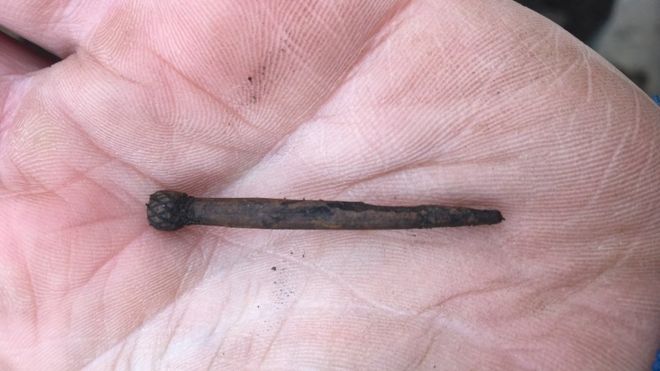
Archaeologists uncover 'treasure trove' of artefacts at Pictish fort

A pin decorated with a bramble is among items discovered at the Pictish fort
UNIVERSITY OF ABERDEEN

A "treasure trove" of Pictish artefacts has been discovered in the remains of an ancient fort on the Moray coast.

The building near Burghhead is believed to have been destroyed by fire in the 10th century as the Vikings invaded.

It spelled the end of Pictish life in the area but the blaze preserved material that would normally have rotted away hundreds of years ago.

As well as a complex layer of oak planks in a wall, archaeologists have uncovered jewellery and animal bones.

Read the rest of this article...

Take your pick: Is this Britain's oldest tin mining tool?


New research suggests Cornwall can lay claim to having Britain's oldest tin mining tool.

A pick made from a deer antler found near Truro in the 1800s has been on show at the Royal Cornwall Museum for decades.

Part of the prehistoric tool has now been radiocarbon dated, revealing that it is about 3,500 years old.

Simon Timberlake, a freelance archaeologist from Cambridge, said it's still in a remarkable condition 

Read the rest of this article...

Archäologen erforschen Antike mit Laserscanning


Mit "Airborne Laserscanning" (ALS) in die Antike: Dank dieses Verfahrens zur Erfassung und Kartierung lassen sich Stätten des Altertums zerstörungsfrei untersuchen. In einem Artikel für das Fachblatt PNAS berichten Archäologe Prof. Dr. Achim Lichtenberger und Kollegen über ALS in Jordanien.

Read the rest of this article...