Monday, February 05, 2018

New tunnel bypassing Stonehenge could destroy traces of human life dating back to the Ice Age, experts warn

Hoof prints dating back 8,000 years could be destroyed by road plans at ‘precious‘ site, archaeologist says

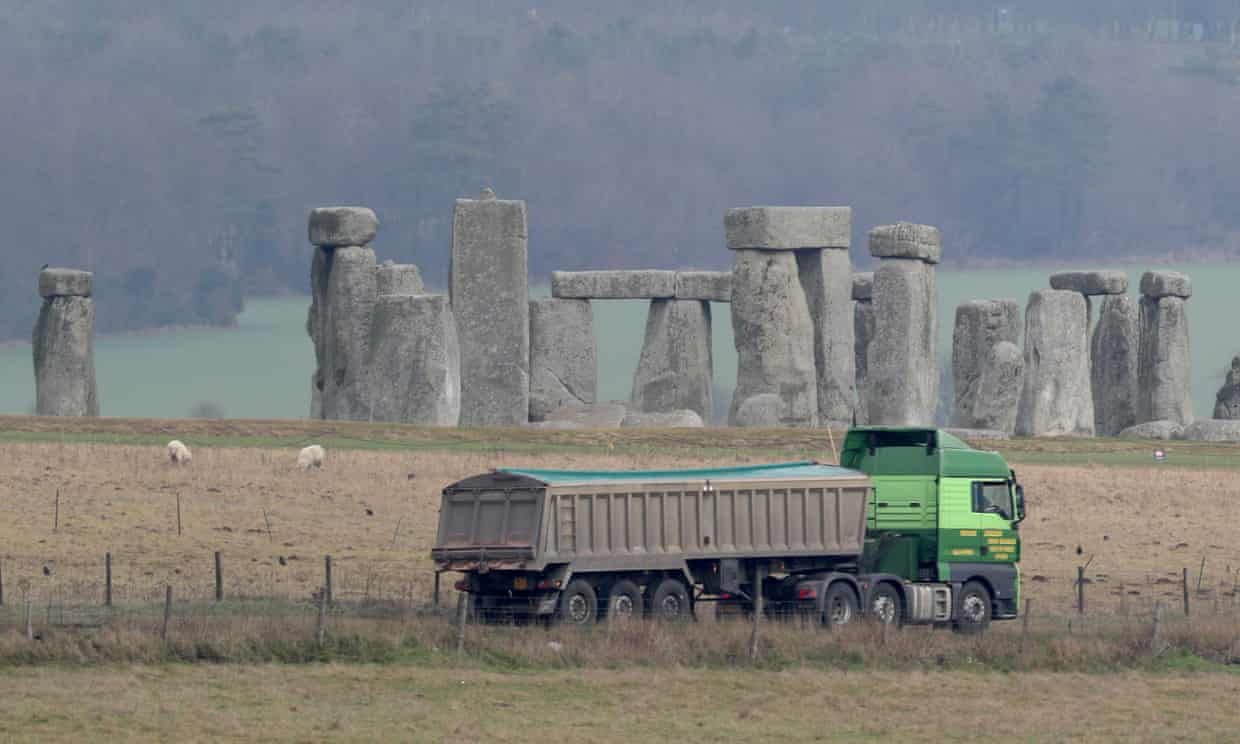
The Government has backed road works to ease traffic congestion near Stonehenge Getty

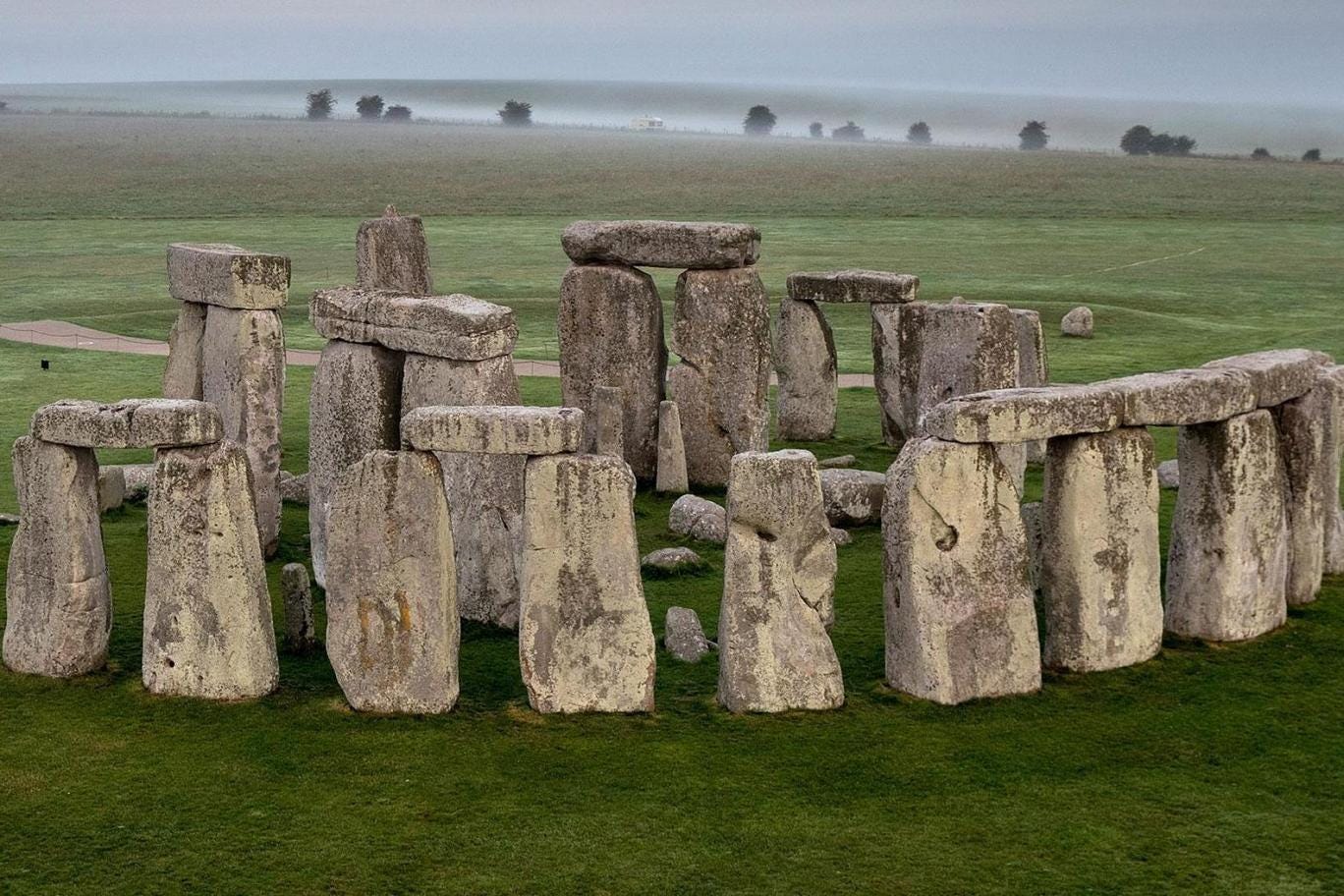
A new tunnel bypassing Stonehenge could destroy a “unique” site where traces of humans living as far back as the last Ice Age have been preserved, experts have warned.

Hoof prints of wild cattle known as aurochs were recently discovered at excavations a mile and a half from the famous stone circle in Wiltshire, University of Buckingham archaeologist David Jacques said.

The 6,000-year-old marks, preserved in what appears to be a ritualistic manner, are the latest finds of a decade-long dig at Blick Mead, which Prof Jacques said form a "national archive of British history".

However, the proposed tunnel and a flyover close to Blick Mead, which could be built under Government-backed roadwork plans to ease congestion on the A303, could irrevocably damage the site, he warned.

Opponents of the plan fear it could harm the rich archaeological landscape.

Read the rest of this article...

Stonehenge tunnel could destroy 'unique library' of early history

Plans for A303 could spell loss of Blick Mead site, where humans may have lived since the Ice Age


The construction of a tunnel past Stonehenge could spell the loss of a unique site that can trace the presence of people back to the last Ice Age, experts have said.

Perfectly preserved hoofprints of wild cattle known as aurochs have recently been found at excavations a mile and a half from the Wiltshire stone circle, David Jacques, and archaeologist at the University of Buckingham, said.

The 6,000-year-old prints, preserved in what appears to be a ritualistic way, are the latest in a wealth of finds made during a decade-long dig at Blick Mead, which Jacques said amounted a “national archive of British history”.

The tunnel, and a flyover close to the Blick Mead excavations which could also form part of the roadworks to improve the A303, could irrevocably damage the site, he said.

The government has backed plans to build a tunnel to house the A303 as it passes Stonehenge as part of measures to ease congestion and improve the setting of the neolithic site.

Read the rest of this article...
Radiocarbon dating reveals mass grave did date to the Viking age

A team of archaeologists, led by Cat Jarman from the University of Bristol's Department of Anthropology and Archaeology, has discovered that a mass grave uncovered in the 1980s dates to the Viking Age and may have been a burial site of the Viking Great Army war dead.


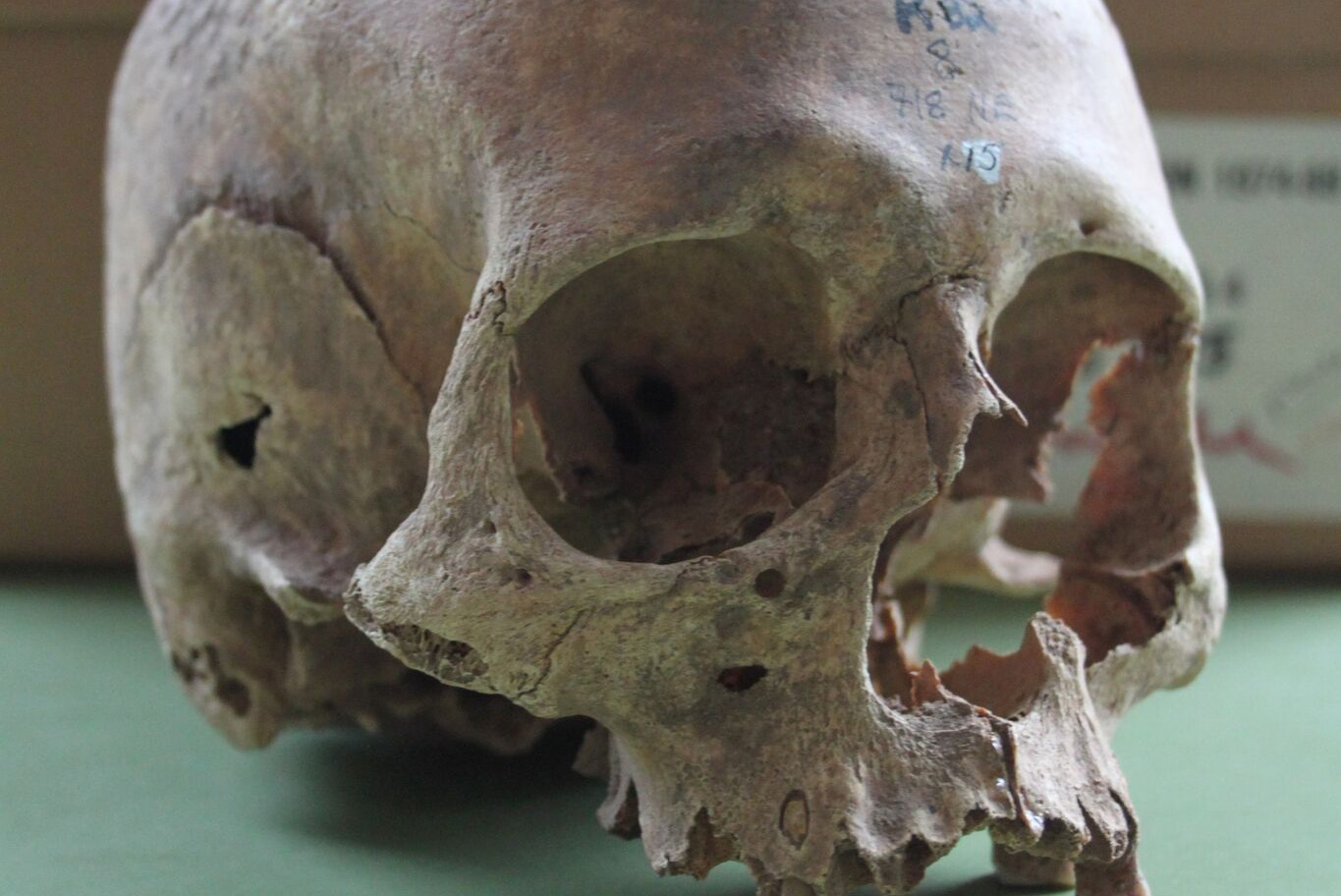
One of the female skulls from the Repton charnel [Credit: Cat Jarman]

Although the remains were initially thought to be associated with the Vikings, radiocarbon dates seemed to suggest the grave consisted of bones collected over several centuries. New scientific research, published in Antiquity, now shows that this was not the case and that the bones are all consistent with a date in the late 9th century. Historical records state that the Viking Great Army wintered in Repton, Derbyshire, in 873 A.D. and drove the Mercian king into exile.

Excavations led by archaeologists Martin Biddle and Birthe Kjølbye-Biddle at St Wystan's Church in Repton in the 1970s and 1980s discovered several Viking graves and a charnel deposit of nearly 300 people underneath a shallow mound in the vicarage garden.

The mound appears to have been a burial monument linked to the Great Army.

An Anglo-Saxon building, possibly a royal mausoleum, was cut down and partially ruined, before being turned into a burial chamber.

Read the rest of this article...

This Mass Grave May Belong to 'Great Viking Army'

Bones are yielding new clues about the massive, mysterious Viking forces that invaded England.

A photo taken at a 1982 excavation of the gravesite shows remains from what may belong to the Great Viking Army. 
PHOTOGRAPH BY MARTIN BIDDLE

For years, archaeologists were stumped. What happened to the Great Viking Army, a massive force that seized great swaths of England in the 9th century but left barely a trace?
Archaeologists now report that a mass grave in England may contain nearly 300 Viking warriors—the only remains of the Great Viking Army’s warriors ever found.Archaeologists first uncovered the burial site in the 1980s, in Derbyshire, England, and thought it might contain remains from the Great Viking Army, also known the Great Heathen Army. But there was one problem—radiocarbon dating of the site revealed that the remains were too old to be Viking invaders.
Read the rest of this article...

Sunday, February 04, 2018

Midlands mass grave was burial site for Viking 'Great Heathen Army' war dead, new study reveals

The powerful Norse army was sent to invade the four Anglo-Saxon kingdoms that constituted England in 865 AD.

One of the female skulls excavated from the Repton burial site Cat Jarman 

In the 70s, a mysterious mass grave complex, containing the remains of hundreds of people, was unearthed by archaeologists in Repton, Derbyshire. The initial signs indicated that the burial site was associated with a Viking army, however, radiocarbon dating seemed to pour cold water on this hypothesis, suggesting that the bones had actually been left there over several centuries.

Now, new research has revealed that, in fact, the remains are consistent with a date in the 9th century. Based on these findings, Cat Jarman and colleagues from the University of Bristol's Department of Anthropology and Archaeology suggest that the mass grave was a burial site for the war dead of the Viking Great Army.

This military force – known by the Anglo-Saxons as the Great Heathen Army – was a powerful coalition of Norse warriors mainly originating from Denmark, although some came from Sweden and Norway, who banded together under a unified command to invade the four Anglo-Saxon kingdoms that constituted England in 865 AD.


Historical records indicate that this army spent the winter at Repton in 873 AD, driving the king of Mercia – one of the Anglo-Saxon kingdoms, centred on the midlands – into exile in the process.

Read the rest of this article...
Scandinavians shaped by several waves of immigration

Directly following the last ice age, people from the western parts of what is now Norway were a population that had substantially different genetics from the people living in the area corresponding to present-day Sweden.

Anne-Marian Snaaijer, a PhD candidate at the Norwegian University of Science and Technology works  in Trondheim's Archive Centre at Dora. The collection trays hold lots of bone discoveries 
[Credit: Åge Hojem, NTNU University Museum]

"We were surprised that the results showed such marked dissimilarities," says associate professor and archaeologist Birgitte Skar at the Norwegian University of Science and Technology's (NTNU) University Museum. Skar is responsible for the museum's Stone Age and Bronze Age collections.

Scandinavia was one of the last parts of Europe to become habitable when the glaciers released their icy grip more than 10,000 years ago. The ocean's resources and the coastal archipelago attracted marine hunter-gatherers of yore to the region.

Swedish and Norwegian researchers have collaborated on analysing the DNA in 9500-year-old bone samples from the southern and western Norwegian coast and from the Swedish islands of Gotland and Stora Karlsö. This period corresponds to the Mesolithic Stone Age.

Read the rest of this article...
Melting Glaciers Could Reveal How Our Ancestors Dealt With Changing Climates

While some archaeologists dig with trowels and shovels, others use a warming planet to their advantage.


Archaeologist holding a c. 1400-year-old arrow, lost reindeer hunting in the high mountains of Oppland, Norway, during the Late Antique Little Ice Age. 
PHOTOGRAPH BYJULIAN MARTINSEN, SECRETS OF THE ICE OPPLAND COUNTY COUNCIL

When Lars Pilø, co-director of the Glacier Archaeology Program at Oppland County Council, noticed Norway was experiencing a particularly warm autumn in 2006, the archaeologist turned to the mountains. If climate change was thawing glacial ice, what did that mean for the artifacts that were emerging from the melt? So, starting officially in 2011, Pilø and an international team took to Norway's icy Jotunheimen and Oppland mountains to see what ancient objects they could rescue from the snowmelt.

Over the years, the archaeologists uncovered thousands of artifacts, some of which date back 6,000 years. Since the ice acts like a giant freezer and preserves the objects, the finds look like they could have been uncovered yesterday. (Read: "Alaska's Thaw Reveals—And Threatens—A Culture's Artifacts")

"The moment these artifacts melt out of the ice, they're immediately vulnerable to the elements," says James H. Barrett, a University of Cambridge environmental archaeologist.

The glacier archaeologists detailed their findings in a Royal Society Open Science paper published January 24. Pilø and Barrett are authors on the paper.

Read the rest of this article...
Friday, February 02, 2018

Archaeologists may have found architects' camp for Stonehenge


A team of archaeologists believe they may have discovered a spot where some of the architects of Stonehenge gathered and camped.
The team have been investigating a causewayed enclosure – these are thought to be ancient meeting places or centres of trade – on army land at Larkhill close to Stonehenge.
They found an alignment of posts that matches the orientation of the circle at Stonehenge, leading to the theory that Larkhill could have been some sort of blueprint for the temple.
Si Cleggett, of Wessex Archaeology, conceded it was possible to suggest that any evidence of prehistoric settlement could be connected to the creation of Stonehenge.
But he argued that the proximity of Larkhill – a relatively short walk from the stone circle – and the coincidence of the alignment of the nine posts gave weight to the idea that the people who created and visited the enclosure could have had a hand in the conceptualisation of Stonehenge.
Read the rest of this article...
Canterbury artefacts 'may have been stolen by metal thieves'


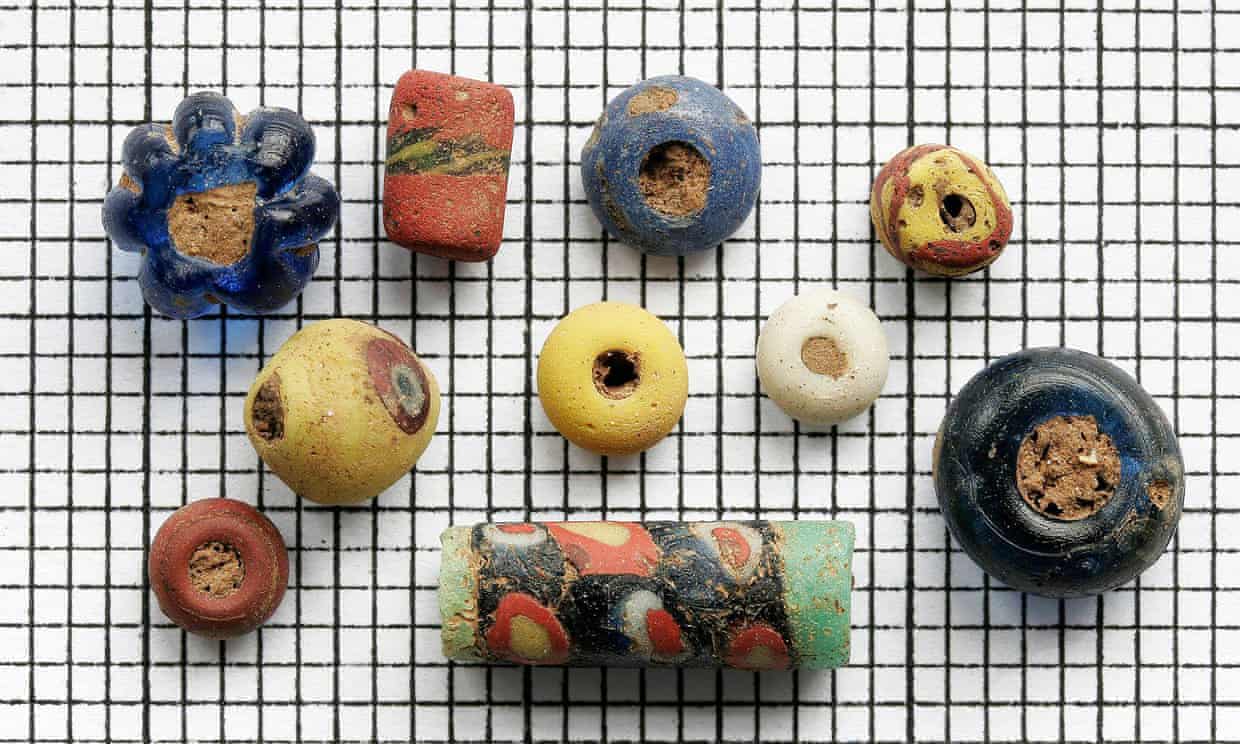
Two suspected metal thieves are believed to be behind the theft of an archaeological hoard including hundreds of Anglo-Saxon beads and iron age coins, having apparently stumbled on the artefacts while scavenging for copper pipes and wiring.
Canterbury Archaeological Trust is appealing for the public’s help in scanning online sale sites such as eBay for any sign of the artefacts stolen in three raids last month at its warehouse, in the north-east of the city.
The trust is also furious with its landlord, Canterbury city council, because it claims the council failed to inform it, or the police, about metal theft on an adjacent derelict site.
The trust’s archive manager, Andrew Richardson, is devastated by the loss of at least 1,500 items, including Anglo-Saxon brooches and coins each worth thousands of pounds.
Read the rest of this article...

Thieves steal hundreds of priceless artefacts from Canterbury charity


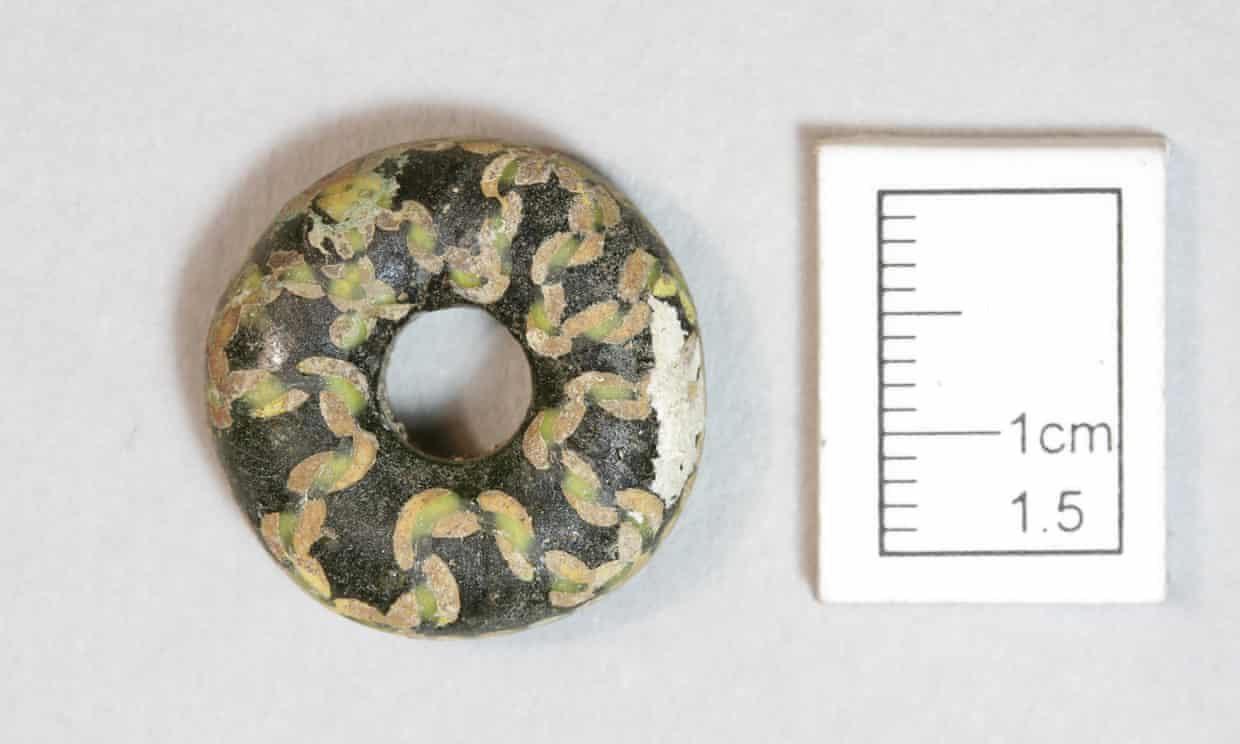
Priceless artefacts including 850 Anglo-Saxon beads have been stolen from an archaeological charity in Canterbury during a series of break-ins.

Thieves broke into the store of the Canterbury Archaeological Trust, which undertakes excavations and research and educates the public about archaeology, twice last week and once over the weekend.

As well as the beads, large quantities of coins and metal artefacts, and an assortment of bone objects have been stolen.
The charity has put on an appeal asking the public to look out for the historical items being offered for sale.

The trust’s outreach and archive manager Dr Andrew Richardson told the Guardian: “It’s been pretty distressing for everyone at the trust, not only because of the lost items but also the scale of the damage.

Read the rest of this article...
Bones clue to 'lost' Viking army which made England

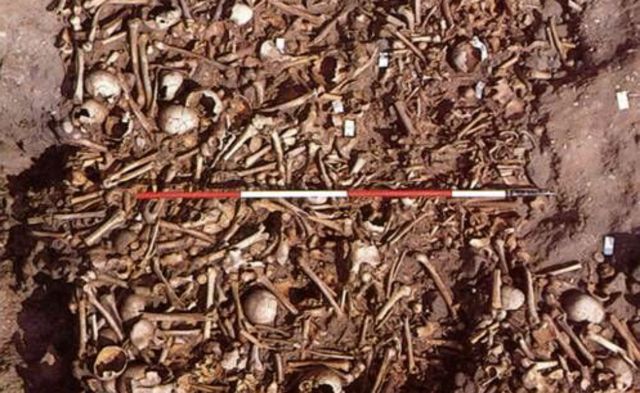
The mass grave was first excavated in the 1970s and 80s
Martin Biddle

A lost Viking army which was a "key part" of the creation of England may have been identified by archaeologists.

More than 250 skeletons found at St Wystan's church, Repton, Derbyshire, have been dated to the 9th Century.

Chronicles state a "large heathen army" began to hack its way across England in 866AD, toppling Anglo-Saxon kings until being halted by Alfred the Great.

Cat Jarman from the University of Bristol said: "This army had left almost no trace, but maybe here it is."

Read the rest of this article...
Wednesday, January 31, 2018

Unique Viking runes discovered in Denmark

Runologist and senior researcher Lisbeth Imer takes a closer look at the newly discovered runes.  (Video: Kristian Højgaard Nielsen)


“These are the runes we’ve been missing,” says archaeologist.

A comb with a runic inscription of the word “comb,” perhaps doesn’t sound so sensational. But it is.

The comb dates to the early Viking Age around 800 CE. Just a handful of runic texts from this period exists.

The comb was discovered during excavations of a Viking Age market place in Denmark’s oldest town Ribe.

Alongside the comb, archaeologists also discovered a runic inscription on a small plate of bone or antler.

Together, the two objects reveal details from a crucial period of Viking history, says archaeologist and excavation leader Søren Sindbæk from Aarhus University, Denmark.

“These are the runes we’ve been missing. We’ve waited generations to be able to dig into this,” says Sindbæk.

Read the rest of this article...

Sunday, January 21, 2018

Ancient human remains found in Mayo date back over 5,000 years

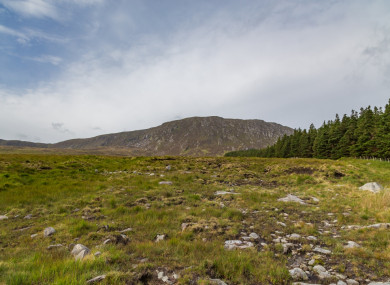
Ben Gorm Mountain, Mayo
Image: T Kahlert via Department of Culture

THE DEPARTMENT OF CULTURE, Heritage and the Gaeltacht has revealed that ancient human remains, which were discovered by a local hillwalker on a Mayo mountainside in 2016, date back as early as 3,600 BC.
The research found that the natural boulder chamber in which the remains were found was used for human burial practice through the Neolithic period.
A least 10 individuals – adults, teenagers and children – were placed in the chamber over a period of up to 1,200 years, according to the research. One of the adult bones dated to 3,600 BC, while a bone of a child skeleton dated to 2,400 BC.
In August 2016, local hillwalker Michael Chambers discovered a cave-like chamber among some large boulders on Ben Gorm Mountain in Newport, Mayo.
He found human bones scattered over the rock floor of the chamber and contacted gardaí in order to have them tested.
Read the rest of this article...
Unusually sophisticated prehistoric monuments and technology in the heart of the Aegean

Excavations underway on Dhaskalio, off Keros 
[Credit: Cambridge Keros Project]

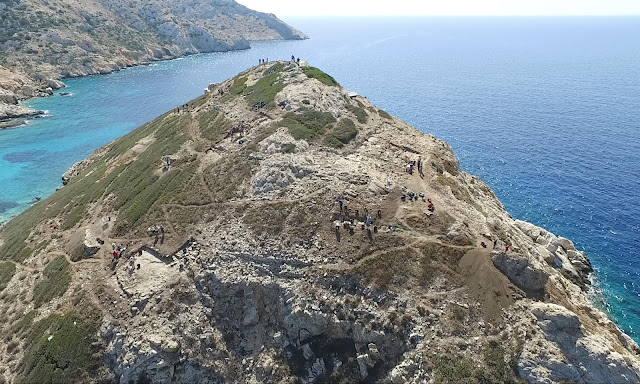
New work at the settlement of Dhaskalio, the site adjoining the prehistoric sanctuary on the Cycladic island of Keros, has shown this to be a more imposing and densely occupied series of structures than had previously been realised, and one of the most impressive sites of the Aegean during the Early Bronze Age (3rd millennium BC).

Until recently, the island of Keros, located in the Cyclades, south of Naxos, was known for ritual activities dating from 4,500 years ago involving broken marble figurines. Now new excavations are showing that the promontory of Dhaskalio (now a tiny islet because of sea level rise), at the west end of the island next to the sanctuary, was almost entirely covered by remarkable monumental constructions built using stone brought painstakingly from Naxos, some 10km distant.

Read the rest of this article...
Bronze Age Arrows and a Viking Sword – The 2017 Fieldwork Was Awesome!

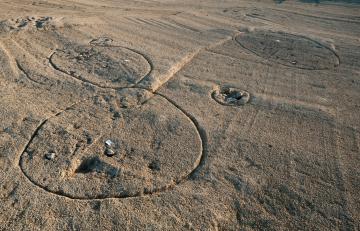
The Storfonne ice patch, photographed in September 2014 during a major melt. Notice the light grey lichen-free zone surrounding the ice. This area was exposed by ice melt in the last 15-20 years. Photo: Lars Pilø, Secrets of the Ice/Oppland County Council.

Both sites had only seen short visits prior to this field-season. This had resulted in a number of artifact recoveries, especially arrows, found close to the melting ice. However, we knew that there were other finds on these sites, and that they were lying on the surface, exposed to the elements. The main job would be to rescue these artefacts. To achieve this, we planned to conduct a systematic and thorough survey of the lichen-free zone (where the ice has melted recently) surrounding the ice on both sites.

The Lauvhøe ice patch

The Lauvhøe ice patch was up first. The earliest finds from this site were reported in 2007: three arrows, dating to the Iron Age and the medieval period. Even with these remarkable finds, the site had to wait ten years for a proper systematic survey. This may sound harsh, but with the short time window available for surveys each year, other sites with more and older finds had to be surveyed first. Lauvhøe’s turn had finally come this year.

Read the rest of this article...

LES FOUILLES ARCHÉOLOGIQUES PRÉVENTIVES DÉMARRENT SUR LA ZAC ODE ACTE 2 SUR LES COMMUNES DE LATTES ET DE PÉROLS (HÉRAULT)


Les fouilles préventives du site des « Hauts de Lattes » s’inscrivent dans la poursuite de l’aménagement de la « Zac Ode Acte 2 », dans le cadre du projet urbain Ode à la Mer qui s’étend depuis la Lironde jusqu’au Parc des Expositions, sur les communes de Lattes et de Pérols.

8 HECTARES DE FOUILLES SUR LE SITE « HAUTS DE LATTES »
À la suite d’un diagnostic archéologique réalisé fin 2015 - début 2016, l’État (Drac Occitanie) a prescrit la réalisation d’une fouille préventive de 8 hectares, situés à l’extrémité nord de la « butte de Pérols », entre la vallée de la Lironde et l’étang de l’Estanel. La SA3M ( Société d’Aménagement de Montpellier Méditerranée Métropole), ainsi que deux autres maîtres d’ouvrage (les sociétés Pitch Promotion et Pégase Immobilier) ont choisi de confier ces recherches à l’Inrap, qui s’est associé au service archéologique de la SAM (Sète Agglopole Méditerranée) pour cette opération.

Read the rest of this article...
Menschheitsgeschichte muss nicht neu geschrieben werden


Der »Fall Untermaßfeld«

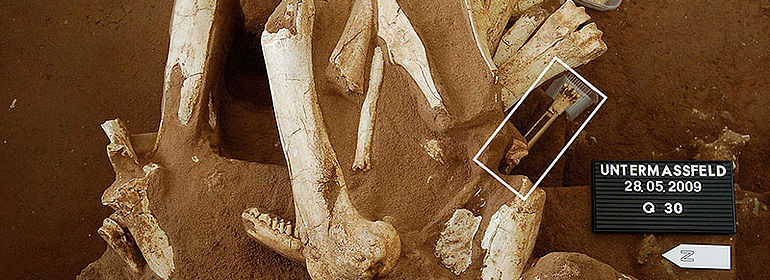
In einer kürzlich im Fachjournal »Journal of Paleolithic Archaeology« veröffentlichten Studie widerlegt der Senckenberg-Wissenschaftler Prof. Dr. Ralf-Dietrich Kahlke gemeinsam mit einem internationalen Team renommierter Steinzeitexperten eine kürzlich erschienene Veröffentlichung zur Ausbreitung des Menschen in Europa. In dieser wird die These aufgestellt, dass die ersten Menschen schon vor etwa einer Million Jahre in Nord- und Mitteleuropa lebten – gut 200.000 Jahre früher als bisher belegt. Das Team zeigt zudem, dass die »Belegstücke« der archäologischen Untersuchung vermutlich aus der Forschungsgrabung Untermaßfeld gestohlen wurden.

Read the rest of this article...

Monday, January 15, 2018

Neolithic girl's reconstructed face unveiled at Athens Acropolis Museum on January 19th

Myrtis is the reconstructed head of a girl that once lived in Classical-era ancient Athens and died during the plague in Athens in the 5th century BC

An 18-year-old girl who lived in Greece 7,000 years ago and was unearthed by archaeologists in Theopetra cave, near the city of Trikala, has had her face reconstructed and is about to officially introduce herself to the public.

Eight years after the revelation of Myrtis, the reconstructed head of a girl that once lived in Classical-era ancient Athens and died during the plague in Athens in the 5th century BC and following the international sensation that it caused, the Acropolis museum is ready to to introduce Dawn’s new face from an even earlier past, to Greek and international audiences.

Dawn (Avgi in Greek) is a woman from the Mesolithic era (7,000 BC) who lived in the Theopetra cave, according to Athens University professor Manolis Papagrigorakis; who has invested a great deal of time and learning in order to bring Greeks “face to face” with their ancestors.

Read the rest of this article...

Ancient highland ruins probed by archaeologists


ARCHAEOLOGISTS are probing an ancient mystery uncovered by workers deep in a Highland forest.

The crumbling ruins are believed to have been an Iron Age fort, or possibly the home of a local chief or lord, and date back to about 2,400 years ago.

The site was known about from a survey taken in the 1940s, but had been forgotten about until it was spotted by loggers clearing the land.

Now researchers are unravelling its tantalising mystery, with evidence showing the structure may have a violent past and was burnt down twice and rebuilt before finally being abandoned.

Read the rest of this article...

Viking centre discovered in Cork city predates Waterford settlement

The latest discoveries at the South Main Street site confirm Cork’s significance in the Hiberno-Norse world, archaeologist says

Cork was a significant centre for Vikings in Ireland with an urban centre that predates the Viking settlement in Waterford, a new report on the excavation of the city’s event centre has revealed.

According to the report by Cork City Council executive archaeologist, Joanne Hughes, the latest discoveries at the South Main Street site confirm Cork’s significance in the Hiberno-Norse world.

In the report presented to members of Cork City Council, Ms Hughes said that excavation of the site by archaeologist Dr Maurice Hurley for developers BAM, was highly revealing about Cork’s past.

She explained that the site of the former Beamish and Crawford Brewery adjacent to the south channel of the Lee had been divided into three separate sections for excavation purposes.

Read the rest of this article...