Thursday, November 29, 2012
Palaeolithic Macedonia: Landscape in the Mist
What do we know about paleolithic Macedonia? Some scarce finds, mostly stone tools, and usually “orphan”, and some general dating references maintain until today a fragmentary, rather distorted picture about this distant era, a picture which is being even more obscured by soil erosion and climate changes that occurred over the last 100,000 years.
Professor of Prehistoric Archaeology at the Aristotle University of Thessaloniki, Nikos Efstratiou, spoke about the need for new, dynamic approaches to this research field, in his announcement at the conference entitled “Hundred Years of Research in Prehistoric Macedonia”.
Mr. Efstratiou pointed out that prehistoric research in Macedonia is still in its infancy and said that one of the most significant problems is the fragmentary character of all periods of the Pleistocene. He also referred to institutional problems, lacking of educational and research programs about this period, as well as the general conditions that do not encourage the realization of systematic paleolithic surveys. The surveys conducted allow a reduced archaeological “visibility” of paleolithic groups, because of the features of the geomorphological landscape of the region and the paleoenvironmental changes, that interfere in a dramatic way in every attempt to reconstruct settlement systems.
Read the rest of this article...
Digs reveal evolution of Paphos theatre
Fragments of marble sculptures from a monument consecrated to the nymphs of ancient Greek and Roman mythology have been uncovered during on-going excavations at Paphos' ancient theatre, the archaeological team in charge of the dig have announced.
The 15th season of excavations into one of Cyprus’ largest ancient theatres unearthed a number of significant finds, including fragments of carved marble adornments from the stage and from a monument to the nymphs or nymphaeum.
Paphos was the capital of Cyprus in Greek and Roman times and its ancient archaeological remains are on the World Heritage List.
Read the rest of this article...
Bronze Age Brain Surgeons
The 4,400-year-old skull of an early neurosurgery patient.
5,000 years ago, people living in Turkey were surprisingly good at what seems like a purely modern practice.
You might shudder at the mere thought of ancient brain surgery, but recent studies of the practice at Bronze Age sites in Turkey suggest that early neurosurgeons were surprisingly precise and that a majority of their patients may have survived.At Ikiztepe, a small settlement near the Black Sea occupied from 3200 to 1700 B.C., archaeologist Önder Bilgi of Istanbul University has uncovered five skulls with clean, rectangular incisions that are evidence for trepanation, or basic cranial surgery. The procedure may have been performed to treat hemorrhages, brain cancer, head trauma, or mental illness. Last August Bilgi also unearthed a pair of razor-sharp volcanic glass blades that he believes were used to make the careful cuts.
Read the rest of this article...
Secrets of an Iron Age smith
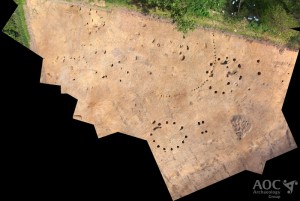
Ironworking may have been carefully controlled knowledge in the Iron Age, leaving the uninitiated wondering whether it involved divine power, higher knowledge, or perhaps even magic. If so, the Iron Age smiths kept their secrets well, for the scarcity of direct archaeological evidence leaves many questions about how they practiced their craft. New finds at Beechwood Farm, Inverness may help to reveal these ancient techniques, and provide new perspectives on metalworking in northern Scotland. As well as ironworking debris in the form of slag the site has yielded an unusual find: the remains of a clay-lined furnace, a feature that only rarely survives in the archaeological record.
The excavation, conducted by AOC Archaeology Group, has unearthed evidence showing that activity on the site stretches back to before the age of metal, into the Neolithic. Early prehistoric artefacts have also been recovered, including a selection of pottery sherds and quern stones used for grinding grain into flour.
Read the rest of this article...
Bulgaria Unearths Ancient 'Millionaire's' Treasure
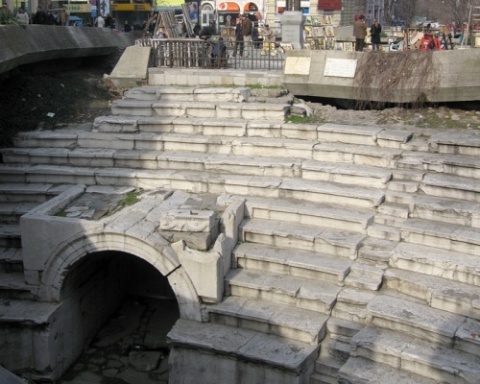
Bulgarian archaeologists have unearthed 40 silver coins during excavations in the second largest city of Plovdiv.
The coins, dating from the 3rd century A.C., have images of a number of Roman Emperors or different Gods.
They are extremely well-preserved, meaning they have not been in circulation, experts say.
The coins were located in an ancient hiding place and were a real treasure for this period with their owner being a very wealthy man, they further explain, adding the hiding place in the floor showed the said owner had intentions to get them back at some point, but was prevented, most likely because he was killed.
Read the rest of this article...
Antiquity: Submerged Prehistoric Archaeology and Landscapes of the Continental Shelf
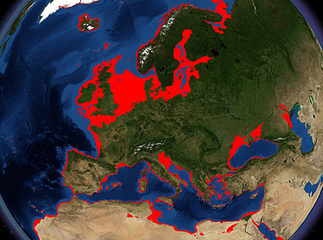
For most of human history on this planet—about 90 per cent of the time—sea levels have been substantially lower than at present, exposing large tracts of territory for human settlement. Europe alone would have had a land area increased by 40 per cent at the maximum sea level regression (Figure 1). Although this has been recognised for many decades, archaeologists have resisted embracing its full implications, barely accepting that most evidence of Palaeolithic marine exploitation must by definition be invisible, believing that nothing has survived or can be found on the seabed, and preferring instead to emphasise the opportunities afforded by lower sea level for improved terrestrial dispersal across land bridges and narrowed sea channels.
Read the rest of this article...
Bronze Age "microbrewery" found by Manchester scientists
Archaeologists led by an expert from the University of Manchester are raising a glass to the discovery of a Bronze Age "microbrewery" in western Cyprus.
The team excavated a 2 metres x 2 metres mud-plaster domed structure which it says was used as a kiln to dry malt and make beer 3,500 years ago.
Beers of different flavours would have been brewed from malted barley and fermented with yeasts with an alcoholic content of around 5%. The yeast would have either been wild or produced from fruit such as grape or fig, according to the researchers.
Dr Lindy Crewe has led the excavation at the Early-Middle Bronze Age settlement of Kissonerga-Skalia, near Paphos, since 2007.
She said: "Archaeologists believe beer drinking was an important part of society from the Neolithic onwards and may have even been the main reason that people began to cultivate grain in the first place.
Read the rest of this article...
'Spectacular finds' may see road delayed to August and extra £2m cost
The archaeological dig on the route of the new Cherrymount Link Road in Enniskillen could delay the opening until next August at an additional cost of over £2 million, it has been claimed.
However, last Friday a number of public representatives visited the excavation of the Drumclay Crannog, the site of an ancient dwelling on the section of the by-pass between Cherrymount and the Coa Road.
Ulster Unionist MLA Tom Elliott was among those who met the team of over 30 archaeologists involved in the dig.
Read the rest of this article...
Medieval artefacts found at crannog
Pieces of a medieval board game and 1,000-year-old combs are among rare artefacts uncovered during an archaeological dig that is set to rewrite the history books.
Experts have hailed the finds in Co Fermanagh as internationally significant, claiming they shed new light on life in medieval Ireland and its connection with the wider world.
Iron, bronze and bone ornaments have been discovered at the crannog just outside Enniskillen, along with the chess-like pieces believed to have been part of the game. Parts of log boats, leather shoes, knives, decorated dress pins, wooden vessels and a bowl with a cross carved on its base were also unearthed during the six-month dig.
The style and design of the antler and bone combs suggest influences from northern Europe and indicate that the Fermanagh settlement had international links 1,000 years ago.
Read the rest of this article...
Tuesday, November 27, 2012
Winchester Palace Roman Wall Painting Website
Sadly, the erstwhile conservator for the Department of Greater London Archaeology, Sean A. MacKenna (Tony MacKenna), Tony died in October 2012.
The most important project of his career was the excavation and restoration of the Winchester Palace Roman wall painting. Tony had published a detailed account of the work on his own website, but that website will not remain.
The material has, therefore, been transferred to the Archaeology in Europe website. You can find it at:
www.archeurope.com/index.php?page=winchester-palace-roman-wall-paintings
The work is sure to be of considerable interest to Romanists and Conservators alike.
Go to the website...
Weitere Spuren römischer Besiedlung in Liechtenstein
Im Oktober entdeckte das Team der Landesarchäologie im Winkel in Balzers weitere Spuren der römischen Siedlung. Dabei handelt es sich um die letzten Reste eines Gebäudes, das vermutlich von den unberechenbaren Fluten des Rheins zerstört worden ist.
Bei Aushubarbeiten kamen in einer Kiesschicht ca. 1,5 Meter unter der Oberfläche römische Funde ans Tageslicht. Das eingestürzte Mauerwerk mit Resten eines rötlichen Verputzes und die Dachziegelfragmente dürften von einem Gebäude stammen. Sie werden genau gleich wie die Keramikscherben in das 2./3. Jahrhundert n. Chr. datiert.
Read the rest of this article...
Monday, November 26, 2012
Fragments of an early
Anglo-Saxon silver brooch found in Norfolk has given archaeologists new
evidence of a cremation burial in the area.
The brooch, along with a Medieval copper coin-like medal known as a jetton and a Middle Anglo-Saxon sword belt mount, has been declared treasure.
An expert from the British Museum said the 13th Century jetton was "unusual".
Read the rest of this article...
'Trust' provides answer to handaxe enigma
Trust rather than lust is at the heart of the attention to detail and finely made form of handaxes from around 1.7 million years ago, according to a University of York researcher.
Dr Penny Spikins, from the Department of Archaeology, suggests a desire to prove their trustworthiness, rather than a need to demonstrate their physical fitness as a mate, was the driving force behind the fine crafting of handaxes by Homo erectus/ergaster in the Lower Palaeolithic period.
Dr Spikins said: “We sometimes imagine that early humans were self-centred, and if emotional at all, that they would have been driven by their immediate desires. However, research suggests that we have reason to have more faith in human nature, and that trust played a key role in early human societies. Displaying trust not lust was behind the attention to detail and finely made form of handaxes.”
Read the rest of this article...
Police recover artefacts stolen from Olympia
An array of ancient artifacts are
displayed by police after they were recovered. Greek police say they
have arrested three people in connection with an armed robbery that
targeted the Archaeological Museum of Olympia, the birthplace of the
ancient Olympics. The three men were arrested Friday in the western
Greek city of Patras, close to Ancient Olympia, after they tried to sell
the most ancient of the antiquities to an undercover policeman [Credit:
AP]
Police say they have arrested three people in connection with an armed robbery that targeted the Archaeological Museum of Olympia, the birthplace of the ancient Olympics.
The three men were arrested Friday in the western Greek city of Patras, close to Ancient Olympia.
They were arrested after they tried to sell the most ancient of the antiquities, a golden seal-ring dating from the late Bronze Age, about 3,200 years ago, for an initial asking price of (EURO)1 million ($1.3 million).
Read the rest of this article...
Saturday, November 24, 2012
Cardinal Wolsey's Hall at Christ Church, Oxford
This short video, made by
Paul Matwiy for the Oxford Experience, shows details of Cardinal Wolsey's Great
Hall at Chrrst Church.
Wolsey built the Hall and
Kitchen as part of Cardinal's College.
When he fell from grace in 1529 the college became the property of King
Henry VIII. Henry re-founded the
College in 1546 and appointed the old monastery church as cathedral of the new
diocese of Oxford. The Hall is the
largest in Oxford and gained fame as the model for Hogwart's Hall in the Harry
Potter films,
Ottawa researcher’s firing derails Viking project
This should be the best of times for Pat Sutherland. November’s issue of National Geographic magazine and a documentary airing Thursday night on CBC’s The Nature of Things both highlight research the Ottawa archeologist has been doing in the Canadian Arctic for the past dozen years that could fundamentally alter our understanding of our early history.
If Sutherland is right, Norse seafarers — popularly known as Vikings — built an outpost on Baffin Island, now called Nanook, centuries before Columbus blundered on to North America. Moreover, there’s evidence they traded with the Dorset, the Arctic’s ancient, now-vanished inhabitants, for as many as 400 years.
”That’s incredible,” says Andrew Gregg, who wrote, directed and produced The Norse: An Arctic Mystery, the CBC documentary that recounts Sutherland’s findings. “That rewrites all the history books.”
But Sutherland’s pleasure at the recognition her discoveries are receiving has been sharply tempered by a harsh reality. Last April, even as the documentary about her work was being filmed, the 63-year-old, then curator of Arctic archeology at the Canadian Museum of Civilization, was abruptly dismissed from her job.
At the same time, museum officials also stripped her husband, Robert McGhee — himself a legendary Arctic archeologist described as “one of the most eminent scholars that Canada has produced” — of the emeritus status it had granted him after his retirement from the Gatineau museum in 2008.
Read the rest of this article...
Skulls, longbows, arrows … and nitcombs! Science sheds light on life aboard Tudor warship
Tudor skulls, bones, longbows, arrows and nitcombs were among the array of artefacts examined by Bishopston Comprehensive School pupils as Swansea University academics showed how 21st century technology is shedding new light about life aboard the 16th century warship The Mary Rose.
Nick Owen and Dr Sarah Forbes-Robinson from the Colleges of Engineering and Science visited the Year 8 pupils at the school to reveal how science and technology has helped them to discover more about the lives of the people on board Henry VIII’s warship which was sunk in 1545.
Mr Owen, a Sport and Exercise Biochemist who has been working with The Mary Rose Trust, showed pupils his work on samples of skeletons that were raised with the ship from the Solent in 1982.
Mr Owen’s research has focussed on the bones believed to be those of an elite company of professional archers who were known to have been on board the ship when it went down. Many of the skeletons show evidence of repetitive stress injuries of the shoulder and lower spine which are thought to be as a result of the shooting heavy longbows regularly.
Read the rest of this article...
Friday, November 23, 2012
Scan reveals 5500-year old mummy was stabbed in back
An ancient mummy who has been on display in the British Museum for over 100 years was a young man murdered by a killer who stabbed him in the back, new research shows.
Scans of the ancient Egyptian, known officially as Gebelein man but nicknamed Ginger for his red hair, show that a puncture just beneath his left shoulderblade was made by his murderer.
Forensic experts studied the scan on a 'virtual autopsy table' concluded that there is almost no doubt he was the victim of a deliberate, violent killing in peacetime.
Daniel Antoine, the museum's expert on human remains, told The Times: 'His left shoulderblade is slightly damaged.
Read the rest of this article...
You may also be interested in this Oxford summer school course:
Treasures of the British Museum...
Thursday, November 22, 2012
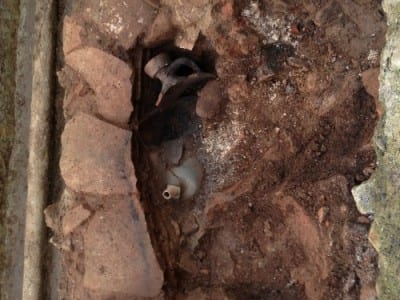
Roman jug found behind Estepona high street
A ROMAN jug has been unearthed behind Estepona high street.
A team of archaeologists discovered the ancient artifact yesterday morning close to the town’s shopping area.
Sailing instructor Tomas Reyes spotted the organised dig outside his house and took the snap above.
“It was very interesting, it must be at least 2,000 years old.
“I asked if I could take a picture as they found it,” said Reyes.
Romans used the containers to transport liquids such as water, wine, oil and honey.
Read the rest of this article...
Charcoal clues to Assynt's Bronze Age woodland
Analysis of charcoal at the site of a suspected Bronze Age "sauna" suggests the surrounding area hosted a rich and diverse woodland.
Archaeologists have been examining what is called a burnt mound at Stronechrubie, in Assynt. Wood from birch, alder, hazel and hawthorn, or apple, trees has been identified.
Archaeologists said the species were far more diverse than those found in Assynt today.
Excavations of the burnt mound - a crescent shaped mound of stones - revealed a metre-deep pit linked to a nearby stream by a channel.
The find was made by the Fire and Water Project, which is run by archaeology and history group Historic Assynt and AOC Archaeology.
The project's archaeologists believe it may have been created for bathing, or as a sauna.
Read the rest of this article...
Subscribe to:
Posts (Atom)