Monday, June 27, 2016

Roman Burials Discovered In East England


A previously undiscovered Roman cemetery has been found by archaeologists working on a Lincoln city centre site. The skeletal remains of two babies and an adult, plus ashes in an urn, were uncovered by the team preparing the ground for the University of Lincoln's new Sarah Swift building. And archaeologists working on the land between High Street and Brayford Wharf East are excited because the major finds further emphasise the importance of Lindum as a Roman centre.


No indications of a Roman cemetery had been found in the Lincoln area until 
an excavation at the city's university [Credit: © Allen Archaeology Ltd]
City archaeologist Alastair MacIntosh said: "Previous archaeological work in the area has revealed evidence of Roman buildings dating from the 1st century onwards. And until now it was thought that the area was only used for housing, so this is an exciting discovery."
Read the rest of this article...

EMAS Field Trip to Wells Cathedral and Bishop's Palace

Field Trip to Wells Cathedral and Bishop's Palace


Guide: David Beard MA, FSA


Saturday, 9th July 2016


There are still a few places left on this field trip.

You can find further information here...

Tuesday, June 21, 2016

After 1,000 years, ‘forgotten’ Danish Viking fortress opens

The 'forgotten' Viking fortress is one of five in Denmark. Photo: Mathias Løvgreen Bojesen/Scanpix

The historic discovery two years ago of a fifth Viking ring fortress was celebrated in grand style on Monday.

After lying forgotten for over 1,000 years, archaeologists uncovered a circular Viking fortress just west of the Zealand town of Køge in a find that shook up popular knowledge of the Viking Age
 
Researchers had long assumed that the four previously discovered Viking fortresses were all that remained in Denmark and the September 2014 find was the first of its kind in 60 years. 
 
On Monday, Queen Margrethe officially unveiled the fortress, dubbed Borgring. It opens to the general public on Wednesday, June 1st and is expected to draw upwards of 30,000 visitors per year. 

Read the rest of this article...

Largest-ever Viking gold collection found in Denmark


Six gold bracelets and a silver one represent the largest-ever Viking treasure trove uncovered in Denmark. Photo: Nick Schaadt, Museet på Sønderskov

Three amateur archaeologists have uncovered the largest ever trove of Viking gold in Denmark.


The three archaeologists, who call themselves Team Rainbow Power, found seven bracelets from the Viking Age in a field in Vejen Municipality in Jutland. The bracelets, six gold and one silver, date to around the year 900. 
With a combined weight of around 900 grammes, the find is the largest ever discovery of Viking gold in Denmark. 
Team Rainbow Power member Marie Aagaard Larsen said that she had only been on the field for around ten minutes before striking gold – literally. 

Read the rest of this article...
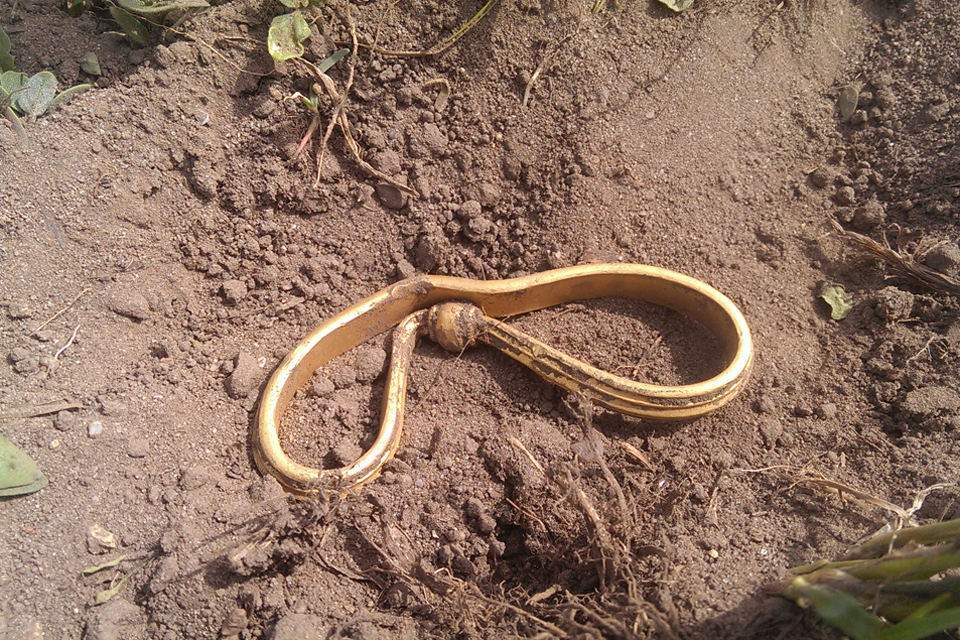
Whistling Sling Bullets Were Roman Troops' Secret 'Terror Weapon'

Some of the Roman sling bullets found at the Burnswark Hill battle site in Scotland. The two smallest bullets, shown at the bottom of this image, are drilled with a hole that makes them whistle in flight.
Credit: John Reid/Trimontium Trust

Some 1,800 years ago, Roman troops used "whistling" sling bullets as a "terror weapon" against their barbarian foes, according to archaeologists who found the cast lead bullets at a site in Scotland.
Weighing about 1 ounce (30 grams), each of the bullets had been drilled with a 0.2-inch (5 millimeters) hole that the researchers think was designed to give the soaring bullets a sharp buzzing or whistling noise in flight.
The bullets were found recently at Burnswark Hill in southwestern Scotland, where a massive Roman attack against native defenders in a hilltop fort took place in the second century A.D. [See Photos of Roman Battle Site and Sling Bullets]
Read the rest of this article...

Monday, June 20, 2016

Story of one of the largest Saxon cemeteries ever found in Wessex revealed 42 years after its discovery

One of the largest Saxon cemeteries ever found in Wessex contains cremations, inhumations and warrior burials


Found in Collingbourne Ducis in Wessex, this skull shows a well-healed trepanation. There is no indication that the man had suffered any head injuries prior to the procedure
© Wessex Archaeology

Cremations, inhumations and graves accompanied by shield bosses, knives and spearheads were among the 77 burials at one of the largest Saxon cemeteries ever discovered in Wessex, say archaeologists who have released their findings at the site after re-examining a tricky terrain first excavated during the 1970s.

A local woman alerted the local council in the village of Collingbourne Ducis when she saw bones protruding from the ground at a housing development site in late 1973. More than 30 graves were found there by archaeologists in 1974, with a further 86 – believed to date from between the 5th and 7th centuries – uncovered in 2007.


Read the rest of this article...

Viking Gold Hoard Discovered In Denmark


Denmark's main museum says amateur archaeologists have found seven bracelets - one of silver and six of gold - which are considered to be the largest Viking-era gold find in Denmark.
Viking Gold Treasure found at Vejen in 2016 [Credit: Museum of Sønderskov/Nick Schadt]

National Museum of Denmark spokesman Peter Pentz says finding one "is huge but it is something special to find seven."

Pentz says the bracelets weighing a total of almost one kilogram (2.2. pounds) were discovered last week near Vejen in western Denmark by people using metal detectors.

He said in a statement Thursday the bracelets could have been used by a Viking chieftain to reward faithful followers. They likely were part of a treasure that includes a gold chain found in the same field in 1911.


Read the rest of this article...

Gaulcross Hoard Sheds Light On Northern Scotland During Roman Era


Major breakthroughs in our understanding of the Picts, the “lost” ancient people of Northern Scotland, and their possible interaction with the last Romans in Britain have followed the discovery of a hoard of Roman silver in Aberdeenshire.
The entire silver hoard (except for the three pieces discovered in 1838) on display 
[Credit: National Museums Scotland]

First uncovered in 1838 and again in 2014 and now known as the Gaulcross Hoard, the items discovered over the past 18 months now extend to more than 100 silver coins and objects.

What is exciting archaeologists and historians is that although the hoard is Pictish in origin, the metal itself is Roman and includes Hacksilber, fragments of cut and bent silver items that were often used as currency by the Romans.

The suggestion by the discoverers is that the Gaulcross Hoard was originally in high-status Roman hands and that the Picts acquired them either through looting, trade or military means.


Read the rest of this article...

Thursday, June 16, 2016

Viking Gold Hoard at the End of the Rainbow


It really feels as if we found  gold at the end of the rainbow, tells one of the amateur archaeologists, who last week found the largest treasure of Viking gold ever discovered in Denmark

Last week three amateur archaeologists found seven bangles from the 10thcentury in a field near Vejen in Jutland. The amazing thing is that six of the seven are made of gold, while the last is of silver.
– When we discovered the first ring, we really felt that we had found the gold at the end of the rainbow. And then more surfaced; it was almost unreal, says Marie Aagaard Larsen, who together with her husband Christian Nedergaard Dreiøe and their common friend Poul Nørgaard Pedersen is one of the three happy finders.

It took only about ten minutes to find the first three bangles; afterwards a phot was sent quickly to the local museum in Sønderskov where the curator was quick to secure the place.


Read the rest of this article...

Monday, June 13, 2016

Archaeology in the Round?


A new website providing links to archaeological photo spheres is now online.

The purpose of the site is to make these photo spheres easily available and also to encourage people to make archaeological photo spheres and publish them on the site.


You can find the site at: archosphere.eu

Body in well confirms Viking Saga

Archeologists from NIKUnorway working in the well. 
Image: The Norwegian Institute for Cultural Heritage Research

Archaeologists working in Trondheim in Norway are amazed by the discovery of a human skeleton in the bottom of an abandoned castle well. The skeleton provides evidence that confirms dramatic historical events mentioned in the Sagas.
The location and contents of the well are mentioned in Sverre’s Saga, a chronicle of one of the kings of Norway, and one of very few historical manuscripts describing events in the Norwegian Viking age and medieval period.
Scholars have questioned the chronicle’s trustworthiness as a historical document. But now, at least one part of the saga seems to hold truth – down to the tiniest detail.
This is truly astonishing. As far as I know there is no known example of the discovery of an individual historically connected with an act of war as far back as the year 1197. And the fact that this actually corroborates an event described in Sverre’s saga is simply amazing“, says lead archaeologist at the site, Anna Petersén.
Read the rest of this article...

Study: Stone Age migrants introduced agriculture to Europe

This undated picture provided by the Paliambela Excavation Project Archive, shows a human burial from the archaeological site of Paliambela in northern Greece.  
K. KOTSAKIS, P. HALSTEAD/PALIAMBELA EXCAVATION PROJECT ARCHIVE VIA AP

BERLIN -- Stone Age people from the Aegean Sea region moved into central and southern Europe some 8,000 years ago and introduced agriculture to a continent still dominated at the time by hunter-gatherers, scientists say.
The findings are based on genetic samples from ancient farming communities in Germany, Hungary and Spain. By comparing these with ancient genomes found at sites in Greece and northwest Turkey, where agriculture was practiced centuries earlier, researchers were able to draw a genetic line linking the European and Aegean populations.
The study challenges the notion that farming simply spread from one population to another through cultural diffusion. The findings were published Monday in the Proceedings of the National Academy of Science.
Read the rest of this article...

The day I stumbled on a Roman villa in my back garden


Luke Irwin at his home, next to the gate under which a Roman mosaic was found 
CREDIT: JAY WILLIAMS


When Luke Irwin discovered evidence of a palatial second century Roman villa in his quiet corner of Wiltshire, he wasn’t prepared for the world’s reaction. The chance nature of the find in his back garden, which was exposed last February when a stretch of vividly coloured mosaic was uncovered during wiring work, certainly made for an attention-grabbing story.

But what was less predictable was the speed at which it spread around the world after he went public with the news in April this year. Within a couple of days, the internet was agog with debate (“What are ancient Roman luxury villas going for nowadays?”) and Irwin’s video about the discovery and excavation of the site – previously a sheep field – had been watched by thousands of people. Things became truly surreal when Fox News introduced the villa to America as “the opulent home of a Roman-era 'Kardashian’ family”.

Read the rest of this article...

44 Celtic Gold Coins Found In Austria


Archaeologists have unearthed gold treasure in Austria thought to be worth as much as €50,000. The 44 Celtic gold coins, weighing 7.5 grams, were found on a site in Traun, near Linz in Upper Austria, that was being excavated before the building of a machinery hall.


The 44 Celtic gold coins were found on a site in Traun, near Linz in Upper Austria 
[Credit: OÖ Landesmuseum]
The gold pieces are thought to have been made in the Iron Age between the 1st and 2nd centuries BC in the region that is known as Bohemia today and likely ended up in Austria through trade.

According to the ORF, researchers at the provincial museum say the discovery is of the highest importance as it is one of the just three similar finds from the pre-Romanian time in Upper Austria.

This era is seen as the crossover from an economy based on trading goods to a monetary economy, which came with the Romans.

Read the rest of this article...

Sunday, May 29, 2016

Red paint found at Roman Baths during excavations

Wall plaster with a red-painted finish has been found on an external wall

The building housing some of Britain's most famous Roman baths may have been painted red, archaeologists have said.
A dig at the site, in Bath, uncovered remnants of red paint on the outside wall - contradicting a widely-held assumption they were white in colour.
The discovery was made during a dig in an area of the world heritage site not currently open to the public.
Manager Stephen Clews said it would have helped the building to stand out to visitors.
"Our assumption was that it was white but it's turned out to be red," he said.

Read the rest of this article...

Discovery of Roman fort built after Boudican revolt


New research published by archaeologists from MOLA reveals a previously unknown Roman fort, built in AD63 as a direct response to the sacking of London by the native tribal Queen of the Iceni, Boudica. The revolt razed the early Roman town to the ground in AD60/61 but until now little was understood about the Roman’s response to this devastating uprising.

Excavations at Plantation Place for British Land on Fenchurch Street in the City of London exposed a section of a rectangular fort that covered 3.7acres. The timber and earthwork fort had 3metre high banks reinforced with interlacing timbers and faced with turves and a timber wall. Running atop the bank was a ‘fighting platform’ fronted by a colossal palisade, with towers positioned at the corners of the gateways. This formidable structure was enclosed by double ditches, 1.9 and 3m deep, forming an impressive obstacle for would be attackers.
Read the rest of this article...
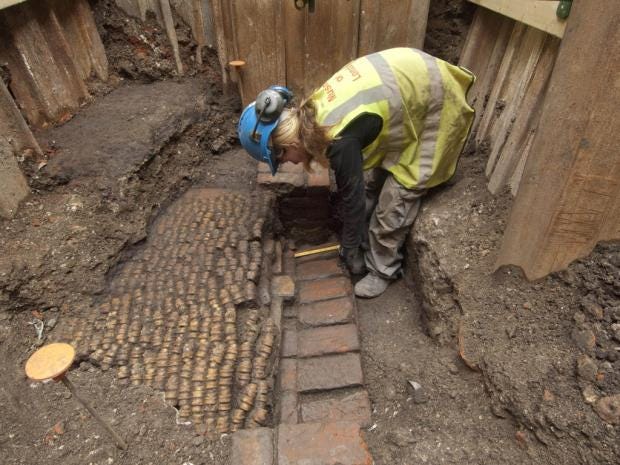
How London became Britain's capital has been revealed for the first time


A Roman fort suggests the Romans chose London as their new British political headquarters after Boadicea's revolt in the mid 1st century AD

A brutal blood-soaked bid to wipe London off the map was a key factor that led to the city first emerging as Britain's capital.
New archaeological research is showing that London's elevated status stemmed partly from a Roman military and political reaction to Boadicea's violent destruction of London and other key cities in the mid 1st century AD.
The investigation, carried out by Museum of London Archaeology(Mola), suggests that the Romans shifted the capital of their British province from Colchester to London shortly after her revolt.
Read the rest of this article...
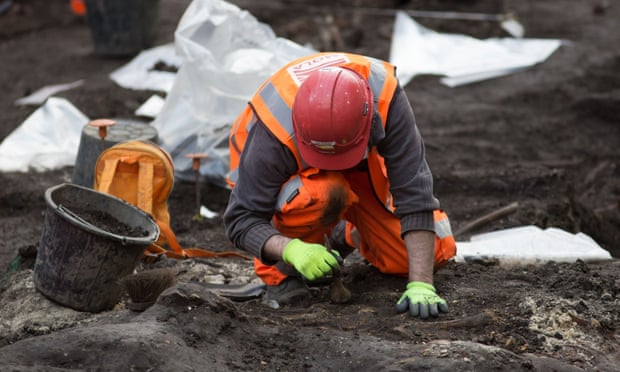
New Lead in the Search for Elusive Norse Settlements

Wayne MacIsaac stands near what he believes may be the remnants of a Norse fortification wall. (Tara MacIsaac/Epoch Times)

CODROY VALLEY, Canada–A story passed down in my family for generations may be the clue to finding a lost Norse settlement.
The only Norse settlement in the New World thus far confirmed by archaeologists is in L’Anse aux Meadows at the northern tip of Newfoundland, Canada. But the Norse sagas tell of other colonizing expeditions.
Last summer, archaeologists announced that they had found evidence of a Norse presence–a hearth used for roasting bog iron ore, which is the first step in the production of iron–at Point Rosee in southern Newfoundland. My uncle, Wayne MacIsaac, was so excited he said he didn’t sleep for three days. He felt vindicated in his long-cherished, but long-ignored, theory that he had found an ancient Norse site in the nearby Codroy Valley where he lives.
His previous attempts to attract the interest of archaeologists to the site had met with failure, but that has now changed. An international team of archaeologists are due to investigate in July.
Read the rest of this article...
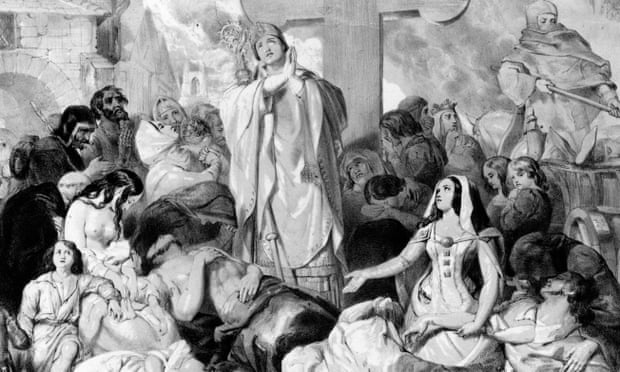
Experts stunned to discover early Shakespearian theatre was rectangular


The Curtain Theatre – one of the three earliest purpose-built playhouses in England – was 30 metres long and 22 metres wide, and not round like as expected

Archaeologists undertaking the initial excavation work at The Curtain Theatre AP

Remarkable new archaeological discoveries in London are shedding fresh light on the birth of the English theatre.
Excavations of a 16th century Shakespearian playhouse in Shoreditch have revealed that, contrary to all expectations, the purpose-built theatre was rectangular – not polygonal or round like the Globe or the Swan.
"It's a total surprise to us," said one of the U.K.'s top Shakespeare scholars, Professor Stanley Wells, honorary president of the Shakespeare Birthplace Trust.
The rectangular shape reveals that the Curtain (and therefore potentially one or two other early theatres) were modelled on four-sided galleried inn courtyards – the major traditional venues for theatrical performances prior to the construction of the first purpose-built theatres.
Read the rest of this article...

Archaeology must open up to become more diverse


Archaeology classrooms are becoming more representative, but we need practitioners with more varied backgrounds and perspectives

 An archaeologist at work on the Bedlam burial ground in London. 
Photograph: Daniel Leal-Olivas/PA

As a British Asian woman, I am one of a small handful of black, Asian and minority ethnic (BAME) people to carve out a lengthy career in the archaeology sector. This is a problem.
In 2013, the Chartered Institute for Archaeologists (CIfA) published its Profiling the Profession (pdf) report, which included a section on ethnicity. We are 99% white, with a miserly 1% “other” ethnicities. There are about 6,000 people employed in the archaeology sector in the UK. Of the 837 respondents, seven described themselves as non-white – and one of those was me.
These numbers are mirrored in wider arts audiences as well as people who access archaeology and heritage in its many forms, including museums and other venues. In December 2015, the chair of Arts Council England (ACE), Sir Peter Bazalgette, highlighted these continuing issues at ACE’s Diversity and the Creative Case event.
Read the rest of this article...

'Eye-watering' scale of Black Death's impact on England revealed


Thousands of volunteers have helped to uncover the full and devastating extent of the population collapse caused by the epidemic

Praying for relief from the bubonic plague or Black Death Hulton hh3748.jpg Photograph: Hulton Getty

Scraps of broken pottery from test pits dug by thousands of members of the public have revealed the devastating impact of the Black Death in England, not just in the years 1346 to 1351 when the epidemic ripped Europe apart, but for decades or even centuries afterwards.
The quantity of sherds of everyday domestic pottery - the most common of archaeological finds - is a good indicator of the human population because of its widespread daily use, and the ease with which it can be broken and thrown away. By digging standard-sized test pits, then counting and comparing the broken pottery by number and weight from different date levels, a pattern emerges of humans living on a particular site.
Read the rest of this article...
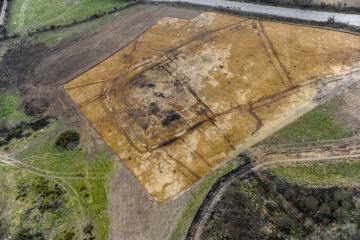
Women In Southern Germany Corded Ware Culture May Have Been Highly Mobile


Women in Corded Ware Culture may have been highly mobile and may have married outside their social group, according to a study published May 25, 2016 in the open-access journal PLOS ONE by Karl-Göran Sjögren from Göteborg University, Sweden, and colleagues.


Examples of pottery from the Corded Ware period; these pieces date to ca. 2500 BC 
[Credit: WikiCommons]

The Corded Ware Culture is archaeologically defined by material traits, such as the burial of the dead under barrows alongside characteristic cord-ornamented pottery, and existed in much of Europe from ca. 2800-2200 cal. B.C.

To better understand this culture, the authors of the present study examined human bones and teeth from seven sites in Southern Germany dating from different periods of Corded Ware culture, including two large cemeteries. They used carbon dating and additional dietary isotope analysis to assess the diet and mobility of the population during this period.

Read the rest of this article...
Neanderthals Were Stocky From Birth


If a Neanderthal were to sit down next to us on the underground, we would probably first notice his receding forehead, prominent brow ridges and projecting, chinless face.


Reconstruction of a Neanderthal child from the Musee National de Prehistoire 
in Les Eyzies de Tayac, France [Credit: Don Hitchcock]

Only on closer inspection would we notice his wider and thicker body. Researchers from the Max Planck Institute for Evolutionary Anthropology in Leipzig have now investigated whether the differences in physique between Neanderthals and modern humans are genetic or caused by differences in lifestyle. Their analysis of two well-preserved skeletons of Neanderthal neonates shows that Neanderthals’ wide bodies and robust bones were formed by birth.

Read the rest of this article...

LA RICHE HISTOIRE DU SITE DE LAVALLOT NORD À GUIPAVAS


L'Inrap mène, depuis le 11 janvier 2016, une fouille préventive aux portes de Brest, sur le site de Lavallot Nord à Guipavas. Prescrite par la Drac Bretagne (service régional de l’Archéologie), elle permet la sauvegarde par l’étude des vestiges du sous-sol, préalablement à un projet d’aménagement porté par Brest Métropole Aménagement. La fouille révèle les témoignant d’une longue occupation depuis la fin du Néolithique. Mais c’est pendant l’Antiquité puis au Moyen Âge que le site révèle son histoire la plus dense.

Read the rest of this article...

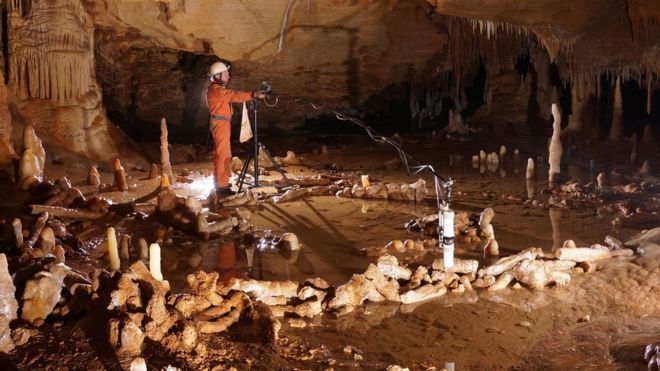
Neanderthal stone ring structures found in French cave

The structures were found deep inside the cave, so the builders would have needed fire to see 

Researchers investigating a cave in France have identified mysterious stone rings that were probably built by Neanderthals.

The discovery provides yet more evidence that we may have underestimated the capabilities of our evolutionary cousins.

The structures were made from hundreds of stalagmites, the mineral deposits which rise from the floors of caves.

Dating techniques showed that they were broken off 175,000 years ago.

The findings are reported in the journal Nature.

Read the rest of this article...
Saturday, May 14, 2016

A kitchen story, a quarry, bones and gaming pieces: These medieval finds have been found at a Suffolk school


A school site in an 11th century road system in Suffolk has been excavated for medieval remains ahead of the creation of a new classroom and kitchen. The first cooking there, though, might actually have happened during the 14th century, according to the most unusual of the discoveries made during the dig: a small flint and mortar building which is thought to have been a kitchen or cold store.

Any fires during cooking wouldn’t have affected the main house, with the kitchen building set some distance from the street frontage and houses. Above ground, it would have been constructed of timber with a tiled floor and roof.

Bury St Edmunds’s Abbot set up the roads at the core of the old town, where a large medieval market thrived. Pilgrims to the abbey made the area an important and wealthy regional centre.


Read the rest of this article...
'Stone Age Art' in Bavarian cave not carved by humans after all


The Mäanderhöhle cave near Bamberg was previously regarded as an archaeological sensation. It was thought to contain some of the oldest cave art in Germany. However, Julia Blumenröther, a former student at Universität Erlangen-Nürnberg, has demonstrated in her Master's thesis that the markings discovered inside the cave in 2005 are not fertility symbols carved by humans as previously thought. In fact, these lines occurred as a result of natural processes, the archaeologist says.
One of the caverns in the 75-metre long cave is full of spherical deposits of minerals known as cave clouds that form on rocks in a similar way to stalactites and stalagmites. In 2005, cave researchers discovered a large number of lines that looked like they could have been made by humans on the rock-hard surface of these cave clouds. An archaeologist studied these lines several years later and published his interpretation of them in a preliminary report, in which he said that the between 14,000 and 16,000 year-old lines were made by humans and probably depicted a phallus and abstract female figures.
Read the rest of this article...

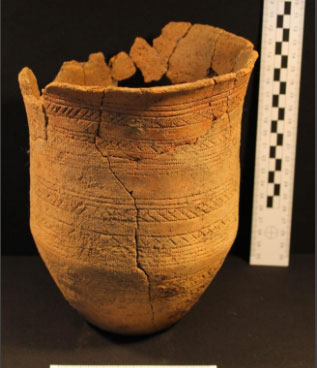
Bronze Age Burial Found in England


EVESHAM, ENGLAND—Archaeologists surveying a future development site in England’s West Midlands region were surprised to find a Bronze Age burial, reports the Worcester News. The team was following up on an earlier excavation at the site that revealed ditches thought to date to the Iron Age. In broadening their investigation to include a larger tract of land, the archaeologists discovered ditches with artifacts dating 1,000 years earlier than they expected, to the early Bronze Age. “The really unexpected find was a ‘beaker’ burial,” said Laurence Hayes of the environmental consulting firm RSK. “This large burial pit contained a near complete Early Bronze Age vessel known as a beaker, covered with intricate patterns, and a polished stone archer’s wrist guard.” 

Wednesday, May 11, 2016

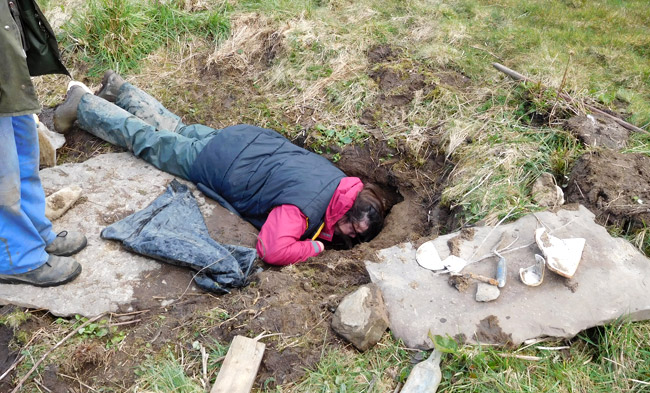
Two finds in one at Harray chamber

County archaeologist Julie Gibson at the entrance to the underground chamber. (Archaeology Institute UHI)

A prehistoric underground structure has been rediscovered in Harray – rediscovered in that the archaeologists found it to be full of Victorian rubbish!
But although it had obviously been opened,  entered and used in the 19th century, the chamber appears to have gone unrecorded.
Martin Carruthers, of the Archaeology Institute UHI, and county archaeologist Julie Gibson made their way out to the site, near the Harray Manse, last weekend.
Martin explained: “It’s either a souterrain or a ‘well’ and, given similar examples elsewhere in the county, probably dates to the Iron Age.
“The site was discovered by the landowner Clive Chaddock, who, happily, also happens to be a colleague at Orkney College UHI!
Read the rest of this article...

More Anglo-Saxons - including a warrior and a high-status woman - have been found by archaeologists in Wiltshire

A six-foot warrior and a high-status woman were part of an Anglo-Saxon cemetery excavated in south-east Wiltshire


Last month, archaeologists found an Anglo-Saxon cemetery, Neolithic monuments and spears, knives and bone combs at a proposed Ministry of Defence housing site on Salisbury Plain. In the nearby garrison town of Tidworth, they’ve now excavated a 1,300-year-old cemetery of 55 burials from between the late 7th and early 8th centuries, containing the remains of men, women and children representing a cross-section of a local community.

“The mid-Saxon cemetery is of particular importance in its own right,” says Bruce Eaton, the Project Manager for Wessex Archaeology, surveying one grave confining a six-foot tall warrior with an “unusually large” spearhead and conical shield boss. “But taken together with the excavation of the cemetery on MOD land at Bulford, which was of a similar date, we now have the opportunity to compare and contrast the burial practices of two communities living only a few miles apart. They would almost certainly have known each other.”

Read the rest of this article...

Viking 'parliament' site uncovered on Scottish island


IT is an ancient meeting place where Vikings would gather to decide laws, settle disputes and make key political decisions.
Now archaeologists believe they have identified one of the Norse parliament sites – known as a ‘thing’ - on the island of Bute, which points to it being the headquarters of the powerful Norse King, Ketill Flatnose, whose descendants were the earliest settlers on Iceland.
The significance of the mound site at Cnoc An Rath, which has been listed as an important archaeological monument since the 1950s, has been unclear for decades. Some had suggested it could have been prehistoric or a medieval farm site.
However, the idea of the location being a Viking site had been raised through a recent study of place-names on the island, which suggested long-lost names in the area may have contained the Norse word ‘thing’.
Read the rest of this article...

Wednesday, May 04, 2016

Hominins may have been food for carnivores 500,000 years ago


Tooth-marks on a 500,000-year-old hominin femur bone found in a Moroccan cave indicate that it was consumed by large carnivores, likely hyenas, according to a study* published April 27, 2016 in the open-access journal PLOS ONE by Camille Daujeard from the Muséum National D'Histoire Naturelle, France, and colleagues.
During the Middle Pleistocene, early humans likely competed for space and resources with large carnivores, who occupied many of the same areas. However, to date, little evidence for direct interaction between them in this period has been found. The authors of the present study examined the shaft of a femur from the skeleton of a 500,000-year-old hominin, found in the Moroccan cave "Grotte à Hominidés" cave near Casablanca, Morocco, and found evidence of consumption by large carnivores.
Read the rest of this article...

Neandertals and Upper Paleolithic Homo sapiens had different dietary strategies

This is an image of a fossilized human molar used in the study of dietary habits of Neandertals and Upper Paleolithic Homo sapiens. Credit: Sireen El Zaatari 
PLOS ONE—When fluctuating climates in the Ice Age altered habitats, modern humans may have adapted their diets in a different way than Neandertals, according to a study published April 27, 2016 in the open-access journal PLOS ONE by Sireen El Zaatari of the University of Tübingen, Germany, and colleagues.
The Neandertal lineage survived for hundreds of thousands of years despite the severe temperature fluctuations of the Ice Age. The reasons for their decline around 40 thousand years ago remain unclear. The authors of this study investigated the possible influence of dietary strategies using the fossilized molars of 52 Neandertals and Upper Paleolithic Homo sapiens (modern humans). They analysed the type and degree of microwear on the teeth to attempt to draw conclusions about diet type and to establish a relationship with prevalent climactic conditions.
Read the rest of this article...

Meta-Vikings: Runestone Long Thought to Honor Kings Actually Monument to Writing Itself

This is Per Holmberg, researcher at University of Gothenburg, with the Rök Runestone. 
Photo: University of Gothenburg

The Rök Runestone was carved in Sweden in the late 800s. Since it was discovered in the 1940s, interpretations of the writing honed in on supposed references to heroic journeys, battles and warrior-kings.
But a new interpretation says the Runestone is in fact referencing itself – and the power of writing, according to a new study.
“The riddles on the front of the stone have to do with the daylight that we need to be able to read the runes, and on the back are riddles that probably have to do with the carving of the runes and the runic alphabet, the so-called futhark,” said Per Holmberg, associate profess of Scandinavian languages at the University of Gothenberg.
The three-part “arc” of the stone concerns the daylight needed to write and read the stone, the carving of the stone itself, and the legacy that is produced by the writing, according to the paper, published in Futhark: The International Journal of Runic Studies.
Read the rest of this article...

New Interpretation Of The Rok Runestone Inscription Changes View Of Viking Age

Per Holmberg, researcher at University of Gothenburg, with the Rok Runestone 
[Credit: University of Gothenburg]

The Rok Runestone, erected in the late 800s in the Swedish province of Ostergotland, is the world's most well-known runestone. Its long inscription has seemed impossible to understand, despite the fact that it is relatively easy to read. A new interpretation of the inscription has now been presented -- an interpretation that breaks completely with a century-old interpretative tradition. What has previously been understood as references to heroic feats, kings and wars in fact seems to refer to the monument itself.

'The inscription on the Rok Runestone is not as hard to understand as previously thought,' says Per Holmberg, associate professor of Scandinavian languages at the University of Gothenburg. 'The riddles on the front of the stone have to do with the daylight that we need to be able to read the runes, and on the back are riddles that probably have to do with the carving of the runes and the runic alphabet, the so called futhark.'

Previous research has treated the Rok Runestone as a unique runestone that gives accounts of long forgotten acts of heroism. This understanding has sparked speculations about how Varin, who made the inscriptions on the stone, was related to Gothic kings. In his research, Holmberg shows that the Rok Runestone can be understood as more similar to other runestones from the Viking Age. In most cases, runestone inscriptions say something about themselves.

Read the rest of this article...

Tuesday, May 03, 2016

DNA secrets of Ice Age Europe unlocked

 
study of DNA from ancient human bones has helped unlock the secrets of Europe's Ice Age inhabitants.
Researchers analysed the genomes of 51 individuals who lived between 45,000 years ago and 7,000 years ago.
The results reveal details about the biology of these early inhabitants, such as skin and eye colour, and how different populations were related.
It also shows that Neanderthal ancestry in Europeans has been shrinking over time, perhaps due to natural selection.