Thursday, September 25, 2014

Beyond Angkor: How lasers revealed a lost city


Deep in the Cambodian jungle lie the remains of a vast medieval city, which was hidden for centuries. New archaeological techniques are now revealing its secrets - including an elaborate network of temples and boulevards, and sophisticated engineering.
In April 1858 a young French explorer, Henri Mouhot, sailed from London to south-east Asia. For the next three years he travelled widely, discovering exotic jungle insects that still bear his name.
Today he would be all but forgotten were it not for his journal, published in 1863, two years after he died of fever in Laos, aged just 35.
Mouhot's account captured the public imagination, but not because of the beetles and spiders he found.
Read the rest of this article...

Temple of Mithras: How do you put London's Roman shrine back together?


Sixty years ago, a Roman God was uncovered at a London building site. The excavations for the Temple of Mithras moved around but are now going back to the original site - how do you reconstruct a Roman temple, asks Tom de Castella.
The muddy find in September 1954 provoked urgent debate. Winston Churchill's cabinet discussed it three times. A huge new office block - for insurance firm Legal & General - was being built on the site of the Temple of Mithras, described as the Roman discovery of the century. Building work was stopped. People would be able to see it for two weeks before the remains were packed up and moved. A few hundred visitors were expected on day one. Instead about 35,000 queued round the block. Advertisers piled in: "In Londinium they believed in Mithras. In London they believe in Shell." Roughly 400,000 people saw it in all. Then the ruins began a peripatetic existence, including a stay at a builders yard in New Malden, before ending up being exhibited in the City 100 metres from where it had been found.
Read the rest of this article...

Monday, September 22, 2014

Viking Ireland - the Videos


In order to commemorate the 1000th anniversary of the Battle of Clontarf, the National Museum of Ireland have produced a superb set of videos depicting various aspects of Viking Age Ireland.

You can find the Museum’s Website for these videos here…

Or you can find the individual videos on Youtube:
Viking Ireland 1 – Weapons – The Axe

Viking Ireland 2 – Weapons – The Sword


Viking Ireland 3 – Viking Wealth and Trade


Viking Ireland 4 – Viking Women in Ireland


Viking Ireland 5 – Arrival of Vikings and Beliefs


Viking Ireland 6 – The Irish and the Vikings


Viking Ireland 7 – Daily Life in Viking Ireland


Viking Ireland 8 – Legacy of the Vikings in Ireland

TAG 2014: OK Computer? Digital Public Archaeologies in Practice


Call for Papers

Community or public archaeology has often emphasised communities defined by an attachment to place, often defined by the archaeological site (cf. Simpson 2008); increasingly digital technologies allow a breakdown of this privileging of physical place and the concept of ‘community’ (cf. Waterton 2005; 2010), to connect geographically disparate populations. Digital public archaeology projects have emphasised crowd-sourcing, engagment, dissemination, and publicity using blogs, social media, webfeeds and so on (e.g. Richardson 2012, 2013; Bonacchi et al. 2012). As well as the challenges and opportunities relevant to other public archaeology projects, work which includes a significant digital public archaeology component has a series of more specific concerns. Increasingly the need for archaeologists to engage thoughtfully with digitally technologies has been recognised by a number of organisations (Archaeological Data Service 2010; Heritage Lottery Fund 2012; Institute of Archaeologists 2012), and greater numbers of projects are defined by their predominantly digital work. As a result there are implications both for local site-specific practice by people working as archaeologists — where we are “…progressively transforming a ‘‘world of scarcity’’ into one of ‘‘saturation’’, where space is no more an issue…” (Bonacchi 2012); the wider political context in which people interested in heritage operate (Richardson 2012, 2014); and how different interest groups including intelligent and critical consumers work in the historic environment “…without any professional or academic input whatsoever…” (Moshenka 2008).

Read the rest of this article...

Divers sure of new finds from 'ancient computer' wreck


Athens - Archaeologists began on Monday using a revolutionary new deep sea diving suit to explore the ancient shipwreck where one of the most remarkable scientific objects of antiquity was found.
The so-called Antikythera Mechanism, a 2nd-century BC device known as the world's oldest computer, was discovered by sponge divers in 1900 off a remote Greek island in the Aegean.
The highly complex mechanism of up to 40 bronze cogs and gears was used by the ancient Greeks to track the cycles of the solar system. It took another 1 500 years for an astrological clock of similar sophistication to be made in Europe.
Read the rest of this article...

Roadworks reveal ancient city in Western Greece


The construction works for the new motorway Ionia Odos, in Messolonghi, western Greece, led to an important archaeological discovery. 


The recently discovered archaeological site of Alikyrna near Missolonghi  in western Greece [Credit: Protothema] The archaeological site of Alikyrnas stretches to many acres and includes an entire ancient city near Aghios Thomas in Messolonghi. 

The Minister of Infrastructure, Transport and Networks Michael Chryssochoides visited the area and expressed his admiration for this great discovery. 

According to sources in the Greek media, the first findings suggest an ancient urban center which crosses over to the Ionia Odos construction site.

Read the rest of this article...

New photos of Amphipolis Caryatids released


The two caryatids found at the Kasta Tomb in ancient Amphipolis were uncovered entirely by excavators, the ministry of Culture announced on Sunday. 


The Caryatids wear a long chiton and long fringed robe with rich folds  [Credit: Greek Ministry of Culture] 

The full height of each caryatid is 2.27 metres and they are wearing chitons - or full-length draped dresses, tied in the middle - and a long himation, or a shawl-like cover over their dress, with fringes and several folds. 

They are wearing kothornoi, resembling platform boots or shoes and best known for being worn by ancient Greek actors. Their shoes preserve traces of red and yellow pigments, while their toes are depicted in very fine detail.

Read the rest of this article...

Naturfreunde schmelzen für Eisenzeit dahin: In Lehrte bald historisch-ökologische Bildung

DBU-Kurator Matthias Miersch überreichte den Bewilligungsbescheid über 150.000 Euro an den ersten Vorsitzenden der Naturfreunde Lehrte, Wilfried Helmreich. (© Anette Helmreich)

In der Eisenzeit stand die Eisenerz-Verhüttung auch in und um Hannover hoch im Kurs – und produzierte schon früh erste ökologische Krisen. Was diese historische Epoche mit der Gegenwart in Sachen nachhaltige Landwirtschaft, Imkerei und Forstwirtschaft trennt oder verbindet, wollen die Naturfreunde Lehrte in einem "Miniatur-Freilichtmuseum" aufzeigen und so ein "differenziertes Nachhaltigkeitsverständnis für Schüler der Sekundarstufen I und II wie für Jugendgruppen befördern".

Read the rest of this article...

2,000 year old boomerang unearthed in France


The Gauls used boomerangs 2,000 years ago, according to archaeologists who have found a wooden curved stick on a beach in the northern French town of Cotentin. 


The Gallic "throwing stick" found at the site of Urville-Nacqueville  [Credit: Cyril Damourette] 

Boomerangs are usually associated with Australian aborigines but these amazing wooden weapons have been found in Egypt, apparently dating back 2,000 years, and in Europe - the oldest one, which was found in a cave in Poland, being 30,000 years old. 

They were apparently toys but now archaelogists have found what sems to be a 2,000-year-old boomerang on the beach at Cotentin and it was not used for play, Le Monde newspaper reports. 

Read the rest of this article...

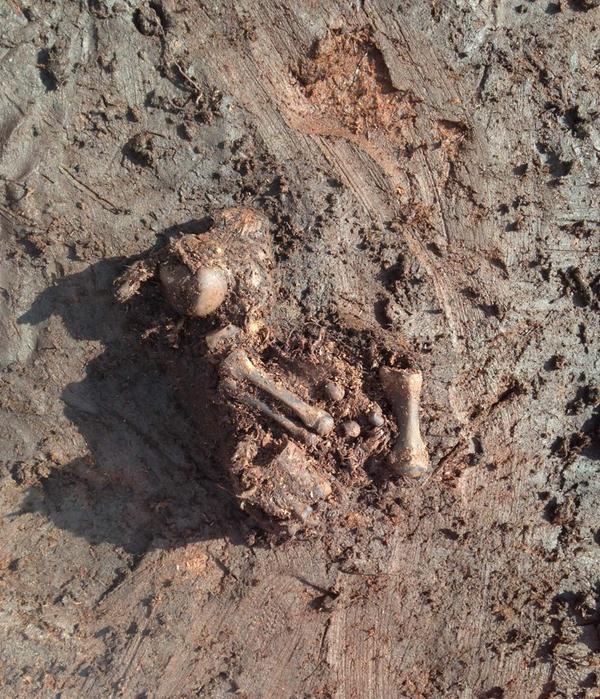
'Lost chapel' skeletons found holding hands after 700 years

A couple who have been holding hands for 700 years have been uncovered at the ‘lost’ chapel of St Morrell in Leicestershire. Credit: University of Leicester Archaeological Services

Some relationships last a lifetime – and University of Leicester archaeologists have discovered that they can last even longer after unearthing two skeletons at a lost chapel in Leicestershire that have been holding hands for 700 years.
The happy couple refused to be parted by death when they were discovered by a team of archaeologists from the University of Leicester Archaeological Services (ULAS) working with local volunteers during an excavation at the Chapel of St Morrell in Leicestershire, a site of pilgrimage in Hallaton during the 14th Century.
The four year  with the Hallaton Fieldwork Group (HFWG) has revealed the full plan of the chapel as well as the cemetery and evidence that the hillside has been used since at least the Roman period.
Read the rest of this article...

Engineers found Teutonic axes in the Forest District Wipsowo


Three Teutonic battle axes from the late Middle Ages have been found by engineers who remove World War II artillery shells left the forests in the Forest District Wipsowo (Warmia and Mazury). Historic weapons will be donated to the museum.
Engineers stumbled upon the historic axes by chance, while searching the woods metal detectors. The weapons have been initially identified by an archaeologist as late-medieval Teutonic battle axes.

Iron axes were close to each other, shallow underground, among the roots of trees. "It can be assumed that this is a deposit that someone left for better times. Perhaps the person fled, hid the weapons and never returned to this place" - told PAP Agata Trzop-Szczypiorska, responsible for archaeological supervision of the engineers’ work.

Read the rest of this article...

Fourth chamber likely at Amphipolis tomb


A high-ranking Ministry of Culture official told Greek news sources that the archaeologists who are currently clearing out the dirt from the third chamber in the Amphipolis tomb believe that a fourth chamber may exist. 


Meanwhile, the head of the excavation Katerina Peristeri told journalists that based on the findings so far, she believes the enigmatic tomb definitely dates back to the last quarter of the 4th century B.C.

 Mrs. Peristeri complained about colleagues who appear in the media claiming that the tomb may have been constructed in the Roman era. 

“The tomb is Macedonian. We have all the proof for that." said Mrs. Peristeri. "It’s futile for some people to say that it is Roman. I feel indignation against some colleagues of mine that speak to the TV channels, just for 5 minutes on prime time TV without knowing anything about the excavation.” 

Read the rest of this article...

Greeks captivated by Alexander-era tomb at Amphipolis

Two sphinxes guard the entrance to the tomb at Amphipolis

The discovery of an enormous tomb in northern Greece, dating to the time of Alexander the Great of Macedonia, has enthused Greeks, distracting them from a dire economic crisis.
Who, they are asking, is buried within.
In early August, a team of Greek archaeologists led by Katerina Peristeri unearthed what officials say is the largest burial site ever to be discovered in the country. The mound is in ancient Amphipolis, a major city of the Macedonian kingdom, 100km (62 miles) east of Thessaloniki, Greece's second city.
The structure dates back to the late 4th Century BC and is 500m (1,600ft) wide, dwarfing the burial site of Alexander's father, Philip II, in Vergina, west of Thessaloniki.
Read the rest of this article...

Friday, September 19, 2014

Prehistoric pit discovered on Coney Island beach


A box-like structure built from large stone slabs may have been used for bathing or cooking during the Bronze Age

Volunteers excavate the box-like archeological structure on Coney Island. The site may date back 4,000 years
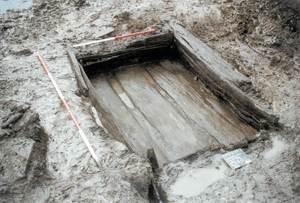
Archaeologists have discovered signs of human habitation, possibly dating back 4,000 years, on Sligo’s Coney Island.
A box-like structure built from large stone slabs found on the island may have been used for bathing or cooking during the Bronze Age, experts believe. It has been excavated by a team led by Eamonn Kelly, director of Irish Antiquities at the National Museum.
The structure is thought to be part of a fulacht fiadh, a prehistoric trough or pit that was dug into the ground and filled with water. Stones, heated separated on an outdoor hearth, would be added to bring the water to boil.
Measuring about a metre long and 80cm wide, the structure was recently identified as an archaeological site by Ciaran Davis, an archaeology student at IT Sligo, and native of nearby Rosses Point, who alerted the museum.
Read the rest of this article...

Letter from Ireland: Mystery of the Fulacht Fiadh


Versions of the same Bronze Age structure pop up all around Ireland and throughout the United Kingdom. Archaeologists, however, still have not agreed on their purpose.

On a typically misty morning in the west of Ireland, just outside the medieval town of Athenry, County Galway, archaeologist Declan Moore opens the trunk of his car and invites me to pull on a pair of Wellingtons. “Believe me, you’ll need them,” he assures me as we cross the parking lot and hop a fence into a nearby field.

Moore is taking me to visit an unexcavated fulacht fiadh (pronounced FULL-ahk FEE-add), or fulachtaí fia in plural, the most common type of prehistoric archaeological site in Ireland. Better known as a “burnt mound” in the neighboring United Kingdom, where they are also found, there are nearly 6,000 recorded fulacht fiadh sites dotted around Ireland alone. As we trudge through the wet and soggy field, Moore points out a small stream. “They are usually found near water or in marshy areas, so this is a prime location,” he explains.


When we arrive at the site, Moore shows me the basic features of a fulacht fiadh—a horseshoe-shaped mound of soil and rocks surrounding a depression big enough to park a small car in. Moore climbs the four-and-a-half-foot mound and quickly wipes away some of the soil to expose the layer of stones. He then points to the depression. “If we were to excavate, we’d find a trough dug into the ground there,” he says. It takes us only 15 minutes to fully explore the still-buried site.

Read the rest of this article...

Dig near Dumfries unearths Roman Army artefacts


Archaeological investigations near Dumfries have unearthed artefacts relating to the Roman Army's occupation of southern Scotland. 


A javelin head was among the items discovered  [Credit: Guard Archaeology] 


The discoveries include an iron javelin head, the remains of a Roman boot, samian pottery and tile fragments. 

They were found at Wellington Bridge near Kirkton during Scottish Water works to lay a new mains in the area. 

Simon Brassey, of its environmental engineering team, said the items dated back more than 1,850 years. 

"It is fascinating for everyone involved to make this kind of discovery when working on a project such as the laying of new pipes," he added.

Read the rest of this article...

Thursday, September 18, 2014

Village from the Roman period discovered in the Carpathians

Pottery kiln from the 3rd century AD discovered by archaeologists from the Subcarpathian Museum in Krosno in the village Lipnica Dolna, commune Brzyska in Subcarpathia. Photo: PAP/Darek Delmanowicz 03.09.2014

Village from the Roman period, dating from 3rd-4th century AD, has been discovered in Lipnica Dolna near Jasło (Subcarpathia). Among approx. one thousand archaeological objects there is a large pottery kiln, in which ceramics were fired.
"The kiln is two meters in length and the same in width. It stands on a small tip in the Wisłoka valley. Its location shows that the wind blowing from the river was used to maintain the temperature during the firing cycle" - said Tomasz Leszczyński, archaeologist from the Subcarpathian Museum in Krosno.

He added that "such kilns are extremely rare in the Carpathians". "So far two similar structures have been found, in Krosno and Sanok" - he emphasised.

Read the rest of this article...

Die genetische Herkunft der Europäer

Schädel der ungefähr 7.000 Jahre alten Bäuerin aus Stuttgart, Deutschland. Es fehlt der untere rechte Backenzahn, aus dem die DNA gewonnen wurde. (Bild: Joanna Drath, Universität Tübingen)

Forscher vergleichen Genome ursprünglicher Jäger und Sammler sowie früher Bauern mit denen heutiger Menschen: die Spuren der Europäer führen zu Ahnen aus drei Populationen

Der Beginn der Landwirtschaft und die Domestizierung wilder Tiere, die vor rund 11.000 Jahren im Nahen Osten ihren Anfang nahmen, hatten einen enormen Einfluss auf das Leben der Menschen. Jäger und Sammler wurden vielerorts von sesshaften Bauern abgelöst. Die Populationen wuchsen und schufen so die Voraussetzungen für das Entstehen größerer Städte und komplexer Gesellschaften. Die archäologischen Nachweise legen nahe, dass sich der Übergang zur bäuerlichen Lebensweise in Mitteleuropa vor rund 7.500 Jahren vollzog, gleichzeitig mit dem Auftreten der Linienbandkeramik, der ersten jungsteinzeitlichen Kultur in Europa.

Read the rest of this article...

'Emmets Post' excavation blog - weeks 1-2


When Olaf mentioned that he was going to be digging a round barrow in its entirety on the edge of Dartmoor in August, I did everything I could think of in order to secure a place on the crew. This is an incredible and very rare chance to investigate what hopefully may yet turn out to be a relatively undisturbed Bronze Age ring cairn/round barrow c. 2000 BC or so. I have been interested – to an almost manic degree – in British prehistory and specifically megaliths for more than 20 years now. I am a self-confessed stone circle, longbarrow, standing stone, stone row and rock art-loving fanatic and proud of it.

Long before I began a career in archaeology in the late 1990s I travelled to England with fanciful ideas of our prehistoric ancestors and only a handful of sites under my belt to ponder. I had been to Avebury and Stonehenge and the like but, amazing as these sites are, they were covered in throngs of people. I first went to Dartmoor in the summer of 1997 and fell madly in love with every aspect of this lonely and enchanted land, and this love drove me around much of the rest of the British Isles to see more. Being back in Dartmoor for a month has given me the chance to hike around the Moor in the evenings to new and ever more mysterious sites. This place is really a paradise for hikers and lovers of the prehistoric past. This near-obsession back in Canada at the dawn of the new millennium drove me to pursue a degree and career in archaeology. Almost 20 years later I am back here again been given the chance to fully investigate something from the period, people and type of place that turned me into an archaeologist in the first place.

Read the rest of this article...
Murder 'comes naturally' to chimpanzees

Groups of male chimpanzees patrol the borders of their territory in single file

A major study suggests that killing among chimpanzees results from normal competition, not human interference.
Apart from humans, chimpanzees are the only primates known to gang up on their neighbours with lethal results - but primatologists have long disagreed about the underlying reasons.
One proposal was that human activity, including destroying habitats and providing food, increased aggression.
But the new findings, published in Nature, suggest this is not the case.
Instead, murder rates in different chimp communities simply reflect the numerical make-up of the local population.
Read the rest of this article...

Stonehenge: children revealed to be the metal workers of prehistoric Britain


Research suggests children wrecked their eyesight embellishing weapons and jewellery with minute scraps of gold

Daggers at the Wiltshire Heritage Museum, Devizes, discovered in 1808 in Bush Barrow, Salisbury Plain, the richest and most important bronze age grave ever excavated in Britain. Photograph: Sam Frost for the Guardian

Scientists believe that some 4,000 years ago children as young as 10 wrecked their eyesight embellishing weapons and jewellery with minute scraps of gold, creating dazzling pieces so fine that the detail can barely be picked out with the naked eye. They were some of the best prehistoric metal work ever found in Britain.
The children may have been working in Brittany, where the largest concentration of daggers decorated with the tiny gold pins have been found, but the finest of all was excavated more than 200 years ago from a burial mound half a mile from Stonehenge.
Read the rest of this article...

Europeans drawn from three ancient 'tribes'


The modern European gene pool was formed when three ancient populations mixed within the last 7,000 years, Nature journal reports.
Blue-eyed, swarthy hunters mingled with brown-eyed, pale skinned farmers as the latter swept into Europe from the Near East.
But another, mysterious population with Siberian affinities also contributed to the genetic landscape of the continent.
The findings are based on analysis of genomes from nine ancient Europeans.
Agriculture originated in the Near East - in modern Syria, Iraq and Israel - before expanding into Europe around 7,500 years ago.
Read the rest of this article...

Wednesday, September 17, 2014

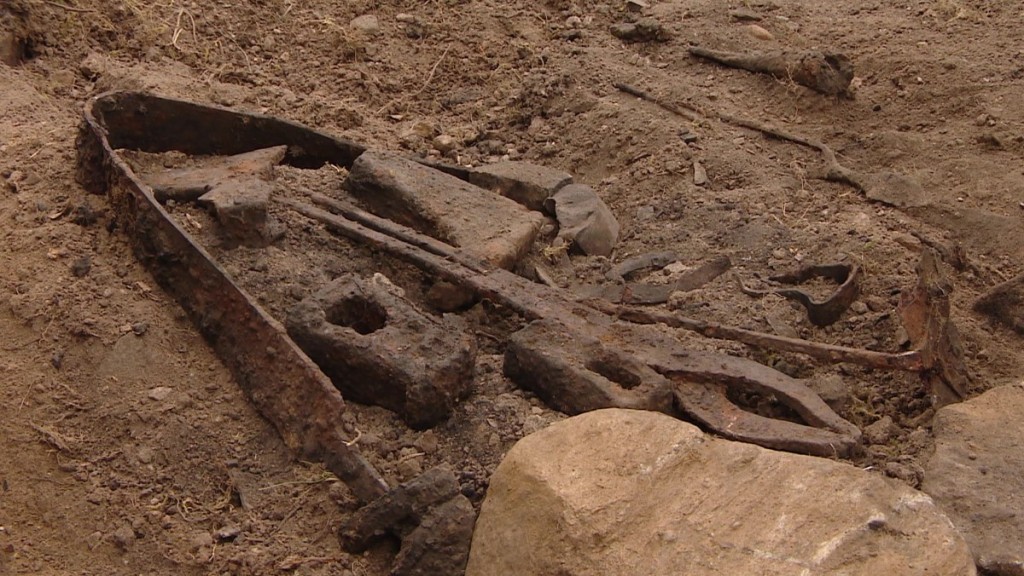
Viking Blacksmith’s Grave Uncovered in Norway

The weapons and tools from the grave

The spectacular remains of what appears to be a Viking grave, most likely belonging to a blacksmith, has been uncovered in Sogndalsdalen, Norway (as reported by NRK). The grave was found by Mr Leif Arne Norberg, under a series of stone slabs in his back garden. Mr Norberg had been carrying out landscaping works when he suddenly spotted a blacksmith’s tongs, followed soon afterwards by a bent sword. On closer examination it quickly became apparent that he had stumbled upon a remarkable Viking Age find. Archaeologists from Bergen University and the County’s Cultural Department were called to the scene and the remains were subsequently excavated. The finds recovered from the grave suggest that it probably dates from the 8th or 9th century AD. They included various pieces of metalwork, a tongs, a sword and an axe, all of which will be conserved before being put on display at the University Museum of Bergen. Personally I can’t wait to find out more information about this exciting discovery.

Read the rest of this article...

Long lost Roman fort discovered in Germany


In the course of an educational dig in Gernsheim in the Hessian Ried, archaeologists from Frankfurt University have discovered a long lost Roman fort: A troop unit made up out of approximately 500 soldiers (known as a cohort) was stationed there between 70/80 and 110/120 AD. Over the past weeks, the archaeologists found two V-shaped ditches, typical of this type of fort, and the post holes of a wooden defensive tower as well as other evidence from the time after the fort was abandoned. 


The excavation site in Gernsheim [Credit: Goethe-Universität Frankfurt am Main] 

An unusually large number of finds were made. This is because the Roman troops dismantled the fort and filled in the ditches when they left. In the process they disposed of a lot of waste, especially in the inner ditch. 

Read the rest of this article...

New bog body discovered in Co. Meath


A new, partially intact bog body has been discovered by Bord na Mona workers in Co Meath. Archaeologists from the National Museum of Ireland (NMI) have confirmed that it is working on a find of human remains in a bog near the border with Co Westmeath, at Rossan bog.


 Bog body remains of adult discovered last weekend at Rossan Bog, Meath  [Credit: National Museum Ireland] 

Archaeologist Maeve Sikora told the Irish Examiner that workers from Bord na Mona came across the remains. 

“Archaeologists and conservators from The National Museum of Ireland have been on site investigating the findspot of archaeological human remains in a bog in Co. Meath, near the border with Co. Westmeath,” Ms Sikora said.

Read the rest of this article...
King Richard III killed by blows to skull

Forensic teams studied the skeleton to determine the nature of the injuries and weapons that were used

King Richard III was probably killed by two blows to the head during a "sustained attack", according to new scientific research.
The English king was killed at the Battle of Bosworth on 22 August, 1485.
Forensic teams at the University of Leicester have now revealed he suffered at least 11 injuries, some possibly inflicted after death.
CT scans were used on his 500-year-old skeleton to help determine his injuries and the medieval weapons used.
Read the rest of this article...

Tuesday, September 16, 2014

Kingsmead Quarry – Roman Burial Discovered with Bronze Rings


One of the discoveries from this year’s excavation at the CEMEX Kingsmead Quarry is a human burial with bronze ear or hair rings. As with other skeletons at the Quarry, the bone is poorly preserved. In this case some of the bone, including the skull was block lifted for excavation in the lab by WA staff  – osteoarchaeologist Kirsten Dinwiddy and conservator Lynn Wootten. X-rays of the soil block discovered objects of bronze on either side of what remained of the skull including a set of three fine bronze rings and a single ring made from a twisted strip of probable bronze.
 
The soil blocks will now be carefully excavated to record the position of the rings relative to the remains of the skull to try and determine whether they are hair or ear rings. Provisional examination of the form and style of the rings suggest that the burial could be of Late Iron Age or Roman date and may well be an inhabitant of the nearby settlement that was found during previous work.

Read the rest of this article...

New bog body found in Rossan, Co. Meath

New bog body remains (photo National Museum of Ireland)

Exciting news. The partial remains of a bog body has been uncovered in Rossan bog near Kinnegad in Co. Meath. The find was discovered by Bord na Móna workers and subsequently excavated by a team of archaeologists, led by Maeve Sikora of the National Museum of Ireland. Although as yet undated the remains were found in an area that has previously produced bog body remains (Moydrum Man) that were radiocarbon dated to the Early Iron Age (700-400 BC).

This latest addition to growing a corpus of Irish bog bodies will hopefully reveal as much information as two recent peat land discoveries. These aforementioned bog bodies, Old Croghan man and Clonycavan man, form the centre piece of the excellent Kingship and Sacrifice display at the National Museum of Ireland. What is striking about these remains is their fantastic state of preservation, something which is characteristic of bog bodies in general. This is primarily due to the cold, acidic, oxygen-free conditions that persist beneath peat bogs and which prevent decay and mummify human flesh.

Read the rest of this article...

Digital Epigraphy


The Oriental Institute has released a new book titled Digital Epigraphy, a manual for the methods that they are using to record items found in their Epigraphic Survey.
During the past several decades the Epigraphic Survey has refined its conventions and recording methodologies to fit with the widely divergent nature of the inscribed surfaces we record and the changing conditions in Egypt that are resulting in the accelerating decay of those inscribed surfaces. For the past two years we have been experimenting with new digital tools, software, and equipment that have allowed us to streamline our recording process while still achieving the highest degree of accuracy, the bottom line of any scientific documentation. It has always been our aim to share these conventions and methodologies with our friends and colleagues, and it is our great pleasure to present the initial results here now. The digital formats in which this manual is made available are particularly appropriate and will be updated and changed regularly, since the manual will always be a work in progress. The possibilities are limitless.
The free volume is available from their website as either a PDF or ePub book.

Open Source Computing and GIS in the UK


Two weeks ago now saw the return of the OSGIS conference in Nottingham, after a year off in 2013 for FOSS4G. I think there had been mixed feelings about this event; those of us heavily involved in the organisation of FOSS4G 2013 had taken a back seat this year, and with FOSS4G 2014 imminent in Portland, it was clearly going to be a smaller scale get together.
I have to say that overall, my impression is that small is good! Small allows you to chat to everyone, see everything you want to see, and generally enjoy, rather than rush around like a mad man or woman. It was nice to see some new faces, and to see a number of papers from local government and business, belying the idea that OSGIS is primarily an academic event. Thanks as always to the chaps at Nottingham for organising.
Astun had a strong showing at the event, with two workshops and two presentations. My colleague Matt Walker did a workshop on OpenLayers3 and Leaflet, and I did one on WPS and PgRouting (a beginners guide). I did a quick introduction to Portable GIS, and another colleague Antony Scott did a comparison to web servers. You can see the workshops at the Astun Technology GitHub pages. As a slight techy aside, Matt and I collectively decided to try GitBookfor preparing our workshops, and we’re both very impressed. If you’re interested in a cheeky workflow for pushing a gitbook directly to GitHub gh-pages, see this gist.
Read the rest of this article...

Mystery Surrounds Skeletons in Mass Grave

Further tests will be conducted on skeletons initially recovered from a centuries-old mass grave in Durham City, in the UK, in 2013.
Initial analysis on the bones of 28 individuals recovered from the site provided some evidence regarding their origins and identity, but was inconclusive.
The tests, coordinated and partly carried out by Durham University’s Department of Archaeology, included examination of the human bones by academic specialists; radiocarbon dating of two individuals and a programme of isotope analysis to ascertain diet.
The University will commission radiocarbon dating of some of the other skeletons, with results expected in the New Year.  
Read the rest of this article...

Groundwater tied to human evolution

Insert shows with arrow the location of study area in eastern Africa. Map of the Northern Tanzanian Divergence Zone depicts the East African Rift System (EARS), containing Lake Natron (north), diverging around the Ngorongoro Volcanic Highland massif and splitting into two separate rift valleys (Lake Eyasi on west) and Lake Manyara (on east). Prevailing wind is from the east. Olduvai basin lies to the west of and in the rain shadow of Ngorongoro.
Credit: Map made by Sara Mana, http://www.geomapapp.org; from Cuthbert et al., doi:10.1371/journal.pone.0107358.g001

Our ancient ancestors' ability to move around and find new sources of groundwater during extremely dry periods in Africa millions of years ago may have been key to their survival and the evolution of the human species, a new study shows.
The research -- published in the journal PLOS ONE -- combines geological evidence from the Olduvai sedimentary basin in Northern Tanzania, which formed about 2.2 million years ago, and results from a hydrological model.
It shows that while water in rivers and lakes would have disappeared as the climate changed due to variations in Earth's orbit, freshwater springs fed by groundwater could have stayed active for up to 1000 years without rainfall.

Read the rest of this article...

Hitting the jackpot on a dig in Gernsheim: Long lost Roman fort discovered

Legion surnamed " Primigenia Pia Fidelis ". This Roman elite unit was from the late 1st century. Chr. Kästrich in Mainz (Mogontiacum) formed the strategic backbone of the Roman frontier defense in the province of Upper Germany.
Credit: Image courtesy of Goethe-Universität Frankfurt am Main

In the course of an educational dig in Gernsheim in the Hessian Ried, archaeologists from Frankfurt University have discovered a long lost Roman fort: A troop unit made up out of approximately 500 soldiers (known as a cohort) was stationed there between 70/80 and 110/120 AD. Over the past weeks, the archaeologists found two V-shaped ditches, typical of this type of fort, and the post holes of a wooden defensive tower as well as other evidence from the time after the fort was abandoned.
An unusually large number of finds were made. This is because the Roman troops dismantled the fort and filled in the ditches when they left. In the process they disposed of a lot of waste, especially in the inner ditch. "A bonanza for us," according to Prof. Dr. Hans-Markus von Kaenel from the Goethe University Institute of Archaeology. "We filled box after box with shards of fine, coarse and transport ceramics; dating them will allow us to determine when the fort was abandoned with greater accuracy than was possible before."
Read the rest of this article...

Monday, September 15, 2014

NEOLITHIC NECROPOLIS CONTAINS TWENTY MONUMENTAL TOMBS

Hypothetical reconstruction of the plain occupied by the cemetery. © Laurent Juhel / Inrap

team of archaeologists is currently conducting excavation work on 20 hectares of land in Fleury-sur-Orne (northwestern France), which is earmarked for residential development. This site has revealed an important Middle Neolithic (4500 BC) necropolis containing twenty monuments and some intact burials.
During the Middle Neolithic new types of monuments appear: constructions of earth and wood, varying in length from a few dozen to several hundred metres. These monumental tombs, the first of their kind are called “Passy” – named after the eponymous site found in Yonne (Burgundy).

Monumental funerary architecture

These large, elongated structures are bounded by ditches which may be associated with fences, and a mound entombs the deceased. In a break with past traditions, these large monuments suggest that a type of hierarchy has been introduced into society.
Read the rest of this article...

Roman settlement found at new homes' site


Archaeologists have uncovered the remains of a Roman settlement on a site earmarked for a new development. 


The clear line of a Roman road was found on the proposed  development site [Credit: BBC] 

A University of Leicester team excavated a nine-acre site in Aston Clinton, Buckinghamshire, as a condition of the planning permission for 48 homes. 

As well as dwelling remains, it found the line of a Roman road and burials. The development will go ahead with the site's story "preserved by record", the county council said.

Read the rest of this article...

Two 1,000-year-old skeletons holding hands found by archaeologists in Leicestershire


Volunteers Lotty Wallace and Ken Wallace work on a small section of the excavation.


Centuries-old skeletons holding hands have been uncovered at a “lost” chapel by archaeologists.

The remains, of a man and a woman, were found at the Chapel of St Morrell, an ancient site of pilgrimage in Hallaton.

Tiles from a Roman building, were found underneath the chapel.

The dig, by Hallaton Fieldwork Group volunteers, has been taking place for two weeks a year for four years.

Read the rest of this article...

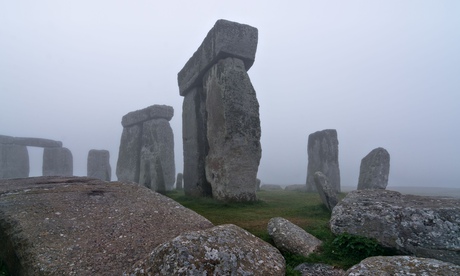
Stonehenge researchers discover site is much larger than previously thought

Stonehenge. Photograph: Geert Verhoeven/University of Bi/PA
Stonehenge stood at the heart of a sprawling landscape of chapels, burial mounds, massive pits and ritual shrines, according to an unprecedented survey of the ancient grounds.
Researchers uncovered 17 new chapels and hundreds of archaeological features around the neolithic standing stones on Salisbury Plain, Wiltshire, including forms of monuments that have never been seen before.
Brought together for the first time in a digital map of the historic site, the discoveries transform how archaeologists view a landscape that was reshaped by generations for hundreds of years after the first stones were erected around 3100BC.
Read the rest of this article...

Grave finds at Hungate dig in York


Archaeologists at a site in York have found glass, tiles, pots, pipes and human remains. Members of the Hungate Dig, organised by the York Archaeological Trust, have recently found items dating back to the 12th century, including cattle horn and skull fragments which were by-products of leather production from the early 19th century. 


Work under way on grave cuts along the rectory's  north wall [Credit: York Press] 

Now, all the items found are being placed into bags ready to be analysed, with trainees keeping records which will serve the trust for many years to come. 

A spokesman said: “The benefit of being quite so fussy is that the records go on to make up our final site archive – nothing is re-done and it is this archive that forms the basis of the final site report.”

Read the rest of this article...

Une nécropole du Néolithique moyen à Fleury-sur-Orne


Une équipe d’archéologues de l’Inrap mène actuellement, sur prescription de l’État (Drac Basse-Normandie), une fouille de 20 hectares à Fleury-sur-Orne, dans le cadre de l’aménagement de quartiers d’habitation par Normandie Aménagement et l’agglomération de Caen-la-Mer. Le site révèle une importante nécropole du Néolithique moyen (4500 avant notre ère) contenant une vingtaine de monuments funéraires dont un tertre encore intact.

Read the rest of this article...