Thursday, June 21, 2012

Britain's Only Known Roman Chariot Racing Circus Get's a Visitor Centre


The Colchester Roman Circus is Getting a Visitor’s Centre

Drawing: BBC.CO.UK
The Colchester Roman Circus, the only archaeologically known Roman Circus in Britain is getting an Interpretation Centre.  The Colchester Archaeological Trust is now in possession of the site which had been slated for development. The new HQ for the Trust site is the former Army Education Centre building at the Colchester Garrison.

The site was excavated in advance of development and according to the Gazette online: “The eight starting gates of Britain’s only chariot circus were found under the gardens of the Sergeants’ Mess, off Circular Road North, in Colchester.

To sue or not to sue? Parthenon Marbles activists debate


The British Museum says it can display the sculptures "in the context of world history"
Activists from around the world seeking the return of the Parthenon sculptures to Athens have met in London to discuss their strategy as Greece faces troubled times.

"The Olympics are a four-yearly reminder to the world of all we owe to Greece," said former MP Eddie O'Hara - who chairs the British Committee for the Reunification of the Parthenon Marbles.

The meeting, he added, "ought to remind people in London and throughout the world that there's one debt to Greece that will never be repaid until those sculptures in the British Museum are returned."

But he said there was a "hiatus" in the campaign because economic woes meant not much action could be expected from the Greek authorities.

Mammoth field found at Serbia coal mine 'great find for Ice Age knowledge'


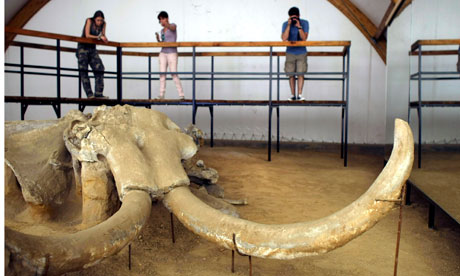
A mammoth recovered from the 'mass grave' at the Kostolac open-pit coal mine about 50 miles east of Belgrade. Photograph: Marko Drobnjakovic/AP

Archaeologists say bones of five woolly mammoths at Kostolac coal pit may reveal more about Balkans several millennia ago
 
FArchaeologists have unearthed at least five mammoths at a site in Serbia. The discovery last week at Kostolac coal mine, east of the Serbian capital of Belgrade, is the first of its kind in the region and could offer important insights into how the ice age affected the area now known as the Balkans. Miomir Korac, of Serbia's Archaeology Institute, said: "There are millions of mammoth fragments in the world, but they are rarely so accessible for exploration."

"A mammoth field can offer incredible information and shed light on what life looked like in these areas during the ice age." The remains were found during coal excavations about 20 metres below ground. Korac said the mammoth field stretched over nearly nine hectares (20 acres) of sandy terrain. In 2009 a well-preserved skeleton of a much older mammoth was found at the same site. The female skeleton, nicknamed Vika, is up to a million years old and belonged to the southern mammoth type which lacked dense fur.

Welsh people could be most ancient in UK, DNA suggests

A depiction of early man for The Story of Wales series

Welsh people could lay claim to be the most ancient Britons, according to scientists who have drawn up a genetic map of the British Isles.

Research suggests the Welsh are genetically distinct from the rest of mainland Britain.

Professor Peter Donnelly, of Oxford University, said the Welsh carry DNA which could be traced back to the last Ice Age, 10,000 years ago.

The project surveyed 2,000 people in rural areas across Britain.

Participants, as well as their parents and grandparents, had to be born in those areas to be included in the study.