Thursday, September 12, 2013

As Fashion Week Ends, Pondering the Origins of Clothes

A reconstruction of a Neanderthal female.
Photograph by Joe McNally, National Geographic
As Fashion Week winds down in New York, scientists continue their own search for the very latest in ancient fashion—latest meaning oldest. They're asking one seemingly simple question: Who invented clothes anyway?
As straightforward as it sounds, it isn't easy to answer. We may be used to artistic depictions of prehistoric Homo sapiens and Neanderthals wrapped in furry hides, but, in truth, the story of how clothing became such a prominent mark of humanity is only just starting to be unraveled.
Clothing doesn't readily fossilize. Much like the soft tissues that wrap our bones, fabrics and other body coverings decay rapidly. Yet, despite this, archaeologists and anthropologists are starting to figure out the elements of prehistoric style through an array of indirect evidence that includes everything from dyed plant fibers to lice.
Read the rest of this article...

NEW PASSAGE-TOMB DISCOVERY NEAR NEWGRANGE

LiDAR image of Boyne Valley. Image: Heritage Council (INSTAR)

Details of the “first passage-tomb to be discovered in in Boyne Valley in 200 years” have been reported in the Sept 7 edition of the Meath Chronicle. It was recently discovered along with many other previously unknown features by archaeologists using light detection and ranging imaging (LiDAR).
The archaeologists, led by Kevin Barton, have called for a fully comprehensive research project in order to fully assess the results of the entire LiDAR survey performed in and around the Brú na Bóinne UNESCO World Heritage Site
Warranted further investigation
The “new” passage-tomb, on the floodplain of the Boyne southwest of Newgrange, had showed up on LiDAR imagery of the valley, Mr. Barton said. Because of its situation in proximity to the Boyne monuments, it was considered that the feature warranted further work.
Read the rest of this article...

Stonehenge was built on solstice axis, dig confirms


English Heritage says it has discovered a "missing piece in the jigsaw" in our understanding of Stonehenge, England's greatest prehistoric site. Excavations along the ancient processional route to the monument have confirmed the theory that it was built along an ice age landform that happened to be on the solstice axis, according to Professor Mike Parker Pearson, a leading expert on Stonehenge.

Stonehenge was built on solstice axis, dig confirms
Archaeologists found ridges, formed by Ice Age meltwater, that align Stonehenge
with the solstice axis [Credit: Francis Dean/Rex]
The Avenue was an earthwork route that extended 1.5 miles from the north-eastern entrance to Wiltshire's standing stones to the River Avon at West Amesbury. Following the closure of the A344 road, which cut across the route, archaeologists have been able to excavate there for the first time.

Just below the tarmac, they have found naturally occurring fissures that once lay between ridges against which prehistoric builders dug ditches to create the Avenue. The ridges were created by Ice Age meltwater that happen to point directly at the mid-winter sunset in one direction and the mid-summer sunrise in the other.


Read the rest of this article...

Stonehenge ditch discoveries prove archaeology link to River Avon true

An overhead shot of Stonehenge now (top) and how it is expected to look by summer 2014, once the A344 has been covered by grass

Found near the Heel Stone lying about 24 metres from the entrance to Stonehenge, the ditches represent either side of The Avenue, a long, linear feature to the north-east of the site which has been severed for centuries by the A344.

“The part of the Avenue that was cut through by the road has obviously been destroyed forever, but we were hopeful that archaeology below the road would survive,” said Heather Sebire, an archaeologist for English Heritage, who are currently helping decommission the road as part of a plan to make the landmark more tranquil for visitors.

“It is very exciting to find a piece of physical evidence that officially makes the connection which we were hoping for.”


Read the rest of this article...

Ploughed field find was silver Viking ring


A man who found a dirty piece of metal in a field has discovered he is actually the lucky owner of a silver Viking ring.

Ploughed field find was silver Viking ring
The ring was found close to the remains of a medieval church [Credit: BBC]
David Taylor, from County Down, Northern Ireland, discovered a bracelet-shaped object while helping lift stones from a field. His wife thought it was a bull ring and told him to throw it out. A coroner's court has now found the ring to be treasure trove.

Almost 18 months ago, Mr Taylor noticed the strangely-shaped object lying on a stone in his brother-in-law's freshly ploughed field near Kircubbin on the Ards peninsula.


Read the rest of this article...

Wednesday, September 11, 2013

'Bull ring' was silver Viking ring treasure


A man who found a dirty piece of metal in a field has discovered he is actually the lucky owner of a silver Viking ring.
David Taylor, from County Down, Northern Ireland, discovered a bracelet-shaped object while helping lift stones from a field.
His wife thought it was a bull ring and told him to throw it out.
A coroner's court has now found the ring to be treasure trove.
Almost 18 months ago, Mr Taylor noticed the strangely-shaped object lying on a stone in his brother-in-law's freshly ploughed field near Kircubbin on the Ards peninsula.
Read the rest of this article...

Man finds Viking ring in Northern Ireland field


A man in Northern Ireland says an object his wife mistook for an old bull ring turned out to be a silver Viking ring from between the 10th and 12th centuries.

David Taylor of County Down said he found the object while lifting stones in a field near Kircubbin and his wife told him it was an old bull ring and he should throw it out, the BBC reported Monday.

"I just knew by the shape of it, it was something," Taylor said.

Taylor said experts identified the object as a silver Viking ring from between the 10th and 12th centuries.

University College Cork archaeologist John Sheehan said the ring was found near the ruins of a medieval church and may have been stolen from Viking settlers.

Read the rest of this article...

Perfect example of medieval holy well is being restored


A HOLY well near Helston is undergoing major restoration to rescue the stone structure from collapsing.

Volunteers joined archaeologists and builders to clear and restore Trelill Well.
  1. ​Volunteers busy clearing the overgrown  Trelill Well, near Helston.
    Volunteers busy clearing the overgrown Trelill Well, near Helston.
  • •
  •  
  • •
The building became the first structure in Cornwall to be designated a scheduled monument in the 1920s.

It is regarded as a perfect example of a medieval well-house.

Read the rest of this article...

Review of Tour of the Nile [iPad App]


Reviewed by Helen Strudwick (July 2013)

Cite this as: Strudwick, H. (2013). Review of Tour of the Nile [iPad App]. Internet Archaeology 34. http://dx.doi.org/10.11141/ia.34.6
Helen Strudwick, Exhibitions Officer, The Fitzwilliam Museum, Cambridge, UK. Email: hms12@cam.ac.uk
Review of: Petrie Museum's Tour of the Nile app (University College London, 2013 ). Available: https://itunes.apple.com/us/app/tour-of-the-nile/id599949929?mt=8 Free app, released: Feb 12, 2013. Size: 88.7 MB. Version 1.1 released: Jul 2, 2013. Size: 103 MB. See alsohttp://www.ucl.ac.uk/museums/petrie/research/3dpetrie/downloads/
In February 2013, the Petrie Museum released a new iPad app, available for download at no charge from the iTunes App Store. Version 1.1 was released in July 2013. The app is entitled Tour of the Nile and promises 'a virtual journey along the Nile Valley' plus the chance to 'handle' objects through the technology of augmented reality.

Read the rest of this article...

Archaeology: 7000-year-old defensive wall emerges near Bulgaria’s Shoumen


The dry spell blanketing Bulgaria for the past two months has resulted in an unexpected archaeological discovery, with the remains of a 7000-year-old defensive wall emerging from the waters of the Ticha accumulation lake near the town of Shoumen in northeastern Bulgaria.
The wall is more than five meters tall, made of rocks that are being held together by clay. The wall has an arrowslit and appears to be better built than other fortifications dating back to the same period in this part of Europe, historian Stefan Chohadjiev from Veliko Turnovo University told Bulgarian National Television.
On the southern approach of the hill, the fortification is at its strongest, with three parallel lines of defence built to repel attackers. The inhabitants of the stronghold appear to have been a frequent target of attacks, this being the most likely reason why its defences have been built up, instead of featuring only the more traditional moat, according to Chohadjiev.

Read the rest of this article...

Pagan-era rock tombs unearthed in southeastern part of Turkey

The Pagan-era tombs were discovered during construction works that were being conducted to enlarge a road heading to a tent city erected for Syrian refugees.

Construction in the southeastern province of Mardin’s Midyat district has unearthed ancient rock tombs that are believed to date from the pagan era between the third and second centuries B.C. 

The tombs were discovered during construction works that were being conducted to enlarge a road heading to a tent city erected for Syrian refugees. 

A total of four rock tombs were initially discovered, but subsequent excavation work at Mor İbraham Church and other venues revealed an additional 11 tombs, some with human skeletons.


Read the rest of this article...

ROMAN SOLDIER’S CHAIN MAIL FOUND AT BATTLE SITE

Large fragment of chain mail from Harzhorn found at Kalefeld near Göttingen. 
Credit: Clemens Fiedler

Archaeologists from Freie Universität Berlin made a spectacular discovery in their excavations of a Roman-Germanic battlefield at the Harzhorn in Lower Saxony. While exploring the area near Kalefeld in the Northeim district north of Göttingen, the researchers, headed by Prof. Dr. Michael Meyer, found the chain mail of a Roman soldier from the Third Century AD.
It was the first time that such a well-preserved piece of body armour was excavated on a Roman-Germanic battlefield. This find made it possible to reconstruct an individual story in the battle, a close-up image of the war, said Michael Meyer, a professor of prehistoric archaeology at Freie Universität Berlin.

Located on edge of battlefield

The chain mail, which was found in several fragments, consists of thousands of small chain links with a diameter of about six millimetres. The iron in the rings, however, is largely decomposed. Chain mail was worn in battle by Roman soldiers of various ranks. Germanic warriors usually waived this protection; however, in Germanic burial grounds, remains of those laboriously produced armour can often be found. In this case, not only the object itself was an unusual find, but also the position in which it was found. It was located directly on the edge of the battlefield with probably the most intense combat action that could be detected on the Harzhorn hill.
Read the rest of this article...

Field teeming with Bronze Age gold rings


Four Bronze Age gold rings were recently found near the site where six similar rings were found in 2009.


A key question in archaeology is how a tool or a piece of jewellery was used and what significance it had to the people who used it.
Careful observations and descriptions combined with common sense always form a strong basis for these discussions, but sometimes a little more is needed, e.g. analogies from foreign peoples or inspiration from written sources.
Closely tied in with the question of how an item was used is the practice of naming. What do you call archaeological artefact?
Read the rest of this article...

Archeologists date human femur found in northern Britain to 10,000 years ago


A trio of archeologists has found that a human femur unearthed in a cave in the early 1990s, in northern Britain dates back to over 10,000 years ago. The combined team of researchers from the University of Nottingham and Liverpool John Moores University has documented their findings in a paper they've had published inJournal of Quaternary Science.
Up until now, remains from humans living in Britain during a warming spell at the end of the last Ice Age, have been confined to  in the south. Tools and other have confirmed that people were living in the north as well, but up till now, none of their remains have been found. The bone piece-part of a femur, was found in a cave almost 25 years ago in Cumbria (Kents Bank Cavern) and has since been housed at the Dock Museum. It wasn't until very recently, however, that researchers took a closer look—carbon dating places the bone from the cave at a little over 10,000 years ago which would mean it belonged to a person living during a warming spell (when the ice retreated enough for people to endure) during the  which started approximately 12,000 years ago.
Read the rest of this article...

Pictish burials found at ‘Royal Rhynie’ site


The remains of what could be a member of early Pictish royalty have been discovered as part of an archaeological dig.

Pictish burials found at ‘Royal Rhynie’ site
The remains found in the grave could be a member of early
Pictish royalty [Credit: University of Aberdeen]
The discovery, by experts from the University of Aberdeen and the University of Chester, is one of the first ever made in the North-East of Scotland and was found in a carefully made sandstone grave which suggests the person was of high status.

The Pictish Kingdoms were some of the most powerful players in post-Roman Britain but understanding of their social and political structure is poor due to a lack of historical records.


Read the rest of this article...

Hadrian's Wall UNESCO World Heritage Site in half million pound refurbishment


Visitors to Hadrian’s Wall have always been encouraged to treat the 73-mile long UNESCO World Heritage Site with care.

Nearly 2,000 years of erosion, not to mention pillaging by locals, have turned the site from formidable fortification into a broken series of forts and a low three foot wall.

Recent visitors to the Wall might, therefore, have been surprised to see archaeologists taking the wall apart.

Hadrian’s Wall is on many monument lists and registers but the most unfortunate is English Heritage's At Risk Register. In an effort to preserve the wall for future generations, the SITA Trust (an independent environmental funding body) has awarded the Hadrian’s Wall Trust a grant of £537,185 to rebuild parts of the wall, improve access in some areas and provide new signage and interpretation.

Read the rest of this article...

Sourcing obsidian artefacts in only 10 seconds


Researchers at the University of Sheffield have developed a method of sourcing obsidian artefacts that takes only 10 seconds -- dozens of times faster than the current methods -- with a handheld instrument that can be used at archaeological excavations.

Sourcing obsidian artefacts in only 10 seconds
Dr Ellery Frahm using pXRF [Credit: University of Sheffield]
Obsidian, naturally occurring volcanic glass, is smooth, hard, and far sharper than a surgical scalpel when fractured, making it a highly desirable raw material for crafting stone tools for almost all of human history. The earliest obsidian tools, found in East Africa, are nearly two million years old, and obsidian scalpels are still used today in specialised medical procedures.

The chemistry of obsidian varies from volcano to volcano, and the chemical "fingerprints" allow researchers to match an obsidian artefact to the volcanic origin of its raw material. The chemical tests often involve dedicated analytical laboratories, even nuclear reactors, and take place months or years after an archaeological site has been excavated.


Read the rest of this article...

Tuesday, September 10, 2013

'Early Pictish Royal remains' discovered at Rhynie

The remains found in the grave are now being analysed

The remains of what it is thought could be a member of early Pictish royalty have been discovered during an archaeological dig in Aberdeenshire.
The discovery at Rhynie was made by teams from the universities of Aberdeen and Chester.
The remains were found in a carefully made sandstone grave, which the experts believe suggests the person was of high status.
It is the first time remains of a body have been uncovered at the site.
Read the rest of this article...

Monday, September 09, 2013

Saxon remains to be reburied after dig


Saxon remains found during an archaeological dig at an abbey in Warwickshire are being reburied at a church service later.

Saxon remains to be reburied after dig
Radiocarbon dates for the remains should be known in the next
three months [Credit: Peter Ralley/BBC]
Archaeologists working on a three year dig at Polesworth Abbey found up to 15 ancient burials. The dig has uncovered the pre-Norman abbey and a Saxon church.

Father Philip Wells, who is conducting the service, said it was not clear yet if the remains were those of nuns from the original abbey.

The results of radiocarbon dating on the remains should be known within the next three months.

A team of local volunteers have carried out the dig, supervised by professionals from the Northamptonshire Archaeological team. The work has been paid for by English Heritage.


Read the rest of this article...

Striking Patterns: Skill for Forming Tools and Words Evolved Together


A meeting in the mind? In a test of how toolmaking and language activate the brain, an expert knapper made an Acheulean hand ax (above) while researchers monitored the flow of blood to his brain (see video).

When did humans start talking? There are nearly as many answers to this perplexing question as there are researchers studying it. A new brain imaging study claims to support the hypothesis that language emerged long before Homo sapiens and coevolved with the invention of the first finely made stone tools nearly 2 million years ago. However, some experts think it’s premature to draw sweeping conclusions.
Unlike ancient bones and stone tools, language does not fossilize. Researchers have to guess about its origins based on proxy indicators. Does painting cave walls indicate the capacity for language? How about the ability to make a fancy tool? Yet, in recent years, scientists have made some progress. 
Read the rest of this article...

Melting Snow Reveals Iron Age Sweater


A boat neck sweater made of warm wool and woven in diamond twill was a dominating fashion trend among reindeer hunters 1,700 years ago, according to researchers who have investigated an extremely well preserved Iron Age tunic found two years ago under melting snow in Norway.
Announced last March, the finding has been detailed in the current issue of the journal Antiquity.
“Due to global warming, rapid melting of snow patches and glaciers is taking place in the mountains of Norway as in other parts of the world, and hundreds of archaeological finds emerge from the ice each year,” Marianne Vedeler, from the University of Oslo, Norway, and Lise Bender Jørgensen, from the Norwegian University of Science and Technology in Trondheim, wrote.
Read the rest of this article...

Bronze Age boats older than was first thought


Eight Bronze Age boats discovered in a deep Cambridgeshire quarry are much older than it was first thought, carbon-dating research has revealed.

Bronze Age boats older than was first thought
Experts have discovered the boats are made of oak, lime and field maple [Credit: BBC]
The vessels, found by archaeologists at Must Farm near Peterborough in 2011, have now been dated to about 1500 BC, 200 years older than was first thought.

Samples taken during the conservation process have revealed the boats to be made from oak, lime and field maple.

The vessels are undergoing a two-year preservation programme at Flag Fen.

The wooden craft are being sprayed with a special wax to stop the timbers from degrading, the same technique that was applied to the 16th Century Mary Rose warship.

It is hoped the process will reveal more about the Must Farm log boats, one of which is almost 30ft (9m) long.


Read the rest of this article...

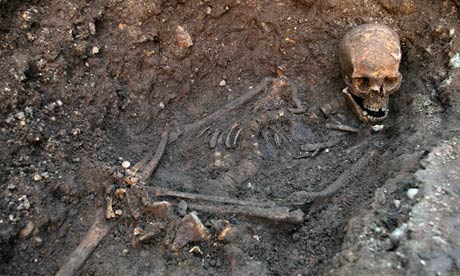
Richard III had roundworm infection, scientists claim

Richard III was probably infected with parasitic worms that grew up to a foot in length. 
Photograph: University of Leicester
Richard III suffered from a roundworm infection, according to research carried out on his skeleton.
The body of the king, who ruled England from 1483-85, was discovered last year by archaeologists at the University of Leicester, and scientists have since been undertaking careful analysis of the remains.
A team of researchers led by Dr Piers Mitchell, of the Department ofArchaeology and Anthropology at Cambridge University, used a powerful microscope to examine soil samples taken from the skeleton's pelvis and skull, as well as from the soil surrounding the grave.
Read the rest of this article...

Saxon graveyard unearthed in Suffolk


A team of archaeologists has returned to a Suffolk river bank to complete a dig at an early Christian burial site.

Saxon graveyard unearthed in Suffolk
The team has returned to the north bank of the River Alde
for a three-week dig [Credit: BBC]
A three-week excavation has begun at Barber's Point near Aldeburgh at a 7th Century Saxon graveyard. The team believes it is one of the first to reveal Christian rather than Pagan burial customs.

New funding has meant they hope to be able to complete work at the site after previous digs in 2004, 2007 and 2010 where 12 graves were discovered.

David Rea was among the volunteers forced to leave the site when funding ended.


"You could clearly see, etched against the wall where we were digging, that there was another grave, but it was the last day so we had to pack up and leave. But I told 'him' we'd be back and here we are and next week we shall be in there."

The team has been able to return because of a £24,000 boost from the Heritage Lottery Fund's Touching The Tide scheme.


Read the rest of this article...

UK treasure hunters make archeologists see red


With a metal detector and some luck, hobbyist treasure hunters in the UK can end up owning highly valuable artifacts. But archeologists are speaking out against treasure hunting, saying it damages key historical traces.
Hobbyists scavenging for ancient jewelry or a cache of Roman coins are an increasingly common sight in the UK's countryside. With some enthusiasts having unearthed thousands of pounds worth of treasure, the lure of heading out with a metal detector can be potent.
Historical artifacts, including coins, old tools and weaponry, turn up with some regularity among the thousands of objects dug up each year. But hobbyists have been so successful that some archeologists are accusing them of looting Britain's heritage. Some even want the practice banned.
Read the rest of this article...
Final excavations underway at Ham Hill


Archaeologists from the Universities of Cambridge and Cardiff are currently undertaking their third, and final, round of excavations at Ham Hill, Britain’s biggest Iron-Age hill fort.

An excavation at Ham Hill, the largest Iron-Age hill fort in Britain, has revealed more about how the ancient structure was developed by its defenders in response to the Roman invasion.

Researchers have been studying the fort, which covers more than 80 hectares of the Somerset countryside, for the past three years in an attempt to understand more about its function, and how such a large structure was defended by the local population.

Read the rest of this article...

Roman period urn grave found in Poland


Crematory pit and urn grave from the 1st/2nd century AD have been discovered by archaeologists during excavations in the Roman period cemetery in Czelin (Zachodniopomorskie).

Roman period urn grave found in Poland
The urn grave discovered by archaeologists during excavations in the Roman
period cemetery in Czelin [Credit: Bartłomiej Rogalski]
Bartłomiej Rogalski from the National Museum in Szczecin , who conducts research, said in an interview with PAP that the form of the clay urn and the specific "toothed wheel" decorating technique are typical for the Elbe area, lying west of the Oder .

According to Rogalski, the ornament on the vessel is in turn typical for the Przeworsk culture , which at that time occupied territories of Wielkopolska and Silesia. "This conglomerate of various cultural trends is symptomatic of Lubusz group" - added Rogalski. In the second, pit burial, in addition to bone archaeologists have also found pieces of similarly ornamented pottery. In the immediate vicinity of the burials, archaeologists have discovered the complex of furnaces and setts.


Read the rest of this article...

Lost Tudor Sculptures Reassembled With Help from 3-D Scanning


University of Leicester experts have tried to recreate two Tudor monuments using a mixture of humanities research and scientific technology.

The experts have studied two tomb monuments which originally were intended to stand in Thetford Priory, Norfolk, in an exhibition at the Ancient House Museum, Thetford, Norfolk, from 7 September 2013 to 29 March 2014.
The elaborate tombs were planned by Thomas Howard, 3rd Duke of Norfolk – one for himself, and another for Henry VIII’s illegitimate son, Henry Fitzroy, Duke of Richmond.
The tombs were not complete when the priory was dissolved in 1540.  Some parts of the monuments were salvaged and later finished off in a different style and with different materials, in St Michael's Church, Framlingham, Suffolk.

Read the rest of this article...

Declassified Spy Photos Show Ancient Roman Walls In Romania


Archaeologists from two United Kingdom universities examining declassified spy photos rediscovered part of a what they believe is a series of Roman fortifications dating back to the 2nd century A.D.
Although parts of the ruins had once been known to 19th-century researchers, they were subsequently misidentified, dismissed and largely forgotten, according to Bill Hanson, a professor of Roman archaeology at the University of Glasgow. In some areas the structures were heavily damaged by ploughing or construction -- even to the point of complete destruction.
"If you look at any modern book on Roman frontiers, you will find no mention of [these fortifications]," Hanson told The Huffington Post. "[They have] kind of disappeared from consciousness."
Read the rest of this article...

Ruins of Finland’s oldest church discovered


Archaeologists from Turku University found the well-preserved foundations of a stone church in the Ravattula district of Kaarina, just to the south of Turku. The church is believed to date from the 12th century.

Ruins of Finland’s oldest church discovered
Excavations at Ravattula, Kaarina [Credit: Juha Ruohonen/Turun yliopisto, arkeologia]
The medieval structure is believed to have been around 10 metres high and six metres wide, and to have contained a separate prayer room. Excavations on the eastern edge of the church also uncovered what is believed to be the base of an altar.

Read the rest of this article...

Archaeology Britain iPad App


The Archaeology Data Service and the British Library are pleased to announce the release of the Archaeology Britain iPad App.
The Archaeology Britain iPad app is a collaboration between The British Library and the ADS to create an accessible iPad app with unique and interesting content from both organisations. The app presents antiquarian drawings, paintings and maps for some of Britain's most important archaeological sites. The curated content provides unique and rarely seen perspectives for a wide range of sites from the stone age to the 20th century. The types of sites within the app are castles, churches, megaliths, settlements, and the defense of Britain. 

The app's target audience is the general public, and it is unique due to the rare content provided from the British Library archives. Much of the British Library content is not publically accessible, so the app offers a privileged view of some of the institutions most treasured collections. Additionally open content from the ADS and other sources were included to provide context to the British Library content.

Find out more...

The sad tale of James IV’s body

King James IV died at Flodden on 9 September 1513

Scotland's King James IV was killed at the Battle of Flodden 500 years ago. But what became of his body after the massacre?
Earlier this year, the discovery of the body of Richard III, killed at the Battle of Bosworth in 1485, beneath a car park in Leicester was front-page news.
The obvious implication, that finding long lost kings was a piece of cake, has led to me being repeatedly asked if I am going to look for the body of James IV.
His corpse, disfigured by arrow and bill, was identified after the battle and taken to Berwick, where it was embalmed and placed in a lead coffin before being transported to London.
Read the rest of this article...

Bone dates 'earliest northerner', say archaeologists in Liverpool

Archaeologists discovered the remains of humans and animals in the early 1990s but they have been dated following a study into the findings.

Archaeologists have dated bones found in the 1990s as the earliest known human remains from northern Britain.
Liverpool John Moores University and the University of Nottingham analysed a leg bone found in Cumbria and found it to be more than 10,000 years old.
The bone and other fragments were excavated from Kents Bank Cavern on the edge of Morecambe Bay and are stored at The Dock Museum in Barrow.
Read the rest of this article...