Friday, February 15, 2013

Tracing a Royal Y Chromosome


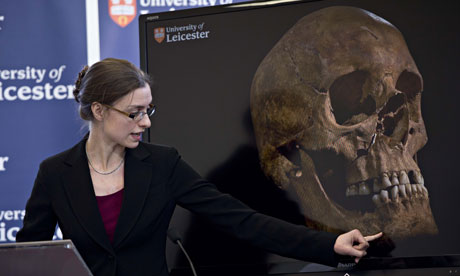
Researchers last week developed DNA evidence to help identify the remains of a skeleton found under a parking lot in Leicester, England, as those of Richard III, the last English king to die in battle, in 1485. But the researchers’ work is only half-done. They have made a strong but not conclusive link through the female line, and are now turning to the male side for corroboration.

Turi King, a geneticist at the University of Leicester, found a match in the mitochondrial DNA extracted from the parking lot skeleton and that of two living descendants of Anne of York, Richard III’s sister. About 1 percent of the English population carries this type. Mitochondrial DNA is bequeathed exclusively through the female line.

Chris Tyler-Smith, a geneticist at the Wellcome Trust Sanger Institute near Cambridge, said the mitochondrial DNA type identified by Dr. King was “rare enough to be interesting, but not rare enough to be conclusive.”        

Read the rest of this article...

Didcot dig: A glimpse of 9,000 years of village life

The archaeological trenches can still be seen at the site where the builders are now working


When archaeologists began digging the fields in 2010 they knew it was a site of historical interest, but even they were surprised by the wealth of ancient finds their trowels unveiled.

Back in 1995, a hoard of 400 Roman coins was discovered west of Didcot in Oxfordshire, indicating the land had been lived on for centuries.

As plans progressed for 3,300 new homes, schools and shops on the 180-hectare site, archaeologists were called in to investigate.

It has taken them nearly three years to excavate 30 hectares, but they now know people have been living in Didcot for about 9,000 years - since the end of the last ice age.


Read the rest of this article...

Battered Skulls Reveal Violence Among Stone Age Women


Skulls from a forensic anthropology lab.
CREDIT: David Hunt, North Carolina State University                                             


  Stone Age farmers lived through routine violence, and women weren't spared from its toll, a new study finds.

The analysis discovered that up to 1 in 6 skulls exhumed in Scandinavia from the late Stone Age — between about 6,000 and 3,700 years ago — had nasty head injuries. And contrary to findings from mass gravesites of the period, women were equally likely to be victims of deadly blows, according to the study published in the February issue of the American Journal of Physical Anthropology.

Linda Fibiger, an archaeologist at the University of Edinburgh in Scotland, and her colleagues focused on the late Stone Age, when European hunter-gatherers had transitioned into farming or herding animals.


Read the rest of this article...

Delphi to get $800,000 makeover

The Temple of Apollo at Delphi [Credit: TANN]

Ancient One of Greece’s favorite and most treasured archaeological sites, Delphi, will undergo 600,000 euros ($803,000) in restoration work through the Operational Program Thessaly – Central Greece – Epirus from 2007 to 2013, its Regional Director said.

This project involves the enhancement and preservation of the site, particularly the Temple of Apollo, the sanctuary of Athena Pronaia and the Gymnasium and Castalia, one of the most important archaeological sites in Greece, which is one of UNESCO’s cultural heritage.

As part of the project, several surveying actions on the sanctuary of Apollo are expected to take place. These actions include the mosaics maintenance and cleaning – fixation of surfaces of monuments, construction and placement of the Serpent Column, an ancient bronze column at the Hippodrome of Constantinople.


Read the rest of this article...

Friday, February 08, 2013

Segedunum: The 'most excavated' fort on Hadrian's Wall


An exhibition at Segedunum Roman Fort, Baths & Museum takes a look back at the history of the "most excavated" fort on Hadrian's Wall. Excavations at the fort in Wallsend in North Tyneside, began in 1975 ahead of new housing.

See the photos...

Richard III exhibition opens in Leicester


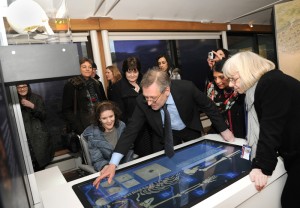
A new free exhibition dedicated to the search for Richard III opened today (8 Feb) at Leicester’s Guildhall.
Richard III: Leicester’s search for a king reveals the archaeological detective work that led to therediscovery of Greyfriars church, the location ofRichard’s grave, and the identification of his remains.
Displays place these findings in their historical context, exploring what written sources tell us about the king’s life and death, and compare these to clues provided by analysis of his bones, from scoliosis to battle wounds.

Read the rest of this article...

Early Humans in Southeast Europe Were of a Different Sort, Say Researchers


Newly conducted dating of a human mandible fossil discovered in 2008 in the Mala Balanica cave in southern Serbia has revealed that the human species to which it belonged featured a morphology (form and structure) that significantly departed from the pattern of features of early humans who inhabited what is today Western Europe during the same time period.
Considered a remain from what is now suggested to be the oldest hominin (human-related) species found in the Balkans of Eastern Europe, its age is now placed between 397,000 and 525,000 years old based on the application of electron spin resonance (ESR), uranium series isotoptic analysis and infrared/post infrared luminescence dating. These cutting-edge dating techniques are thought, used in combination in this instance, to provide a highly reliable date range for the fossil found. The new testing and study* was conducted by an international team of researchers that included William Jack Rink of McMaster University, Canada, Dušan Mihailović, University of Belgrade, Serbia, and Mirjana Roksandic, University of Winnipeg, Canada. Mihailović and Roksandic were both involved in the initial discovery of the ancient mandible (scientifically labeled "BH-1") in 2008. The new date range corresponds to a time when a human species called Homo heidelbergensis was present in Western Europe and an early stage in Neanderthal evolution. Homo heidelbergensis is suggested by many scientists to be a possible progenitor to Neanderthals or humans, or possibly a common ancestor.

Read the rest of this article...

Curses, musical scores and a fisherman swallowed by a whale


The daily lives of medieval townsfolk have been brought to light by an extraordinary haul of graffiti found in Norwich Cathedral.

Messages have been scratched into the walls of the historic buildings over hundreds of years, but few people have ever stopped to work out what they say.

Archaeologists have now started a major project to decipher the extraordinary messages, and have found a mixture of musical pieces, pious exhortations and even supernatural curses.


Read the rest of this article...

Reconstructing Richard III’s resting place


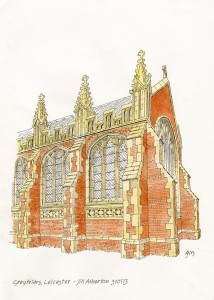
wo days after unveiling a reconstruction of the face of Richard III, Leicester experts have now recreated how Greyfriars, his final resting place, might have looked.

Built in 1230, Greyfriars was one of the first Franciscan friaries to be established in England, just 6 years after the order came  to Britain, but it was completely demolished during the 16th century Dissolution of the Monasteries.

Now artist and archaeological illustrator Jill Atherton has recreated the friary church, as well as the choir where Richard’s grave was located, in sketches based on similar Medieval buildings, together with archaeological evidence from the recent excavation , including window fragments and pieces of lead, suggesting stained glass, together with stonework, pieces of a large window frame, and roof and floor tiles.


Read the rest of this article...

Temple Of Mithras Stays Boxed As City’s Big Dig Continues


British archaeology has enjoyed a surge of interest of late, with the recent unearthing of Richard III in a certain Leicester car park. However, one London archaeological site remains in limbo: the Temple of Mithras is still waiting for its new home, as one of the City’s biggest ever digs continues.
The temple, dating from 240AD, has been dismantled and is currently in storage with the Museum of London. It’s awaiting a permanent home in the rebuilt Bucklersbury House on Queen Victoria Street, which is set to be the European headquarters of media giant Bloomberg LP.
Bloomberg was granted planning permission in 2010 to uproot the temple’s remains and incorporate them into its new corporate base. However, work on the £300m project, designed by Foster + Partners, hasn’t yet begun. The site, occupying a huge city block, is still a big hole in the ground. Museum of London Archaeology (MOLA), which is leading the project to move the temple, says it will be “a matter of years” before it is once again visible to the public.

Read the rest of this article...

Remarkable new finds below York Minster


ARCHAEOLOGISTS have found evidence of a previously-unknown settlement below York Minster, dating back more than 1,000 years.
Experts working at the Minster say the finds – including a ninth-century coin – help to plug a gap in York’s known history, between the departure of the Romans in the fifth century and the arrivals of the Normans in 1066.
The period is referred to as the Dark Ages due to the lack of knowledge about the time, and although Viking finds have increased awareness of York history from 866 onwards, broader understanding is scarce.
Now, a team from York Archaeological Trust working in a pit below the Minster say they have made priceless finds, including evidence of a local mint.


Read the rest of this article...

York Minster finds shed light on post-Roman period

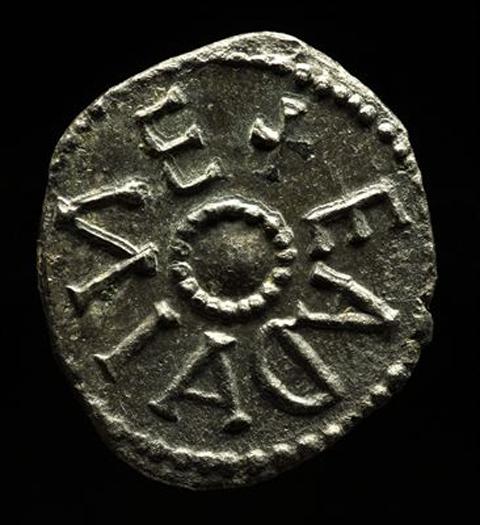
The rare Anglo-Saxon coin found at the minster shows that the city had its own mint [Credit: Maev Kennedy/Guardian]

The recent excavation of a pair of Viking feet and a tiny silver Anglo-Saxon coin may lack the glamour of the discovery of the last Plantagenet, but it has shone a light on one of the least known periods in the long history of York Minister: the centuries between the fall of Roman empire and the coming of the Vikings, in AD866.

The coin, no bigger than a 5p piece, is a sceat, minted in York. It is in such good condition that experts at the British Museum first thought it was a Victorian fake. So good is its state of repair that marks are legible identifying the maker as Eadwine, who also minted coins for the Northumbrian court. It proves that York had enough status and wealth in the early 9th century to support its own mint.

The coin is so pristine it was probably never circulated, so the archaeologists surmise that it was dropped accidentally almost as soon as it was struck, and that the mint must therefore have been very close to the site of the present enormous medieval church, which was built over layers of earlier foundations, some of them Roman.


Read the rest of this article...

Prehistoric rock art found in Scottish Highlands

One of the 28 stones on Swordale Hill which bear Bronze Age cupmarks [Credit: STV News]

An archaeologist has uncovered the biggest collection of ancient rock art in the Highlands. Douglas Scott, 64, of Tain, Ross-shire, discovered a circle of 28 carved rocks which date back 5000 years while combing a 200-metre hillside farm in Evanton.

Mr Scott reckons the stones, which have cup-marked shapes cut into them, represent one of the biggest collections of ancient rock art ever found in Scotland. He revealed he only visited the site, on Swordale Hill, Evanton, after one of his close friends died.

Mr Scott said: "I was first invited up the hill over 25 years ago by a friend of mine who was an archaeologist called Bob Gourlay.


Read the rest of this article...

Archäologie im Rheinland 2012


Unerwartetes und Unwiederbringliches aus der rheinischen Paläontologie und Archäologie boten die 45 Vorträge auf der Jahrestagung des LVR-Amtes für Bodendenkmalpflege im Rheinland am 4. und 5. Februar. Mehr als 400 Teilnehmerinnen und Teilnehmer zog es ins LVR-LandesMuseum Bonn, um den Jahresrückblick zu verfolgen und sich auszutauschen.

Read the rest of this article...

Wednesday, February 06, 2013

Will they now dig up Alfred the Great?

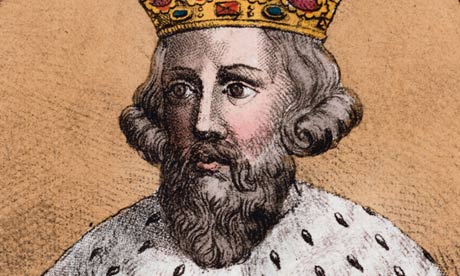
Alfred the Great, king of Wessex, as imagined by Raineri in the 1830s. Photograph: Philip Spruyt/Stapleton Collection/Corbis


Age: 1,164.
Appearance: "More comely than … his brothers; in look, in speech, and in manners he was more graceful than they."
But still beardy with a crown on. Thou shouldst speak with more reverence of England's only monarch to be called "Great"!
Until the tabloids get started on Elizabeth. Thencefar, yes.
Is thencefar a word? I know not. But it doth not matter! We speak of Alfred, king of the West Saxons from the year of our Lord's Incarnation 871 until 899. With great wisdom did he reverse the Viking advances from the north and then agree a treaty, after which he established fortified settlements and the rule of law, and spread literacy and learning across the land, he himself being a writer, the noblest of all callings.
He also burned some cakes. All ovens doth vary in performance. Besides, probably figurative is that anecdote from Bishop Asser's Life of Alfred, shewing as it doth the king's low point before changeth he his tactics to a guerrilla campaign. Which lo! proved ultimately successful.
A great man indeed then. Richard III could have learned something about legacy from him. Funny thou dost mention that! For now it is the turn of the bones of Alfred to be upduggen, sayeth reports

Read the rest of this article...

Why the princes in the tower are staying six feet under

Westminster Abbey, where remains believed to belong to the princes in the tower are buried. Photograph: David Levene


It is one of the great mysteries of English history. Did Richard III, the last of the Plantagenets, really murder the princes in the Tower as his Tudor successors, including their greatest propagandist, William Shakespeare, always alleged?
Previously confidential correspondence reveals that the Church of England, with backing from the Queen and ministers, has repeatedly refused requests to carry out similar forensic tests to those used to identify the remains of Richard III this week to see if the bones buried in Westminster Abbey are those of Richard's two nephews.
DNA testing was refused on the grounds that it could set a precedent for testing historical theories that would lead to multiple royal disinterments. The church was also uncertain what to do with the remains if the DNA tests were negative, potentially leaving the church with the dilemma of how to manage bogus bones. Authorities also resisted on the grounds the tests could not finally establish "if Richard III is to be let off the hook".

Read the rest of this article...

Face to face with Richard III


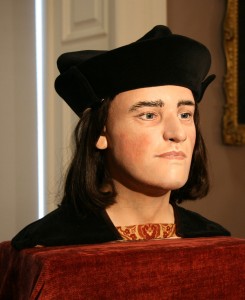
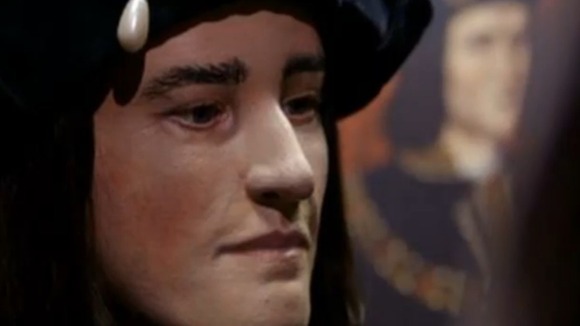
More than 500 years after his death, members of the public can look King Richard III in the eye once more, following the unveiling of a reconstruction of how he may have looked.
Based on human remains found beneath a carpark in Leicester city centre by University of Leicester Archaeological Services, and recently identified as those of England’s last Medieval monarch, the model was created by Caroline Wilkinson, Professor of craniofacial identification at the University of Dundee and unveiled yesterday (5 Feb) at the Society of Antiquaries in London.
Beginning with a 3D scan of the king’s skull, layers of muscle and skin were built up digitally on a computer. The result was then used to create a plastic model, which was painted and dressed in period-appropriate clothing.

Read the rest of this article...

Ice Age Art at the British Museum: 'Not even Leonardo surpassed this'

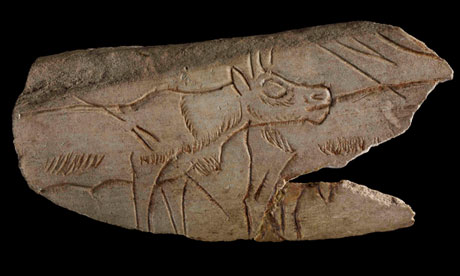
Human bodies in this show are overwhelmingly abstract, while animals are portrayed with gobsmacking accuracy … an image of a reindeer, carved into a reindeer bone, from Ice Age Art at the British Museum in London


I am looking at women with floppy breasts, massive hips and eyeless faces. Their bodies are deeply alien – disturbing in their total lack of what the modern world sees as desirable. Nearby, the British Museum has installed two nudes by Matisse, in one of many attempts in this exhibition to draw parallels between the earliest art and that of our own era. But this comparison just adds to the unease. To put it in language no archaeologist is likely to use: the curves of a Matisse woman are sexy; the bulges and blanknesses of these nudes, carved from ivory in central Europe 30,000 years ago, are not.
Then something catches my eye: a sculpture of a bison, created 21,000 years ago. It's so real, so alive, I can almost hear it snort and stamp. It has the same magical presence, the same thrilling realism, as cave paintings I've seen, also dating back to the ice age: images of mammoths, horses, bison. So why did the same artists choose to depict humans with such bizarre abstraction? It is one of the mysteries that make this show so eerie and thought-provoking.

Read the rest of this article...

Tuesday, February 05, 2013

Neanderthal extinction earlier than thought


Neanderthals may have become extinct in Europe some ten thousand years earlier than scientists currently think, a new radiocarbon dating study suggests.
Over the past 20 years, it has become widely accepted that the Iberian peninsula - modern day Spain and Portugal - served as a kind of refuge for the last remaining Neanderthals, who survived there five or ten thousand years longer than they did elsewhere in Europe.
Much of the evidence for this hypothesis came from radiocarbon dating of material found in caves associated with Neanderthal fossils or the particular kinds of stone tools, known to archaeologists as Mousterian, which are closely associated with the species.
North of the Ebro valley which crosses northern Spain, scientists previously found that evidence of Neanderthals disappeared around 42,000 years ago when anatomically modern humans arrived. South of that valley, it appeared, Neanderthals survived until 36,000 years ago with little evidence of modern humans.

Read the rest of this article...

Neanderthals 'unlikely to have interbred with human ancestors'

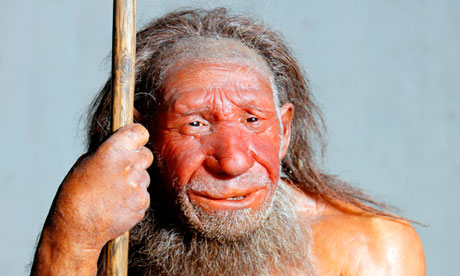
A model of a Neanderthal man from a museum in Mettmann, Germany. Traces of neanderthal DNA can be found in humans today. Photograph: Jochen Tack/Alamy


A new finding has cast doubt on the theory that ancestors of modern humans interbred with Neanderthals over thousands of years. Scientists have re-dated fossil bones from two sites in southern Spain and discovered they are much older than previously thought.
According to the new evidence, it is unlikely Neanderthals and modern humans ever lived together in the region. Researchers now think the Neanderthals had long gone before the arrival of the first Homo sapiens.
Since the 1990s experts have believed the last Neanderthals sought refuge in the Spanish peninsula and died out around 30,000 years ago. That would have provided easily enough time for the Neanderthals to mix their DNA with that of modern humans, who are believed to have colonised Spain more than 10,000 years earlier.

Read the rest of this article...

Australians shed new light on Neanderthals


A reconstructed Neanderthal skeleton, right, with a modern human skeleton. Photo: AP

Australian scientists have re-dated a collection of Neanderthal bones from southern Europe and found they are about 10,000 years older than first thought.

The new evidence means many of the region's Neanderthal specimens may be much older than previous studies suggest, and casts doubt on the date archaeologists believe the human subspecies became extinct.

Since the early 1990s several research groups have claimed to have radio-carbon dated some of the youngest Neanderthal bones, several just 32,000 years old, in a region known as Iberia, modern Spain and Portugal.
But the leader of the new research, Rachel Wood, said many archaeologists were not convinced of the specimens' ages.


Read the rest of this article...

What would chopped up Traprain Law Roman silver have looked like


The largest hoard of "hacked up" Roman silver ever found was discovered on a hill east of Edinburgh almost 100 years ago.

Now experts have taken a fresh look at two of the small fragments in the treasure and think they were from one of the biggest silver dishes in the whole of the Roman world. Why was valuable and ornate Roman silverware cut into small pieces and what would it have looked like if it had not been?

It is thought the hoard of Roman silver from Traprain Law in East Lothian was buried more than 1,500 years ago, at the beginning of the Early Medieval period - or, as it used to be referred to, the Dark Ages.

Two fragments from the rim of a plate were used in the recreation
This is the period when, after 400 years of occupation, the Roman empire receded from Britain.


Read the rest of this article...

The face of King Richard III to be unveiled today


A facial reconstruction of King Richard III is to be unveiled today, following yesterday's announcement that his skeleton had been found, under a car park in Leicester.
Based on a CT scan, taken by the team behind the archaeological dig, the 'face' will be revealed today at The Society of Antiquaries in London.
Last September The University of Leicester discovered a skeleton, thought to be that of the former King, who died in the Battle of Bosworth in 1485.
Due to extensive DNA tests, it was not confirmed until yesterday, that the skeleton did in fact belong to Richard III.


Read the rest of this article...

Richard III dig: Facial reconstruction shows how king may have looked

The reconstruction was revealed earlier for the first time


A facial reconstruction based on the skull of Richard III has revealed how the English king may have looked.
A skeleton found under a car park in Leicester has been confirmed as that of the king.
The reconstructed face has a slightly arched nose and prominent chin, similar to features shown in portraits of Richard III painted after his death.
Historian and author John Ashdown-Hill said seeing it was "almost like being face to face with a real person".
The development comes after archaeologists from the University of Leicester confirmed the skeleton found last year was the 15th Century king's, with DNA from the bones having matched that of descendants of the monarch's family.

Read the rest of this article...

Monday, February 04, 2013

FAROE ISLANDS BEFORE THE VIKINGS: NEW EVIDENCE

Kevin Edwards, Professor of Physical Geography, collecting samples for analysis on the Faroe Islands. Image: University of Aberdeen

Over the years, there has been much speculation regarding whether Irish monks may have travelled north across the sea to the Faroe Islands long before the Vikings ever arrived there.
However, despite the best efforts of scientists, researchers and archaeologists, nothing was uncovered that could prove the existence of settlers on the Faroes before the year 800 AD.
Until now!

Cereal pollen indicates early farming

Scientists from Aberdeen University in northeast Scotland have found something exciting in early Faroese pollen samples that gives them a reason to rethink Faroese prehistory: cereal pollen.
Kevin Edwards, a professor of physical geography and archaeology at Aberdeen University, tells ScienceNordic about the work:
”One of the main problems with cereal pollen is that it is produced in tiny quantities. Cereal pollen grains are also very large, and that means they don’t spread far with the wind. That’s why it’s so important to find.”
Now they have found cereal pollen in the early samples from the Islands there is just one problem: the soil where they found it is far from ideal for accurate pollen analysis, so they must try to discover more, but given the rarity it will be difficult.

Read the rest of this article...

Richard III: found!


At a Leicester press conference today (4 Feb), experts announced that the human remains found beneath a city centre carpark last August are ‘beyond reasonable doubt’ those of Richard III.
Addressing over 100 journalists from all over the world, the panel reported that the skeleton was that of an adult male, aged in his late 20s or early 30s when he died. Richard III was 32 when he was killed at the Battle of Bosworth in 1485. Two radiocarbon dates obtained from the remains also pointed towards the skeleton being that of England’s last Medieval king, giving a range of AD 1455-1540.
The crucial detail, however, was whether the researchers had been able to extract DNA from the 500-year-old remains, and whether these had shown a link with Michael Ibsen, a known descendant of Richard III’s sister, Anne of York.

Read the rest of this article...

Richard III: The Royal Armouries' Bob Woosnam-Savage on the violent death of the King in battle

Bob Woosnam-Savage (third from left) with (left to right) Philippa Langley (Richard III Society), Dr Stuart J Hamilton (Deputy Chief Forensic Pathologist, East Midlands Forensic Pathology Unit, University of Leicester)  and Dr Jo Appleby (Lecturer in Human Bioarchaeology, University of Leicester)


Richard III: The Royal Armouries' Curator of European Edged Weapons Bob Woosnam-Savage, who was part of the team which investigated the Grey Friars skeleton, on the final moments of Richard III's life...


“What we have is a very tentative, first attempt to try and create a possible narrative reconstructing the last minutes and death of Richard III, the last king of England to die in battle.

It is extremely important to bear in mind that this is exactly that; a first attempt. It will no doubt evolve as more is discovered.

My narrative that follows is a synthesis, based upon various elements from the historical accounts - and what we presently understand the evidence the skeleton may possibly suggest. The scenario offered suggests just one possible scenario:


Read the rest of this article...

Richard III discovery shows scientists playing to the media gallery

Jo Appleby From Leicester University during a press conference confirming the discovery of the remains of King Richard III. Photograph: Andy Weekes/Rex Features


The "king in the car park" story has proved irresistible for the media. The discovery of the body of Richard III is a huge coup for archaeologists at Leicester University who can be rightfully proud of their find. But the way it's been reported raises some uncomfortable questions about news values and history.
Charlotte Higgins has blogged that it's all about "impact", the dreaded pressure on academics to demonstrate public engagement with their work. But it's also about the media and what news organisations want to print, promote and broadcast. Can you really blame universities for picking out those bits of their research that will interest the press, and putting them out there in the most media-savvy way possible?
This is a historical story that ticks lots of news boxes. It has royalty and celebrity – controversial royalty at that, given Richard's historical reputation as a "bad king". It has a nice touch of the ordinary: the discovery in the mundane urban environment of a car park. It has a supporting tale by the screenwriter and member of the Richard III Society, Philippa Langley, who says in the Daily Mail, that she "felt a chill on a hot summer's day as she walked through the area where it was thought he was buried". Not just history, but ghosts. And the big reveal of the results has been thoroughly stage-managed, with live TV coverage and a Channel 4 documentary.

Read the rest of this article...

Desecrated remains of King Richard III discovered under parking garage


Last August, an archaeological dig in Leicester, England uncovered skeletal remains beneath a parking garage. Mitochondrial DNA taken from the remains were matched with Canadian cabinetmaker, Michael Ibsen, who turned out to be a direct descendent of Anne of York, King Richard III’s sister, thus confirming that the remains are of none other than King Richard III himself. If the DNA tests weren’t enough, researchers note that the battle wounds found on the remains, as well as evidence of scoliosis, support the identification of King Richard III. Radiocarbon dating was also used to suss out the age of the remains, and found that they were from 1455 to 1540, and belonged to a man in his 20s or 30s — Richard died at the age of 32 in 1485. Historical remains of royalty discovered under a parking lot.
The parking lot was built on top of the Greyfriars friary, which was built in Leicester around 1255 and survived until the late 1530s when it was demolished when Henry VIII dissolved the monasteries. This is where King Richard III was buried.

Read the rest of this article...

Skeleton found under car park is King Richard III


DNA points to a skeleton found under a car park in Leicester being that of King Richard III, the University of Leicester has confirmed.
There were cheers from media who had gathered from around the world as the announcement was made at the University of Leicester.
University archaeologist Dr Jo Appleby said the skeleton was found in good condition with its feet missing in a grave.
Its hand were crossed over the front of the pelvis and there was no evidence of a coffin or shroud found with the skeleton.
Dr Appleby, an osteoarchaeologist based at the University’s School ofArchaeology and Ancient History, said: “Taken as a whole the skeletal evidence provides a highly convincing case for identification as Richard III.

Read the rest of this article...

Iron Age skull found at Scottish golf course

Police were called to this spot at Musselburgh Links Golf Course, on the race course where bones have been found [Credit: East Lothian News]

A skull unearthed during maintenance work at Musselburgh’s world famous Old Links is believed to be that of a young Iron Age woman.

Police were called to the historic nine-hole golf course last Tuesday after council workers dug up human remains while repairing a bunker at the fourth green, close to Mrs Forman’s pub.

The police investigation was halted after initial forensic tests confirmed that the skull had not been buried recently.

Subsequent tests by East Lothian Council’s archaeology officers showed the find to date back more than 2,000 years.


Read the rest of this article...

Das Schwert des Fürsten


Ende der 1990er Jahre entdeckten Archäologen in Usedom das prachtvolle Kammergrab eines slawischen Fürsten aus dem späten 11. Jahrhundert. Diese aufwändig gebaute Kammer befand sich inmitten eines Gräberfeldes und enthielt neben wertvollen Schalen und Münzen auch ein kostbares Schwert. Für die große CREDO-Ausstellung in Paderborn wird dieses Kammergrab mit Beigaben im Museum in der Kaiserpfalz rekonstruiert und erstmals einem breiten Publikum gezeigt. Die Exponate sind Eigentum des Landesamtes für Kultur und Denkmalpflege Schwerin.
Das Schwert und weitere Beigaben werden vor ihrer Präsentation in den Werkstätten des Landschaftverbandes Westfalen-Lippe (LWL) restauriert. In einem komplizierten Prozess wird das wertvolle Schwert konserviert, wobei die eigentliche Substanz nicht beschädigt werden darf. "Ein in seiner organischen Substanz so gut erhaltenes Schwert hatten wir bislang nur selten in unseren Werkstätten. Zudem zeigen der Schaft und die Klingenform eine Form, die sich in Westfalen so nicht findet", sagt Andreas Weisgerber, Restaurator der LWL-Archäologie für Westfalen Lippe.

Read the rest of this article...

Saturday, February 02, 2013

UNLOCKING THE SECRETS OF EUROPE’S CASTLES


The castles of Europe still hold many secrets – and now a new charity, the Castle Studies Trust, is being set up to help unlock them.
Castles continue to capture the imagination of young and old alike, little is known of the vast majority although they are often still central to their local communities hundreds of years after they were built. Even with those which are well known, there is still a lot to learn about them.
With many badly damaged – or even lost altogether – simple questions such as what they looked like or when and why they were built remain riddles.
Now the Castle Studies Trust has been set up to fund research projects to help answer some of those questions – and it is appealing for donations from organisations, businesses and members of the public.
Castle Studies Trust joint patron John Goodall said: “Castles great and small litter the land and townscapes of the British Isles. Despite the public interest they arouse, the vast majority remain very little studied. By the careful application of funds The Castle Studies Trust promises to help enable further research into these buildings.”
And Edward Impey, another joint patron, said: “'Castles are with us everywhere - in reality, in the imagination and in literature. They are mighty reminders and documents of the past. What they can tell us is staggering - but so much remains to be learnt. The Castle Studies Trust stands to make a major contribution in this field.”
People can donate in a number of ways: either by credit card at https://mydonate.bt.com/charities/castlestudiestrust; by cheque; direct debit or payroll giving. For further information about how to donate people can go to www.castlestudiestrust.org
Grants will initially focus on new work on castles such as architectural and geophysical surveys or scientific tests such as radio-carbon dating. Places for which grants could be considered range from sites in major cities, such as London where little is known of Baynard’s Castle, to smaller historically important locations such as Pleshey in Essex.
View the Castle Studies Trust Website...

Roman settlement uncovered by builders in Flintshire

Work on the site near Flint has already uncovered a section of Roman road


A substantial Roman settlement has been uncovered during work on a major building development in Flintshire.
The find at the Croes Atti project near Flint has unearthed a section of Roman road, pottery and evidence of an industrial complex processing lead and silver mined at nearby Halkyn Mountain.
The discoveries were made as groundwork began on an 180-house scheme.
A three-week exploration of the site is now under way, funded by construction firm Anwyl and the heritage body Cadw.

“Start Quote

The site is throwing up all manner of interesting things”
Will WalkerEarthworks Archaeology
Andy Davies, Anwyl's technical director, said his workforce had discovered the proof that had eluded archaeologists.

Read the rest of this article...

Ice Age Lion Man is world’s earliest figurative sculpture

40,000 years old: Lion Man sculpture. Photo: Thomas Stephan, © Ulmer Museum


Work carved from mammoth ivory has been redated and 1,000 new fragments discovered—but it won’t make it to British Museum show
The star exhibit initially promised for the British Museum’s “Ice Age Art” show will not be coming—but for a good reason. New pieces of Ulm’s Lion Man sculpture have been discovered and it has been found to be much older than originally thought, at around 40,000 years. This makes it the world’s earliest figurative sculpture. At the London exhibition, which opens on 7 February, a replica from the Ulm Museum will instead go on display.

The story of the discovery of the Lion Man goes back to August 1939, when fragments of mammoth ivory were excavated at the back of the Stadel Cave in the Swabian Alps, south-west Germany. This was a few days before the outbreak of the Second World War. When it was eventually reassembled in 1970, it was regarded as a standing bear or big cat, but with human characteristics.


Read the rest of this article...

Restoration of Pompeii slated to begin next week

Aerial view of Pompeii [Credit: Web]

The long-awaited restoration of the Pompeii archaeological site will begin on February 6, the authorities said Wednesday.

An agreement on how to proceed at the UNESCO World Heritage site has been finalized and more details will be coming, said Fabrizio Barca, minister for territorial cohesion.

The so-called the Grande Progetto Pompei or Great Pompeii Project is to secure and improve access to the ruins of Pompeii.

It has financial backing from the European Commission, as well as the Italian government.


Read the rest of this article...

Section of Conon's Walls to be excavated

Section of Conon's Walls to be excavated [Credit: To Vima]

The Board of Trustees of the Piraeus Port Authority has decided to fund the archaeological excavations along the classical fortification walls known as Conon's Wall, in front of the new Cruise Passenger Terminal, after an agreement with the Ministry of Culture. The excavations will be conducted at the part between Palataki and the new Passenger Terminal, which has never been examined in the past by archaeologists. The project will cost 100,000 €.

By revealing the rest of Conon's Walls, the 26th Ephorate of Prehistoric and Classical Antiquities will complete its work in the area. At a recent meeting between the General Secretary of Culture Lina Mendoni, the managing director of Piraeus Port Authority Giorgos Anomeritis, the representatives of the Technical Services and the 26th EPCA, it was decided that the above mentioned part of Conon's Walls should remain open to the public and be partly covered with reinforced glass.

As Mr. Anomeritis stated: “Piraeus is not only a big cruise port, it is also a port which presents its 2,500-year-old history and its contribution to the development of Athens, Greece and Europe”. He also added that the ancient walls will be a very good way of welcoming cruise passengers to our land, by showing them a part of the port’s ancient history. This project along with the masterplan of the “Cultural Coast of Piraeus” will transform the port into a “portal” of tourism and culture, as Mr. Anomeritis said.


Read the rest of this article...