Thursday, June 21, 2012

Serbian archaeologists discover mammoth field containing at least five of the giant beasts

Miomir Korac, left, the director of the Viminacium archaeological park, and fellow archaeologists, work on a mammoth tusk at an open pit coal mine in Kostolac, 80 kilometers (50 miles) east of Belgrade, Serbia. Archaeologists in Serbia say they have discovered a rare mammoth field containing remains of at least five of the giant animals that lived here tens of thousands of years ago. AP Photo/ Marko Drobnjakovic. By: Marko Drobnjakovic, Associated Press KOSTOLAC, SERBIA (AP).- First there was one. Then another. And another. Archaeologists in Serbia say they have discovered a rare mammoth field containing the remains of at least five of the giant beasts that lived here tens of thousands of years ago. The discovery last week at the Kostolac coal mine, east of the Serbian capital of Belgrade, is the first of its kind in the region. It could offer important insight into the ice age in the Balkans, said Miomir Korac from Serbia's Archaeology Institute. "There are millions of mammoth fragments in the world, but they are rarely so accessible for exploration," he told The Associated Press. "A mammoth field can offer incredible information and shed light on what life looked like in these areas during the ice age."

More Information: http://www.artdaily.org/index.asp?int_sec=2&int_new=56063[/url]
Copyright © artdaily.org


Miomir Korac, left, the director of the Viminacium archaeological park, and fellow archaeologists, work on a mammoth tusk at an open pit coal mine in Kostolac, 80 kilometers (50 miles) east of Belgrade, Serbia. Archaeologists in Serbia say they have discovered a rare mammoth field containing remains of at least five of the giant animals that lived here tens of thousands of years ago. AP Photo/ Marko Drobnjakovic.


Archaeologists in Serbia say they have discovered a rare mammoth field containing the remains of at least five of the giant beasts that lived here tens of thousands of years ago. 

The discovery last week at the Kostolac coal mine, east of the Serbian capital of Belgrade, is the first of its kind in the region. It could offer important insight into the ice age in the Balkans, said Miomir Korac from Serbia's Archaeology Institute. 

"There are millions of mammoth fragments in the world, but they are rarely so accessible for exploration," he told The Associated Press. 

"A mammoth field can offer incredible information and shed light on what life looked like in these areas during the ice age."
Archaeologists in Serbia say they have discovered a rare mammoth field containing the remains of at least five of the giant beasts that lived here tens of thousands of years ago. The discovery last week at the Kostolac coal mine, east of the Serbian capital of Belgrade, is the first of its kind in the region. It could offer important insight into the ice age in the Balkans, said Miomir Korac from Serbia's Archaeology Institute. "There are millions of mammoth fragments in the world, but they are rarely so accessible for exploration," he told The Associated Press. "A mammoth field can offer incredible information and shed light on what life looked like in these areas during the ice age."

More Information: http://www.artdaily.org/index.asp?int_sec=2&int_new=56063[/url]
Copyright © artdaily.org
Miomir Korac, left, the director of the Viminacium archaeological park, and fellow archaeologists, work on a mammoth tusk at an open pit coal mine in Kostolac, 80 kilometers (50 miles) east of Belgrade, Serbia. Archaeologists in Serbia say they have discovered a rare mammoth field containing remains of at least five of the giant animals that lived here tens of thousands of years ago. AP Photo/ Marko Drobnjakovic.

More Information: http://www.artdaily.org/index.asp?int_sec=2&int_new=56063[/url]
Copyright © artdaily.org


Read the rest of this article...

Tuesday, June 19, 2012

Ten years on - restoration of Newport's medieval ship continues


The Newport ship when it was discovered during building work for the Newport Riverfront Theatre

It captured the imagination of Newport when it was found and sparked a campaign that attracted the support of thousands of people.

Ten years on from the discovery of the city’s medieval ship DAVID DEANS investigates progress to conserve it.

IT has been a decade since it was discovered on a bank of the Usk – but a team of specialists are still continuing the work to preserve and eventually rebuild the Newport Medieval Ship.

New Anthropology and Archaeology Resources Published at Sciences Social Network


The Anthropology and Archaeology Sciences are two new key mathematics categories covered by the Sciences Social Network ScienceIndex.com. The users of the website monitor 69 scientific journals and submit the most significant scientific results of these journals for inclusion in these two categories which currently contain a total of 4,843 articles. ScienceIndex.com was established in 1998 to index the very latest news, headlines, references and resources in all fields of biology, business, chemistry, engineering, geography, health, mathematics and society.

ScienceIndex.com is a Anthropology Sciences social network established in 1998 to index the very latest news, headlines, references and resources from science journals, books and websites worldwide. The site covers news in all fields of biology, business, chemistry, engineering, geography, health, mathematics and society. In the field of Society Sciences, the site has now included the two new categories Anthropology and Archaeology. While the Anthropology category covers the origins, physical and cultural development, biological characteristics, and social customs and beliefs of humankind, the Archaeology category covers historic or prehistoric peoples and their cultures by analysis of their artifacts, inscriptions, monuments, and other such remains.

Video News from TAC


The Archaeology Channel now has a monthly video news magazine.

You can find out more here...

Monday, June 18, 2012

Hexham Abbey receives £1.8m to restore medieval buildings


Hexham Abbey in northeast England has been granted £1.8m from the Heritage Lottery Fund for a restoration of the Abbey’s medieval monastery buildings.

The restoration project includes the creation of a state-of-the-art visitor centre and community facilities within the former monastic complex adjoining the 7th century abbey church which dominates the heart of Hexham.

Ivor Crowther, Head of the Heritage Lottery Fund North East, said: “Hexham Abbey has played a pivotal role in the lives of local people and visitors for hundreds of years. This project, that will restore and reunite the Abbey’s monastery buildings, will mean that the heritage of this special place is brought to life and provide a place for everyone to reflect, learn from and enjoy. HLF are incredibly proud to be supporting this project to protect a true heritage gem in the North East.”

DNA bolsters Bulgaria's John the Baptist bones claim

A Bulgarian East-Orthodox priest holds up a box containing bones, believed to be the relics of John the Baptist, in front golden-domed ''Alexander Nevski'' cathedral in Sofia, November 12, 2010. The bones, discovered earlier this year in excavation works in the town of Sozopol on the Black Sea coast, will be displayed in ''Alexander Nevski'' cathedral for several days.  
  
Bulgaria's claim to have unearthed six bones belonging to John the Baptist has received a boost from scientists who have concluded after dating them and analyzing their genetic code that they could indeed be relics of the man who baptized Jesus.


The remains, which include a molar and a piece of cranium, were found in July 2010 in a marble sarcophagus in the ruins of a medieval church on the island of Sveti Ivan, or Saint John, off Bulgaria's Black Sea coast near the resort of Sozopol.

They are on display in a church in Sozopol where thousands of worshippers have flocked to view them, untroubled by questions about their authenticity.

"When I first heard this story in 2010 I thought it was a bit of a joke, to be honest," said Tom Higham of the University of Oxford's Radiocarbon Accelerator Unit, one of the world's top laboratories for carbon dating of archaeological material.


Greek archaeology students: Please send us to Iraq


Greek archaeology students hit by state funding cuts are making an online appeal for donations to join excavations in Iraqi Kurdistan, the state-run Athens News Agency said on Monday.

In a posting on donation site www.indiegogo.com, the group of Athens University students ask for help to cover the 500-euro ($632) plane fare.

"Without wishing to sound like a cliche, everyone knows that times are tough right now," the students said in their posting.

"The university cannot cover the cost of our airplane tickets," they said. "So please donate and send us there."

Roman dig in Maryport


Archaeologist began work on the site last year Credit: ITV
A major excavation is taking place at the Roman Fort in Maryport. It follows on from work done last year, which discovered evidence of a large wooden building.

Up until that point it was thought that 17 altar stones found on the site in the 19th Century had been buried as part of a religious ceremony, but they were found to have been reused in the foundations of the timber framed building.

Die jetzt abgeschlossenen Ausgrabungen am westlichen Stadtrand an der Barkhauser Straße in Paderborn ermöglichen einen Blick in den bäuerlichen Alltag vor 2000 Jahren.


Die Archäologen des Landschaftsverbandes Westfalen-Lippe (LWL) haben hier Zeugnisse einer Siedlung dokumentiert und gesichert, die vom Leben, Arbeiten und den alltäglichsten Bedürfnissen in den ersten Jahrhunderten vor Christus berichten. 

Die Befunde zeugen von einer guten Organisation. Vor über 2000 Jahren lebten die Menschen an der heutigen Barkhauser Straße in großzügigen Häusern. Die Pfosten, die die Dächer der Behausungen getragen haben, wurden von ihren Erbauern tief in den Boden eingegraben. Etwas abseits von den Wohngebäuden errichteten sie kleinere Nebengebäude und eine Grube. "Darin wurden die Vorräte und das Saatgetreide gelagert", schildert LWL-Archäologe Dr. Werner Best die ersten Erkenntnisse nach Abschluss der Ausgrabungen.

C14 bolsters Bulgaria's John the Baptist bones claim


A knucklebone claimed to be of John the Baptist has been dated as first century AD by Oxford researchers. The new dating evidence supports claims that bones found under a church floor in Bulgaria may be of the leading prophet and relative of Jesus Christ as described in the Bible. 
Bones claimed to be of John the Baptist that were analysed by the research team. Clockwise from top left, the knucklebone, ulna, part of cranial bone and molar (together) and rib [Credit: Oxford University]
The research by the Oxford University team will be explored in a documentary 'Head of John the Baptist' to be aired in the UK on National Geographic Channel on Sunday 17 June. 

A team from the Oxford Radiocarbon Accelerator Unit at Oxford University dated a knucklebone from the right hand. The researchers were surprised when they discovered the very early age of the remains adding, however, that dating evidence alone cannot prove the bones to be of John the Baptist.

Read the rest of this article...

Sunday, June 17, 2012

Researchers solve Roman Empire historical mystery


In ancient Roman times A.D., Palmyra was the most important point along the trade route linking the east and west, reaching a population of 100 000 inhabitants. But its history has always been shrouded in mystery: What was a city that size doing in the middle of the desert? How could so many people live in such an inhospitable place nearly 2 000 years ago? Where did their food come from? And why would such an important trade route pass directly through the desert?

Norwegian researchers collaborated with Syrian colleagues for four years to find answers.

“These findings provide a wealth of new insight into Palmyra’s history,” says project manager Jørgen Christian Meyer, a professor at the University of Bergen. The project has received funding of over NOK 9 million from the Research Council of Norway’s comprehensive funding scheme for independent basic research projects (FRIPRO)

Uranium-series dating reveals Iberian paintings are Europe's oldest cave art


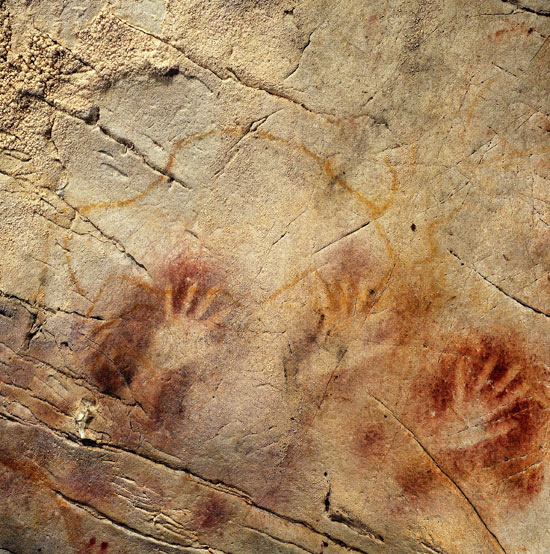
The practice of cave art in Europe thus began up to 10,000 years earlier than previously thought, indicating the paintings were created either by the first anatomically modern humans in Europe or, perhaps, by Neanderthals. 

Fifty paintings in 11 caves in Northern Spain, including the UNESCO World Heritage sites of Altamira, El Castillo and Tito Bustillo, were dated by a team of UK, Spanish and Portuguese researchers led by Dr Alistair Pike of the University of Bristol, UK.

As traditional methods such as radiocarbon dating don't work where there is no organic pigment, the team dated the formation of tiny stalactites on top of the paintings using the radioactive decay of uranium. This gave a minimum age for the art. Where larger stalagmites had been painted, maximum ages were also obtained.

Hand stencils and disks made by blowing paint onto the wall in El Castillo cave were found to date back to at least 40,800 years, making them the oldest known cave art in Europe, 5-10,000 years older than previous examples from France.

Cromwell’s men’s severed heads unearthed


Human remains believed to belong to three of Oliver Cromwell’s soldiers have been unearthed during redevelopment work at James Green. 
Patrick Neary, (left) Archaeologist and Andrzsj Gwozdzik from Poznan, Poland at the excavations in James Green [Credit: Michael Brophy]
The discovery was made in recent days and the remains are now being examined by an archaeologist, Patrick Neary. 

“The heads of seven of Cromwell’s men are believed to be buried there. They were killed near Ballinakill in Co Laois in 1642 and their heads were hung from the Market Cross in Kilkenny on the next market day and later buried. To date we have found what we believe are two severed heads belonging to the soldiers ,” he said.

Illegal digs on the rise in Greece


Prompted by Greece’s severe economic crisis, a growing number of treasure hunters are scouring the country in search of antiquities and other treasures. 

The trend, which is more evident in the country’s northwestern Macedonia region, is not only driven by economic necessity but also by the cash-strapped state’s failure to protect its ancient heritage. 


“Illegal digs have always been carried out around the mountains in this area,” Kavala archaeologist Sofia Doukata told Kathimerini. “But the practice has recently turned into a sport,” she added. 


Mount Paggaio near the city of Kavala appears to have attracted an usually large number of would-be looters. The illicit diggers, Kathimerini understands, are conducting excavations around archaeological sites hoping to find something and sell it.

Friday, June 15, 2012

'Vampire' rites still have bite in Bulgaria

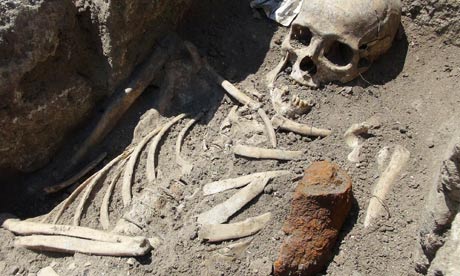
An unearthed skeleton is pictured in the Black Sea town of Sozopol, Bulgaria. Archaeologists have unearthed two skeletons from the Middle Ages pierced through the chest with iron rods to keep them from turning into vampires, according to the head of the history museum.

The ancient skeleton of a man, pinned down in his grave in order not to turn into a vampire, piqued interest in Bulgaria this week, where vampire tales and rites still keep their bite even nowadays.

The 700-year-old skeleton -- unearthed in the necropolis of a church in the Black Sea town of Sozopol earlier in June -- was stabbed in the chest with an iron rod and had his teeth pulled before being put to rest.

Anti-vampirism rituals were behind the find, archaeologists said, making this potential vampire and another one found at his side an instant media hit.

"These were most probably intellectuals who outgrew the moral ideas of their 14th century (...) They were feared and buried outside town walls," their discoverer, archaeologist Dimitar Nedev, told AFP.

Neanderthals may have been first human species to create cave paintings


Several times in the past 10 years scientists have had to rewrite the textbooks on Neanderthals, the latest species of human to go extinct. Once the archetype for primitive, uncivilised behaviour, the species, illuminated through fossil excavations and lately analysis of their genome, has emerged as being not too dissimilar from our own.

Contrary to their dim-witted image Neanderthals have been found to have used tools, to have worn jewellery, and, lastly, to have interbred with our Homo sapiens ancestors to such an extent that 4% of every modern European's genome is traceable to Neanderthal origins.

Now comes what could be the final nail in the coffin of the "unintelligent Neanderthals" myth: they might have been the first human species to paint in caves.

Early printed book contains rare evidence of medieval spectacles


Many scholars rank the invention of eyeglasses among the most important contributions to humankind in the last 2,000 years. Yet, the inventor of this now thoroughly quotidian piece of technology remains anonymous. Indeed the inventor (or inventors) will almost certainly never be known, given the numerous conflicting claims, lack of specificity, and scarcity of surviving documentation.

What scholars do know about the history of eyeglasses is that they were probably invented at the end of the thirteenth century by a craftsman living near Pisa. The evidence originates from a passage by Friar Giordano da Pisa who recounts having met the anonymous craftsman in 1286. A friend of Giordano named Friar Allesandro della Spina learned how to make them shortly thereafter and shared the secret with the public. A number of other possible inventors of eyeglasses have been posited over the centuries, all of which have finally been proven spurious in recent scholarship.

Read the rest of this article...

Natural History Museum – Evolution App


Introduction to the NHM Evolution App – brought to you by Authored Apps and the Natural History Museum London – The most extraordinary illustrated traveller’s guide to the past 600 million years on earth. http://www.nhm.ac.uk/business-centre/publishing/books/evolution/evolution-app/evolution-app.html

Red dot becomes 'oldest cave art'


Red dots, hand stencils and animal figures represent the oldest examples yet found of cave art in Europe.

The symbols on the walls at 11 Spanish locations, including the World Heritage sites of Altamira, El Castillo and Tito Bustillo have long been recognised for their antiquity.

But researchers have now used refined dating techniques to get a more accurate determination of their ages.

One motif - a large red dot - is said to be more than 40,000 years old.

Thursday, June 14, 2012

Closure of The Institute of Archaeology and Antiquity at University of Birmingham


Closure of The Institute of Archaeology and Antiquity at University of Birmingham including Birmingham Archaeology, VISTA and Birmingham Archaeo-Environmental

We would like to bring to the archaeology communities attention the imminent closure of The Institute of Archaeology and Antiquity (IAA) at the University of Birmingham, an IfA Registered Organisation which encompasses archaeological research and teaching staff alongside project and grant funded staff under the headings of Birmingham Archaeology, VISTA and Birmingham Archaeo-environmental (BAE). Following a rapid (and staff believe flawed and prejudicial) review of the department it has been recommended that the IAA be dispended. Under the proposals 19+ staff will loose their jobs including all project and research archaeology staff, a group originally formed following the restructuring of Birmingham Archaeology in early 2011 as they wereidentified as a team with a successful and proven track record.


Minister condemns attack on Tara stone

 The Lia Fáil, Stone of Destiny, on the Hill of Tara, which was damaged in the attack.Photograph: Ciara Wilkinson

MINISTER FOR Heritage Jimmy Deenihan has condemned apparent vandalism to the Lia Fáil standing stone that adorns the Hill of Tara in Co Meath.

In recent days it was noticed that it had been struck with a heavy object and fragments had broken off the national monument.

The damaged areas are clearly visible as white patches around the top of the stone.

“Shocking” is how the chairman of the Heritage Council and archaeologist Dr Conor Newman described it.

Furness Viking treasure appeal reaches £50,000 target


The hoard of Viking silver coins and artefacts will now stay in south Cumbria
 
A museum has raised almost £50,000 to keep a hoard of Viking treasure in Cumbria, where it was found. 

A metal detector enthusiast found the 92 silver coins and ingots near Stainton, Dalton, in 2010. 

Barrow Dock Museum launched an appeal to buy the treasure and it has now hit its target.

The hoard was officially declared treasure, giving museums the rights to buy the haul. Museum curator Sabine Skae said she was "over the moon".

Even ancient Greece suffers from austerity measures


A jarring public-awareness ad that has appeared recently on Greek television news shows a little girl strolling with her mother through the National Archaeological Museum in Athens, one of the country's cultural crown jewels. The girl skips off by herself, and as she stands alone before a 2,500-year-old marble statue, a hand suddenly sweeps in from behind, covering her mouth and yanking her away.

An instant later, she reappears, apparently unharmed but staring forlornly at an empty plinth: The kidnappers weren't after the girl — they were after the statue.

The ad, produced by the Association of Greek Archaeologists, is most immediately a reminder of an armed robbery of dozens of artifacts from a museum in Olympia in February, amid persistent security shortcomings at museums across the country. But the campaign's central message — “Monuments have no voice. They must have yours” — is a much broader attack on deep cultural budget cuts being made as part of the austerity measures imposed on Greece by the European economic establishment, measures that have led in recent weeks to an electoral crisis, a caretaker government and the specter of Greece's departure from the eurozone.

Rome's Trevi fountain crumbling 'for lack of maintenance'


City officials blame freak snowfall for damage, but critics decry 'dangerous' cuts to funding to protect Italian heritage

Trevi fountain inspected after pieces of top frieze fell off
Rome's Trevi fountain is inspected after pieces of the top frieze fell off. Experts are investigating whether it needs a major restoration. Photograph: Ettore Ferrari/EPA
 
Ornate stucco reliefs have crumbled from the Trevi fountain, Rome's baroque masterpiece, making it the latest in a series of Italian monuments to suffer damage and reigniting a row over Italy's commitment to protect its heritage.

As hundreds of tourists lobbed pennies into the fountain's pool on Monday, workmen were erecting scaffolding around a section of the facade where fragments of a gargoyle's head and foliage crashed to the ground on Saturday night.

City officials played down the damage, blaming it on Rome's freak snowfall this winter, which caused water infiltration. But as the rest of the fountain was checked for crumbling stucco, Italy's Green party launched a campaign against what it described as dangerous cuts to the funding to maintain Rome's monuments.

Wednesday, June 13, 2012

WOOLLY MAMMOTH EXTINCTION HAS LESSONS FOR MODERN CLIMATE CHANGE


ALTHOUGH HUMANS AND WOOLLY MAMMOTHS CO-EXISTED FOR MILLENNIA, THE SHAGGY GIANTS DISAPPEARED FROM THE GLOBE BETWEEN 4,000 AND 10,000 YEARS AGO, AND SCIENTISTS COULDN’T EXPLAIN UNTIL RECENTLY EXACTLY HOW THE FLINTSTONIAN BEHEMOTHS WENT EXTINCT.

In a paper published June 12 in the journal Nature Communications, UCLA researchers and colleagues reveal that not long after the last ice age, the last woolly mammoths succumbed to a lethal combination of climate warming, encroaching humans and habitat change — the same threats facing many species today.
“We were interested to know what happened to this species during the climate warming at the end of the last ice age because we were looking for insights into what might happen today due to human-induced climate change,” said Glen MacDonald, director of UCLA’s Institute of the Environment and Sustainability (IoES). “The answer to why woolly mammoths died off sounds a lot like what we expect with future climate warming.”

Monmouth ruin find could pre-date pyramids


Archaeologists Paul Davies (left) and Steve Clarke at the site in Monmouth  
Archaeologists Paul Davies (left) and Steve Clarke at the site in Monmouth
Archaeologists claim to have unearthed the remnants of a large prehistoric building, which they say could be older than Egypt's pyramids.

Experts said they were mystified by the "unique" find on the site of a housing development in Monmouth.

Monmouth Archaeology, which found the wooden foundations, said they dated to at least the Bronze Age, but could be early Neolithic, about 6,500 years old.

New British Archaeology app


Readers of British Archaeology can subscribe to the digital edition of the award-winning magazine, by downloading the new app for the iPhone and iPad from the iTunes store. Catch up on the latest in UK archaeology on the move, view sample pages on your smartphone, and subscribe for access to the latest issue and back library online, wherever you are. British Archaeology is also available to Android users through our online app. 

ARTIFACTS UNEARTHED AT OLYMPIC PARK: PHOTOS


The London 2012 Summer Olympic and Paralympic Games open on July 27. Among the first to prepare for this historic moment were archaeologists, who excavated a 1.6-square-mile site in east London. Olympic Park, with its stadium, Aquatics Center and Velodome, was later constructed on the land.

Most viewers of the games will see these buildings, not realizing that thousands of years of U.K. history exist underneath the structures.

One of the oldest artifacts to be unearthed was this Neolithic flint axe head.

Wessex Archaeology’s Andrew Powell, who helped to analyze the findings, told Discovery News,  “Axes like these would have been used for clearing woodland for cultivation, but would also have been prestige objects, exchanged over long distances and possibly used, perhaps as here, as some form of votive offering.” He thinks the axe may have been tossed in the Lea River, since placing valuable objects in rivers held ritualistic significance for certain cultures during prehistoric times.

Ancient Greek Cemetery Found in Marseille


It is already known that the first residents of Marseille in Southern France were Greeks, specifically from the ancient tribe of Phocaea. But now, archaeologists discovered an ancient Greek cemetery in the region that would shed light on the habits and customs of the ancient inhabitants of the area.

The ancient graveyard, dating back to the 4th or 5th century B.C.E, was brought to light by archaeologists who have established ongoing excavations in the ancient port of Marseille. At present, they have already located six sarcophagi and urns.

“These findings in this specific area are totally unexpected,” said Lionel Guévalet, director of the Provence de la société Bouygues Immobilier and added that this was a very important discovery because “it could dispute everything we know about the Marseille habitants of Greek origin.”

Tuesday, June 12, 2012

How infectious disease may have shaped Human origins


Roughly 100,000 years ago, human evolution reached a mysterious bottleneck: Our ancestors had been reduced to perhaps five to ten thousand individuals living in Africa. In time, "behaviorally modern" humans would emerge from this population, expanding dramatically in both number and range, and replacing all other co-existing evolutionary cousins, such as the Neanderthals. 
Escherichia coli bacteria, like these in a false-color scanning electron micrograph by Thomas Deerinck at UC San Diego’s National Center for Microscopy and Imaging Research, cause a variety of often life-threatening conditions, particularly among the young. Varki and colleagues suggest a genetic change 100,000 or so years ago conferred improved protection from these microbes, and likely altered human evolutionary development [Credit: University of California, San Diego Health Sciences]
The cause of the bottleneck remains unsolved, with proposed answers ranging from gene mutations to cultural developments like language to climate-altering events, among them a massive volcanic eruption. 

Add another possible factor: infectious disease.


BRITISH ARCHAEOLOGICAL AWARDS 2012


The British Archaeological Awards are a showcase for the best in UK archaeology and a central event in the archaeological calendar. Established in 1976, they now encompass six Awards, covering every aspect of UK archaeology.
For guidance on the 2012 Awards or any other query please contact the Administrator.

BRITISH ARCHAEOLOGICAL AWARDS 2012

To be announced on 9 July, British Museum, London. The shortlist for each Award is given below.

Medieval 'Banksy' drawings discovered in Sussex


Mysterious graffiti by a 'medieval Banksy' has been discovered in a 14th Century wine cellar in the Sussex town of Winchelsea. 

The medieval etchings show the masts, rigging, hulls, flags, cross masts, and sails of sailing ships, inscribed into the plaster work.

Presenter Shaun Williamson asks archaeologist Matthew Champion about the origins of this medieval graffiti.

'Vampire' skeletons to go on display in Bulgarian museum


Men killed and buried in 14th century were spiked through the chest to prevent them turning into undead, say archaeologists


One of the skeletons with an iron rod through its chest at the archaeological site in Sozopol, Bulgaria. Photograph: AP
 
Bulgaria's national history museum plans to display a "vampire" skeleton after unearthing the 700-year-old remains of two men stabbed through the chest with iron rods.

Archaeologists excavating a monastery near the Black Sea city of Sozopol discovered the skeletons, which were buried in a pagan ritual aimed at keeping the men from turning into vampires.

"This was a pagan belief widespread in the Bulgarian lands in the 12th to 14th centuries. People were very superstitious then," the museum's head, Bozhidar Dimitrov, said.


Trajan's Market: Overlooked jewel in the heart of Rome


On a heavily trafficked street where few tourists pass in the heart of ancient Rome lies the entrance to one of the Eternal City's most extraordinary and overlooked monuments -- Trajan's Market.

Built in the second century AD as a series of vaulted offices for managers of the nearby Trajan Forum headed up by a "procurator", the architectural complex has served as a fortress, a convent and a barracks over the centuries.

Clinging to a hillside that overlooks the Roman Forum, the nearly 2,000-year-old monument offers spectacular views over the Colosseum.

The site is often referred to as the "world's oldest shopping mall," but its name is something of a misnomer as it was never the main market of Imperial Rome, site director Lucrezia Ungaro told AFP.

Ancient Artefacts Discovered Underwater Skiathos Island


 Underwater explorations from May 14 though 25 near Skiathos island resulted in a treasure trove of  archaelogical antiquities.

The first organized underwater exploration was held under the supervision of the Greek Ephorate of Underwater Antiquities and explored through areas including the old port of Skiathos, notable for the Venetian fortress called Burtzi, Kehria area and others.

An ancient breakwater as well as a Byzantine jetty were uncovered in the area around the ancient port, which precisely coincides with  the modern harbor of Skiathos.

Around the old harbor were also discovered many pieces of ceramic jars. The most important findings were two complete lamps dated back to the 4th and 6th century, as well as two complete jars of the late classical period.

Stephen Fry's Parthenon Marbles plea backed in debate vote


 The Parthenon Gallery at Athens' new museum is designed to take all the Parthenon sculptures

A call backed by actor Stephen Fry for the return to Greece of the British Museum's Parthenon Marbles has come out on top in a debate held in London.

Fry said it would be a "classy" move to restore the sculptures brought to the UK by Lord Elgin in the 19th Century. 

The debate, hosted by Intelligence Squared, ended with a majority for the motion of 384 to 125.

Opposing the motion, Tristram Hunt MP said the British Museum played a key role in cosmopolitan culture.

Monday, June 11, 2012


 The skeleton, pinned through the chest with an iron rod, at the excavation site in Sozopol, Bulgaria. Photograph: National History Museum of Bulgaria/EPA

Last weekend, Bulgarian archaeologists working near the Black Sea town of Sozopol unearthed centuries-old skeletons pinned down through their chests with iron rods. Interestingly, this technique was evidently used to “stop the dead from becoming vampires”: people who had been “unusual” in life (alcoholics, criminals and assorted outsiders) were automatically suspect, even before any vampiric assaults had actually occurred.

The Bulgarian finds were mere youngsters by comparison with the deviant burials unearthed in Mikulovice, in the Czech Republic, a few years ago. There, the bodies weighted down with rocks were thought to be around 5,000 years old.

In the age of modern “vampotainment” – with Johnny Depp recently offering yet another vampire who many women (and men) would die for – we might forget that vampires were not invented for fun. For most of history, vampirism was the subject of mind-shattering terror. During a vampire outbreak, everyone would routinely flee their houses and sleep together in one building. Meanwhile, there was the question of those who fell into a coma. In Greece, one family was so terrified that their comatose daughter risked becoming undead that they buried her alive, against the desperate pleas of the local doctor (secretly, he opened up her grave that night, only to have her die in his arms). In the same country, another luckless man woke from a coma at his own funeral, in his open coffin. Sadly, this was no cause for celebration. Traumatised by this vampiric being, the villagers stoned him to death.

Archaeologists Drill Tønsberg’s Viking Ancestry

The Norwegian city of Tønsberg, was first mentioned by a contemporary writer was in the year 1130. According to Snorri Sturluson, Tønsberg was founded before the Battle of Hafrsfjord, which, according to Snorri, took place in 871.

What year the battle took place is disputed, however, and most current historians believe the battle took place closer to 900. However, if the battle did in fact take place in 871, this would make Tønsberg the oldest present Scandinavian city.

Now archaeologists believe the city dates from at least 900AD after a series of drill samples taken from the site contain evidence of occupation and human activity called Kulturlag.

The sample drilling was undertaken by Norway’s institute for Cultural Heritage (Norsk institutt for kulturminneforskning, NIKU) who confirmed that the samples prove Tønsberg’s existence during the Viking Period as early as 900AD.

Early Iron Age fashion from Denmark


Colourful patterned clothes appear in the early Iron Age according to new analyses of 180 textile samples from 26 different bog finds, carried out by Ulla Mannering, a senior researcher and archaeologist at the Danish National Research Foundation’s Centre for Textile Research at the National Museum.


Ulla Mannering examines textiles at the Centre for Textile Research. Image: University of Copenhagen

“The beginning of the Iron Age sparked a revolution in fashion in which clothes became coloured and patterned,” she says. Conventional theory held that access to  colourful textiles only emerges in Scandanavia  in the centuries after the 1st centuries AD.  This discovery pushes back the date by at least 500 years.

The new analyses also shows that the bog bodies from which the textiles were taken are older than previously thought with most of them dating back more than 2,000 years.

The discovery also challenges the view that the bodies, which had been buried in an ancient sacrificial bog, where prisoners or poorer people, who for some reason had been destined to be sacrificed or punished.

Scientists are accused of distorting theory of human evolution by misdating bones


Briton says Spanish researchers are out by 200,000 years and have even got the wrong species

A skull from one of the bodies found in a pit in Spain
 
A skull from one of the bodies found in a pit in Spain. Photograph: Paul Hanna/Reuters
 
It is the world's biggest haul of human fossils and the most important palaeontology site in Europe: a subterranean chamber at the bottom of a 50ft shaft in the deepest recesses of the Atapuerca cavern in northern Spain. Dozens of ancient skeletons have been unearthed.

La Sima de los Huesos – the Pit of Bones – has been designated a Unesco world heritage site because of its importance to understanding evolution, and millions of euros, donated by the EU, have been spent constructing a museum of human antiquity in nearby Burgos.

But Britain's leading expert on human evolution, Professor Chris Stringer, of the Natural History Museum, has warned in the journal Evolutionary Anthropology that the team in charge of La Sima has got the ages of its fossils wrong by 200,000 years and has incorrectly identified the species of ancient humans found there.

Monumental effort to save the threatened Viking treasures of Oseberg


The wood fibers of the richly decorated ceremonial wagon are disintegrated because of the preservation method. Credit: © Museum of Cultural History, University of Oslo / Eirik Irgens Johnsen

Researchers from the Museum of Cultural History in Oslo, working closely with Helmholtz-Zentrum Berlin, have been studying ancient wooden Viking artefacts at the synchrotron radiation source BESSY II. The conservators expect this non-destructive method will yield crucial insights into the degradation of these unique works of art. The wooden artefacts come from a Viking grave found in 1904 at Oseberg near the Oslo fjords.

WikiLoot aims to use crowdsourcing to track down stolen ancient artefacts


Man behind WikiLoot hopes crowdsourcing experiment will help to find some of the world's oldest and most valuable treasures

Greek krater
The man behind the WikiLoot idea hopes it will bring about the recovery of many more artefacts such as this 2,300-year-old Greek krater, which was returned to Italy by the J Paul Getty Museum. Photograph: Beatrice Larco/AP
 
Campaigns to combat archaeological tomb raiders have notched up some big successes, notably a deal under which the J Paul Getty museum in Los Angeles agreed to hand back 40 precious artefacts after it was shown they had been looted from digs in Italy.

Activists, however, call that a drop in the ocean in a business valued at as much as $10bn (£6.5bn) a year, and claim hard-pressed lawyers and police forces are struggling against unscrupulous dealers.

Which is why plans are afoot to put thousands of previously unpublished photos and documents about stolen artefacts online to create WikiLoot, a new crowdsourcing, data mining experiment to help track down some of the world's oldest treasures.

New secrets from 2,300 year old Roman warship


A new study puts some finishing touches on the 2,300-year history of the beak-like weapon that an ancient warship used to ram enemy ships in the First Punic War, the conflict between ancient Rome and Carthage. 


The report, in ACS' journal Analytical Chemistry, also identifies a major threat that conservators must address in preserving this archaeological treasure for future generations. 

Patrick Frank and colleagues explain that the ram, called a rostrum, was found in 2008 under 22 feet of water, 150 feet offshore from Acqualadrone (which means "Bay of the Pirates") in northeastern Sicily. 

The Acqualadrone rostrum is bronze, with a wooden core that was preserved because of burial beneath the seafloor. Carbon-14 dating suggests that the warship sank around 260 B.C. after being damaged in the battle of Mylae during the opening stages of the First Punic War, which may have been among the largest wars of its time.

Shakespearean playhouse unearthed in London


Archaeologists in London have discovered the remains of an early playhouse used by William Shakespeare's company where "Romeo and Juliet" and "Henry V" were first performed. 

An archaeologist as she undertakes initial archaeological excavation work at the site of The Curtain Theatre in London in October 2011. Archaeologists say they have discovered the remains of an Elizabethan theatre where some of William Shakespeare's plays were first performed. Experts from the Museum of London have uncovered a yard and gallery walls from the Curtain Theatre in Shoreditch, just east of London's business district [Credit: Museum of London Archaeology]
Pre-dating the riverside Globe, the Curtain theater, north of the river Thames in Shoreditch, was home to Shakespeare's company - the Lord Chamberlain's Men. 


Remains of walls forming the gallery and the yard within the venue have been discovered by archaeologists from Museum of London Archaeology (MOLA). 


"This is a fantastic site which gives us unique insight into early Shakespearean theatres," said Chris Thomas from MOLA, who is leading the archaeological work.