Monday, May 11, 2020

1,700-year-old board game found in Norwegian burial mound

The burial cairn site [Credit: UiB]

This April, the University Museum of Bergen, excavated the remains of a small Early Iron Age grave cairn at Ytre Fosse, Western Norway. The location is spectacular, overlooking Alversund and the “Indre Skipsleia”, a part of the old shipping lane, Nordvegen, – which gave Norway its name. The whole area is dotted with monumental grave mounds on both sides of Alversund, symbols of an Iron Age political landscape and the power and control of goods and travels along the Norwegian coast. 

The grave turned out to be a cremation patch containing 3 ceramic pots, a bronze pin, burnt glass and 18 gaming pieces and an elongated dice. The dice is of a very rare type, exclusive for Roman Iron Age (AD 1 - 400). In Scandinavia, similar dices are found in the famous Vimose weapon-offering site at Fyn, Denmark.

At Vimose also the gaming board was preserved, giving a unique view into Early Iron Age board games among the Germanic tribes in Scandinavia. Board games, inspired by the Roman game Ludus latrunculorum, seems to have been played amongst the elite in Roman Iron Age Scandinavia. These games are also the forerunner to the more famous Viking Age (AD 750-1050) board game Hnefatafl.

Read the rest of this article...

Archaeologists in Denmark discover huge defensive structure from the Roman Iron Age

Credit: Museum Lolland-Falster

Archaeologists have unearthed a massive structure in Lolland that is believed to have been used to ward off an attacking army back in the Roman Iron Age.  So far, 770 metres of the structure has been detected, but Museum Lolland-Falster estimates it could stretch to twice that.  

“This is a really big structure. It’s taken a lot of work to build,” Bjornar Mage, an archaeologist and curator from Museum Lolland-Falster, told TV2 News. “We believe the structure was built around a kilometre from the coast between two impenetrable wetland areas – in a bid to stop attacking foe from entering Lolland.”  

The structure involved the digging of long lines and rows of holes in the earth – at least 10,000 holes are estimated to have been dug. In similar structures discovered in Jutland, the defensive ‘belt’ was combined with sharpened poles. 

Read the rest of this article...

Section of Theodosian Walls of Constantinople collapses

Credit: Greek City Times

A section of the famous Theodosian Walls (Tower 69) of Constantinople (modern Istanbul), located on Sulukule Street in the Topkapi neighbourhood, has collapsed "due to an unknown reason", Turkish news sources have reported.

The reports state that police and firefighters attended the scene. While there were no dead or injured in the incident, police inspected around the area where the crash occurred, while municipal teams cleared the fallen rubble from the walls.

In their present state, the Theodosian Walls stretch for about 5.7 km from south to north, from the "Marble Tower" (Turkish: Mermer Kule), also known as the "Tower of Basil and Constantine" (Gk. Pyrgos Basileiou kai Konstantinou) on the Propontis coast to the area of the Palace of the Porphyrogenitus (Tr. Tekfur Sarayi) in the Blachernae quarter.

Read the rest of this article...
2,200-year-old Celtic village discovered in Hungary

Aerial view of the site showing excavated houses 
[Credit: Andriko Lajos, Deri Museum, Pelta Bt]

Archaeologists from the museum made the discovery during a rescue excavation prior to a construction project in the area of the Tocoskert housing estate, at the end of Derek Street.

The late Iron Age village, probably dating to the third-second centuries BC, occupies approximately 8,000-square-metre on the eastern bank of the Toco stream, which slopes slightly towards the watercourse.

Archaeologists have managed to excavate several rectangular houses, measuring twelve to thirteen square feet in area, as well as numerous artefacts, including ceramics, objects made of bone, iron and clay, as well as the remains both domesticated and wild animals.

Read the rest of this article...
A Wedding Photographer Took an Online Archaeology Class During Lockdown—and May Have Discovered a Lost Stonehenge-Like Structure

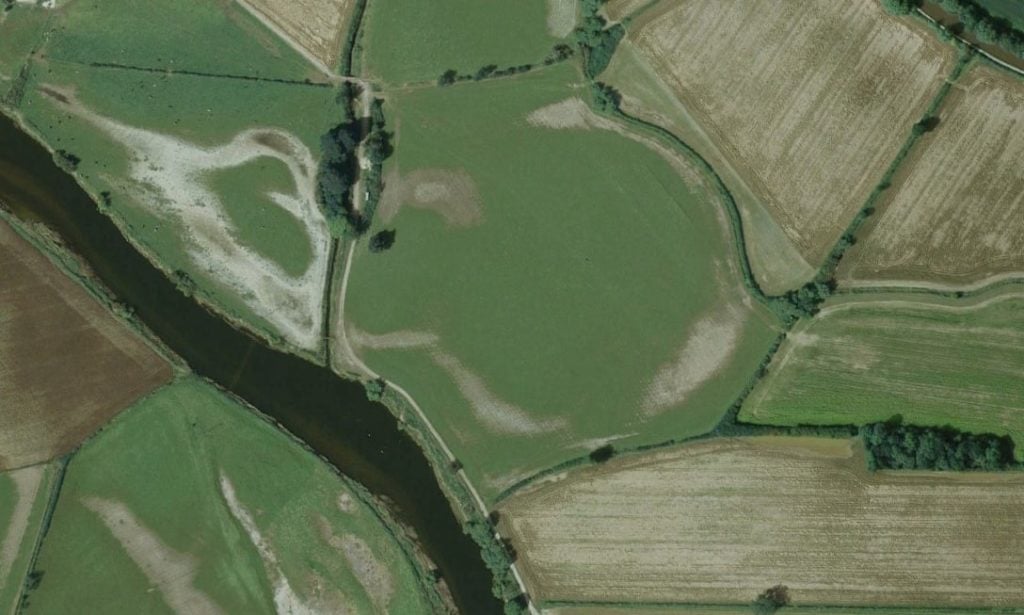
Wedding photographer Chris Sedden spotted what could possibly be traces of a newly discovered henge in the village of Swarkestone in south Derbyshire in an aerial photograph. 
Photo courtesy of Google Earth.

Excavations may be paused, but discoveries are still being made thanks to aerial photography and high-tech scans that are available online.

Excavations around the world have ceased activity as archaeologists observe widespread stay-at-home orders. But that didn’t stop a British wedding photographer from making an intriguing archaeological discovery of his own—without ever leaving his house.

Chris Sedden found himself out of work during the shutdown as government restrictions put an end to weddings and other large gatherings. But the break in his normal routine afforded Sedden the opportunity to put on his amateur archaeology hat and spend hours pouring over images of the terrain surrounding his home in southern Derbyshire.

As he scanned along the River Trent, near the village of Swarkestone, he noticed something strange. “I thought, ‘what’s that? It looks a bit odd, and a bit round,’” Sedden told the Guardian.

Read the rest of this article...
Climate change could unlock Ice Age bugs that spark the world’s next pandemic

Humans could be exposed to ‘eradicated’ or completely new microbes because of climate change thawing (Picture: Getty)

Dr Dennis Carroll – who appears in the Netflix documentary Pandemic – said we should be ‘should be exceedingly cautious about underestimating the potential threats’ that reborn germs could pose. Speaking exclusively to Metro.co.uk, Dr Carroll – dubbed ‘the man who saw the pandemic coming’ – also warned that diseases spread from wildlife should also be seen as a global health concern following the coronavirus outbreak. His intervention comes as scientists today published new research on how rising temperatures melting ‘permafrost’ Arctic soil could give a new lease of life to dormant microbes. Those bacteria and viruses, frozen for thousands of years, could potentially include diseases which humanity has previously ‘eradicated’ – and ones we have never encountered. Dr Carroll explained: ‘The world is faced with the very real prospect that ancient microbes which have long lay dormant beneath the frozen tundra will be given a new life with climate change and the thawing of the Arctic north. 

Read the rest of this article...
Study Examines Possible Medieval Longbow Wounds

(University of Exeter)

According to a statement released by the University of Exeter, an examination of bones and bone fragments led by archaeologist Oliver Creighton indicates that arrows shot from medieval longbows inflicted small entry and large exit wounds similar to those caused by modern bullets. The arrowheads that caused this damage may have been the “bodkin” type, which were square- or diamond-shaped and designed to pierce armor, Creighton explained. The bones, which were unearthed at a Dominican friary in southwest England, are thought to be the remains of warriors killed in battle at other locations. Their bones were later honored with reburial in holy ground.

Read the rest of this article...
Rewilding: lessons from the medieval Baltic crusades

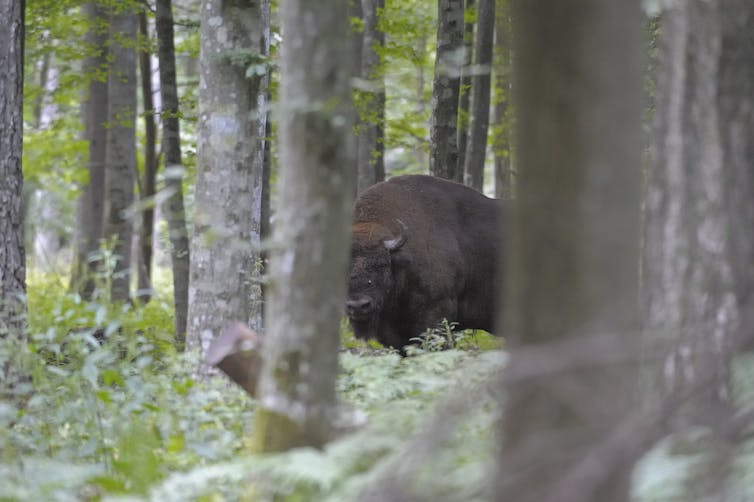
Bison in the forest of Białowieża. © Magnus Elander

The Forest of Białowieża, which straddles the border of Poland and Belarus, is unique in Europe: it is incredibly ancient. Woodland has been continuously present there for some 12,000 years. With the protection of 6059 hectares from human disturbance within the Polish national park, as well as the return of its iconic European bison herds from the brink of extinction, the forest is widely regarded as a model for restoring biodiversity or “rewilding”, which areas across Europe are trying to emulate.

Human memories are remarkably short – often only a generation or so. What we remember as “natural” landscape is often what we remember experiencing as a child. This makes conservation and landscape management particularly subject to “shifting baseline syndrome” – a psychological phenomenon which describes how each new generation accepts as natural or normal the situation in which it was raised. This means that significant time depth is rarely considered in future planning. But understanding environmental change, and planning for the future impact of our species, must include a long-term perspective.

There are ways around this. Archaeologists such as ourselves are uniquely placed to understand how fluctuations in human activity can affect the environment over much longer time periods. It is well known, for example, that our species’ mastery of farming enabled our populations to grow, with resulting deforestation and loss of biodiversity. This can be mapped through pollen coring, and the study of archaeological plant and animal remains. These techniques have become more precise in our lifetime, especially with advances in radiocarbon dating.

Read the rest of this article...

Stone Tools Show How Humans Survived a Supervolcano Eruption 74,000 Years Ago

(Chris Clor/Getty Images)

Of all the volcanic eruptions to shake our planet in the last 2 million years, the Toba super-eruption in Sumatra, Indonesia, was one of the most colossal. But it may not have been the global catastrophe we once thought it was.

The massive eruption happened roughly 74,000 years ago, spewing roughly 1,000 times as much rock as the 1980 eruption of Mt St Helens. For a while there, some thought the fall-out was so extreme, it triggered a decade-long "volcanic winter" and a millenia-long glacial period.

This so-called Toba catastrophe theory left the global human population with just a few thousand survivors. Except, that's probably an exaggeration.

In recent times, archaeological evidence in Asia and Africa has suggested that while the eruption was indeed tremendous, the consequences were not so apocalyptic after all, and it certainly didn't leave humans on the brink of extinction.

Now, an ancient and "unchanging" stone tool industry, uncovered at Dhaba in northern India, suggests instead that humans have been present in the Middle Son Valley for roughly 80,000 years, both before and after the Toba eruption.

Read the rest of this article...

Saturday, May 09, 2020

Dunwich – The medieval town lost at sea

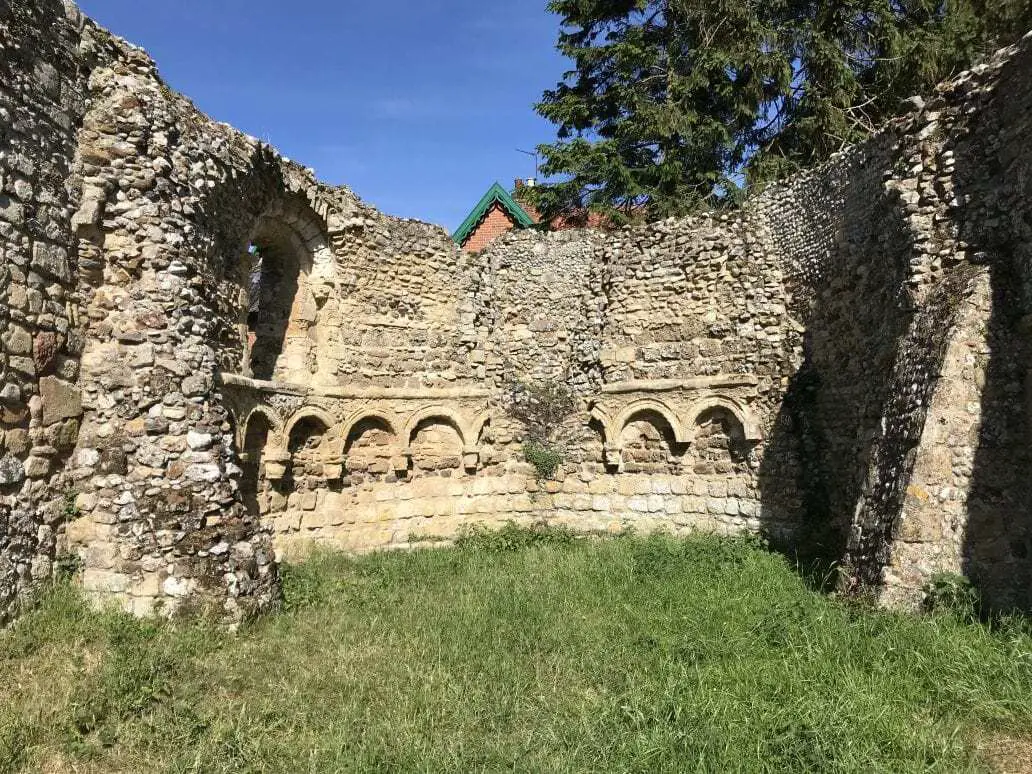
Chapel of St James’ Leper Hospital, Dunwich St James’ Hospital was a C12 leper hospital located just to the west of the medieval coastal town of Dunwich.

Dunwich is a small rural village located on the Suffolk coast in England. Visitors will find a quaint English pub, tea rooms and a pebble beach popular with holiday makers.
At first glance, there’s nothing overly remarkable about this picturesque setting, but beneath the surface Dunwich has a unique story to tell that spans centuries….

The earliest evidence of occupation around the Dunwich area starts in the Roman period, with scant but suggestive evidence of a large settlement. The Anglo-Saxon chronicler Bede referred to “Dunmoc” as a “Civitas”, with archaeological discoveries that includes a Roman tumulus and masonry trawled from the nearby seabed.

The Roman document, ‘Notilia Dignitatum’ even refers to a late Roman fort or station in the area, but due to the continual coastal erosion, any surviving remains of the fort or settlement would be hundreds of metres out to sea.

Read the rest of this article...

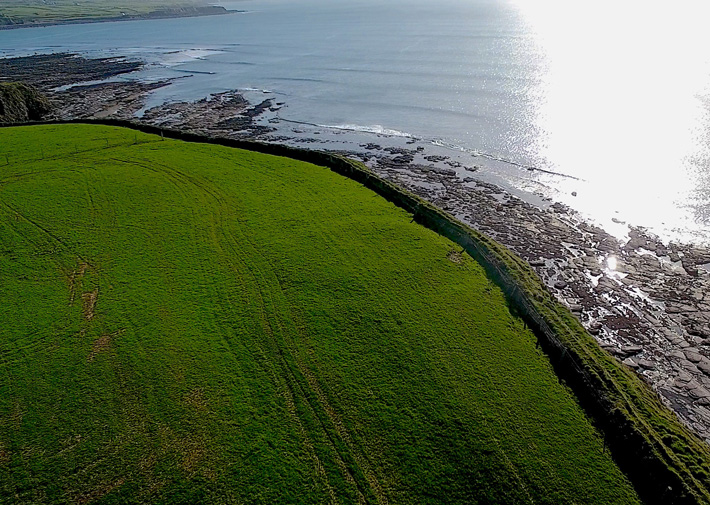
Previously unknown cliff ring fort discovered by drone operator in Clare

image: Matthew Kelly

A PREVIOUSLY UNKNOWN cliff ring fort has been discovered in Co Clare by a drone operator during the Covid-19 lockdown.

Matthew Kelly was operating a drone near Crag, Lahinch when he made the archaeological find.

His discovery came two years after he previously uncovered a group of 5000-year-old forts in Dundalk, Co Louth

Kelly’s latest find had not been previously recorded in the National Monuments Service (NMS) database, but has since been officially added.

Read the rest of this article...

Neanderthal Flute – Divje Babe Flute

The world’s oldest Musical Instrument – Divje Babe Flute

The Divje Babe Flute is made from the bone of a cave bear femur, and it is pierced by holes that have the spacing and alignment of a flute. It is possibly the world’s oldest known musical instrument, and some archeologists believe that Neanderthals made it.

Divje Babe is the oldest known archaeological site in Slovenia. The cave is 45 meters (148 ft) long and up to 15 meters (49 ft) wide and is near Cerkno and the Idrijca River in Slovenia.

Researchers have uncovered more than 600 archaeological items in at least ten levels, including twenty hearths and the skeletal remains of cave bears.

Read the rest of this article...

Neandertals were choosy about making bone tools


Evidence continues to mount that the Neandertals, who lived in Europe and Asia until about 40,000 years ago, were more sophisticated people than once thought. A new study from UC Davis shows that Neandertals chose to use bones from specific animals to make a tool for specific purpose: working hides into leather.

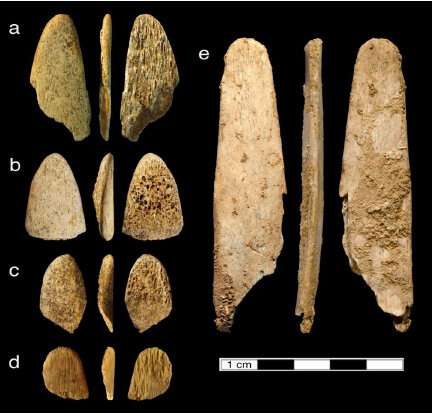
Naomi Martisius, research associate in the Department of Anthropology, studied Neandertal tools from sites in southern France for her doctoral research. The Neandertals left behind a tool called a lissoir, a piece of animal rib with a smoothed tip used to rub animal hides to make them into leather. These lissoirs are often worn so smooth that it's impossible to tell which animal they came from just by looking at them.

Martisius and colleagues used highly sensitive mass spectrometry to look at residues of collagen protein from the bones. The method is called ZooMS, or zooarchaeology by mass spectrometry. The technique breaks up samples into fragments that can be identified by their mass to charge ratio and used to reconstruct the original molecule.

Read the rest of this article...

Thursday, May 07, 2020

Cleethorpes teacher's Anglo-Saxon treasures sell for £30k

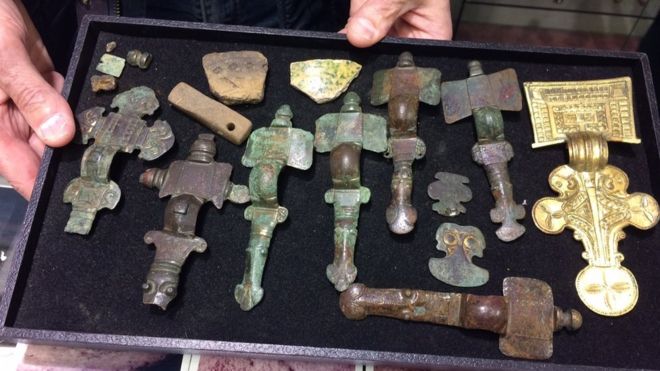
Hundreds of objects sold as part of the collection include spear heads, brooches and beads
HANSONS

Anglo-Saxon treasure unearthed by a history teacher in a field has sold for £30,000 at auction.

Gordon Taylor discovered the artefacts, which date back to 450 AD, in 1962 after finding a piece of bone in Irby-on-Humber, North East Lincolnshire.

It led to a 17-year excavation, in which items including a 1,000-year-old skull, jewellery, scissors and a spear head were also uncovered.

The 250-strong collection is believed to have been sold to a museum.

Mr Taylor, from Cleethorpes, died three years ago aged 88. His son Geoff said the family were "absolutely delighted" by the sale.

"I watched the sale live. I just called my mum and she is over the moon," he said.

He said he hoped the artefacts would be put "on public view".

Read the rest of this article...

Medieval arrows caused similar injuries to gunshots, say archeologists

A skull with a piercing arrow

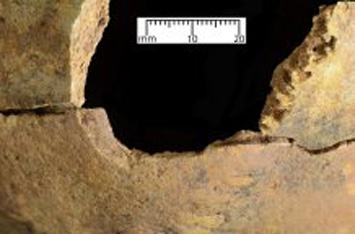
Medieval arrows caused injuries similar to modern gunshot wounds, according to archaeologists analysing newly-discovered human remains.

The bones, recovered from a Dominican friary in Exeter, show arrows fired from longbows could penetrate right through the human skull, creating small entry and large exit wounds.

The human skeletons examined as part of the study, who had possibly died in battle, had been moved from an original burial location elsewhere to this consecrated holy ground later.

Read the rest of this article...

Wednesday, May 06, 2020

Archaeologists have discovered unknown forts in Greater Poland

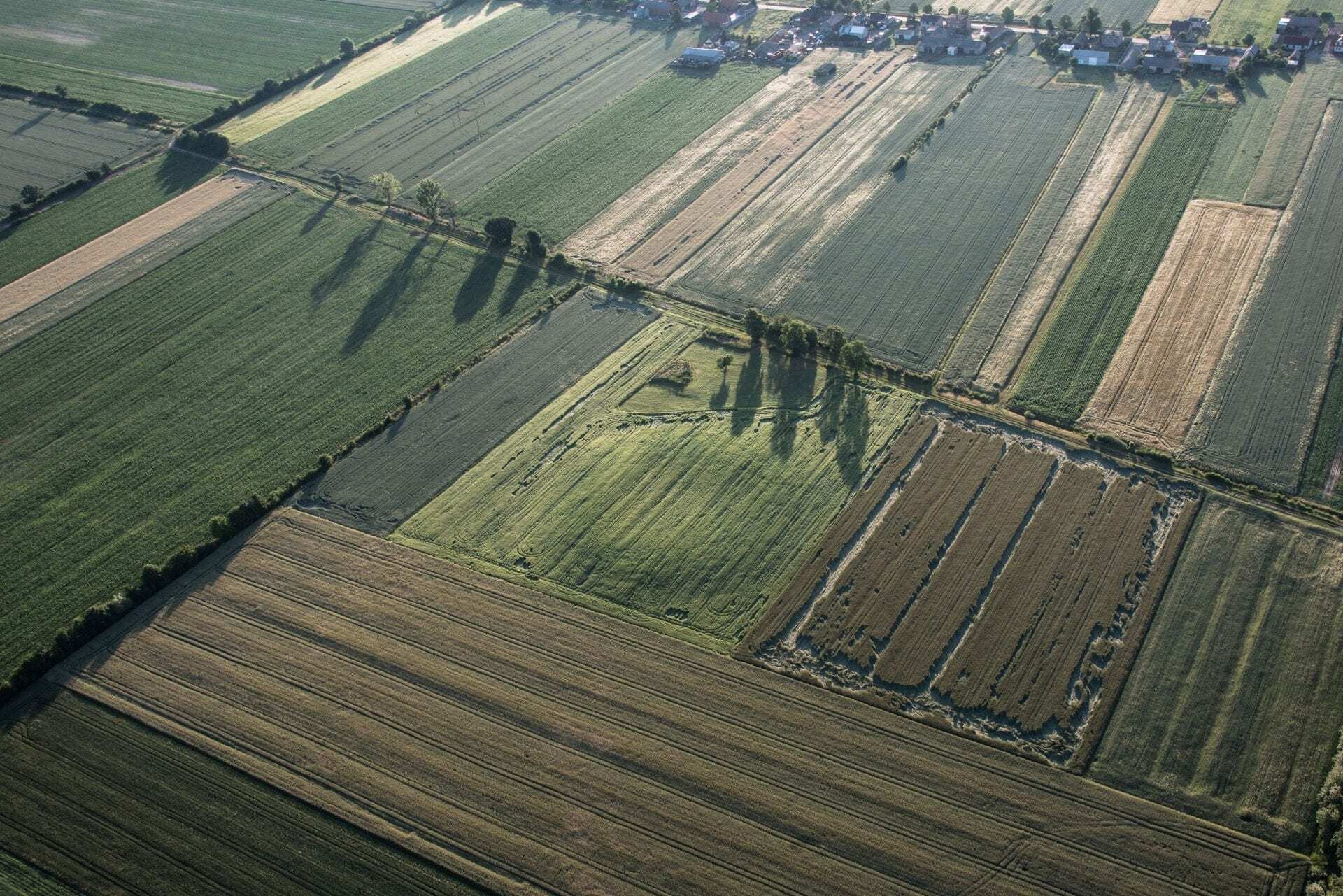
Taczanow Stonghold – Image Credit : Maksym Mackiewicz

Ten newly discovered forts have been revealed by archaeologists applying aerial photography and magnetic measurements in south-eastern Wielkopolska, Poland.
Several sites had been mentioned in historical literature, but their location had remained unknown, as many monuments in the region had been leveled in recent decades due to high levels of agricultural activity.

PAP project manager, archaeologist Maksym Mackiewicz said: “In the region, we have over one hundred forts of various forms from different periods. The discovery is a surprise because this area was quite well recognised in terms of archaeology. This is due to the availability of increasingly new methods we use.”

Most of the recently documented forts have been examined by archaeologists carrying out field observations. The research team found pottery sherds from various periods that date from the early Iron Age to the late Middle Ages.

Read the rest of this article...

Rome Sinkhole Makes Extraordinary Archaeological Find


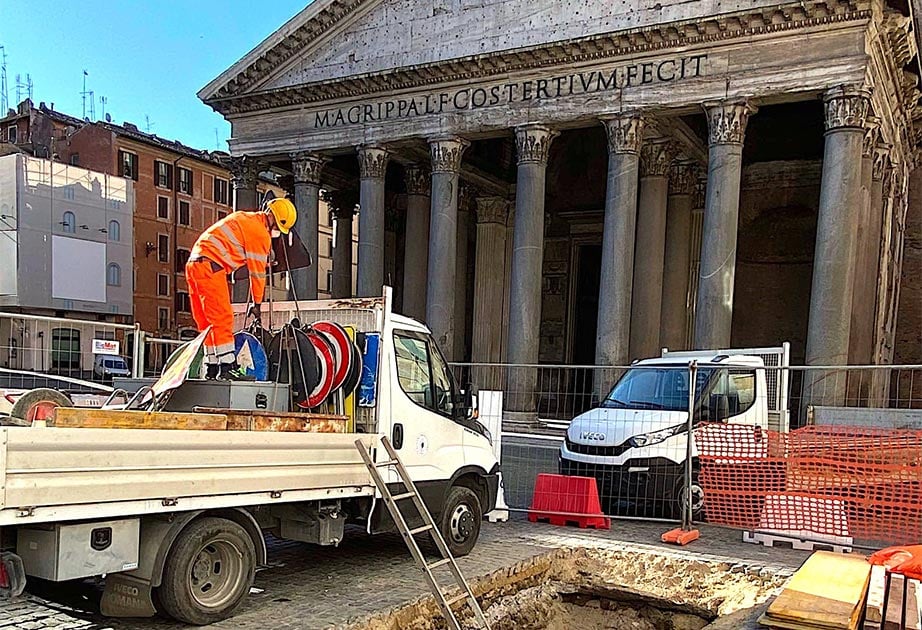
Another Rome sinkhole has appeared, this time, in front of the Pantheon in Piazza della Rotonda and in it, archaeologists have made the unexpected ‘rediscovery’ of an ancient imperial floor consisting of seven travertine slabs.

Built by Agrippa between 27 and 25 BC, the Piazza della Rotonda is a great square which opens out in front of the famous Pantheon, the temple dedicated to all the Roman gods , and this open social space was entirely transformed in the second century AD by the Emperor Hadrian , at which time the level of the piazza was raised and it was all repaved.

Archaeologists have reported finding ancient masonry about 2.5 meters (8.2 feet) beneath the existing level of the piazza, which was first uncovered during works in the 1990s, and after it had been documented by archaeologists at the time it was covered over. But now, more than two decades after its original discovery, the slabs of the ancient floor “emerge intact, protected by a layer of fine pozzolan,” said Daniela Porro, special superintendent of Rome in a Wanted In Rome article.

Read the rest of this article...

Archaeology offers clues to pandemic rebounds from the past


As the COVID-19 pandemic redefines what we think of as "normal," archaeology and ancient history can provide some consolation about the great adaptability of our species.

Flinders University archaeologist and ancient historian Dr. Ania Kotarba points to responses of extreme historical events that have threatened homo sapiens in the past as evidence that society—and the economy—can, and will, spring back again.

Dr. Kotarba researches global connectivity in the past through studying ancient international trade routes and human adaptation to extreme change.

She says the processes of urbanization, population growth and proto-globalization in the ancient world initially allowed outbreaks of infectious diseases and epidemics. These often surprisingly resulted in boosting the economy.

Read the rest of this article...

Where and When Did Humans Domesticate Horses?


In the increasingly urbanized world, few people still ride horses for reasons beyond sport or leisure. However, on horseback, people, goods and ideas moved across vast distances, shaping the power structures and social systems of the premechanized era. From the trade routes of the Silk Road or the great Mongol Empire to the equestrian nations of the American Great Plains, horses were the engines of the ancient world.

Where, when and how did humans first domesticate horses?

Tracing the origins of horse domestication in the prehistoric era has proven to be an exceedingly difficult task. Horses – and the people who care for them – tend to live in remote, dry or cold grassland regions, moving often and leaving only ephemeral marks in the archaeological record. In the steppes, pampas and plains of the world, historic records are often ambiguous or absent, archaeological sites are poorly investigated and research is published in a variety languages.

At the heart of the issue is a more basic struggle: How can you distinguish a “domestic” animal from its wild cousin? What does it even mean to be “domesticated”? And can scientists trace this process in archaeological sites that are thousands of years old and often consist of nothing more than piles of discarded bones?

Read the rest of this article...

Everything you wanted to know about Roman Britain – but were afraid to ask


In a recent podcast interview with Dr Miles Russell, we tackled the top questions about the four centuries of Roman rule in Britain…

How long were the Romans in Britain? How did they make their mark? And why did they leave? As part of our recent ‘Everything you need to know’ podcast series, we sat down with historian Dr Miles Russell to find out more about the popular historical period. Tackling questions submitted by our readers, and the top queries posed to the internet, Miles explored everything you ever wanted to know…

Read the rest of this article...