Monday, July 29, 2019

Slovakia/Thousands of years old traces of human presence found in Tatra cave


Source: Prof. Paweł Valde-Nowak

Researchers including Polish archaeologists discovered 14-15 thousand years old traces of human presence in the Hučava Cave in the Belianske Tatras. These are stone blades used by hunters. Until now, no prehistoric items have been found in any of the Tatra caves.

The discovery was made in July by a Slovak-Polish archaeological expedition. The Hučava Cave (Hučivá diera) is located in the Belianske Tatras in Slovakia, on the slopes of Kobylí Vrch, at 937 m a.s.l. Excavations are being carried out both at the entrance and in the cavern chamber.

"We have discovered dozens of stone blades that have survived completely or in fragments, originally embedded on poles (that have not survived until our time). We recovered some of the blades from the remnants of a hearth" - says Prof. Paweł Valde-Nowak from the Institute of Archaeology of the Jagiellonian University in Kraków. Valde-Nowak leads the research project together with Dr. Marian Sojak from the Institute of Archaeology of the Slovak Academy of Sciences in Nitra.


Read the rest of this article...

10,000-year-old engraved 'pebble' found near Rome said to be earliest known lunar calendar

The 10,000-year-old pebble which is believed to be the oldest lunar calendar in the world
[Credit: Sapienza Universita di Roma]

The oldest known lunar calendar may be an engraved pebble dating back to the Upper Palaeolithic found in Velletri, in the Alban Hills, south of Rome. The news has been announced by Flavio Altamura, a researcher at the Department of Antiquities of Sapienza University, who analyzed this enigmatic object in collaboration with the Superintendency for Archaeology, Fine Arts and Landscape in the Rome Metropolitan Area, the Province of Viterbo and Southern Etruria. The results of this study have been published in the Journal of Archaeological Science: Reports.

"The study reveals," explains Flavio Altamura, "that the notches were made over time using more than one kind of sharp cutting stone tool, as if they had been used for counting and calculating, or to store some kind of information over a period of time.”

Read the rest of this article...

Sunday, July 28, 2019

Finds from Celtic grave found in Zurich analyzed

Reconstruction of the grave with tree coffin [Credit: Amt für Städtebau, City of Zurich]

The tree coffin burial of a Celtic woman, which was discovered in March 2017 during construction work on the Kern school building, was examined by the Archaeology City of Zurich in an interdisciplinary evaluation. The bones and the unusual burial objects were carefully documented, salvaged, preserved and evaluated. Thus the grave can be assigned to the Late Iron Age around 200 BC. Of the artefacts that have been found, a string of glass beads in particular is unique in its form: it is fastened between two fibulae (clasps) and fitted with precious glass and amber beads.

The now completed interdisciplinary evaluation of the archaeology department of the city of Zurich paints a fairly accurate picture of the deceased. The examination of the skeleton and especially the teeth shows, among other things, that she died at the age of about 40, did little physical work during her lifetime and probably ate a relatively large amount of starchy or sweetened food.

Read the rest of this article...

Royalty theory to 'brutally-killed' Rosemarkie Man

The Pictish man's skeleton was discovered during a cave excavation in the Black Isle 
Rosemarkie Caves Project

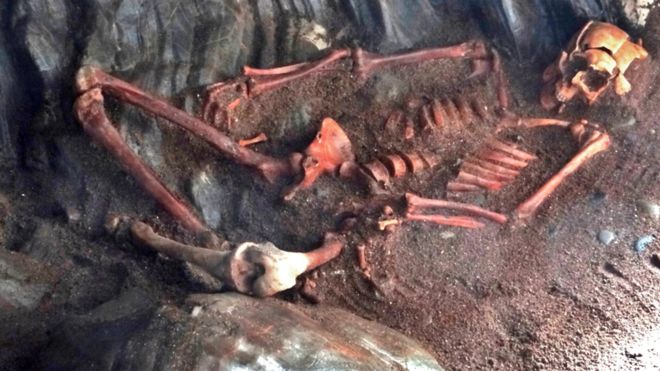
A Pictish man who was "brutally killed" 1,400 years ago could have been royalty, say researchers.

Archaeologists found the man's skeleton buried in a recess of a cave at Rosemarkie in the Black Isle.

In 2017, scientists made a facial reconstruction of the man during a forensic examination of his remains, which found he had severe injuries.

New analysis has shown he had a high-protein diet suggesting he ate foods enjoyed by people of high status.

The Pict was discovered in a cross-legged position with stones weighing down his limbs while his head had been battered multiple times.

Read the rest of this article...
Seltene Brandgräber aus der Steinzeit bei Wedringen


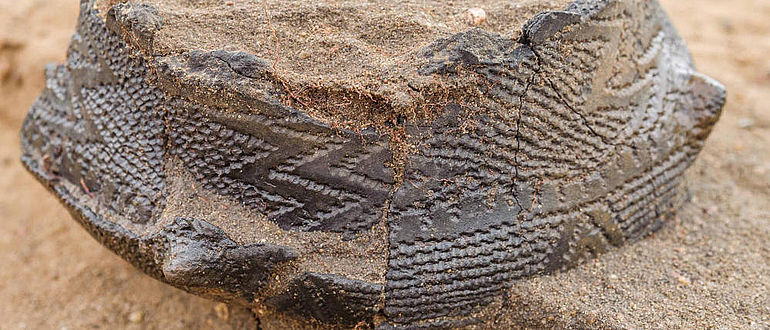
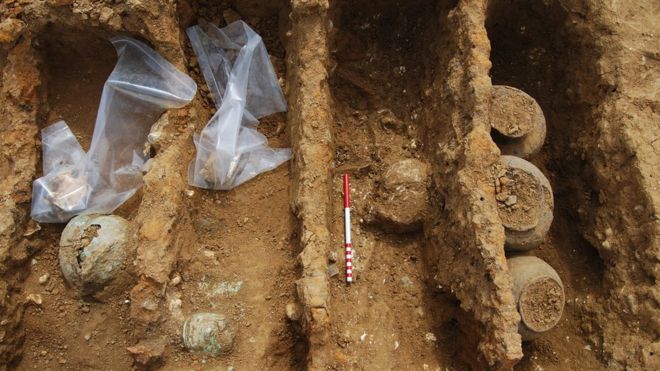
Im Zuge des Neubaus der Ortsumfahrung bei Wedringen, Ortsteil von Haldensleben, Ldkr. Börde, führt das Landesamt für Denkmalpflege und Archäologie Sachsen-Anhalt (LDA) derzeit archäologische Ausgrabungen durch. Auf dem aktuellen Abschnitt der Grabungsfläche wurden seltene Brandgräber der Rössener Kultur (ca. 6600–6450 vor heute) entdeckt. Die etwa 25 Grabgruben sind an der dunklen, aschigen Verfüllung gut in dem sie umgebenden Boden erkennbar. Als Beigaben in den Gräbern sind reich verzierte Gefäße sowie Beile und Äxte aus Felsgestein zu finden. Im näheren Umfeld der Brandbestattungen und ohne erkennbaren Befundzusammenhang deponierte Keramikgefäße lassen an ein noch nicht näher zu definierendes Ritual während der Bestattungszeremonie denken.

Read the rest of this article...

Rare relics of an Iron Age warrior who fought the Romans

The helmet and crest of the Iron Age warrior. Photo Allan HutchingsPhotography

As the Novium in Chichester prepares to display the late Iron Age Bersted Warrior and his possessions in January 2020, we talk to archaeologist James Kenny about one of the most spectacular warrior burials ever found in Britain

When archaeologists arrived to investigate a grave discovery on the site of a new housing development near Chichester in West Sussex, they had little idea what was awaiting them.

A large scale archaeological excavation had been taking place ahead of the development in 2008 at North Bersted, and when the grave was uncovered Chichester District Council’s archaeologist, James Kenny, was one of the first people to view it.

Read the rest of this article...
Iron Age warrior's remains to go on show in Chichester


The grave contained "significant" artefacts
Chichester District Council

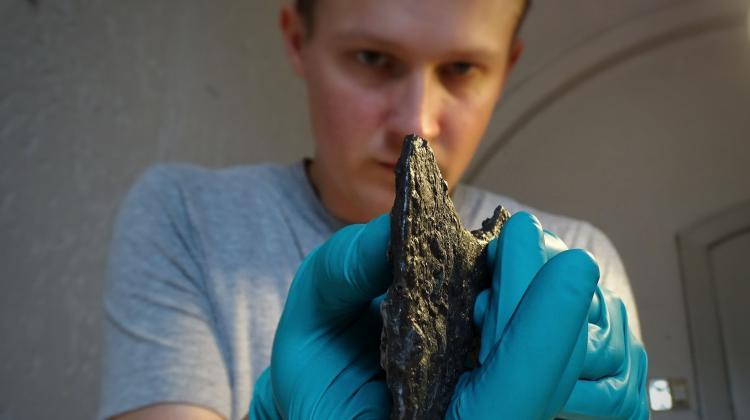
The remains of an Iron Age warrior and his possessions - hailed as a "spectacular discovery" by archaeologists - are to go on display.

Weaponry and other artefacts were found alongside the ancient fighter during excavations at a site near Chichester, West Sussex.

It is thought the grave belonged to someone of high status.

The man, who may have fought alongside a Roman king, will be the centre-piece of an exhibition at a city museum.

A team from Thames Valley Archaeological Services found the grave on land at North Bersted, near Bognor Regis, in 2008.

Read the rest of this article...

Grave of 'real-life Asterix' who fought Caesar found amid trove of weapons and possessions in West Sussex

'Unique find': the artefacts have been carefully studied for the last decade CREDIT: PA

The grave of a real-life Asterix containing what is believed to be an ancient Gallic warrior who came to Britain and fought Julius Caesar has been discovered, archaeologists have announced.

The unique and highly-elaborate resting place was found on a West Sussex building site.

The Iron Age warrior, buried with his glamorous and ornate head-dress, is thought to have been a refugee French Gallic fighter who fled Julius Caesar's legionnaires as they swept across continental Europe in about 50BC.

Archaeologists have described the discovery, which will go on display at Chichester's Novium Museum in January 2020, as "the most elaborately equipped warrior grave ever found in England".

Read the rest of this article...
Tuesday, July 23, 2019

Polish researcher identified possible grave of Slavic warrior woman in Denmark

Dr. Leszek Gardeła examining the axe found in a woman's grave in western Norway. 
                                                            Photo by Mira Fricke.

 Possible grave of a Slavic warrior woman has been identified by Dr. Leszek Gardeła. Archaeologists discovered it many years ago in the Viking cemetery on the Danish island of Langeland. But until now they did not notice a typical Slavic axe.

Militant Viking women have been popularised in recent years in mass culture by the popular TV series Vikings. Dr. Leszek Gardeła from the Department of Scandinavian Languages and Literatures at the University of Bonn decided to take a closer look at this little researched issue.

According to the researcher, both the form of the burial - a chamber grave with an additional coffin - and the discovered weapon suggest that the deceased woman could originate from the territory of present-day Poland, therefore she could be a Slav. It is known that the burial is just over a thousand years old, as evidenced by an Arab coin from the 10th century found in the grave. The scientist emphasizes that it was the only grave in this cemetery that contained weapons.

Read the rest of this article...
Were the Vikings Smoking Pot While Exploring Newfoundland?

The L'Anse aux Meadows archaeological site is the only confirmed Viking settlement in Newfoundland.
Credit: Yves Marcoux/First Light/Getty Images Plus

The discovery of cannabis pollen near a Viking settlement in Newfoundland raises the question of whether the Vikings were smoking or eating pot while exploring North America.

The researchers also found evidence the Vikings occupied this outpost for more than a century, way longer than previously believed.

Located in northern Newfoundland, the site of L'Anse aux Meadows was founded by Vikings around A.D. 1000. Until now, archaeologists believed that the site was occupied for only a brief period. The new research, published today (July 15) in the journal Proceedings of the National Academy of Sciences, suggests that the Vikings lived there possibly into the 12th or even the 13th century.

Read the rest of this article...
Isle of Man Round Mounds: 'Spectacular' 4,000-year-old jet necklace found

Sand on the beads from the burial site will be removed as part of the conservation process
MNH

A 4,000-year-old necklace has been uncovered during an archaeological dig on the Isle of Man.

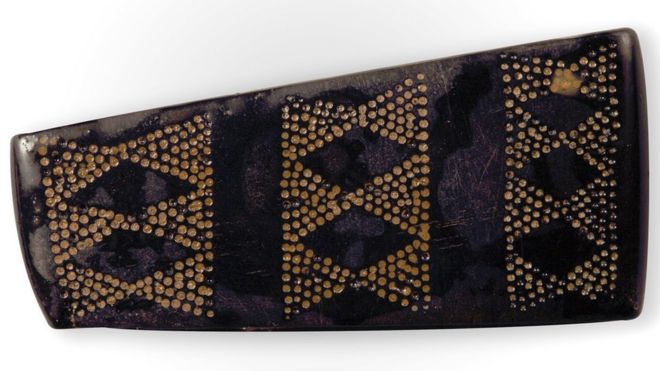
The piece of jewellery, found in the west of the island, is made up of 122 "intricately" decorated jet beads each measuring between 1cm and 5cm.

Thought to have originated in Whitby, North Yorkshire it is the first of its kind to be found on the Isle of Man.

When fully assembled, the necklace was crescent-shaped and made from multiple strings.

Read the rest of this article...
'Important' Iron Age settlement found at Warboys dig

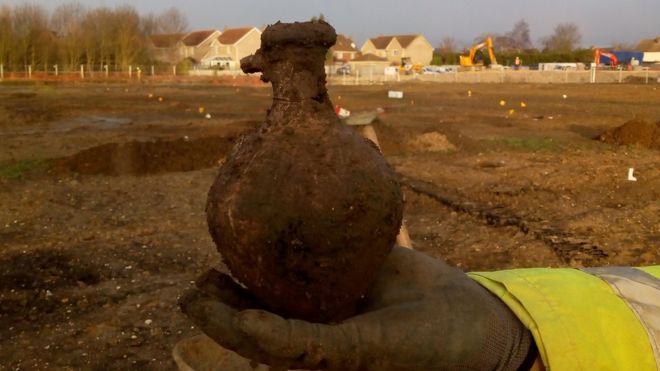
Roman finds include this jug and human remains, including six skeletons
Oxford Archaeology East

Iron Age roundhouses, Roman burials and Saxon pottery have been discovered in a "hugely important and hitherto unknown settlement".

The seven month-long dig in Warboys in Cambridgeshire also uncovered "a rare example" of "early Saxon occupation mingled with the latest Roman remains".

Archaeologist Stephen Macaulay said: "We almost never find actual physical evidence of this."

The settlement reverted to agricultural use after the 7th Century.

"What makes this site really significant is we have evidence of early Saxon occupation mingled with the latest Roman remains," said Mr Macaulay, deputy regional manager for Oxford Archaeology East.

Read the rest of this article...

ootball UK politics Environment Education Society Science Tech Global development Cities Obituaries Archaeology Mystery of Chedworth's 1,800-year-old Roman glass shard solved


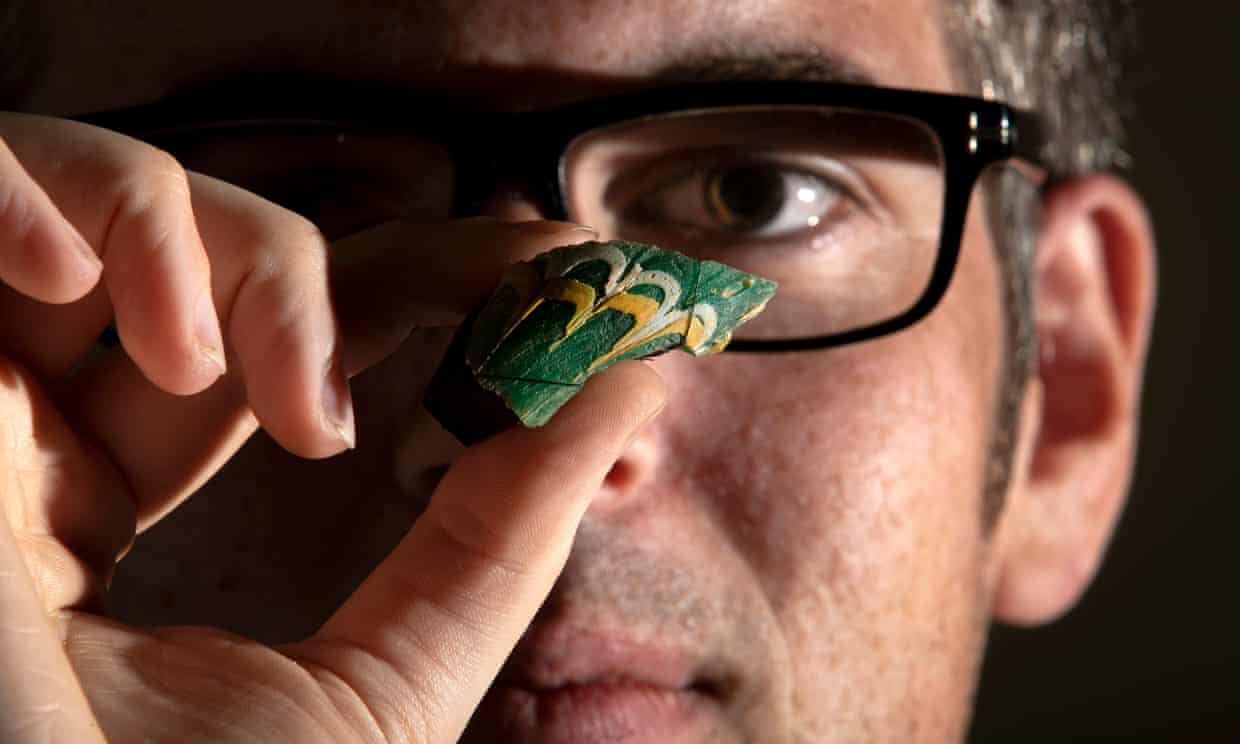
The fragment from the Roman fish bottle, the only one of its type ever discovered in Britain. Photograph: National Trust/Rod Kirkpatrick/F Stop Press 

Find sheds fresh light on wealth and influence of ex-inhabitants of National Trust property
A fragment from a Roman bottle so exceptionally rare that it has taken glass experts from around the world two years to conclusively identify it has been discovered thousands of miles from where it was made.

The discovery at Chedworth Roman Villa in Gloucestershire of the small shard of patterned green glass, part of an 1,800-year-old fish bottle, has astonished archaeologists.

Nothing like it has ever been found in Britain. It would have been made in an area around the Black Sea in what is now Ukraine and was possibly used to hold exotic perfume.

For it to travel all the way from the Black Sea to the Cotswolds sheds new light on the wealth and influence of the people who occupied Chedworth, a National Trust property regarded as one of the grandest Roman villas in Britain.


Read the rest of this article...
Pompeii row erupts between rival scientific factions

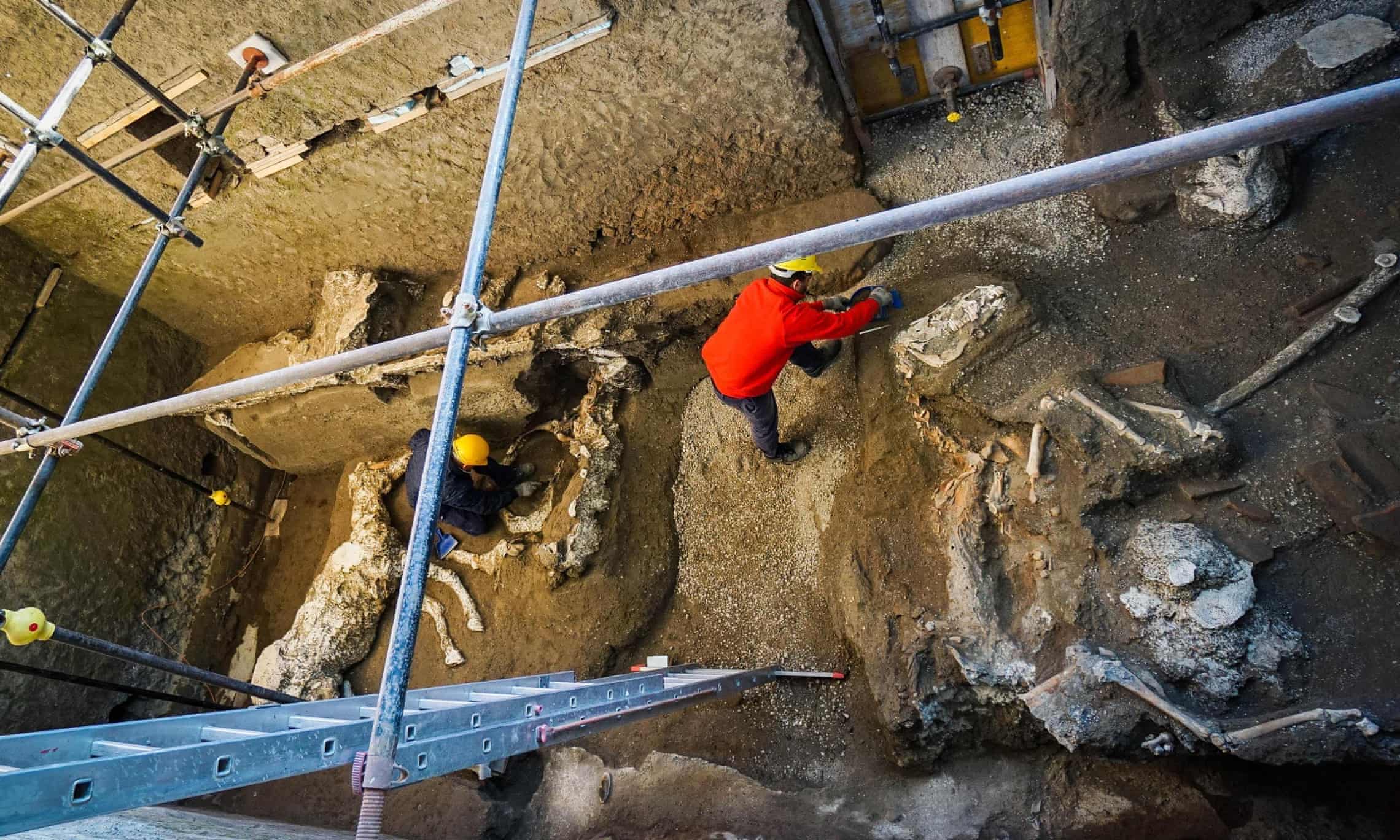
 Archaeologists at work in Pompeii. Volcanologists complain they have been barred from accessing certain areas of the world heritage site. Photograph: Cesare Abbate/AP

Volcanologists say excavations by archaeologists are destroying useful clues about lava flow

 
It is one of the most ambitious archaeological missions ever undertaken. The Great Pompeii Project promises remarkable discoveries about life in the Roman empire, including the genetic profiles of the town’s inhabitants, their dining preferences, occupations and health.

But as layers of volcanic rock are chipped away to uncover the secrets that lie below, not everyone is celebrating. Volcanologists say the excavation risks destroying clues about the AD79 eruption that could be crucial for protecting the 600,000 people who live in the shadow of Vesuvius today.


After years of simmering tensions, a row has broken out between the two scientific factions, and volcanologists published an open letter in the journal Nature this month criticising the “alarming” destruction of volcanic deposits.

Read the rest of this article...

Friday, July 19, 2019

Stone tool changes may show how Mesolithic hunter-gatherers responded to changing climate

Reconstruction of a Mesolithic camp-site with a hunter in the front ready to fire an arrow
 mounted with stone microliths [Credit: Ulco Glimmerveen]

The development of new hunting projectiles by European hunter-gatherers during the Mesolithic may have been linked to territoriality in a rapidly-changing climate, according to a study published in the open-access journal PLOS ONE by Philippe Crombé from Ghent University, Belgium.

As a result of warming occurring at a rate of ca. 1.5 to 2°C per century, hunter-gatherers in Europe during the Mesolithic era (approximately 11,000-6,000 years ago) experienced significant environmental changes, very similar to the ones we face today: rising sea levels, increased drought, plant and animal migrations and wildfires. Here, Crombé examined microliths, small stone arrowheads/barbs used in hunting, to see how their design and usage by Mesolithic hunter-gatherers shifted in conjunction with climatic and environmental changes.

Building on archaeological research from the last two decades, Crombé used Bayesian modelling to reveal potential correlations between 228 radiocarbon dates specific to Mesolithic sites along the southern North Sea basin and the different types and shapes of microliths (triangles, crescents, leaf-shaped and mistletoe-shaped microliths, trapezes, etc.) found at these sites.

Read the rest of this article...

Thursday, July 18, 2019

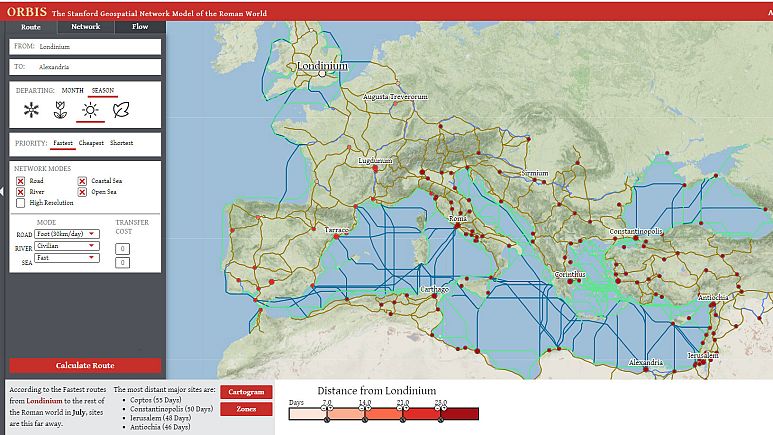
Travel back in time with the 'Google Maps' of Ancient Rome


Summer is now well-underway across Europe and many of us are planning our holiday escape with travel comparison websites and web mapping services.

Low-cost air carriers, fast trains, and cross-national motorways have made travelling across the Old Continent a quick and often cheap affair. But let's imagine that cars, trains and planes haven't been invented yet and that your options are limited to ox or mule cart and ships.

–– ADVERTISEMENT ––
Researchers at Stanford University have used modern technology to answer by creating a web mapping version of Ancient Rome.

Their model, called ORBIS, consists of 632 sites spread across 10 million square kilometres of terrestrial and maritime space, covering most of modern Western Europe and the Mediterranean coast in North Africa and the Middle East.

The tool generates solutions for travel between any two sites depending on specific means and mode of transport and the months of the year, providing different options based on time and expense.

Read the rest of this article...

Ancient Roman port history unveiled

A team of international researchers led by La Trobe University and the University of Melbourne have, for the first time worldwide, applied marine geology techniques at an ancient harbour archaeological site to uncover ancient harbour technologies of the first centuries AD  [Credit: La Trobe University]

Researchers successfully reconstructed anthropic influences on sedimentation, including dredging and canal gates use, in the ancient harbour of Portus - a complex of harbour basins and canals that formed the hub of commerce in the capital of the Roman Empire.

The findings suggest that the Romans were proactively managing their river systems from earlier than previously thought - as early as the 2nd century AD.

The history was reconstructed using a range of high-resolution sediment analysis including piston coring, x-ray scanning, radiocarbon dating, magnetic and physical properties and mineral composition of the ancient harbour sediments.

Read the rest of this article...

Archaeology Anthropology Palaeontology Evolution Exhibitions Natural Heritage Astronomy Out of Africa and into an archaic human melting pot

A map showing where the ancestors of modern humans appear to have met and mixed
with archaic hominins [Credit: University of Adelaide]

Genetic analysis has revealed that the ancestors of modern humans interbred with at least five different archaic human groups as they moved out of Africa and across Eurasia.


While two of the archaic groups are currently known - the Neanderthals and their sister group the Denisovans from Asia ¬- the others remain unnamed and have only been detected as traces of DNA surviving in different modern populations. Island Southeast Asia appears to have been a particular hotbed of diversity.

Published in the Proceedings of the National Academy of Sciences, researchers from the University of Adelaide's Australian Centre for Ancient DNA (ACAD) have mapped the location of past "mixing events" (analysed from existing scientific literature) by contrasting the levels of archaic ancestry in the genomes of present-day populations around the world.


Read the rest of this article...

Maternal secrets of our earliest ancestors unlocked

Australopithecus africanus impression by Jose Garcia and Renaud Joannes-Boyau, Southern Cross University
[Credit: Jose Garcia and Renaud Joannes-Boyau, Southern Cross University]

Analysis of more than two-million-year-old teeth from Australopithecus africanus fossils found in South Africa have revealed that infants were breastfed continuously from birth to about one year of age. Nursing appears to continue in a cyclical pattern in the early years for infants; seasonal changes and food shortages caused the mother to supplement gathered foods with breastmilk. An international research team led by Dr Renaud Joannes-Boyau of Southern Cross University, and by Dr Luca Fiorenza and Dr Justin W. Adams from Monash University, published the details of their research into the species in the journal Nature.

"For the first time, we gained new insight into the way our ancestors raised their young, and how mothers had to supplement solid food intake with breastmilk when resources were scarce," said geochemist Dr Joannes-Boyau from the Geoarchaeology and Archaeometry Research Group (GARG) at Southern Cross University.

"These finds suggest for the first time the existence of a long-lasting mother-infant bond in Australopithecus. This makes us to rethink on the social organisations among our earliest ancestors," said Dr Fiorenza, who is an expert in the evolution of human diet at the Monash Biomedicine Discovery Institute (BDI)
Read the rest of this article...

Stonehenge may have been built using pig fat

Fat residues on shards of pottery found at Durrington Walls, near Stonehenge, have long been assumed to be connected with feeding the many hundreds of people that came from across Britain to help construct the ancient monument.
But, new analysis by archaeologists at Newcastle University, UK, suggests that because the fragments came from dishes that would have been the size and shape of buckets, not cooking or serving dishes, they could have been used for the collection and storage of tallow—a form of animal fat.

Dr. Lisa-Marie Shillito, Senior Lecturer in Landscape Archaeology, Newcastle University, said: "I was interested in the exceptional level of preservation and high quantities of lipids—or fatty residues—we recovered from the pottery. I wanted to know more about why we see these high quantities of pig fat in pottery, when the animal bones that have been excavated at the site show that many of the pigs were 'spit roasted' rather than chopped up as you would expect if they were being

Read the rest of this article...