Sunday, July 30, 2017

Bronze Age Iberia received fewer Steppe invaders than the rest of Europe

Archaeological remains of individual MC337 excavated from the site of Hipogeu de Monte Canelas I, Portugal, and analysed by the archaeologist Rui Parreira and the anthropologist Ana Maria Silva.
Credit: Rui Parreira

The genomes of individuals who lived on the Iberian Peninsula in the Bronze Age had minor genetic input from Steppe invaders, suggesting that these migrations played a smaller role in the genetic makeup and culture of Iberian people, compared to other parts of Europe. Daniel Bradley and Rui Martiniano of Trinity College Dublin, in Ireland, and Ana Maria Silva of University of Coimbra, Portugal, report these findings July 27, 2017 in PLOS Genetics.
Between the Middle Neolithic (4200-3500 BC) and the Middle Bronze Age (1740-1430 BC), Central and Northern Europe received a massive influx of people from the Steppe regions of Eastern Europe and Asia. Archaeological digs in Iberia have uncovered changes in culture and funeral rituals during this time, but no one had looked at the genetic impact of these migrations in this part of Europe. Researchers sequenced the genomes of 14 individuals who lived in Portugal during the Neolithic and Bronze Ages and compared them to other ancient and modern genomes. In contrast with other parts of Europe, they detected only subtle genetic changes between the Portuguese Neolithic and Bronze Age samples resulting from small-scale migration. However, these changes are more pronounced on the paternal lineage.
Read the rest of this article...

Malaria already endemic in the Mediterranean by the Roman period

Malaria was already widespread on Sardinia by the Roman period, long before the Middle Ages, as indicated by research at the Institute of Evolutionary Medicine of the University of Zurich with the help of a Roman who died 2,000 years ago.
Even today, Malaria is one of the greatest medical challenges worldwide, killing hundreds of thousands of people every year. In the past, people have adapted to the threat of malaria in various ways. These methods range from interventions in the environment like draining swamps, to genetic adaptations in the human body.

Read the rest of this article...

Tomb depicting famous gladiator brawl discovered in Pompeii


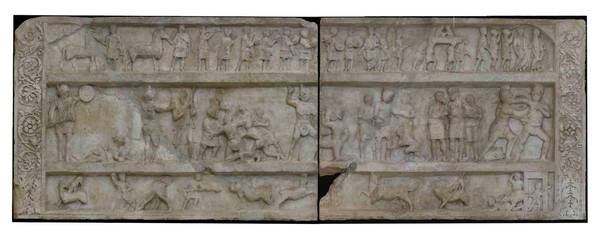
A brawl between gladiators that ended in tragedy, narrated by Tacitus, and a mysterious character that probably died in it is a 2,000-year-old mystery of Pompeii brought to light by a marble monumental tomb with the longest funerary epigraph ever found. The excavation was connected with the rehabilitation of state-owned property as part of the Great Pompeii Project in the San Paolino area near Porta Stabia, one of the accesses to the ancient city.

The tombstone was made shortly before the eruption that destroyed Pompeii in 69 AD and was presented on Thursday in the archaeological area. The inscription is over 4 meters long, in seven narrative registers, and though it does not include the deceased's name, it describes in detail the major events in the life of the man buried within it: from the acquisition of the 'toga virilis' to his wedding, and describes the munificent activities that accompanied such events such as public banquets, largess, the holding of gladiatorial games and battling large beasts.


Read the rest of this article...

Medieval men were diagnosed with infertility and prescribed treatments

Some medieval medical books had unusual advice to help improve men’s fertility. 
Credit: University of Exeter

Men could be held responsible for the failure to produce children as far back as medieval times, a new study of medical and religious texts has shown.

The analysis of popular medical and religious books by the University of Exeter shows that from the 13th century, widely-circulated medical texts recognised the possibility of male infertility, including sterility and 'unsuitable seed'.

A urine test to determine if a husband or a wife was to blame for the absence of children in a marriage was even devised, and medical recipes drawn up as a treatment for men.

Read the rest of this article...

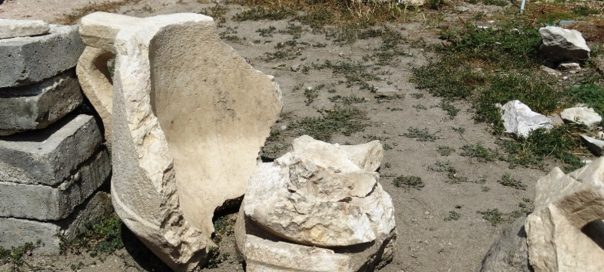
Archaeology: Ancient stone baptismal vessel found at Plovdiv’s Episcopal Basilica site


A team of archaeologists coming to the close of a 10-month project at Plovdiv’s Episcopal Basilica site have found a stone baptismal vessel given to the basilica by a Bishop Makedonii, possibly dating from some time in the fifth century.
The 10-month archaeological excavations at the 2500 square metre site come to a close this week, and it is expected that early in the week beginning on July 31, the site will be visited by a commission from the Ministry of Culture.
Archaeological team leader Zheni Tankova expressed thanks to the America for Bulgaria Foundation, which together with Plovdiv municipality “gave the opportunity to reveal this truly amazing monument of architecture, culture, art and religion”.
Read the rest of this article...

16th century copy of Hesiod examined with different imaging techniques by Northwestern researchers 
[Credit: Emeline Pouyet]

After being hidden for centuries, the secrets within medieval manuscripts might soon come to light. By fusing two imaging techniques — visible hyperspectral imaging and x-ray fluorescence — an interdisciplinary team of Northwestern University researchers has developed a new, non-destructive technology that gives access to medieval texts hidden inside of ancient bookbindings.

Between the 15th and 18th centuries, bookbinders recycled the bindings from medieval parchments into new binding materials for printed books. While scholars have long been aware that books from this time period often contain hidden fragments of earlier manuscripts, they never had the means to read them.

“For generations, scholars have thought this information was inaccessible, so they thought, ‘Why bother?’” said Marc Walton, senior scientist at the Northwestern University-Art Institute of Chicago Center for Scientific Studies (NU-ACCESS). “But now computational imaging and signal processing advances open up a whole new way to read these texts.”

Read the rest of this article...

Thursday, July 27, 2017

Amazingly well preserved 3,500-year-old lunch box discovered in Swiss Alps

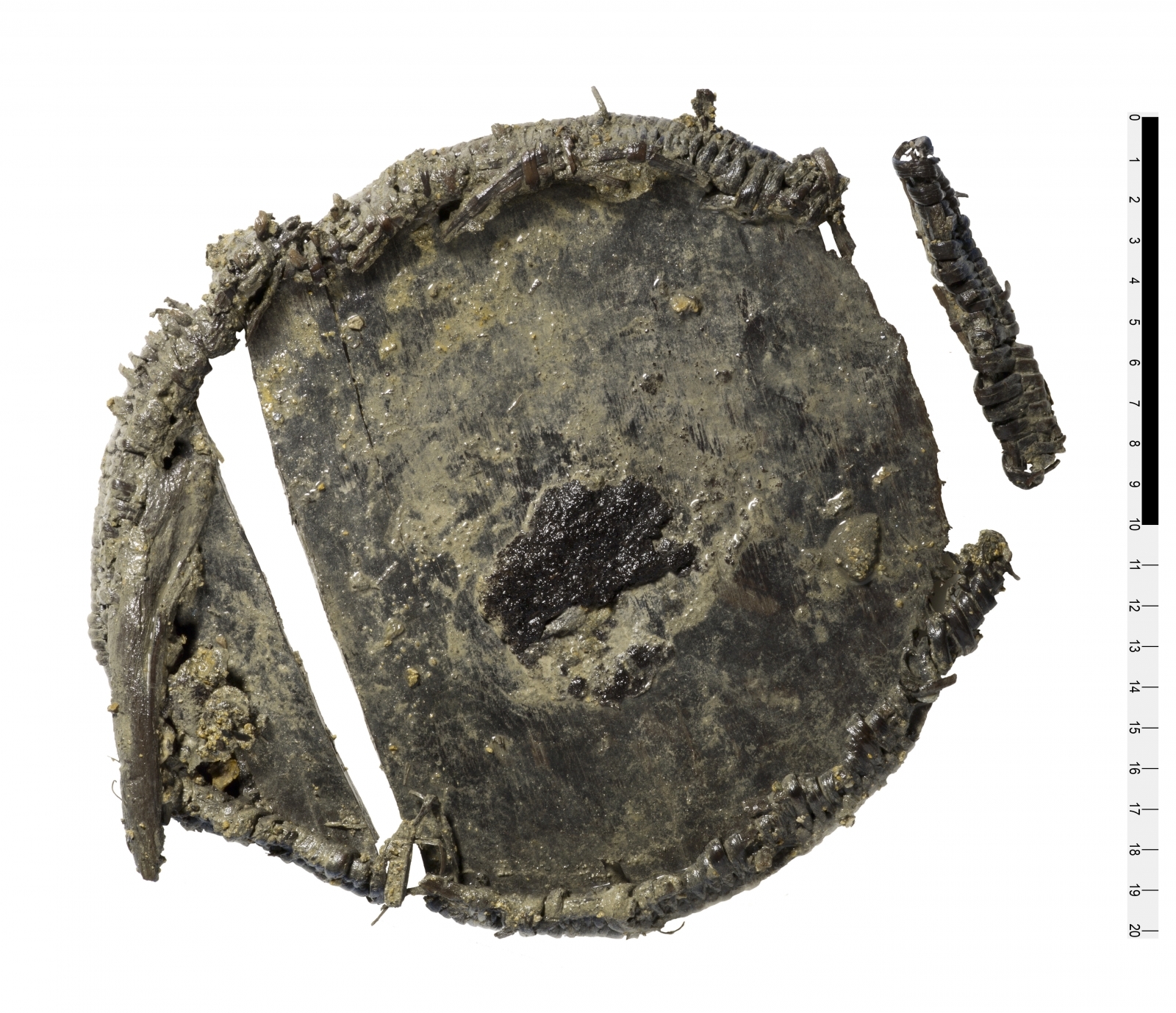
An incredibly rare wooden container from the Bronze Age has been discovered on the Lötschberg mountain in Switzerland, still with detectable traces of the grains that the box contained.
The box was found at the summit of the Lötschenpass, a transit through a glacier, at an elevation of about 2,650 metres above sea level. It's thought to have remained frozen since it was lost or abandoned by its owner in 1500 BCE.
Such discoveries are rare. Only one other similar artefact has been discovered, found in another alpine pass, the Schnidejoch, about 25km to the west of the Lötschenpass. Perhaps the most famous discovery from the ice-packed Alps is Ötzi the iceman, a human discovered dating from about 3300 BCE.
Analysis of the box showed traces of spelt, emmer and barley, according to a study in the journal Scientific Reports. The research is the first time that such detailed information on food contents has been retrieved from a Bronze Age artefact.
Read the rest of this article...

Uncovering the Galloway Viking Hoard, layer by layer


Hold on to your Viking helmet; you’re about to dig, layer by layer, into one of the most extraordinary Viking hoards ever found on the British Isles – the Galloway Hoard – with Dr Martin Goldberg, Senior Curator at National Museums Scotland

The team of metal detectorists had been working this field in Galloway for some time, but what they eventually found was way beyond their expectations.

The top layer contained eleven ingots and eleven silver arm-rings that had been flattened into bullion. They would have been made from the type of ingots they’re buried with. There’s a nice variety of decoration, with lots of punched lines and hatches. This type of arm-ring is normally found in hoards in Ireland and there are some from North Wales and from Lancashire – all around the Irish Sea, but we don’t have a lot of this particular type in Scotland. This hoard completes the circle around the Irish Sea.

They’re called a Hiberno-Scandinavian type of arm-ring and obviously the Scandinavian is the new element added to the cultural mix at the time, but they’re given that Hiberno- prefix because they’re normally found in Ireland. For me it is always the hyphen between these cultural labels where the interesting things are happening.

Read the rest of this article...

Wednesday, July 26, 2017

Archaeologists Return to Legendary Birthplace of King Arthur


Archaeologists have completed the first stage of a major five-year study of the archaeology of the Tintagel headland in Cornwall, in the southwest of England. In English folklore, the site is thought to be the birthplace of King Arthur.
Credit: Emily Whitfield-Wicks/English Heritage

Archaeologists are back at the legendary birthplace of King Arthur.

Last summer, researchers discovered traces of early medieval life at Tintagel in Cornwall, on England's southwest coast, where the legendary British monarch was said to have been born.

Now, they've returned to the site for another round of digging, to further explore buried buildings dated from the fifth to the seventh centuries. 

Read the rest of this article...

1,100-year-old coin found in royal Pictish power centre


The 1,100-year-old coin found at an archaeological dig at Burghead Fort. Picture: PA

A 1,100-year-old coin is amongst a series of discoveries made at what experts believe was a royal power centre of a northerly Pictish kingdom.

The coin was found along with the remains of a longhouse at Burghead Fort near Lossiemouth, which was thought to have been largely destroyed by the development of a new town during the 19th century.

Now archaeologists from Aberdeen University hope further significant findings will be revealed at the site – a probable seat of power of Northern Pictland between 500AD and 1000AD, given the fresh discoveries.

Read the rest of this article...

Casting light on the Dark Ages: Anglo-Saxon fenland is re-imagined

What was life in the fens like in the period known as the dark ages? Archaeologist Susan Oosthuizen revisits the history of an iconic wetland in the light of fresh evidence and paints a compelling portrait of communities in tune with their changeable environment. In doing so, she makes an important contribution to a wider understanding of early medieval landscapes.


Highland Cattle grazing in the Wicken Fen [Credit: © Wicken Fen]

The East Anglian fens with their flat expanses and wide skies, a tract of some of the UK's richest farmland, are invariably described as bleak – or worse. Turn the clock back 1,000 years to a time when the silt and peat wetlands were largely undrained, and it's easy to imagine a place that defied rather than welcomed human occupation.

Historians have long argued that during the 'dark' ages (the period between the withdrawal of Roman administration in around 400 AD and the Norman Conquest in 1066) most settlements in the region were deserted, and the fens became an anarchic, sparsely inhabited, watery wilderness.

A new interdisciplinary study of the region by a leading landscape archaeologist not only rewrites its early history across those six centuries but also, for the first time anywhere in Europe, offers a detailed view of the settlement and agricultural management of early medieval wetland landscapes.

Read the rest of this article...

3,000 Year Old Necropolis Discovered Beneath Site Of Visigoth Graves In Spain

Spanish archaeologists excavating a Visigoth necropolis in Sena, in the northeastern province of Huesca, have uncovered what they say is a burial site dating to the 10th century BCE and that was part of the Late Bronze Age Urnfield culture.


An urn that revealed the existence of the cemetery dating back more than 2,000 years [Credit: EFE]

Two urns and a lid were discovered in the graveyard. Hugo Chautón, the archaeologist overseeing the excavation, says Urnfield culture spread from central Europe into northeastern Spain around 1,000 years BCE. The name comes from the Urnfield culture’s custom of cremating the dead and placing their ashes in urns, which were then buried.

“This culture represents the transition from the Bronze Age to the Iron,” said Chautón, “and provides valuable information about burial practices, particularly the move from burying the dead to cremating them.”

Read the rest of this article...

Friday, July 21, 2017

Extremely rare Roman sarcophagus lifted from ancient Southwark burial site

rchaeologists prepare to lift the lid of Roman sarcophagus found in Southwark, London 
[Credit: Lauren Hurley/PA Wire]

This is an exceptional find for London, where only two similar late Roman sarcophagi have been discovered in their original place of burial in recent years: one from St Martin-in-the Fields near Trafalgar Square (2006) and one from Spitalfields in 1999.

The excavation, which began in January this year, revealed a large robber trench around the coffin and found that the lid had been moved, suggesting that the coffin was discovered and robbed in the past. However, it is possible that only the precious items were removed, and the less valuable artefacts, such as the body itself, still remain within the stone sarcophagus.

Southwark and the City of London are remarkable in being the only two London Boroughs that have their own, in-house, dedicated archaeologist. Southwark Council champions archaeology and has dedicated planning policies to ensure that the borough’s ancient history is identified, protected and managed for future generations. The Harper Road excavation is just one of the many archaeological projects that are currently running across Southwark.

Read the rest of this article...

Thursday, July 20, 2017

Sofia will have a Second Archaeological Complex


Sofia will have a second archaeological park, where visitors can see a prehistoric settlement from the first European civilization. In the place of the excavations is revealed a large residential complex with extremely complex architecture, DARIK writes

The prehistoric settlement, discovered in 1985 by the archaeologists, is situated in the territory of the Slatina district. It has a size of 145 square meters and the complex has an unusual construction for its time. According to archaeologist Vasil Nikolov, the settlement is one of the first made by the Mongoloid race in Europe.

"They suddenly experienced some innovative shock and started building in a whole new way, given the new environmental conditions, having ideas that are unbelievable for their time," he explained.

Read the rest of this article...

Orkney Neolithic 'butterfly-like' motifs found by chance


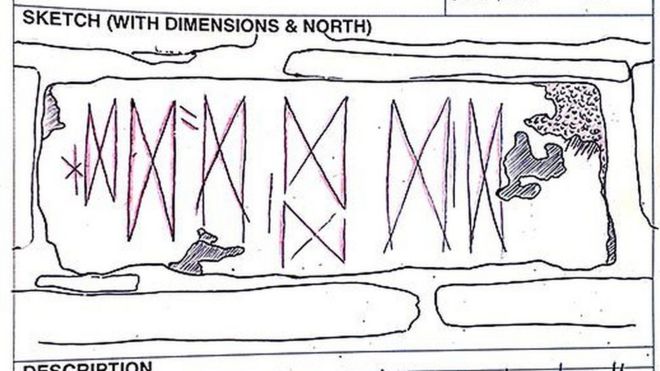
A sketch of the designs found on a block of stone

Neolithic markings carved into a stone in Orkney that were missed for years by archaeologists have been discovered by chance.
The faintly incised "butterfly-like" motifs were revealed on Tuesday as sunlight lit up the rock at the "right moment, at the right angle".
Experts believe the marks were deliberately made to be delicate and to catch light at certain times of day.
The find was made during excavations at Ness of Brogdar.
The incisions are so faint they do not show up in photographs taken so far of the stone.
Read the rest of this article...

Copper in Ötzi the Iceman’s ax came from surprisingly far away

BLADE TRADE  Copper for Ötzi the Iceman’s ax, or possibly even the finished blade, came from what’s now central Italy, an unexpectedly long way from the ancient man’s home region in northern Italy.

Ötzi the Iceman’s copper ax was imported.
The mummy’s frozen body and assorted belongings were found in 1991 poking out of an Alpine glacier at Italy’s northern border with Austria. But Ötzi’s ax originated about 500 kilometers to the south in what is now central Italy’s Southern Tuscany region, say geoscientist Gilberto Artioli of the University of Padua in Italy and colleagues. It’s unclear whether Ötzi acquired the Tuscan copper as raw material or as a finished blade, the investigators report July 5 in PLOS ONE.

While mostly copper, the blade contains small concentrations of lead, arsenic, silver and more than a dozen other chemical elements. Researchers previously suspected the copper came from known ore deposits 100 kilometers or less from the site of the Iceman’s demise. But comparing the mix of different forms of lead, or isotopes, in the ax with that in copper ore from present-day deposits across much of Europe indicated that the ancient man’s blade came from Southern Tuscany. Other chemical components identified in the copper implement also point to a Southern Tuscan origin.

Read the rest of this article...

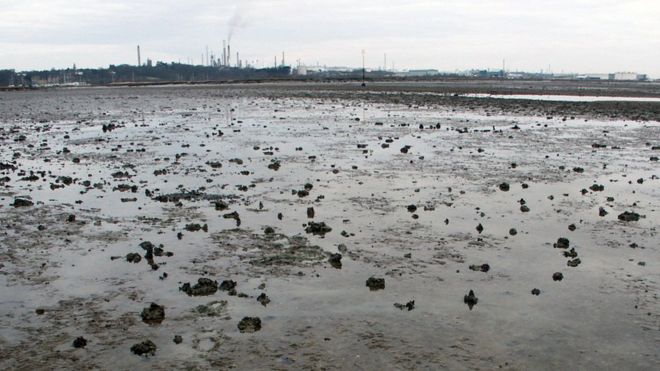
Southampton Water fish trap dated to Saxon times

The trap was found by chance close to the Fawley oil refinery by archaeology students more than 10 years ago.

A timber fishing trap exposed on the Hampshire coast dates back to Saxon times, it has been confirmed.
The weir, built as a permanent wooden structure to catch fish as the tide ebbed, was found by chance on the shore of Southampton Water in 2005.
Radiocarbon dating has shown it was built in the 8th or 9th centuries.
Experts from Exeter University said the results were "thrilling" and provided new insights into the process of coastal erosion in the area.
Read the rest of this article...

How did dogs become our best friends? New evidence


Dogs most probably evolved from wolves at a single location about 20,000 to 40,000 years ago, a study suggests.
Previously, it had been thought that dogs were tamed from two populations of wolves living thousands of miles apart.
Researchers studied DNA from three dogs found at archaeological sites in Germany and Ireland that were between 4,700 and 7,000 years old.
The ancient canines share ancestry with modern European dogs.
By looking at the rates of change to the DNA from the oldest specimen, scientists were able to place the timing of the domestication of dogs to between 20,000 and 40,000 years ago.

Read the rest of this article...

Wednesday, July 19, 2017

More extraordinary Roman writing tablets found at Vindolanda Roman Fort


More ‘Vindolanda writing tablets’ full of visible cursive Latin text have been unearthed at Vindolanda Roman Fort, on Hadrian’s Wall

Archaeologists at Vindolanda Roman Fort on Hadrian’s Wall have discovered a new hoard of around 25 Roman ink documents, known as the Vindolanda writing tablets, as part of an extraordinary excavation season at the archaeological site.

Found during the latest dig at the former Roman Army encampment, the tablets containing letters, lists and personal correspondence were discovered lying in the damp and anaerobic earth where they had been discarded towards the end of the 1st century AD.

Read the rest of this article...

Archaeologists discover mound next to Slough car park is 'prestigious' Anglo-Saxon monument


Archaeologists have found that a 20-foot high mound in Slough, thought to be a Norman castle motte and for centuries the centrepiece of a bizarre Eton College ceremony, is actually a rare Saxon monument, built 1,500 years ago.
University of Reading archaeologists say that Montem Mound in the Berkshire town, now surrounded by Municipal buildings and car parks, dates roughly to the same time as the famous burial mounds of Sutton Hoo in Suffolk, and the nearby burial  at Taplow. It is likely to mark the resting place of someone of high status and could contain artefacts.
The discovery of the 'Sutton Hoo of Slough' is a remarkable finding as only a handful of mounds from this period are known about. The findings go against the previous assumption that it was a Norman Conquest-era 'motte and bailey' castle.
Dr Jim Leary, the University of Reading archaeologist who led the investigation in December 2016, said: "Conventional wisdom placed the Montem Mound 500 years later, in the Norman period. But we have shown that it dates to between the 5th and 7th centuries, not long after the collapse of Roman Empire.
Read the rest of this article...