Tuesday, August 09, 2016

Lost Greek statue of Zeus remade with 3D printing

The original statue was made of wood, ivory and gold but the recreation is entirely thermoplastics

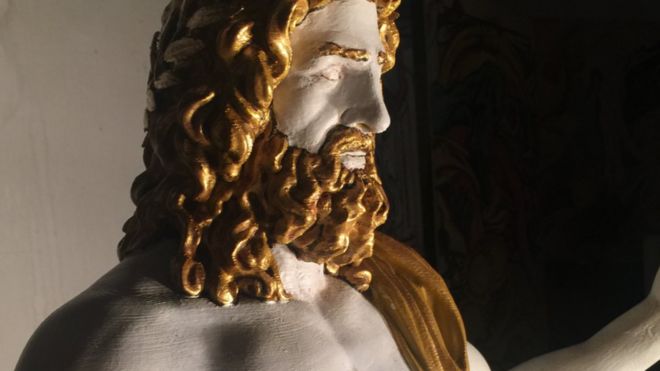
An ancient Greek statue of Zeus has been recreated using 3D printing, after it was lost in the 5th Century.
One of the seven wonders of the ancient world, the statue of Zeus at Olympia was recorded only in descriptions and illustrations on coins.
3D printing firms Stratasys and 3DPTree made the recreation for the Millennium Gate Museum in the US city of Atlanta.
One expert in classical sculpture said 3D printing was a "powerful tool" for learning about lost artefacts.
The Greek statue was roughly 13m tall but the 3D-printed version stands at a more modest 1.8m.
Read the rest of this article...

Danish archaeologists find mysterious well

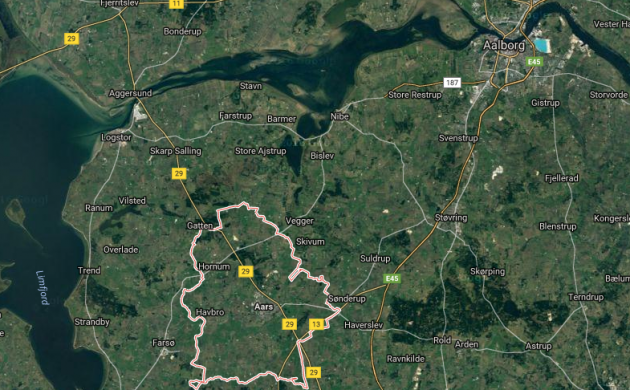
The mysterious site was found near Aars west of the Limfjord in northeastern Jutland (photo: Google Maps)

Danish archaeologists have discovered a mysterious New Stone Age construction near the town of Aars in northeastern Jutland.
“I never use the word sensation, but I must admit this is as close as it gets,” Bjarne Nielsen, the leader of the research team and curator at Vesthimmerlands Museum, told newspaper Nordjyske Stiftstidende.
“We have not seen anything like it before.”
Read the rest of this article...

Roman goddess unearthed at South Shields culture spot


Delighted volunteers at a South Shields culture spot had a blast from the past after unearthing a Roman goddess. 

Volunteers from the WallQuest community archaeology project and the Earthwatch Institute made the startling discovery at Arbeia Roman Fort. 

The dramatic discovery is a beautifully crafted miniature bronze figure of the Roman goddess Ceres which is thought to be a mount from a larger piece of furniture. 

Ceres was the goddess of agriculture, grain and fertility which is a highly appropriate goddess for Arbeia because it was a supply base where thousands of tons of grain were stored in granaries to feed the army stationed along Hadrian’s Wall.

Read the rest of this article...

Restored Pompeii kitchens show how Romans cooked


The ancient Roman kitchens of a Pompeii launderette have once again been kitted out with pots and pans as part of a new project that is trying to give visitors a sense of what day-to-day life in the city was like.


The kitchens at the Fullonica di Stephanus 
[Credit: Archaeological Superintendency of Pompeii]

Before they were buried by a volcanic eruption in AD 79, the kitchens once provided food for the hungry attendants of the three-storey launderette, the Fullonica di Stephanus.

The Fullonica was the place where wealthy Roman patricians sent their togas to be washed in huge baths using clay and urine. The garments were then rinsed, dried and placed on special presses to ensure they returned to their noble owners crease-free.

Thanks to a refurbishment which finished on Monday, the kitchens inside the Fullonica now appear as they did 2,000 years ago, complete with metal grills, pots, pans and earthenware crockery.

Read the rest of this article...
Luxury at Tintagel in the Early Medieval Period


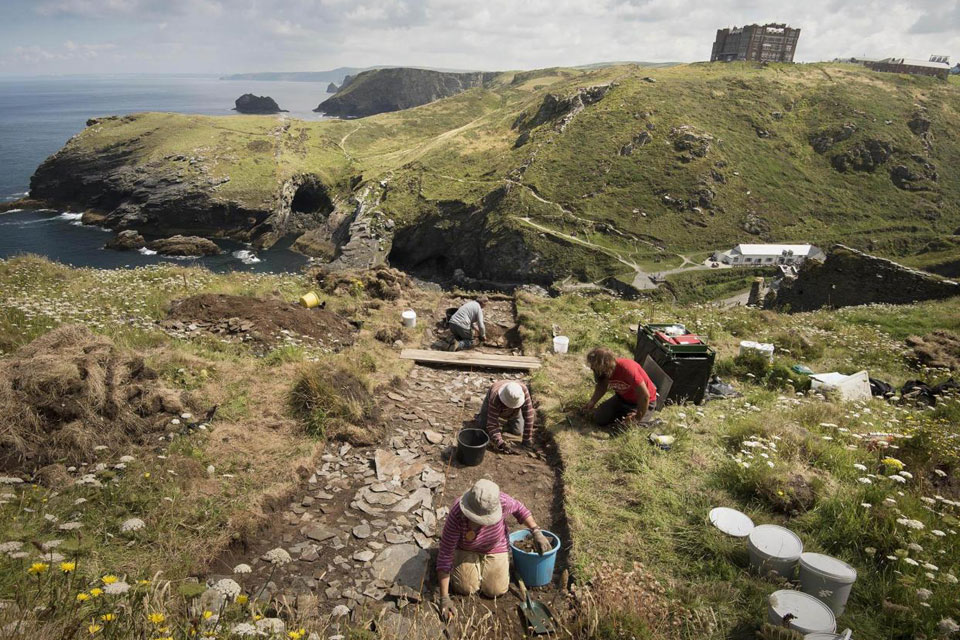
This summer archaeologists have been excavating in Cornwall at Tintagel, the famous site for Arthurian Legend. The results are exhilarating.

English Heritage, which runs Tintagel, recently commissionedCornwall Archaeological Unit to carry out onsite excavations at Tintagel, the famous seat of the legendary King Arthur.
The first phase of excavations, which took place in July, included digging trenches in two previously unexcavated terrace areas of the island settlement. It was hoped research into these carefully chosen areas would reveal more about how the people of Tintagel lived in the Post-Roman period from 5th to 6th centuries AD.

Read the rest of this article...

Archaeological Finds In Bulgaria: July 2016 Highlights


The month of July 2016 saw the traditional archaeological season in Bulgaria in full swing, with finds at digs in various parts of the country – from an 8000-year-old settlement in Sofia to the rock tomb of a Thracian princess near Benkovski to the long-awaited unearthing of the eastern gate of Perperikon – producing headlines.


An aerial shot showing the excavated section of the prehistoric, ancient, and medieval rock city of Perperikon  in Southern Bulgaria, i.e. almost fully excavated acropolis 
[Credit: Nikolay Ovcharov]


At the beginning of July, it was announced that a team of Bulgarian archaeologists had uncovered the remains of an early Neolithic settlement, dating back 8000 years, in the Slatina neighbourhood of Bulgaria’s capital city Sofia.

It has long been known by archaeologists that the oldest human settlement in Sofia was in Slatina.

In recent days, archaeologists had come across the remains of two burnt houses, of an impressive size for the age. The head of research, Professor Vassil Nikolov, said that the structures were 150 square metres, with three rooms and two additional business premises.

Read the rest of this article...

Huge Merovingian Cemetery Discovered Near Somme


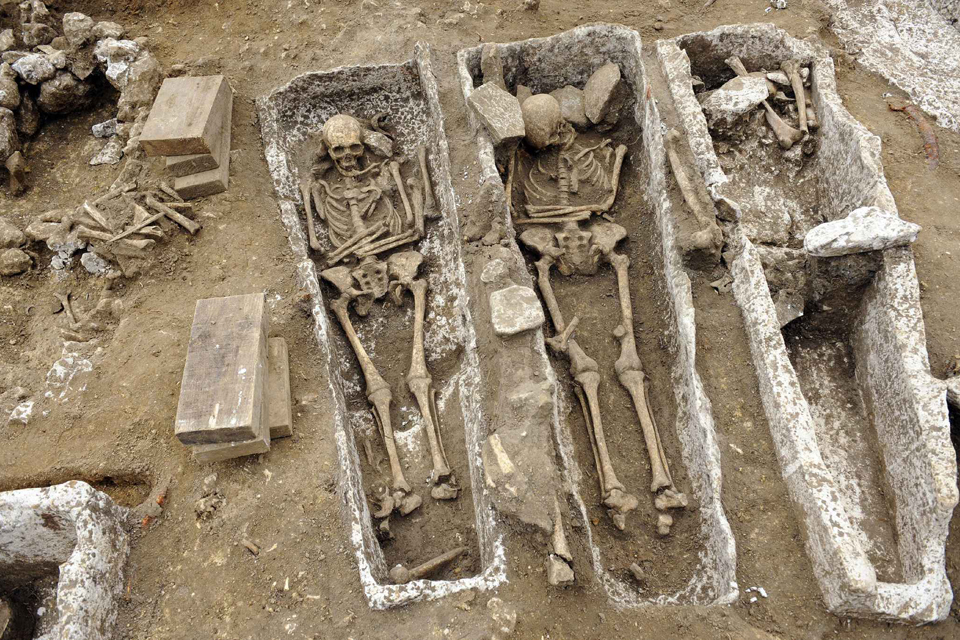
Recently a very large Merovingian cemetery was discovered. With more than 600 graves the medieval archaeologists from INRAP are excited.

This summer, as part of the construction of a school in the village of Monchy-Lagache east of Amiens in Somme, an archaeological evaluation has – as is required by French law – been carried out . Huge was the amazement, when the archaeologists found a unique cemetery.

Read the rest of this article...
Monday, August 01, 2016

American student finds 12th century Irish brooch on a Galway Beach


McKenna McFadden, an Irish American film and television major at New York University, is in Dublin for the summer with an NYU program. She was walking on the shore of Oney Island in Connemara in the west of Ireland this week when something sitting in the sand caught her eye.

Little did she think it would be a rare artifact from the 12th century.

The NYU Dublin group was being led on a tour of the island by the Connemara-based archaeologist Michael Gibbons.

As McFadden told IrishCentral, “I had been looking at some rabbit burrows with my friend while on a tour of the island lead by archaeologist Michael Gibbons. When stepping back from the burrows, I looked down and saw the back of the brooch and picked it up.

Read the rest of this article...

Ceres Figurine Found In South Shields


A beautifully crafted miniature bronze figure of the Roman goddess Ceres was found by volunteers from the WallQuest community archaeology project and the Earthwatch Institute at Arbeia Roman Fort, South Shields.


The figure of the Roman goddess Ceres uncovered in South Shields 
[Credit: Arbeia Fort]

The artifact thought to be a mount from a larger piece of furniture. Ceres was the goddess of agriculture, grain and fertility which is a highly appropriate goddess for Arbeia because it was a supply base where thousands of tons of grain were stored in granaries to feed the army stationed along Hadrian’s Wall.

This is the second goddess that the WallQuest project has found at Arbeia in two years. In 2014, a local volunteer found a carved stone head of a protective goddess, ortutela.

Read the rest of this article...

High-Tech Tools Yield Roman Discovery


A team of Duke scholars and students spent this summer at two historic sites in Italy and made significant discoveries. The team, based in part in the dig@lab, a digital laboratory run by Maurizio Forte, a professor of classical studies and art, art history and visual studies, discovered two Roman Empire-era facilities, a public building and an amphitheater.

The project team included Duke faculty members Bill Seaman, David Johnson, Todd Berreth and Regis Kopper, as well as Nevio Danelon, a post-doctoral fellow; Katherine McKusker, PhD student; Benedict Parfit, an undergraduate student. Everette Newton, who works with Duke's Nicholas School of the Environment's marine lab, piloted the drone used in the excavation. The team also included scholars from other universities.

Read the rest of this article...

James Brindley: The canal pioneer who changed England


A new exhibition marking 300 years since the birth of canal pioneer James Brindley has opened. How did his work transform the English landscape and unlock a new era in the Industrial Revolution?
When James Brindley sought Parliament's backing for his plan for an aqueduct over the River Irwell in Lancashire, he apparently employed a novel means of gaining their attention.
Taking out a block of Cheshire cheese, the man who engineered England's first canal carved out a model of the waterway he hoped to build.

Read the rest of this article...
Gibraltar caves reveal Neanderthals' secrets


The cave systems at the base of the rock of Gibraltar have just received Unesco world heritage status, in recognition of the rich insights they bring to the study of Neanderthals.
They reveal that modern humans share a little more than you might expect with the extinct species, as Melissa Hogenboom explains.
Video courtesy of BBC Earth.

Read the rest of this article...

Sunday, July 24, 2016

Mighty Viking Ax Discovered in Tomb of Medieval 'Power Couple'


One of the largest Dane axes ever found, recovered by archaeologists from a 10th-century Viking tomb near Silkeborg in central Denmark.
Credit: Silkeborg Museum

Archaeologists have discovered one of the largest Viking axes ever found, in the tomb of a 10th-century "power couple" in Denmark.
Kirsten Nellemann Nielsen, an archaeologist at the Silkeborg Museum who is leading excavations at the site near the town of Haarup, said Danish axes like the one found in the tomb were the most feared weapons of the Viking Age.
"It's a bit extraordinary — it's much bigger and heavier than the other axes. It would have had a very long handle, and it took both hands to use it," Nielsen told Live Science. [See Photos of the 10th-Century Viking Tomb]
The simplicity of the mighty ax, without any decorations or inscriptions, suggests this fearsome weapon was not just for show. "It's not very luxurious," she said.  
Read the rest of this article...

A bronze age barrow and an Anglo-Saxon cemetery have been unearthed in Rothley

Archaeologists from the University of Leicester have discovered the hidden gems of the Leicestershire village during an investigation into how different generations have re-used ancient sacred places.


Archaeologists have dug into Rothley's ancient past and discovered a bronze age barrow and an Anglo-Saxon cemetery - shedding important light on the history of the area.
Archaeologists from the University of Leicester have discovered the hidden gems of the Leicestershire village during an investigation into how different generations have re-used ancient sacred places.
The project, funded by Persimmons Homes in advance of a new housing development off Loughborough Road, Rothley, explored the concept of Iron Age and Anglo-Saxon people possibly making connections with Bronze Age barrow builders in order to create their own sense of place in the landscape.
Read the rest of this article...

Silk Road Gave Infectious Disease a Route, Ancient Poop Shows

Several 2000-year-old personal hygiene sticks with remains of cloth, excavated from the latrine at Xuanquanzhi.
Credit: Reproduced from the Journal of Archaeological Science: Reports.

Silk, tea and spices weren't the only things that travelers carried on China's legendary Silk Road: Ancient poop shows that infectious diseases were also transported along this network of trade routes, according to a new study.
Researchers excavated 2,000-year-old feces from a latrine along the Silk Road in northwestern China, and found that it contained eggs from the Chinese liver fluke, a parasitic worm that is typically found at least 930 miles (1,500 kilometers) away, according to the study.
The researchers suggested that the traveler infected with this parasite must have journeyed a great distance. "This is the earliest evidence for the spread of infectious diseases along the Silk Road, and the first to find evidence at an archaeological site along the Silk Road itself," Piers Mitchell, a paleopathologist at the University of Cambridge and the senior author of the study, told Live Science. [7 Devastating Infectious Diseases]
Read the rest of this article...

Archaeologists find arm bone on dig


ARCHAEOLOGISTS have found a human arm bone during an excavation of Neolithic buildings at Ness of Brodgar on Orkney.
The University of the Highlands and Islands Archaeology Institute, leading the dig, believe the bone was deliberately placed and could be the remains of a respected original founder of the large complex.
Ness of Brodgar site director Nick Card described it as an important and exciting find.
He said there were several theories as to who the arm belonged to which would be explored further.
The Ness of Brodgar is a new archaeological discovery in Orkney located between the Ring of Brodgar and the Standing Stones of Stenness.
Read the rest of this article...

What The World's Oldest Calculator Tells Us About The Ancient Greeks' View Of The Universe


When we talk of the history of computers, most of us will refer to the evolution of the modern digital desktop PC, charting the decades-long developments by the likes of Apple and Microsoft. What many don't consider, however, is that computers have been around much longer. In fact, they date back millennia, to a time when they were analogue creations.


The fragmented remains of the Antikythera mechanism 
[Credit: Reuters/Alkis Konstantinidis]

Today, the world's oldest known "computer" is the Antikythera mechanism, a severely corroded bronze artefact which was found at the beginning of the 20th Century, in the remains of a shipwreck near the Mediterranean island of Antikythera. It wasn't until the 1970s that the importance of the Antikythera mechanism was discovered, when radiography revealed that the device is in fact a complex mechanism of at least 30 gear wheels.

The mechanism has since been established as the first known astronomical calendar, a complex system which can track and predict the cycles of the solar system. Technically, it is a sophisticated mechanical "calculator" rather than a true "computer", since it cannot be reprogrammed, but nonetheless an impressive artefact.

Read the rest of this article...
Menschen nutzten schon vor 40.000 Jahren spezielles Werkzeug zur Seilherstellung


Archäologen der Universität Tübingen präsentieren gut erhaltenen Fund aus Mammutelfenbein – Test an der Universität Lüttich bestätigt Funktion

Schon vor 40.000 Jahren haben Menschen ein spezielles Werkzeug zur Herstellung von Seilen genutzt. Wie Professor Nicholas Conard und seine Grabungsmannschaft von der Universität Tübingen am Freitag berichteten, wurde bei Ausgrabungen im »Hohe Fels« auf der Schwäbischen Alb ein gut erhaltenes Exemplar dieses Werkzeugs gefunden. Das sorgfältig geschnitzte Stück aus Mammutelfenbein ist 20«4 Zentimeter lang und diente dazu, Pflanzenfasern zu Seilen zu drehen, wie Tests an der Universität Lüttich in Belgien zeigten.

Read the rest of this article...

Tuesday, July 19, 2016

Vikings abused and beheaded their slaves

This double grave from the Viking era at Grimsta in south-eastern Sweden was exhumed in 1974. It contained skeletons of two persons who had been decapitated. One of the skulls lies at the foot end at the left of the picture. Many experts think these two buried here were slaves.(Photo: Ove Hemmendorf, 1974/Swedish National Heritage Board)

The Vikings in Norway, Sweden, Denmark and Iceland had slaves, or thralls. These thralls probably held multiple roles, serving their masters in many ways in Viking society a thousand years ago. 
They could also be given the ultimate rough assignment when important Vikings died.
Some followed their masters into the grave.
Few contemporary descriptions of Viking burials exist. But the Arab explorer Ibn Fadlān witnessed one such ritual when a Viking chieftain died.  Fadlān had met the Eastern Vikings, also called Rūsiyyah, in what is now Russia:
Read the rest of this article...

South Downs pre-Roman 'farming collective' discovered

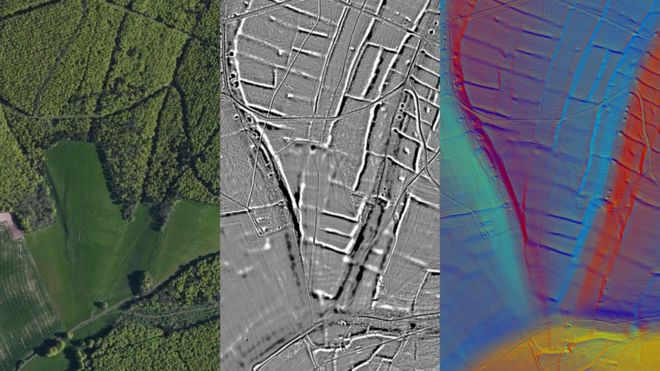
The survey revealed the extent of farming on the South Downs before the Romans arrived

Evidence of a prehistoric "farming collective" has been discovered after aerial laser scanning was carried out in the South Downs National Park.
Large-scale farming from before the Roman invasion suggests a high level of civilisation, archaeologists said.
The survey also revealed the route of a long-suspected Roman road between Chichester and Brighton.
It covered an area between the Arun river valley in West Sussex and Queen Elizabeth Country Park in Hampshire.

Read the rest of this article...