Wednesday, March 02, 2016

More Pompeii houses to open to public from spring


More buildings than ever will be accessible to visitors to Pompeii from the spring, the site's officials said on Thursday. 


More Pompeii houses to open to public from spring A fresco of Venus in the House of Venus in the Shell [Credit: Carole Raddato/Flickr] 

The extra sites include the house of Julia Felix, an extravagant ancient spa, the Little House of the Orchard, which is home to colourful frescoes, and the gardens of the House of Venus in the Shell. Tourists will also be able to see some human casts, shown for the first time, and an exhibition of Egyptian art and statues, called 'Egypt Pompeii', from mid-April. New routes around the site will also be opened, allowing access to these new areas and also ensuring that the usual routes do not get worn out by the three million visitors who come to Pompeii each year.

Read the rest of this article...

Le cimetière allemand de Boult-sur-Suippe


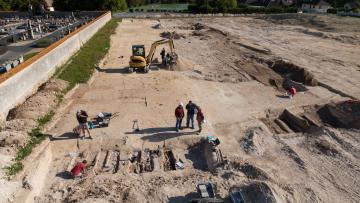
Une équipe de l’Inrap vient de fouiller un cimetière militaire allemand de la Grande Guerre. Ces recherches se sont déroulées en amont de la construction d’un lotissement par la société Immocoop et sur prescription de l’État (Drac Champagne-Ardenne). Environ 530 tombes et plus d’un millier d’objets personnels et militaires ont été mis au jour. Cette recherche d’ampleur permet notamment d’étudier la prise en charge des défunts et des blessés, du champ de bataille à la nécropole, et pour certains de les identifier.

Un cimetière de fortune

Durant les combats, dès 1916, les soldats ont été enterrés dans ce cimetière de fortune. Entre 1925 et 1927, période où les terres sont restituées aux agriculteurs pour relancer l’économie, une partie des sépultures est exhumée en urgence. Aujourd’hui, les archéologues mettent en évidence que les corps ont été partiellement prélevés, certains oubliés.

L’étude portera sur le recrutement des soldats (âge, stature), leur état sanitaire, leurs provenances géographiques, les causes de leur décès, la chirurgie de guerre, la logistique militaire. Déjà figurent des recrues trop jeunes pour avoir eu l’âge légal de s’enrôler.


Read the rest of this article...

Glanzstück der Bronzezeit oder Fälschung?


Eine Tagung zur Goldscheibe von Moordorf 

Seit einiger Zeit arbeiten Archäologen und Naturwissenschaftler an der Enthüllung eines Geheimnisses: Ist die Goldscheibe von Moordorf echt oder modern gefälscht? Bei einer Tagung im Landesmuseum Hannover wurden nun verschiedene Argumente ins Feld geführt und eine vorläufige Bewertung vorgenommen.

Der bronzezeitliche Goldschmuck aus dem bayrischen Bernstorf steht wegen der extrem hohen Reinheit des Metalls im Verdacht, gefälscht zu sein. In diesen Verdacht ist die gleichfalls bronzezeitliche Goldscheibe aus Moordorf (Ostfriesland) im Landesmuseum Hannover geraten, deren außergewöhnlich hoher Goldgehalt ebenso als Hinweis auf eine mögliche Fälschung gedeutet wird. 

Read the rest of this article...

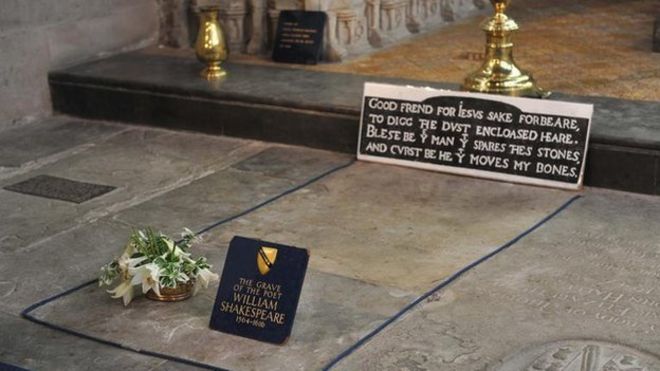
Shakespeare's grave scanned in 400th anniversary

Shakespeare's grave in Stratford - with a warning against anyone who "moves my bones"

A radar survey into William Shakespeare's grave and an excavation of the playwright's house are among research projects marking the 400th anniversary of his death.

Shakespeare's grave in Holy Trinity Church in Stratford upon Avon has never been excavated, but a scan has been carried out to search below ground.

This allows an investigation without physically disturbing the site.

The findings are expected to be revealed in the next few weeks.

There are believed to have been discoveries in the grave, in a church where five members of the Shakespeare family are buried.

There has been speculation about a possible family vault under the stones - and questions about whether such a ground-penetrating scan would show other items buried with Shakespeare.

Read the rest of this article...
Sunday, February 28, 2016

No Wool, No Vikings

Fosen Folk High School students sailing a square-sail-rigged boat in the Trondheim Fjord. Square sails were the norm in Viking days. Photo by Claire Eamer

Gray clouds hang low over the Trondheim Fjord, a huge, convoluted indentation in the central Norwegian coast. A gusting wind blows the tops off the waves, tosses rain in my face, and fills Braute’s great square sail. It heels over, water splashing over its leeward gunwale and through the oar-ports, soaking everyone on that side of the long, open, Viking-style wooden boat.

Braute is sailing out from Fosen Folk High School, located in Rissa, on the north shore of the fjord. I’m sharing a hard wooden bench with some of the school’s students—mostly young Norwegians, with a sprinkling of foreigners. They’ve just spent nine months studying traditional skills that date back to the Viking Age, from boatbuilding and sailing to traditional farming and wool working.

On this, the last trip of the school year, we’re heading for Utsetøya, a little island near the mouth of the fjord. That’s where the school’s small flock of sheep, which provides both meat and wool, runs wild for most of the year, hemmed in only by the sea. Most of Fosen’s student body is crammed aboard Braute and two other Viking-style boats, along with staff, food, mounds of camping gear, and one shivering Canadian journalist. The plan is to camp on the island for several nights, check on the flock, and collect next year’s supply of raw wool.

Read the rest of this article...
Did the Vikings use crystal 'sunstones' to discover America?


Vikings may have used the interaction of sunlight with particular types of crystal to create a navigational aid that may even have worked in overcast conditions.


Leif Erikson discovers America. (Photo: Christian Krogh/Wikimedia Commons)

Ancient records tell us that the intrepid Viking seafarers who discovered Iceland, Greenland and eventually North America navigated using landmarks, birds and whales, and little else. There’s little doubt that Viking sailors would also have used the positions of stars at night and the sun during the daytime, and archaeologists have discovered what appears to be a kind of Viking navigational sundial. But without magnetic compasses, like all ancient sailors they would have struggled to find their way once the clouds came over.

However, there are also several reports in Nordic sagas and other sources of a sólarsteinn “sunstone”. The literature doesn’t say what this was used for but it has sparked decades of research examining if this might be a reference to a more intriguing form of navigational tool.

The idea is that the Vikings may have used the interaction of sunlight with particular types of crystal to create a navigational aid that may even have worked in overcast conditions. This would mean the Vikings had discovered the basic principles of measuring polarised light centuries before they were explained scientifically and which are today used to identify and measure different chemicals. Scientists are now getting closer to establishing if this form of navigation would have been possible, or if it is just a fanciful theory.

Read the rest of this article...

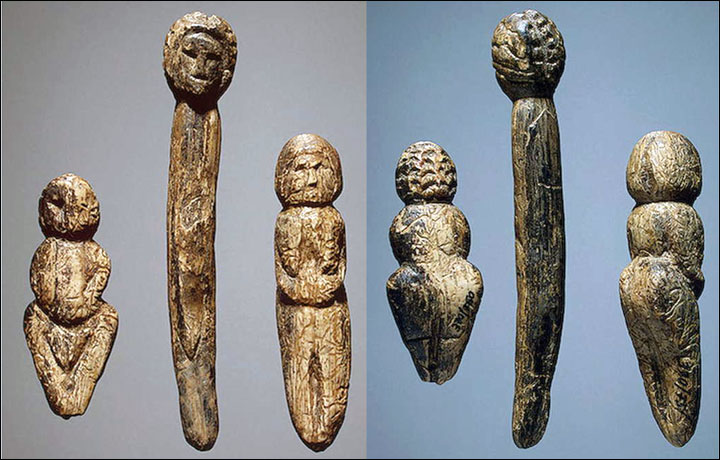
World famous ancient Siberian Venus figurines 'are NOT Venuses after all'

Close microscopic inspection reveals them as being far from idealised female forms. 
Picture: Hermitage Museum

New groundbreaking research shows that a celebrated collection of prehistoric Venus figurines are - in fact - a fashion show of ordinary people of all ages from some 20,000 years ago.
Close microscopic inspection reveals them as being far from idealised female forms. Rather, many are male, and others are children, the new research shows. 

It's true that in the past some of the woolly mammoth tusk carvings were known to be clothed. Notably, these were called alluringly Venus in Furs figurines. They were dressed for protection from the Siberian winter, and are possibly the oldest known images anywhere in the world of sewn fur clothing. Yet even deep in Soviet times, the figurines were hailed for their feminine features, and seen as the idealised female form.

Read the rest of this article...

Non-Destructive Testing Determines Diet From Teeth


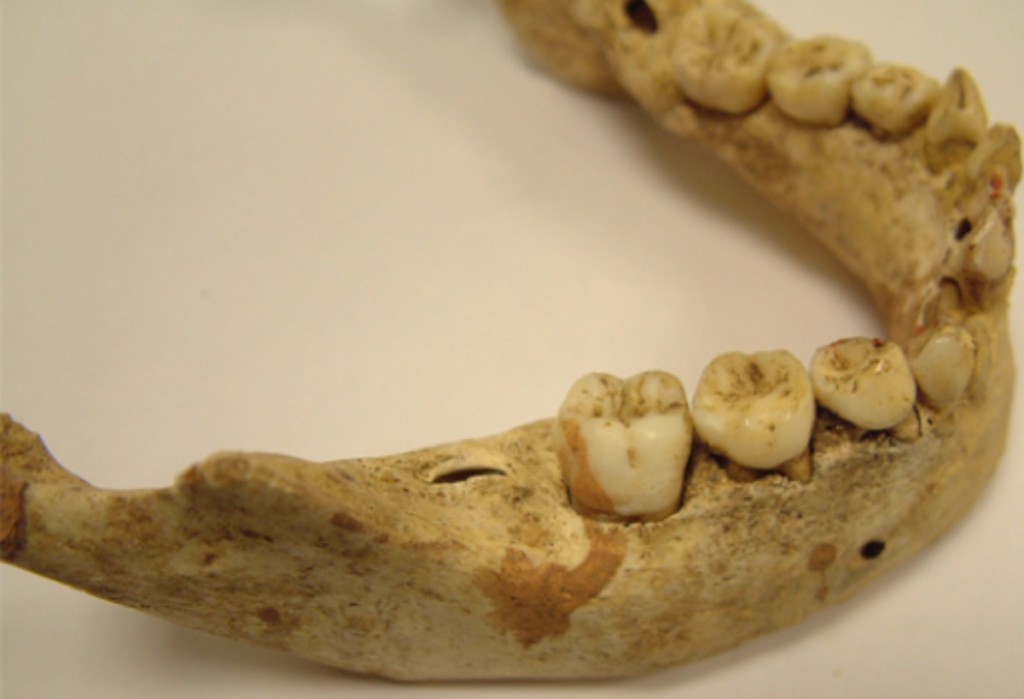
CANTERBURY, ENGLAND—A team from the University of Kent, led by biological anthropologist Patrick Mahoney, used 3-D microscopic imaging to examine the teeth of children between the ages of one and eight years who lived near Canterbury Cathedral during the medieval period. Dental micro-wear texture analysis allowed the researchers to measure microscopic changes in the surface topography of the teeth without damaging them, and offered clues to how hard the food was that the children had been eating. The team found that weaning had begun for the youngest children, and that their diets became tougher at the age of four.

Read the rest of this article...

Engraved Mesolithic pendant unearthed in the UK


An 11,000 year old engraved shale pendant discovered by archaeologists during excavations at the Early Mesolithic site at Star Carr in North Yorkshire is unique in the UK, according to new research. 


The sacred prehistoric stone pendant, discovered by archaeologists in Yorkshire. It was probably worn by a shaman carrying out hunting-related rituals 
[Credit: Harry Robson , University of York] 

The artwork on the tiny fragile pendant, uncovered by a research team from the Universities of York, Manchester and Chester, is the earliest known Mesolithic art in Britain. Crafted from a single piece of shale, the subtriangular three-millimetre thick artefact measuring 31mm by 35mm contains a series of lines which archaeologists believe may represent a tree, a map, a leaf or even tally marks. 

Engraved motifs on Mesolithic pendants are extremely rare and no other engraved pendants made of shale are known in Europe.

Read the rest of this article...

Friday, February 26, 2016

France's earliest 'Muslim burials' found

The individuals appear to have been buried in accordance with Islamic rites

Researchers have identified what may be the earliest Muslim burials in France.

The three skeletons unearthed at Nimes show indications of Islamic burial rites and are thought to date to the eighth century AD.

A team used DNA, radiocarbon dating and archaeological analysis to show the individuals may have been North African soldiers from a brief occupation of southern France by an Islamic army.

Details of the analysis are published in the journal Plos One.

In each of the three graves, the bodies were placed on their right-hand sides facing south-east - in the direction of Mecca. The way the burial pit was dug, with a lateral niche closed off by slabs or stones also corresponds to a traditional Islamic burial practice.

Read the rest of this article...

Monday, February 22, 2016

Tourists in their millions are 'wearing out Pompeii'

The Temple of Apollo, one of the areas most affected by heavy foot-fall. 
Photo: Ian Scott/Flickr

Tourists on cruises are being advised to change their itineraries and check out lesser-known archaeological sites.

Last week, the five towns of Cinque Terre announced that they could no longer cope with the barrage of tourists making their way along the breathtaking coastal walkways. Tourist numbers will be capped and once the daily limit is reached, no more people will be allowed into the Unesco site.

It seems that Pompeii too is struggling from the high numbers of visitors traipsing round the ancient site - and one group in particular is thought to be to blame.

"Cruise-tourists are wearing out the ruins of Pompeii. The entrance steps of the Temple of Apollo, in particular, have been ruined by the influx of tourists,” claimed Adele Lagi, from Unesco, at a conference organized by the non-profit organization I Love Pompeii.

Read the rest of this article...
Six breathtaking Roman ruins that you've never heard of


The bikini isn't as modern as you might think. Photo: Kenton Greening

 Italy has so much history that it's hard to know where to visit when the weekend arrives. Here are six uniquely, fascinating and downright spiffing Roman sites that are well worth a visit.

The Anfiteatro Campano in Campania was built in the first century AD and is 49m high, with a circumference of 170 metres. It once hosted thousands of baying, bloodthirsty Romans who came to watch gladiators perform.

Although the ruin might not be quite as well preserved as the Flavian Ampitheater in Rome, a visitor ticket costs just €2.50 – some €10 less than the price of a visit to the Colosseum.

Read the rest of this article...

Neanderthals mated with modern humans much earlier than previously thought, study finds


COLD SPRING HARBOR LABORATORY—Cold Spring Harbor, NY - Using several different methods of DNA analysis, an international research team has found what they consider to be strong evidence of an interbreeding event between Neanderthals and modern humans that occurred tens of thousands of years earlier than any other such event previously documented.

Today in Nature the team publishes evidence* of interbreeding that occurred an estimated 100,000 years ago. More specifically the scientists provide the first genetic evidence of a scenario in which early modern humans left the African continent and mixed with archaic (now-extinct) members of the human family prior to the migration "out of Africa" of the ancestors of present-day non-Africans, less than 65,000 years ago.

Read the rest of this article...

Dunwich: The storms that destroyed 'lost town'

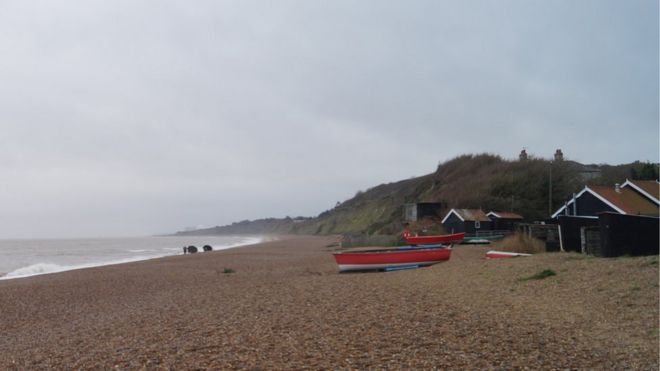
In the 11th Century Dunwich was the 10th largest town in England

Evidence of violent storms that destroyed a lost town known as Britain's Atlantis has been uncovered.

The finds were uncovered off the coast of Dunwich, Suffolk - a small village which in the 11th Century was one of the largest towns in England.

The town was hit by a succession of storms in the 13th and 14th centuries and is now largely below the sea.

Researchers said sediment gathered from the cliffs independently corroborated the historical record.

Read the rest of this article...

Friday, February 19, 2016

Remains Found of 7,000-Year-Old Man Buried Upright

The young man was buried in a vertical pit in a 8,500-year-old cemetery, one of the oldest ever found in Europe.

A Mesolithic site in Germany has revealed the 7,000-year-old remains of a young man buried there in a strange upright position.

Placed in a vertical pit, the body was fixed upright by filling the grave with sand up to the knees. The upper body was left to decay and was likely picked at by scavengers.

The unique burial was found near the village of Groß Fredenwalde, on top of a rocky hill in northeastern Germany, about 50 miles north of Berlin.

Read the rest of this article...

Medieval trading ship raised to surface 'almost intact' after 500 years on riverbed in Netherlands

Divers helped to excavate the "cog" before making it stable for removal  
YouTube, Ukraine Today

A medieval ship has been raised after half a millenium of resting on a riverbed in The Netherlands.
Archaeologists have confirmed that the find is a 15th century "cog" - a trading vessel used to sail the North and Baltic Seas, according to Sky News.

While evacuating the port of the city of Kampen, construction workers came across the skeleton of the ship underwater beneath sand and silt.

It measures approximately 20 metres by eight, weighs about 40 tonnes, and is believed to have lain there for about 500 years.

Read the rest of this article...
Anglo Saxon gold mount 'mystery' in Norfolk

The triangular gold mount, found near Fakenham, is less that an inch in width and length

A "mystery" gold mount found in a Norfolk field has provided "another piece of the jigsaw" for historians looking for Anglo-Saxon settlements. 

The item was found near Fakenham and is possibly from a sword grip, but experts say it has differences to similar finds.

Dr Andrew Rogerson, county archaeologist, said: "It's a fragment, but there's no context for it."
No evidence of dwellings has ever been found in the village.

Read the rest of this article...
Archaeologists Discover Late Roman Graves at Ancient Thracian Tomb Ostrusha near Bulgaria’s Kazanlak

Two of the three graves from the Late Roman period found at the Ostrusha Tomb near Bulgaria’s Kazanlak and Shipka. Photo: Archaeologist Meglena Parvin / TV grab from PressTV

Three funerals from the Late Roman period have been discovered during recent excavations at the Ostrusha Tomb, one of the most famous Ancient Thracian burial mounds (tumuli) in the Valley of Thracian Kings near the town of Kazanlak in Central Bulgaria.

The three graves, which date back to the second half of the 4th century AD, were found during rescue excavations in the late fall of 2015 by archaeologist Diana Dimitrova from the National Institute and Museum of Archaeology in Sofia and Meglena Parvin from the Iskra Museum of History in Kazanlak.

Their findings have just been presented during the 35th Regional Conference of the Archaeologists from Southeast Bulgaria hosted by the Museum in Kazanlak, which featured 15 participants with 11 reports, reports Darik Stara Zagora.


Read the rest of this article...

1st Century bar? Archaeological find in France offers glimpse into ancient tavern


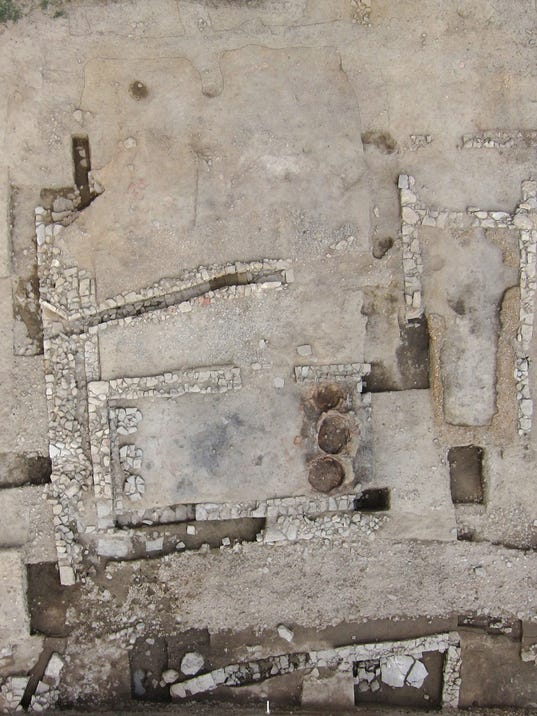
Finally a decent place to eat! Archaeologists digging in southern France have found a restaurant-like structure roughly 2,100 years old, making it one of the earliest such taverns in the western Mediterranean.

The dining complex in the ancient town of Lattara was open for business as the Romans conquered the area, bringing with them ideas that would shake up the local economy and way of life. According to the tavern’s discoverers, Lattara’s people were farmers before the Romans marched in; after the Roman takeover, new kinds of jobs likely arose – and so did dining out.

“If you’re not growing your own food, where are you going to eat?” says archaeologist Benjamin Luley of Gettysburg College, co-author of a new study in Antiquity describing the site. “The Romans, in a very practical Roman way, had a very practical solution … a tavern.”

Read the rest of this article...

Bronze Age wheel at 'British Pompeii' Must Farm an 'unprecedented find'


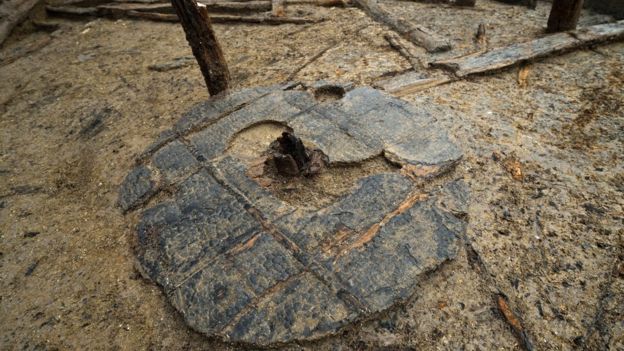
A complete Bronze Age wheel believed to be the largest and earliest of its kind found in the UK has been unearthed.

The 3,000-year-old artefact was found at a site dubbed "Britain's Pompeii", at Must Farm in Cambridgeshire.

Archaeologists have described the find - made close to the country's "best-preserved Bronze Age dwellings" - as "unprecedented".

Still containing its hub, the 3ft-diameter (one metre) wooden wheel dates from about 1,100 to 800 BC.

The wheel was found close to the largest of one of the roundhouses found at the settlement last month.

Read the rest of this article...