Saturday, April 11, 2015

Ancient abbey dig set to resume at Leiston


Archaeologists are hoping to unearth more hidden secrets when they return to Leiston Abbey in search of a lost infirmary this July. 


Aerial view of Leiston Abbey, showing a cropmark in the field adjacent to the ruin,  believed to be the lost eastern range of abbey buildings, perhaps even the infirmary.  This summer s investigations will look more closely at this area  [Credit: East Anglian Daily Times] 

It will be the third time DigVentures has led a crowdfunded dig at the 14th century ruin – with members of the public again invited to grab a trowel and get involved. 

Gossip got out after the first excavation that the bones of Suffolk folklore monster Black Shuck had been found in the trenches. The huge carcass turned out to be the remains of a very large domestic dog, but the discovery caused no less excitement among experts from DigVentures, who have seen the dig gain in popularity since it began in 2013.

Read the rest of this article...

Friday, April 10, 2015

Vikings Survived Greenland’s Harsh Weather for Centuries


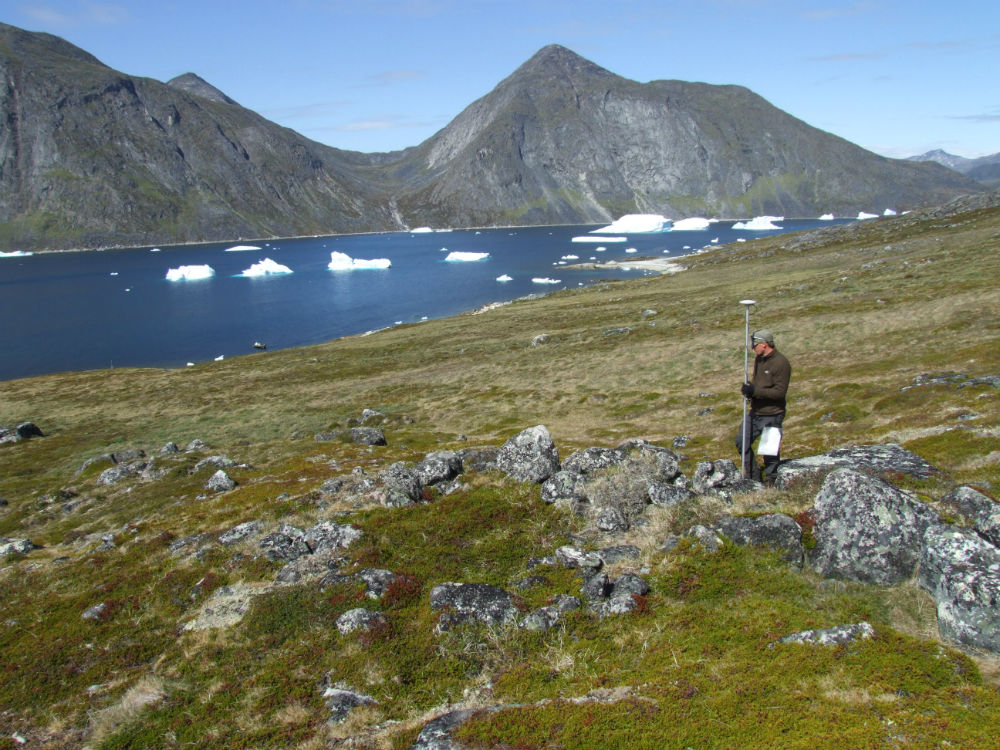
Vikings in Greenland survived the Little Ice Age for much longer than previously thought, according to comprehensive studies of the landscape conducted by archaeologist Christian Koch Madsen of the National Museum of Denmark. “The stories we have heard so far about the climate getting worse and the Norsemen disappearing simply don’t hold water,” he told Science Nordic. He says that there were no more than 2,500 people living in Greenland in the middle of the thirteenth century. Earlier estimates have placed the population as high as 6,000. “When the harsh climatic changes began to set in, we can see that the outermost farms were gradually abandoned. 

Read the rest of this article...

L’australopithèque Little Foot a 3 670 000 ans


Des chercheurs d’institutions américaines, canadiennes, sud-africaines, et françaises publient cette semaine dans la revue Nature la datation de Little Foot. Découvert au nord-ouest de Johannesburg, au cœur du berceau de l’Humanité, dans la grotte de Silberberg (Sterkfontein), ce squelette presque complet d’un australopithèque est exceptionnel. Treize années ont été nécessaires à l’équipe de Ron Clarke (université de Witwatersrand, Afrique du Sud) pour dégager Little Foot (ou StW 573) de sa gangue rocheuse, des millions d’années après sa mort.

Read the rest of this article...

Friday, March 27, 2015

DNA map of UK migration history shows Vikings drew the line at pillaging

Analysis shows less Viking DNA than expected, and no single group of Celts.


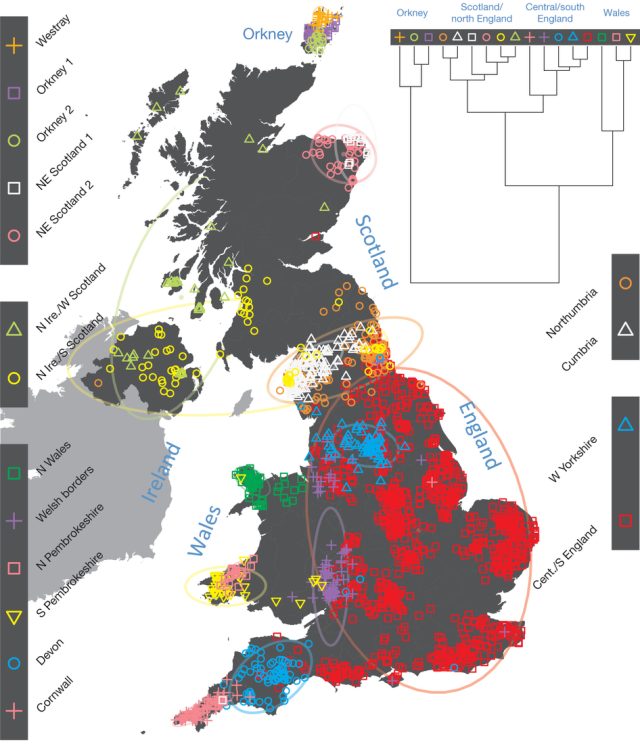
A fine-grained genetic analysis has created a detailed map of genetic variation across the UK. It gives us a clearer picture of the waves of migration that populated the UK and could also contribute to research on genetic diseases.
Obviously, people in the UK these days don’t always stick around where they were born, so people in a given region don’t necessarily share ancestry. But, if you can find people whose ancestry is closely tied to a particular region, it becomes possible to approximate what genomes would have been like a century ago, before people could move around so easily.
A paper published in Nature this week analyzed the genomes of 2039 people whose grandparents were all born within 80 kilometers (50 miles) of one another. This effectively meant that the researchers were sampling the genomes of the grandparents, whose average birth year was 1885 and who obviously had strong ties to a region. This allowed the researchers to investigate the genetic structure of the UK population before the mass movements of last century.
Read the rest of this article...

The Bayeux Tapestry and the Norman Conquest


The Bayeux Tapestry and the Norman Conquest:
A Commemoration of 1066

5 - 7 Feb 2016

2016 is the 950th anniversary of the momentous year 1066, which climaxed with the Battle of Hastings and the Norman Conquest of England. The Bayeux Tapestry commemorated the lead-up to that Conquest and we commemorate, in this conference, both historical events and the work of art. We compare The Bayeux Tapestry’s version of history with other sources and examine the cultural milieu that produced and appreciated it. We consider the ways in which the Bayeux Tapestry is unique among medieval textile furnishings; and we examine how The Bayeux Tapestry itself has been and still is being commemorated, from the nineteenth-century replica displayed in Reading to recent and current community projects that portray history in needlework.

Further details...

Thursday, March 26, 2015

Row over plans to use ancient Spanish amphitheatre as tennis court


Critics say padel tennis tournament will damage monument in Mérida while official insists plans pose no risk to roman structure


In Mérida’s roman amphitheatre, built about 8BC, one cannot smoke or wear a rucksack larger than 40cm.
But in early May, the Unesco world heritage site will be transformed into a padel tennis court, hosting competitors during the World Padel Tour as they volley balls at each other at breakneck speeds. The goal is to combine padel tennis, one of Spain’s most popular outdoor sports, with the rich roman history of Mérida,in the Spanish region of Extremadura. But the idea has provoked widespread opposition.
Nearly 100,000 people have signed an online petition attacking the idea. Authorities insist the project poses no risk to the monument, said Joaquin Paredes, the creator of the petition. “How can it be that the transfer and installation of courts and bleachers as well as allowing access to thousands of people won’t have any effect on a monument that’s more than 2,000 years old?”
Read the rest of this article...

Local cults of saints played a role in Scandinavian Christianisation

Parchment fragment of a medieval church book. Image: 
Sara Ellis Nilsson/University of Gothenburg

There is a clear link between the celebration of native saints and the ecclesiastical organisation that emerged in Scandinavia in the 12th century. Yet, according to a new doctoral thesis in history from the University of Gothenburg, important differences can be noted between Sweden and Denmark.

Local cults of saints emerged during the Early Middle Ages in the area of Scandinavia that was separated into the ecclesiastical provinces of Lund and Uppsala, roughly corresponding to modern-day Denmark and Sweden. Dioceses and other institutions were established in both provinces in the 11th and 12th centuries.

A Scandinavian perspective

This first-ever comparative study of all 23 native saints in both provinces yields a comprehensive Scandinavian perspective that has been missing in previous research on European cults of saints.

Read the rest of this article...
Acropolis of Athens built to withstand earthquakes


“This is an incredible construction, using ingenious solutions to insurmountable engineering and construction problems,” said Professor of Civil Engineering Department of the Aristotle University of Thessaloniki Kyriazis Pitilakis describing the Acropolis and the Parthenon. 


The Acropolis. View from Pnyx [Credit: © YSMA Archive] 

The question of how the Acropolis structures and the Parthenon in particular have survived so many earthquakes in 2,500 years has puzzled scientists and engineers for years. Researching the secret of the “perfect seismic behavior” of the Parthenon and the Acropolis in general, the conclusion is that the buildings were designed ingeniously in order to be protected from earthquakes. 

“The Parthenon condenses all that Greece is and all that it has offered to the Western World in the best way. It stands as a symbol of European culture, a symbol of the principle of measure, of art, technology and human capability. This is because that other than the highest artistic creation, it is also a marvel of mechanical engineering,” said Pitilakis during the opening of the workshop on “Contemporary Interventions in the Athenian Acropolis Monuments” organized by the Department of Civil Engineering, under the Graduate program for Antiseismic Construction Planning.

Read the rest of this article...

Defining beauty - the body in ancient Greek art


Defining beauty - the body in ancient Greek art

26 March – 5 July 2015

Experience the brilliance and diversity of ancient Greek art in this major exhibition focusing on the human body.

For centuries the ancient Greeks experimented with ways of representing the human body, both as an object of beauty and a bearer of meaning.

The remarkable works of art in the exhibition range from abstract simplicity of prehistoric figurines to breathtaking realism in the age of Alexander the Great. These works continued to inspire artists for hundreds of years, giving form to thought and shaping our own perceptions of ourselves.

Read the rest of this article...

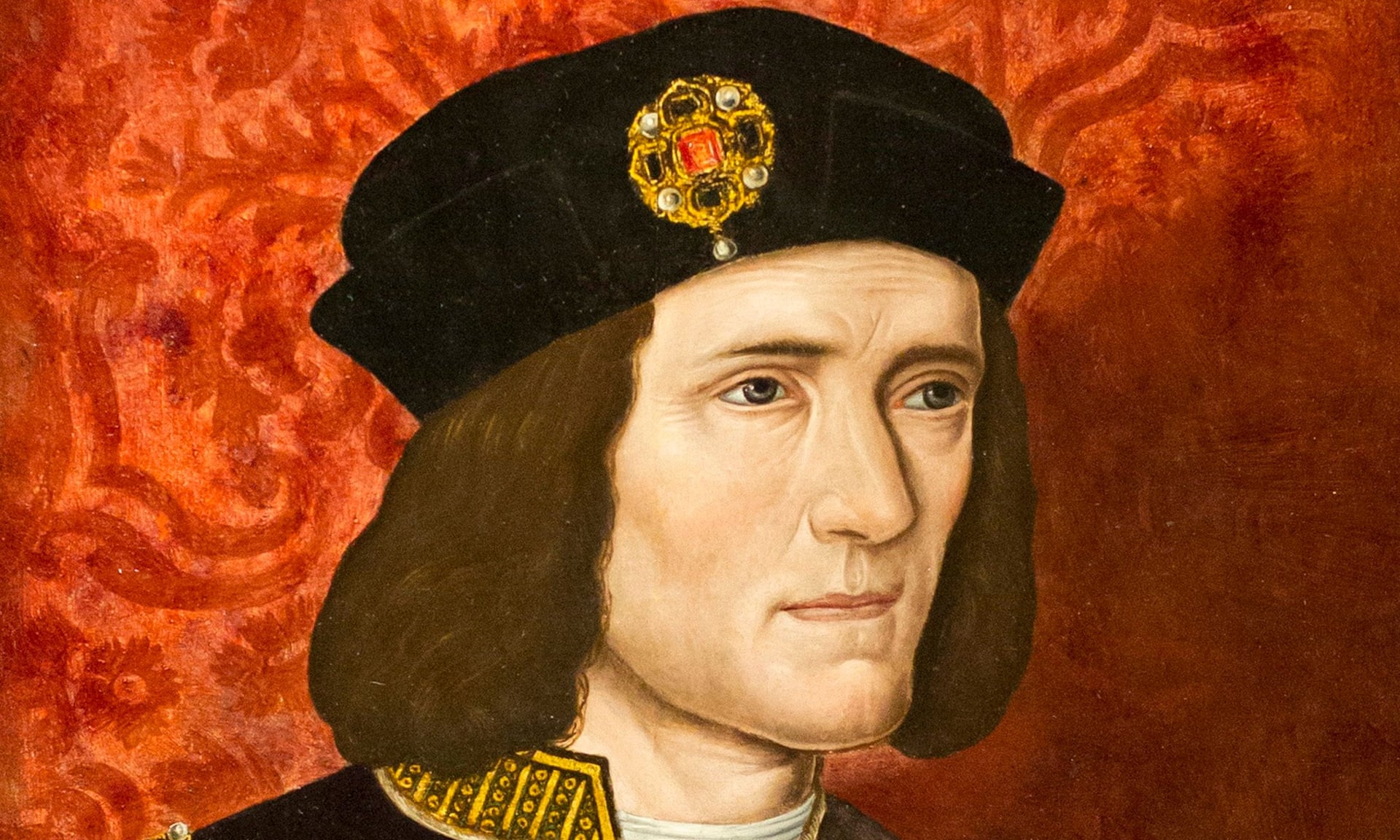
Richard III DNA tests uncover evidence of further royal scandal

Latest genetic tests reveal another break in the male line, potentially undermining the legitimacy of the entire House of Plantagenet


When scientists revealed last year that an adulterous affair had apparently broken the male line in Richard III’s family tree, they vowed to investigate further.
But rather than clear up the mystery, their latest genetic tests have uncovered evidence of another royal sex scandal. This time, the indiscretion could potentially undermine the legitimacy of the entire House of Plantagenet.
The skeleton of Richard III, the last Plantagenet king, was discovered under a car park in Leicester in 2012. His identity was confirmed through his mitochondrial DNA, passed down through the maternal line from his sister to two relatives alive today.
But further DNA tests soon uncovered evidence of a family secret. It emerged when researchers at Leicester University compared the Y chromosomes of Richard III and five anonymous male relatives of Henry Somerset (1744-1803), who claim descent from Edward III, the great great grandfather of Richard III.
Read the rest of this article...

Monday, March 23, 2015

Human parasites found in medieval cesspit reveal links between Middle East and Europe


Analysis of a latrine in Jerusalem that dates back over 500 years finds human parasites common in northern Europe yet very rare in Middle East at the time, suggesting long-distance trade or pilgrimage routes and shedding light on prevalent infectious diseases of the age. 


Image of excavation deep down into the latrine by the Ecole Biblique de  Jerusalem 
[Credit: Jean-Baptiste Humbert] 

A new analysis of a medieval cesspit in the Christian quarter of the old city of Jerusalem has revealed the presence of a number of ancient parasite eggs, providing a window into the nature and spread of infectious diseases in the Middle East during the 15th century. 

Researchers found evidence of six species of intestinal parasites in the over 500-year-old latrine. These included large quantities of roundworm and whipworm, both spread by faecal contamination of food and thought to be endemic to the region dating back to human evolution out of Africa.

Read the rest of this article...

Woolly mammoth could roam again as extinct DNA merged with elephant


Harvard University spliced recreated genes from a woolly mammoth into the DNA of an elephant and found they functioned normally


A major step forward in bringing back the woolly mammoth has been taken by scientists at Harvard University who have inserted DNA from the extinct mammal into the genetic code of an elephant.
Geneticists have studied DNA from mammoths which were preserved in Arctic permafrost looking for genes which separated them from elephants, such as hairiness and ear size.
They then replicated the genes and spliced them into the genetic code of an elephant where they functioned normally.
It is the first time that mammoth genes have been alive for more than 3,300 years - although so far it has only been done in the lab.
Read the rest of this article...

Richard III returns to Bosworth Field for final time


The last time Richard III was at Bosworth Field the outcome proved less than satisfactory for the King.
The battle, which was the last significant skirmish in the War of the Roses, saw Richard not only lose the English throne but also his life.
According to contemporaneous accounts, the dead monarch was stripped naked, slung over a horse and led back to Leicester, his skull banging against Bow Bridge as it was brought into the city. He was the last English king to die in battle.
Today Richard will have a more dignified entrance to Leicester when his body returns in ceremony within a custom-made coffin, borne on a gun carriage.
Read the rest of this article...

Did a volcanic cataclysm 40,000 years ago trigger the final demise of the Neanderthals?


The Campanian Ignimbrite (CI) eruption in Italy 40,000 years ago was one of the largest volcanic cataclysms in Europe and injected a significant amount of sulfur-dioxide (SO2) into the stratosphere. Scientists have long debated whether this eruption contributed to the final extinction of the Neanderthals. This new study by Benjamin A. Black and colleagues tests this hypothesis with a sophisticated climate model. 


Figure 4 in B.A. Black et al.: This image shows annually averaged temperature  anomalies in excess of 3°C for the first year after the Campanian Ignimbrite (CI)  eruption compared with spatial distribution of hominin sites with radiocarbon ages  close to that of the eruption [Credit: B.A. Black et al. and the journal Geology] 

Black and colleagues write that the CI eruption approximately coincided with the final decline of Neanderthals as well as with dramatic territorial and cultural advances among anatomically modern humans. Because of this, the roles of climate, hominin competition, and volcanic sulfur cooling and acid deposition have been vigorously debated as causes of Neanderthal extinction.

Read the rest of this article...

Romano-British roundhouse unearthed in Devon field


After a dig launched to culminate years of theorising by Howard Jones, a local archaeologist and former Royal Marine whose suspicions were strengthened by Google Maps, archaeologists are about to compile their findings from a set of four riverside fields near Plymouth which could have been part of one of Devon’s oldest settlements. 


A drone image of the roundhouse - shown by a ditch curving round - and several  internal post-holes in Spriddlestone [Credit: © One Plymouth Media] 

A wealth of artefacts from the Roman and medieval periods have already been identified since the two-week initial phase of the dig ended last weekend. Having made his way across the fields in pursuit of convincing preparatory evidence, Jones found receptive allies in the form of rugby club hosts, volunteers from local history and archaeology societies and local newspaper the Western Morning News.

Read the rest of this article...

Wednesday, March 18, 2015

DNA study shows Celts are not a unique genetic group

A depiction of the Celtic Queen Boudicca from AD 1. Why are Celts' descendents not a single genetic grouping?

A DNA study of Britons has shown that genetically there is not a unique Celtic group of people in the UK.
According to the data, those of Celtic ancestry in Scotland and Cornwall are more similar to the English than they are to other Celtic groups.
The study also describes distinct genetic differences across the UK, which reflect regional identities.
And it shows that the invading Anglo Saxons did not wipe out the Britons of 1,500 years ago, but mixed with them.
Published in the Journal Nature, the findings emerge from a detailed DNA analysis of 2,000 mostly middle-aged Caucasian people living across the UK.
Read the rest of this article...
Tuesday, March 17, 2015

Anthropocene: New dates proposed for the 'Age of Man'


The Anthropocene - a new geological time period that marks the "Age of man" - began in 1610, a study suggests.
Scientists believe that the arrival of Europeans in the Americas had an unprecedented impact on the planet, marking the dawn of this new epoch.
Others say that the industrial revolution or the first nuclear tests better signal the start of the Anthropocene.
While some believe the exact date for a new epoch can only be determined with the benefit of thousands or even millions of years of hindsight.
Read the rest of this article...

New research indicates homosexuality prevalent in early Christian Rome


Dr Mark Masterson, from Victoria’s School of Art History, Classics and Religious Studies, has analysed communications of all kinds from the late fourth and early fifth centuries to develop a fuller picture of late-ancient men. This includes correspondence between men, as well as legal notices from the authorities of the time which initially ruled against homosexual prostitution and later perhaps against homosexuality itself, although, Dr Masterson says, the law is unclear. 


Detail of a relief from a late Roman sarcophagus (ca. 250 AD)  
[Credit: © Marie-Lan Nguyen/WikiCommons] 

“While sex between men wasn’t against the law in those times, it was explicitly frowned upon by the authorities,” he says.  “But the very fact that the authorities talk about how men ‘must not do this with another man’, using humorous language and puns, reveals that these activities were prevalent and quite well-known. After all, you don’t make decrees against an activity unless it’s something that actually happens in society.” 

Many of the letters between men featured an element of ‘bromance’, says Dr Masterson. “They use super warm language and when you analyse it you find that they’re quoting erotic poetry to each other, as well as using words of love. Although this might not necessarily mean they are having a sexual relationship, their friendship is portrayed in a sexual way to underline its closeness. If you read letters like these between a man and a woman you’d figure they were having a sexual relationship.”

Read the rest of this article...

Pompeii's Villa of the Mysteries reopens


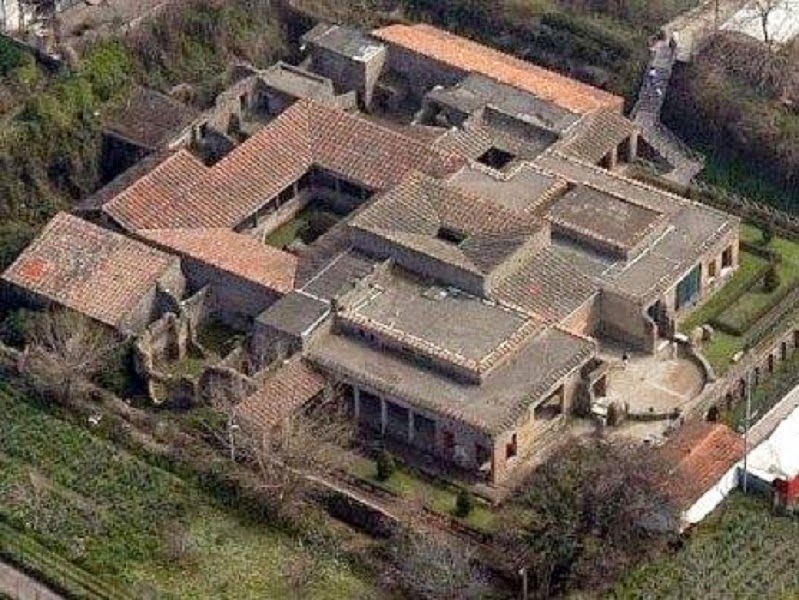
Pompeii's biggest house, the Villa of the Mysteries, is set to reopen in its entirety on March 20, following nearly two years of restoration work that began in May 2013. 


Aerial view of the Villa of the Mysteries at Pompeii [Credit: AD 79 Eruption] 

The restoration was funded by the Special Superintendency for the Archaeological Heritage of Naples and Pompeii (SANP) and was conducted in lots so that parts of the Villa were still open to the public throughout the restoration process. 

The Villa was first discovered in excavations in 1909 and was exceptionally well-preserved despite the eruption of Vesuvius in 79 A.D., which covered it in a layer of over 30 feet of volcanic ash. 

The recent restoration work, which involved 70 rooms of the Villa, corrected some of the damage inflicted by previous restoration techniques that were found to be harmful to the Villa's frescoes over the years.

Read the rest of this article...

Wealth and power may have played a stronger role than 'survival of the fittest'


The DNA you inherit from your parents contributes to the physical make-up of your body -- whether you have blue eyes or brown, black hair or red, or are male or female. Your DNA can also influence whether you might develop certain diseases or disorders such as Crohn's Disease, cystic fibrosis, hemophilia or neurofibromatosis, to name a few.

In a study led by scientists from Arizona State University, the University of Cambridge, University of Tartu and Estonian Biocentre, and published March 13 in an online issue of the journal Genome Research, researchers discovered a dramatic decline in genetic diversity in male lineages four to eight thousand years ago -- likely the result of the accumulation of material wealth, while in contrast, female genetic diversity was on the rise. This male-specific decline occurred during the mid- to late-Neolithic period.
Melissa Wilson Sayres, a leading author and assistant professor with ASU's School of Life Sciences, said, "Instead of 'survival of the fittest' in biological sense, the accumulation of wealth and power may have increased the reproductive success of a limited number of 'socially fit' males and their sons."

Read the rest of this article...