Wednesday, September 17, 2014

New bog body discovered in Co. Meath


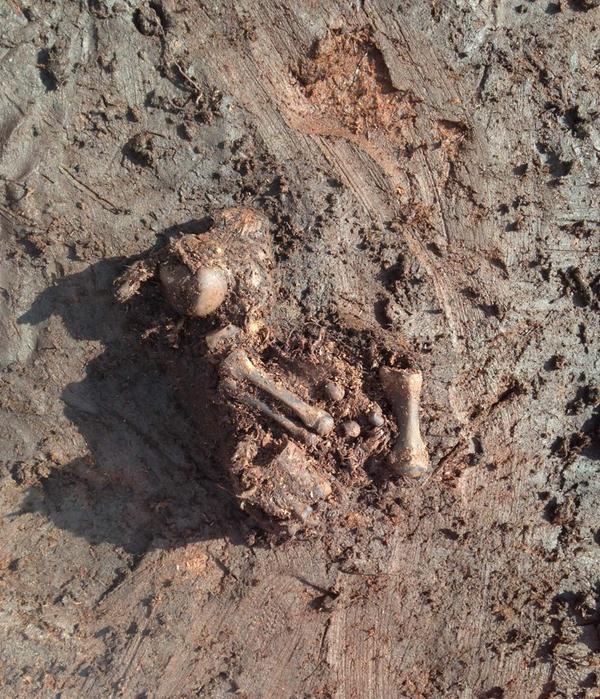
A new, partially intact bog body has been discovered by Bord na Mona workers in Co Meath. Archaeologists from the National Museum of Ireland (NMI) have confirmed that it is working on a find of human remains in a bog near the border with Co Westmeath, at Rossan bog.


 Bog body remains of adult discovered last weekend at Rossan Bog, Meath  [Credit: National Museum Ireland] 

Archaeologist Maeve Sikora told the Irish Examiner that workers from Bord na Mona came across the remains. 

“Archaeologists and conservators from The National Museum of Ireland have been on site investigating the findspot of archaeological human remains in a bog in Co. Meath, near the border with Co. Westmeath,” Ms Sikora said.

Read the rest of this article...

King Richard III killed by blows to skull

Forensic teams studied the skeleton to determine the nature of the injuries and weapons that were used

King Richard III was probably killed by two blows to the head during a "sustained attack", according to new scientific research.
The English king was killed at the Battle of Bosworth on 22 August, 1485.
Forensic teams at the University of Leicester have now revealed he suffered at least 11 injuries, some possibly inflicted after death.
CT scans were used on his 500-year-old skeleton to help determine his injuries and the medieval weapons used.
Read the rest of this article...

Tuesday, September 16, 2014

Kingsmead Quarry – Roman Burial Discovered with Bronze Rings


One of the discoveries from this year’s excavation at the CEMEX Kingsmead Quarry is a human burial with bronze ear or hair rings. As with other skeletons at the Quarry, the bone is poorly preserved. In this case some of the bone, including the skull was block lifted for excavation in the lab by WA staff  – osteoarchaeologist Kirsten Dinwiddy and conservator Lynn Wootten. X-rays of the soil block discovered objects of bronze on either side of what remained of the skull including a set of three fine bronze rings and a single ring made from a twisted strip of probable bronze.
 
The soil blocks will now be carefully excavated to record the position of the rings relative to the remains of the skull to try and determine whether they are hair or ear rings. Provisional examination of the form and style of the rings suggest that the burial could be of Late Iron Age or Roman date and may well be an inhabitant of the nearby settlement that was found during previous work.

Read the rest of this article...

New bog body found in Rossan, Co. Meath

New bog body remains (photo National Museum of Ireland)

Exciting news. The partial remains of a bog body has been uncovered in Rossan bog near Kinnegad in Co. Meath. The find was discovered by Bord na Móna workers and subsequently excavated by a team of archaeologists, led by Maeve Sikora of the National Museum of Ireland. Although as yet undated the remains were found in an area that has previously produced bog body remains (Moydrum Man) that were radiocarbon dated to the Early Iron Age (700-400 BC).

This latest addition to growing a corpus of Irish bog bodies will hopefully reveal as much information as two recent peat land discoveries. These aforementioned bog bodies, Old Croghan man and Clonycavan man, form the centre piece of the excellent Kingship and Sacrifice display at the National Museum of Ireland. What is striking about these remains is their fantastic state of preservation, something which is characteristic of bog bodies in general. This is primarily due to the cold, acidic, oxygen-free conditions that persist beneath peat bogs and which prevent decay and mummify human flesh.

Read the rest of this article...

Digital Epigraphy


The Oriental Institute has released a new book titled Digital Epigraphy, a manual for the methods that they are using to record items found in their Epigraphic Survey.
During the past several decades the Epigraphic Survey has refined its conventions and recording methodologies to fit with the widely divergent nature of the inscribed surfaces we record and the changing conditions in Egypt that are resulting in the accelerating decay of those inscribed surfaces. For the past two years we have been experimenting with new digital tools, software, and equipment that have allowed us to streamline our recording process while still achieving the highest degree of accuracy, the bottom line of any scientific documentation. It has always been our aim to share these conventions and methodologies with our friends and colleagues, and it is our great pleasure to present the initial results here now. The digital formats in which this manual is made available are particularly appropriate and will be updated and changed regularly, since the manual will always be a work in progress. The possibilities are limitless.
The free volume is available from their website as either a PDF or ePub book.

Open Source Computing and GIS in the UK


Two weeks ago now saw the return of the OSGIS conference in Nottingham, after a year off in 2013 for FOSS4G. I think there had been mixed feelings about this event; those of us heavily involved in the organisation of FOSS4G 2013 had taken a back seat this year, and with FOSS4G 2014 imminent in Portland, it was clearly going to be a smaller scale get together.
I have to say that overall, my impression is that small is good! Small allows you to chat to everyone, see everything you want to see, and generally enjoy, rather than rush around like a mad man or woman. It was nice to see some new faces, and to see a number of papers from local government and business, belying the idea that OSGIS is primarily an academic event. Thanks as always to the chaps at Nottingham for organising.
Astun had a strong showing at the event, with two workshops and two presentations. My colleague Matt Walker did a workshop on OpenLayers3 and Leaflet, and I did one on WPS and PgRouting (a beginners guide). I did a quick introduction to Portable GIS, and another colleague Antony Scott did a comparison to web servers. You can see the workshops at the Astun Technology GitHub pages. As a slight techy aside, Matt and I collectively decided to try GitBookfor preparing our workshops, and we’re both very impressed. If you’re interested in a cheeky workflow for pushing a gitbook directly to GitHub gh-pages, see this gist.
Read the rest of this article...

Mystery Surrounds Skeletons in Mass Grave

Further tests will be conducted on skeletons initially recovered from a centuries-old mass grave in Durham City, in the UK, in 2013.
Initial analysis on the bones of 28 individuals recovered from the site provided some evidence regarding their origins and identity, but was inconclusive.
The tests, coordinated and partly carried out by Durham University’s Department of Archaeology, included examination of the human bones by academic specialists; radiocarbon dating of two individuals and a programme of isotope analysis to ascertain diet.
The University will commission radiocarbon dating of some of the other skeletons, with results expected in the New Year.  
Read the rest of this article...

Groundwater tied to human evolution

Insert shows with arrow the location of study area in eastern Africa. Map of the Northern Tanzanian Divergence Zone depicts the East African Rift System (EARS), containing Lake Natron (north), diverging around the Ngorongoro Volcanic Highland massif and splitting into two separate rift valleys (Lake Eyasi on west) and Lake Manyara (on east). Prevailing wind is from the east. Olduvai basin lies to the west of and in the rain shadow of Ngorongoro.
Credit: Map made by Sara Mana, http://www.geomapapp.org; from Cuthbert et al., doi:10.1371/journal.pone.0107358.g001

Our ancient ancestors' ability to move around and find new sources of groundwater during extremely dry periods in Africa millions of years ago may have been key to their survival and the evolution of the human species, a new study shows.
The research -- published in the journal PLOS ONE -- combines geological evidence from the Olduvai sedimentary basin in Northern Tanzania, which formed about 2.2 million years ago, and results from a hydrological model.
It shows that while water in rivers and lakes would have disappeared as the climate changed due to variations in Earth's orbit, freshwater springs fed by groundwater could have stayed active for up to 1000 years without rainfall.

Read the rest of this article...

Hitting the jackpot on a dig in Gernsheim: Long lost Roman fort discovered

Legion surnamed " Primigenia Pia Fidelis ". This Roman elite unit was from the late 1st century. Chr. Kästrich in Mainz (Mogontiacum) formed the strategic backbone of the Roman frontier defense in the province of Upper Germany.
Credit: Image courtesy of Goethe-Universität Frankfurt am Main

In the course of an educational dig in Gernsheim in the Hessian Ried, archaeologists from Frankfurt University have discovered a long lost Roman fort: A troop unit made up out of approximately 500 soldiers (known as a cohort) was stationed there between 70/80 and 110/120 AD. Over the past weeks, the archaeologists found two V-shaped ditches, typical of this type of fort, and the post holes of a wooden defensive tower as well as other evidence from the time after the fort was abandoned.
An unusually large number of finds were made. This is because the Roman troops dismantled the fort and filled in the ditches when they left. In the process they disposed of a lot of waste, especially in the inner ditch. "A bonanza for us," according to Prof. Dr. Hans-Markus von Kaenel from the Goethe University Institute of Archaeology. "We filled box after box with shards of fine, coarse and transport ceramics; dating them will allow us to determine when the fort was abandoned with greater accuracy than was possible before."
Read the rest of this article...

Monday, September 15, 2014

NEOLITHIC NECROPOLIS CONTAINS TWENTY MONUMENTAL TOMBS

Hypothetical reconstruction of the plain occupied by the cemetery. © Laurent Juhel / Inrap

A team of archaeologists is currently conducting excavation work on 20 hectares of land in Fleury-sur-Orne (northwestern France), which is earmarked for residential development. This site has revealed an important Middle Neolithic (4500 BC) necropolis containing twenty monuments and some intact burials.
During the Middle Neolithic new types of monuments appear: constructions of earth and wood, varying in length from a few dozen to several hundred metres. These monumental tombs, the first of their kind are called “Passy” – named after the eponymous site found in Yonne (Burgundy).

Monumental funerary architecture

These large, elongated structures are bounded by ditches which may be associated with fences, and a mound entombs the deceased. In a break with past traditions, these large monuments suggest that a type of hierarchy has been introduced into society.
Read the rest of this article...

Roman settlement found at new homes' site


Archaeologists have uncovered the remains of a Roman settlement on a site earmarked for a new development. 


The clear line of a Roman road was found on the proposed  development site [Credit: BBC] 

A University of Leicester team excavated a nine-acre site in Aston Clinton, Buckinghamshire, as a condition of the planning permission for 48 homes. 

As well as dwelling remains, it found the line of a Roman road and burials. The development will go ahead with the site's story "preserved by record", the county council said.

Read the rest of this article...

Two 1,000-year-old skeletons holding hands found by archaeologists in Leicestershire


Volunteers Lotty Wallace and Ken Wallace work on a small section of the excavation.


Centuries-old skeletons holding hands have been uncovered at a “lost” chapel by archaeologists.

The remains, of a man and a woman, were found at the Chapel of St Morrell, an ancient site of pilgrimage in Hallaton.

Tiles from a Roman building, were found underneath the chapel.

The dig, by Hallaton Fieldwork Group volunteers, has been taking place for two weeks a year for four years.

Read the rest of this article...

Stonehenge researchers discover site is much larger than previously thought

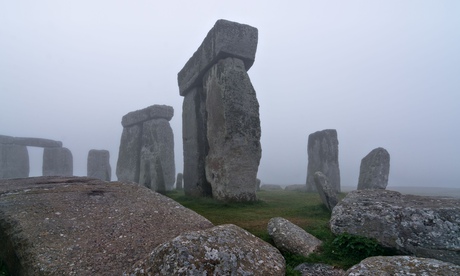
Stonehenge. Photograph: Geert Verhoeven/University of Bi/PA
Stonehenge stood at the heart of a sprawling landscape of chapels, burial mounds, massive pits and ritual shrines, according to an unprecedented survey of the ancient grounds.
Researchers uncovered 17 new chapels and hundreds of archaeological features around the neolithic standing stones on Salisbury Plain, Wiltshire, including forms of monuments that have never been seen before.
Brought together for the first time in a digital map of the historic site, the discoveries transform how archaeologists view a landscape that was reshaped by generations for hundreds of years after the first stones were erected around 3100BC.
Read the rest of this article...

Grave finds at Hungate dig in York


Archaeologists at a site in York have found glass, tiles, pots, pipes and human remains. Members of the Hungate Dig, organised by the York Archaeological Trust, have recently found items dating back to the 12th century, including cattle horn and skull fragments which were by-products of leather production from the early 19th century. 


Work under way on grave cuts along the rectory's  north wall [Credit: York Press] 

Now, all the items found are being placed into bags ready to be analysed, with trainees keeping records which will serve the trust for many years to come. 

A spokesman said: “The benefit of being quite so fussy is that the records go on to make up our final site archive – nothing is re-done and it is this archive that forms the basis of the final site report.”

Read the rest of this article...

Une nécropole du Néolithique moyen à Fleury-sur-Orne


Une équipe d’archéologues de l’Inrap mène actuellement, sur prescription de l’État (Drac Basse-Normandie), une fouille de 20 hectares à Fleury-sur-Orne, dans le cadre de l’aménagement de quartiers d’habitation par Normandie Aménagement et l’agglomération de Caen-la-Mer. Le site révèle une importante nécropole du Néolithique moyen (4500 avant notre ère) contenant une vingtaine de monuments funéraires dont un tertre encore intact.

Read the rest of this article...

Friday, August 22, 2014

Gold coin may be key to solve Sweden's 'Pompeii'


    Archaeologists found the coin on Monday at a site on the island of Öland that's been compared to Italy's Pompeii. 
    A small team of archaeologists at Kalmar County museum, in collaboration with Lund University, has been digging at the site for the past three years. The team is studying the Migration Period in Scandinavian history, from about 400 to 550 AD, centuries before the Viking Age.
    Read the rest of this article...

    Archaeologists Find Humans Were Eating Snails 30,000 Years Ago


    Paleolithic humans of present-day Spain may have eaten snails as much as 30,000 years ago, or 10,000 years earlier than inhabitants of Mediterranean regions, according to research by Javier Fernández-López de Pablo from Institut Català de Paleoecologia Humana i Evolució Social and colleagues.
    The researchers discovered land snail shell remains dated to about 30,000 years ago at the site of Cova de la Barriada, Spain. Groupings of complete shells from a large land snail species were found in three areas of the site, corresponding to different time points. They studied these remains by investigating patterns indicating likley land snail selection, consumption, and accumulation at the site, and then analyzed the shells' decay, fossilization process, composition, and age at death by measuring the shell sizes.
    Read the rest of this article...

    Humans Did Not Wipe Out the Neanderthals, New Research Suggests


    Neanderthals went extinct in Europe about 40,000 years ago, giving them millennia to coexist with modern humans culturally and sexually, new findings suggest.

    This research also suggests that modern humans did not cause Neanderthals to rapidly go extinct, as some researchers have previously suggested, scientists added.

    Neanderthals are the closest extinct relatives of modern humans, and lived in Europe and Asia. Recent findings suggest that Neanderthals were closely related enough to interbreed with ancestors of modern humans — about 1.5 to 2.1 percent of the DNA of anyone outside Africa is Neanderthal in origin.

    Read the rest of this article...

    Tuesday, August 19, 2014

    Before they left Africa, early modern humans were 'culturally diverse'

    A new study provides fresh insights into the life of early modern humans before they left Africa following a massive comparative study of stone tools.

    Researchers have carried out the biggest ever comparative study of stone tools dating to between 130,000 and 75,000 years ago found in the region between sub-Saharan Africa and Eurasia. They have discovered there are marked differences in the way stone tools were made, reflecting a diversity of cultural traditions. The study has also identified at least four distinct populations, each relatively isolated from each other with their own different cultural characteristics.

    Read the rest of this article...

    Archaeologists compare Neolithic Kent site to Stonehenge, find Bronze Age funerary monument


    A Neolithic ditch which became a huge funerary monument when it was enlarged with an outer ring during the Bronze Age has been found on housing development grounds in Kent


    Archaeologists suspect a “sacred way” could have led to a henge 6,000 years ago at Iwade Meadows, to the west of the Kent industrial town of Sittingbourne.

    Positioned on a north-west slope, the 30-metre diameter structure is one of several prehistoric monuments on a north-west slope above the Ridham fleet stream running through the centre of the site.

    “Its purpose is not known,” says Dr Paul Wilkinson, of excavators SWAT Archaeology.


    Read the rest of this article...