Wednesday, May 28, 2014

2,300-year-old false tooth removed in northern France


Iron implant is same size and shape as incisors found with Celtic woman's remains – and was likely added after death
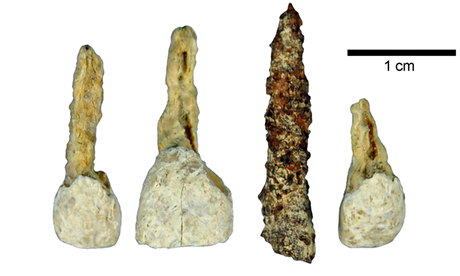
An iron false tooth found with real teeth at a Celtic grave at Le Chene, France. The implant is the oldest of its kind so far discovered in western Europe. 
Photograph: Antiquity Publications Ltd

An iron tooth implant fitted about 2,300 years ago has been found in the grave of a young woman in northern France. Archaeologists believe it may have been fitted to beautify her corpse, as it would have been too excruciating to have had it hammered into the living jaw.


The corroded piece of metal is the same size and shape as the other incisors from her upper jaw – which did not survive as the timber tomb collapsed and crushed her skull – and its appearance may originally have been improved by a wooden or ivory covering.

Read the rest of this article...

Decoding Anglo-Saxon art

Silver-gilt square-headed brooch from Grave 22, Chessell Down, Isle of Wight. Early Anglo-Saxon, early 6th century AD

One of the most enjoyable things about working with the British Museum’s Anglo-Saxon collection is having the opportunity to study the intricate designs of the many brooches, buckles, and other pieces of decorative metalwork. This is because in Anglo-Saxon art there is always more than meets the eye.
The objects invite careful contemplation, and you can find yourself spending hours puzzling over their designs, finding new beasts and images. The dense animal patterns that cover many Anglo-Saxon objects are not just pretty decoration; they have multi-layered symbolic meanings and tell stories. Anglo-Saxons, who had a love of riddles and puzzles of all kinds, would have been able to ‘read’ the stories embedded in the decoration. But for us it is trickier as we are not fluent in the language of Anglo-Saxon art.
Read the rest of this article...

Sunday, May 25, 2014

Maryport Roman Settlement Excavation Yields New Finds


The Hadrian's Wall Trust's research and community archaeology project at the Maryport Roman settlement - directed by Oxford Archaeology North and funded by philanthropist Christian Levett - is revealing new evidence and raising more questions about this internationally famous site.

Site director John Zant said: "We're piecing together the complex story of the site over at least a couple of hundred years from around AD 100 to AD 300.

"From our work so far it's possible there may be an earlier fort than the remains we can see in the next field, and possibly even a lost Roman harbour to the north of the present day harbour.

Read the rest of this article...

Iron Age settlement unearthed at building site


A small Iron Age settlement has been found during excavations at the site of a new housing development near Swindon. 


Further digging at Ridgeway Farm is expected to continue for up to three weeks  

[Credit: Taylor Wimpey/BBC] 

A number of "round houses" with hundreds of pits for storage are among the discoveries at Ridgeway Farm, where Taylor Wimpey is building 700 homes. 

Other items found include loom weights for weaving, quern stones for grinding corn and various personal items.

Read the rest of this article...

Richard III reburial court bid fails


Distant relatives of King Richard III have lost their High Court battle over where his remains should be reburied.
His remains were found in a Leicester car park in 2012 and the city's cathedral was lined up for his tomb, but some wanted him reburied in York.
But a group claiming descent from the king's wider family were granted a judicial review, arguing more views should have been taken into account.
Judges at the High Court said there was "no duty to consult".
Read the rest of this article...

Nottingham: The city where they keep finding caves


Rock Cottage is built into Nottingham Castle's wall (top left) as is Ye Olde Trip to Jerusalem (bottom left); Mortimer's Hole (right) is a popular tourist destination

Nottingham's 544 caves have been used as everything from dungeons to bomb shelters throughout history but 100 of them were only discovered in the past four years. Take a look at how many of the caverns are still in use today.

In 1330, the young King Edward III and a group of conspirators crept through a secret tunnel into the city's castle and took prisoner Roger de Mortimer, a nobleman who had until then effectively been England's ruler.
The tunnel later became known as Mortimer's Hole but this daring coup was made possible by the city's network of man-made caves within the sandstone rock.
The caves appear to have existed for as long as Nottingham and as far back as 868, a Welsh monk named Asser referred to the settlement as Tig Guocobauc, which means "house" or "place of caves".
Read the rest of this article...

Friday, May 23, 2014

Skeleton executed by sword blows to head poses questions on Norman Conquest

A potentially groundbreaking discovery has been announced as part of the 750th anniversary commemorations of the Battle of Lewes in Sussex
© Courtesy Sussex Archaeological Society

An unusual set of battlefield burials have led to the skeleton of the first ever human discovery directly related to the 11th century Norman Conquest

A brutally-murdered man, executed by six sword blows to the back of the skull during a vicious 11th century battle on hospital grounds in Sussex, is compelling archaeologists to reconsider Norman war burials after becoming the first ever skeleton to be related to the 1066 invasion.

Originally discovered during a dig at a former medieval hospital more than 20 years ago, the individual has been carbon dated to within 28 years of 1063.

Read the rest of this article...

GIS technology verifies Caesar and Helvetii history

According to Caesar, more than a quarter of a million Helvetii were settled in the Swiss plateau before they decided to abandon their territory and invade Gaul in 58 BCE.


According to Caesar, more than a quarter of a million Helvetii were settled in the Swiss plateau before they decided to abandon their territory and invade Gaul in 58 BCE

AN INTERNATIONAL team is using Geographic Information Systems (GIS) modelling to assess Julius Caesar’s account of his war with a Celtic tribe.
According to Caesar, more than a quarter of a million Helvetii were settled in the Swiss plateau before they decided to abandon their territory and invade Gaul in 58 BCE.
In his Gallic Wars he says the Helvitii were running out of food.
UWA archaeologist Tom Whitley is developing a GIS model to test Caesar’s population estimate and is testing geophysical techniques to see if they can detect signs of the migration and war.
Read the rest of this article...

7,000-year-old cave paintings found in Spain


Archaeologists in eastern Spain have discovered 12 prehistoric rock paintings depicting hunting scenes from 7,000 years ago. 


The site's location is being kept a secret until the necessary security  precautions are in place [Credit: Vilafranca Town Hall] Town hall representatives in the Valencian municipality of Vilafranca announced the finding on Tuesday, the first of its kind and importance for many years in the region. 

Although archaeologists are still searching the area for more rock paintings, their work has already unveiled detailed depictions of prehistoric hunting; including bulls, goats and archers chasing them down.

Read the rest of this article...

Mit dem Multicopter auf archäologischer Spurensuche

»Unmanned Aerial Vehicle« (UAV), hier ein Hexacopter, im Einsatz. 
Foto: AlejandroLinaresGarcia, CC-BY-SA

Der Einsatz von unbemannten Luftfahrzeugen, sogenannten Multicoptern, in Archäologie und Denkmalpflege ist Thema einer internationalen Tagung des Exzellenzclusters Topoi und des EU-Projekts "ArcheoLandscapes Europe", die derzeit an der Freien Universität Berlin stattfindet.

Teil des Expertentreffens ist eine öffentliche Flugvorführung im Thielpark in Berlin-Dahlem am Samstag, den 24. Mai von 10 bis 12 Uhr, bei der die verschiedenen Luftfahrzeuge im Einsatz zu erleben sind. Von 13 bis 15 Uhr können sich Interessierte außerdem über die Auswertung der aufgenommenen Landschaftsdaten in dreidimensionalen Modellen informieren.

Read the rest of this article...

Tuesday, May 20, 2014

Earliest houses, Bronze Age cremations and tools found by archaeologists in Scotland

An early Bronze Age food vessel found at East Challoch Farm in the south of Scotland
© Guard Archaeology

A Neolithic home which is south-west Scotland’s earliest known house, two cemeteries carrying 20 Bronze Age cremations, a pair of rare jet necklaces and thousands of flint tools used in Mesolithic coastal industries have been discovered during the creation of a bypass in Dumfries and Galloway.

Work on the new Dunragit intersection has uncovered a huge variety of artefacts from 7,000 years of Scottish history. Criss-crossing palaeochannels on the edge of a former estuary obscured a house which is thought to date from 6000 BC, accompanied by a perforated stone adze used to work wood.


The remains of Neolithic dwellers are thought to come from a nearby ceremonial complex excavated by Manchester University diggers more than a decade ago, unearthing three concentric rings of timber posts initially spotted through aerial photography.

Read the rest of this article...

Baby mammoth goes on display in UK


A perfectly preserved baby mammoth which died 42,000 years ago has been unveiled at the Natural History Museum in London.
Named Lyuba by the Siberian deer herder who discovered her in 2007, the specimen is 130cm tall and weighs 50kg.
Palaeontologist Prof Adrian Lister described seeing her for the first time as an "incredible experience".
Transported in a box that was opened on Monday, the juvenile female mammoth looked almost intact.
Read the rest of this article...

Scans bring new insights into lives of Egyptian mummies


Never before has anyone seen mummy hair, muscles and bone at such fine resolution.
It is enabling scientists for the first time to tell their age of the mummies, what they ate, the diseases they suffered from, and how they died.
Each mummy was put into a state-of-the-art CT scanner. Researchers probed them layer by layer to build up a high-definition 3D picture of each one. Once digitised, British Museum staff were then able to peel away each layer, to see the face of the person underneath the bandages.
Read the rest of this article...

Monday, May 19, 2014

Scottish road works unearth Iron Age village


An Iron Age village along with a host of ancient artefacts including tools and jewellery have been discovered on a construction site of a new bypass for a Scottish town. 


Archaeologists have uncovered a range of artefacts and sites, including an Iron Age village, ahead of construction of a new road in southwest Scotland [Credit: Historic Scotland] 

The treasure trove unearthed during the building of the £17 million A75 Dunragit bypass in Wigtownshire sheds new light on land use and settlement in the area over the past 9,000 years. 

The discoveries include a rare and complete 130-piece jet bead necklace dating about 2000BC – the first of its kind ever discovered in south-west Scotland.

Read the rest of this article...

Dunragit road works unearth ancient treasure trove

A neolithic arrowhead found during the construction of Dunragit bypass. 
Picture: Transport Scotland

AN IRON Age village along with a host of ancient artefacts including tools and jewellery have been discovered on a construction site of a new bypass for a Scottish town.

The treasure trove unearthed during the building of the £17 million A75 Dunragit bypass in Wigtownshire sheds new light on land use and settlement in the area over the past 9,000 years.

The discoveries include a rare and complete 130-piece jet bead necklace dating about 2000BC – the first of its kind ever discovered in south-west Scotland.

Read the rest of this article...

Tomb found in Ayios Silas in Limassol

Workers came across significant archaeological finds when digging for a landscaping assignment

THREE burial chambers estimated to be from the late Hellenistic period were accidentally discovered on Tuesday afternoon in a plot in Ayios Silas in Limassol.
The tomb came to light when during landscaping works, an excavator hit the roof of a cave which collapsed and revealed skeletal remains, amphorae and coins.
The Antiquities Department was notified by the police.
So far, amphorae, seven skeletal remains and other small items were found. According to Yiannis Violaris, archaeologist of the Antiquities Department’s Limassol District, the tomb is estimated to be from the late Hellenistic period, between the second and first centuries BC, while modern day items which were found in the tomb are attributed to a probable older collapse of the roof.
Read the rest of this article...

Possible Viking settlement in the Ålands found


According to archaeologists aerial infrared images suggest the existence of a late Iron Age settlement, possibly the largest such find ever in the Åland Islands or all of mainland Finland. 


The highest point of Åland Islands: summit of Orrdalsklint, in Saltvik 
[Credit: RainoL/Panoramio] 

The aerial imaging highlighted a depression 40 metres deep and 12 metres wide which might have been the site of a massive hall used to host gatherings of ancient Vikings. No other similar find of this size has ever been discovered in the Åland of on the Finnish mainland. 

The imaging project followed observations of depressions which resembled the outlines of late Iron Age structures from other parts of Scandinavia. Once the images revealed the outline of the hall, cautious excavation turned up personal ornaments cast in silver and bronze, and which point to the site as an important location in the Viking world.

Read the rest of this article...

Friday, May 16, 2014

Medieval 'pub culture' unearthed in London


Rare ale tankards and pipes used by drinkers in London more than 650 years ago have been unearthed near the city’s oldest railway station. 


These timbers are estimated to be around 1,000 years old and were found under  London Bridge station [Credit: Daily Mail] 

As part of the Thameslink Programme, archaeologists near London Bridge station have already uncovered several relics, including an ale flagon. 

The tankard was discovered during the installation of the Borough viaduct and it is believed that it was used to serve ale in the Abbot of Waverley’s town house. 

It is now on display in the Wheatsheaf pub in Stoney Street near to London Bridge and is owned by the Museum of London.

Read the rest of this article...

Archaeologists have confirmed the presence of a long-lost Roman military camp deep in eastern Germany. The 18-hectare site, found near the town of Hachelbich in Thuringia, would have sheltered a Roman legion of up to 5000 troops. Its location in a broad valley with few impediments suggests it was a stopover on the way to invade territory further east.


Soil marks where Roman soldiers once dug a trench to defend their temporary camp [Credit: © TLDA] 

“People have been searching for evidence of the Romans in this part of Germany for 200 years,” says team leader Mario Kuessner, an archaeologist working for the state of Thuringia. “It took a long time before we realized what we had, and we wanted to be sure.”

Read the rest of this article...

Stone Age items unearthed by work in Surrey


Rare archaeological findings dating back 10,000 years were unearthed during work to replace water mains in Surrey.


Archaeologists excavating the Roman villa uncovered near the River Mole [Credit: BBC] 

Work on the 2.2km pipe finished in May 2012 and it has taken two years to identify what was discovered.

 A Stone Age hunting camp and a Roman villa were among finds made during the work in Cobham Road, Fetcham, carried out by Sutton and East Surrey Water.

 The camp was the oldest find along items from the Bronze and Iron Ages, according to a report by researchers.

Read the rest of this article...