Sunday, February 16, 2014

Bronze Age skeleton removed from school playground


THE SKELETON of a small Bronze Age man with worn-away teeth was today removed from his grave a metre beneath a primary school playground.

The 4000-year-old remains were found by archaeologists surveying Victoria Primary School in Newhaven, Edinburgh, ahead of a proposed school extension.

The archaeologists stumbled upon the well-preserved bones in late January while looking for evidence of the village’s medieval harbour.

The body was curled up in a foetal position common in the Bronze Age, and positioned alongside a pottery food or drink vessel to sustain them in the journey to the next world.

Read the rest of this article...

Ancient Viking code deciphered for the first time


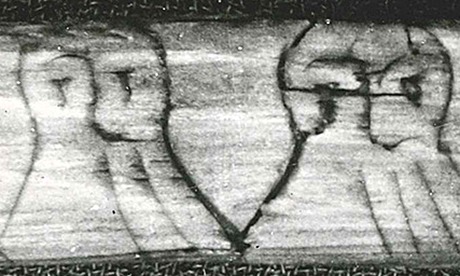
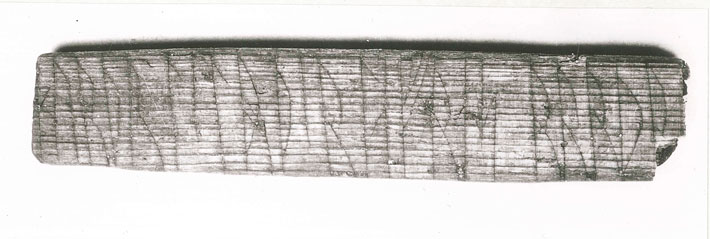
Mystery nosed out ... Fragment of wooden stick with runic inscription on one side found at the old wharf in Bergen. The text is written using a code where the number of 'hairs' in the beards of each face indicate the position of the character in the runic alphabet. Museum of cultural history, University of Oslo. Aslak Liestol Photograph: Aslak Liestol/Museum of Cultural History, University of Oslo
An ancient Norse code which has been puzzling experts for years has been cracked by a Norwegian runologist - to discover the Viking equivalent of playful text messages.
The mysterious jötunvillur code, which dates to 12th or 13th-century Scandinavia, has been unravelled by K Jonas Nordby from the University of Oslo, after he studied a 13th-century stick on which two men, Sigurd and Lavrans, had carved their name in both code and in standard runes. The jötunvillur code is found on only nine inscriptions, from different parts of Scandinavia, and has never been interpreted before.
Read the rest of this article...

Viking Code Cracked

OSLO, NORWAY—Runologist K. Jonas Nordby of the University of Oslo has deciphered the ancient Norse jötunvillur code, found on nine known inscriptions. Nordby used a thirteenth-century stick on which two men had carved their names, Sigurd and Lavrans, in standard runes and in the code. The confusing system requires that the reader have a good working knowledge of the runes in order to swap them out with others for sounds in their names. “What if codes were used like a game, playing with a system? With jötunvillur, you had to learn the names of runes, so I think codes were used in teaching, in learning to write and read runes,” he told The Guardian.

Read the rest of this article...

Ancient skeletons dug up at Florence's Uffizi


Work to expand the Uffizi Gallery's exhibit space has unearthed an ancient cemetery with dozens of skeletons archaeologists say might have been victims of the plague or some other epidemic that swept through Florence during the 4th or 5th century. 

In five months of digging, archaeologists uncovered 60 well-preserved skeletons in a cemetery apparently made in a hurry, perhaps a mass grave, with bodies laid side-by-side at roughly the same time [Credit: EPA / Maurizio Degl'Innocent] 

Archaeologists and art officials showed reporters Wednesday the excavation at the renowned museum. In five months of digging, archaeologists uncovered 60 well-preserved skeletons in a cemetery apparently made in a hurry, perhaps a mass grave, with bodies laid side-by-side at roughly the same time.

Read the rest of this article...

Saturday, February 15, 2014

Fire breaks out at National Archives in Kew, London


A fire broke out at the National Archives in Kew, home to some of the UK's most important historical documents.
Some 20 firefighters tackled the blaze, which affected two disused water towers at the site in Richmond, south-west London.
London Fire Brigade(LFB), which was called out at about 12:30 GMT, said the blaze was now out.
The National Archives is the official UK government archive and publisher.
Read the rest of this article...
Wednesday, February 12, 2014

Richard III DNA mapping: historic first lets experts look into eyes of Plantagenet king


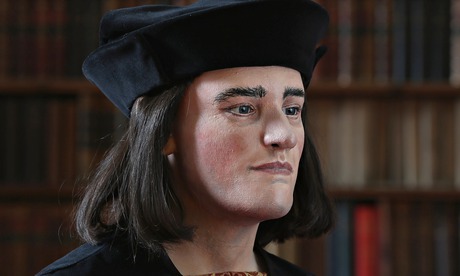
Richard III is to become the first historical figure to have his full genetic code sequenced, in a project that will reveal his hair and eye colour.
Archaeologists have already confirmed that the last Plantagenet king was a hunchback after finding a twisted spine when they recovered his skeleton from beneath a car park in Leicester.
Now they will be able to check whether portraits of a dark-haired brooding monarch are accurate. “It is an extremely rare occurrence that archaeologists are involved in the excavation of a known individual, let alone a king of England,” said Dr Turi King, from the University of Leicester, who is leading the gene sequencing project.
Read the rest of this article...

Is an earthquake behind the Shroud of Turin image?


Neutron radiation caused by 33 A.D. earthquake could have led to "wrong" 1988 radiocarbon dating of Shroud, suggest researchers 


Shroud of Turin [Credit: Springer] 

An earthquake in Old Jerusalem might be behind the famous image of the Shroud of Turin, says a group of researchers led by Alberto Carpinteri of the Politecnico di Torino in Italy in an article published in Springer's journal Meccanica. They believe that neutron radiation caused by an earthquake could have induced the image of a crucified man -- which many people believe to be that of Jesus -- onto the length of linen cloth, and caused carbon-14 dating done on it in 1988 to be wrong.

Read the rest of this article...

Richard III: Scientists to sequence DNA

Skull of Richard III
The project will allow DNA testing to take place before the remains are reburied

he DNA of Richard III is to be mapped, potentially revealing details like hair and eye colour, researchers have said.
The project is to be led by the University of Leicester geneticist who helped identify the remains.
His remains were found in a Leicester car park in 2012.
The £100,000 study, expected to last at least a year, aims to provide an archive of DNA information for historians, scientists and the public.
Details of Richard III's appearance are not known for certain because all portraits of him were done long after his death.
Read the rest of this article...

Richard III's DNA to be analysed to create complete genome sequence

Reconstruction of Richard III's face. The sequencing could reveal his susceptibility to diseases and whether the scoliosis which contorted his spine was genetic.
Photograph: Dan Kitwood/Getty Images

The bones of the king under the car park have more to tell: scientists are to analyse the DNA from the remains of Richard III to create the world's first complete genome sequence for a named historical figure.

The process could reveal his hair and eye colour, his susceptibility to conditions including Alzheimer's disease and diabetes, whether he was lactose intolerant, and whether the scoliosis that contorted his spine was genetic. It could also show if any of the surviving portraits, all completed years after his death, are accurate.

Read the rest of this article...

Tuesday, February 11, 2014

Gladiator Heads? Mystery of Trove of British Skulls Solved


A trove of skulls and other body parts unearthed in the heart of London may have once belonged to Roman gladiators, war captives or criminals, a new study suggests.
The remains, described in the January issue of the Journal of Archaeological Science, belonged to about 40 men, mostly ages 25 to 35, and were marred by violence: cheek fractures, blunt-force trauma to the head, decapitation and injuries from sharp weapons, said study co-author Rebecca Redfern, a curator and bioarchaeologist at the Museum of London. [In Images: Skulls of the Gladiators and War Captives]
Great Britain's ancient cities are littered with archaeological treasures, many of which are often dug up accidentally prior to construction. For instance, in 2013, the burial site of King Richard III was found under a parking lot in Leicester, England, and in April 2013, a medieval knight's tomb was uncovered under a Scottish parking lot.
Read the rest of this article...

Excavation work begins at Carrickfergus Castle to probe more of its history


Historical secrets locked within the walls of Ireland's best preserved Anglo Norman castle could be uncovered through a new archaeological excavation.

Experts started work at Carrickfergus Castle today in a bid to find out more about the 800-year-old fortification on the shores of BelfastLough.
Built in 1177 by Anglo Norman knight John de Courcy soon after his invasion of Ulster, the castle lies on the stretch of coastline where King William III landed in Ireland before the Battle of the Boyne in 1690.
Its storied history includes sieges by King John in 1210 and Edward Bruce in 1315 and capture by the French under Captain Francois Thurot in 1760.
Read the rest of this article...

UC Research Unveils How Some Medieval Cultures Adapted to Rise of Islam


UC history research examines how border areas and frontiers of the past adapted to major political, cultural and social shifts, specifically in terms of the rise of Islam in Asia and the Middle East.

Medieval Afghanistan, Iran and the one-time Soviet Central Asian states were frontiers in flux as the Islamic Caliphate spread beyond the Arabian Peninsula in the seventh through 10th centuries.
As such, different groups, such as the new Arab ruling class, the native landed gentry and local farmers, jockeyed for power, position and economic advantage over an approximately 300-year period as the Sasanian Empire collapsed and the Caliphate took its place.
Read the rest of this article...
NEAR EAST CROSSROAD OF THE PALAEOLITHIC NOW QUESTIONED


The Out-of-Africa model currently holds that anatomically modern humans (AMH) evolved and dispersed from Africa into Asia from about 50,000 years ago, and then continued on later into Europe. For this reason, palaeoanthropological evidence from the Near East assumes great importance, but remains of these early modern humans are extremely scarce.

Doubt over Palaeolithic migration route

The study published in PLOSone in September 2013  suggests they may have arrived in the Near East much later than previously theorised with a concurrent knock on effect that this region was not the single crossroads through which all early humans passed on their way to colonising the Eurasian landmass.

Read the rest of this article...

A 'smoking gun' on the Ice Age megafauna extinctions


Gut content

It was climate that killed many of the large mammals after the latest Ice Age. But what more specifically was it with the climate that led to this mass extinction? The answer to this is hidden in a large number of sediment samples from around the Arctic and in the gut content from permafrozen woolly rhinos, mammoth and other extinct ice age mammals.

It is a bit of a shift in paradigme Willerslev and co-workers publish in this week's edition of the journal Nature. The common image of a light-brown grass-steppe dominating the northern hemisphere during the Ice Age does not hold any longer. The landscape was far more diverse and stable than today, and big animals like woolly rhino and mammoth fed on grasses and particularly on protein-rich forbs. But at the Last Glacial Maximum 25,000 – 15,000 years ago, at a time when the climate was at its coldest and driest, a major loss of plant diversity took place. The animals barely survived.

After the Ice Age ended about 10,000 years ago it became warmer again. After the large reduction of plant diversity during the Last Glacial Maximum another kind of vegetation now appeared. One of the key food sources of the large mammals– the protein-rich forbs – did not fully recover to their former abundance. This likely proved fatal for species like woolly rhino, mammoth, and horse in Asia and North America. Even though it became warmer again after the end of the Ice Age the old landscapes did not return.

Read the rest of this article...

Sunday, February 09, 2014

900,000 year old footprints of earliest northern Europeans discovered


Footprints left behind by the earliest known human ancestors to live in northern Europe have been discovered after stormy seas swept sand off a beach in Norfolk

Footprints left behind by what may be one our first human ancestors to arrive in Britain have been discovered on a beach in Norfolk.
The preserved tracks, which consisted of 49 imprints in a soft sedimentary rock, are believed to be around 900,000 years old and could transform scientists understanding of how early humans moved around the world.
The footprints were found in what scientists have described as a "million to one" discovery last summer when heavy seas washed sand off the foreshore in Happisburgh, Norfolk.
Read the rest of this article...

700-year-old synagogue unearthed in Cologne


Cologne, Germany — Sometime between 1267 and 1349, Samuel Bar Zelig scratched his name onto the bimah (the platform from which the cantor leads the prayer and reads the Torah) of the local synagogue. 


Digging up a medieval Jewish quarter in the heart of Cologne [Credit: Cologne Municipality] 

In the Middle Ages, synagogues were often used as classrooms. In this particular house of worship, in the heart of Europe, the children apparently climbed on chairs and table to sign their names wherever they could, Wiehen explained. “They essentially wrote something like ‘I was here.’” 

Samuel’s ancient “graffiti,” as archaeologists call this kind of scrawling, is only one of a myriad of relics that were — and are currently still being — excavated in a central Cologne square, the site of the city’s ancient synagogue. 

Read the rest of this article...

Earliest footprints outside Africa discovered in Norfolk


Scientists have discovered the earliest evidence of human footprints outside of Africa, on the Norfolk Coast in the East of England.
The footprints are more than 800,000 years old and were found on the shores of Happisburgh.
They are direct evidence of the earliest known humans in northern Europe.
Details of the extraordinary markings have been published in thescience journal Plos One.
Read the rest of this article...

When was Britain first colonised by early humans?


When was Britain first colonised by early humans? The famous Boxgrove bones, found in the 1990s, date back about 500,000 years, and are still the earliest hominin fossils yet found on these shores. Flints from the Cromer Forest Bed, Norfolk, though, are increasingly pointing to a much longer duration. We explore how the story of early human activity in Britain, currently the subject of a major Natural History Museum exhibition, has come to span almost one million years

Read the rest of this article...

Dartmoor tomb treasure hoard uncovered by archaeologists


Archaeologists from around the UK have been examining a hoard of treasures unearthed in a 4,000-year-old tomb on Dartmoor.
Prehistoric jewellery, animal pelts and beads made of amber were among the finds about two years ago in the burial chamber.
The chamber, known as a cist, was found on Whitehorse Hill, near Chagford.
Dartmoor National Park archaeologists have called it the most important ancient find on the moor.
When they levered off the chamber's lid they discovered an intact burial of cremated remains.
Read the rest of this article...

Thursday, February 06, 2014

CULTURAL IDENTITY – CELTIC AND ANGLO-NORMAN REALMS


Jutting out from the edge of the Lake District and home to a proud industrial heritage, the Furness Peninsula seems to weld together many of our contrasting ideas about what Englishness means. To the north lies some of the country’s most outstanding areas of natural beauty; at the southern tip sits a shipyard where nuclear submarines for the Royal Navy are built. The area is defined by working-class values, post-industrial decline and 21st-century regeneration.
By uniting these elements, Furness appears to epitomise many of the complex ideas behind a notion of England that is both very modern, and very old.

Raises questions

But this, it turns out, is far from the complete picture. In a recent project, historians have begun to scratch the surface of a much earlier period in Furness’ past – one that not only changes what we know about its history, but also raises questions about these very ideas of Englishness itself.

Read the rest of this article...