Monday, November 04, 2013

Exceptionally rare Roman statue unearthed in City of London building site


An “exceptional” Roman sculpture thought to have adorned the tomb of a wealthy man in the 1st or 2nd century AD has been found in the City of London, as archaeologists proclaim it the finest of its kind in the world.
The statue, which shows an eagle clasping a serpent in its beak, was found on the building site of a boutique hotel near Aldgate tube station, and will now go on display in the Museum of London.
Experts have hailed it as being among the finest Roman pieces ever discovered in Britain, and the best-preserved example of the eagle and snake motif in the world.
This statue, made from limestone from the Cotswolds, is believed to symbolise the struggle between good and evil, and triumph over death.
Read the rest of this article...

Hi-tech explorers map Rome's ancient aqueduct

A speleo-archaeologist makes his way through a perfectly preserved tunnel section of the Acqua Claudia on the grounds of a Franciscan convent in Vicovaro 60km out of Rome. (Filippo Monteforte, AFP)

Vicovaro - Armed with laser rangefinders, GPS technology and remote control robots, a group of speleologists is completing the first ever mapping of the aqueducts of ancient Rome on archaeology's "final frontier".

They abseil down access wells and clamber through crevices to access the 11 aqueducts that supplied Rome, which still run for hundreds of kilometres underground and along stunning viaducts.

The mission of these "speleo-archaeologists" is to update the last above-ground map of the network compiled at the beginning of the 20th century by British Roman archaeologist Thomas Ashby.


Read the rest of this article...

Norwegian Vikings purchased silk from Persia


The Vikings did not only go West to pillage and plunder. Most of the silk found in the Oseberg ship may have been purchased by honest means from Persia.

Norwegian Vikings purchased silk from Persia
Silk textiles from the Persian region were found in the Oseberg ship. Among the motifs, we can see parts of special birds associated with Persian mythology, combined with clover-leaf axes, a Zoroastrian symbol taken from the Zodiac. The textiles have been cut into thin strips and used for adornment on clothing. Similar strips have also been found in other Viking Age burial sites [Credit: KHM- UiO]
The Norwegian Vikings were more oriented towards the East than we have previously assumed, says Marianne Vedeler, Associate Professor at the Museum of Cultural History, University of Oslo in Norway. After four years of in-depth investigation of the silk trade of the Viking Age, she may change our perceptions of the history of the Norwegian Vikings. The silk trade was far more comprehensive than we have hitherto assumed.

The Norwegian Vikings maintained trade connections with Persia and the Byzantine Empire. A network of traders from a variety of places and cultures brought the silk to the Nordic countries. Her details are presented in the book “Silk for the Vikings”, to be published by Oxbow publishers this winter, but in this article you can glimpse some of her key findings.


Read the rest of this article...

Sunday, October 27, 2013

'Roman child's coffin' found in Leicestershire


A child's coffin believed to date back to the 3rd Century AD has been found beneath a Leicestershire field by metal detectorists.

'Roman child's coffin' found in Leicestershire
A 1,700-year-old lead coffin, thought to contain the remains of a Roman child, has been found by a metal detecting club in a field in Leicestershire. The exact location of the burial is being kept a secret to protect the rare coffin from grave robbers [Credit: Raymonds Press]
The Digging Up The Past club found the lead coffin and Roman coins at a farm in the west of the county.

Club spokesman David Hutchings said: "I knew it was something a bit special as soon as I saw it."


Read the rest of this article...

Sunday, October 20, 2013

Navenby dig: Another building found at Roman site

Project leader Ian Cox said the excavation would be filled in by volunteers when the digging is finished

Archaeologists believe they have found another Roman building at the site of a dig in a private garden in Lincolnshire.
The work in Navenby has already uncovered several buildings used as workshops in the 3rd Century.
Volunteers and specialists will continue to dig for another 11 days before the site is filled back in.
The project, which started in April, has also uncovered a portable altar and an offertory stone.
Read the rest of this article...

The stomach-turning truth about what the Neanderthals ate?

New thinking suggests that Neanderthals may have eaten the contents of animals' stomachs – 'a consistency and a flavour that is not unlike cream cheese'. Photograph: Corbis

The idea of these early humans being plant-eating, self-medicating sophisticates has been brought into question by the findings of researchers at London's Natural History Museum.

It was the tell-tale tartar on the teeth that told the truth. Or at least, that is what it appeared to do. Researchers – after studying calcified plaque on Neanderthal fossil teeth found in El SidrĂ³n cave in Spain – last year concluded that members of this extinct human species cooked vegetables and consumed bitter-tasting medicinal plants such as chamomile and yarrow.
These were not brainless carnivores, in other words. These were smart and sensitive people capable of providing themselves with balanced diets and of treating themselves with health-restoring herbs, concluded the researchers, led by Karen Hardy at the Catalan Institution for Research and Advanced Studies in Barcelona. Our vision of these long-extinct people needs adjusting, they argued.
Read the rest of this article...

Remains of York's 'lost' St John's church revealed

Trainee archaeologists from all over the world worked on Hungate site to discover the remains of the 12th century St John the Baptist Church

The remains of one of York's "lost" medieval churches have been revealed to the public for the first time in about 450 years.
The precise location of the 12th Century St John the Baptist church in Hungate was never recorded before its demolition in the 16th Century.
But York Archaeological Trust (Yat) staff, using old maps, have worked over the summer to reveal the church.
Arran Johnson, from Yat, said the find was "an archaeologist's dream".
Read the rest of this article...

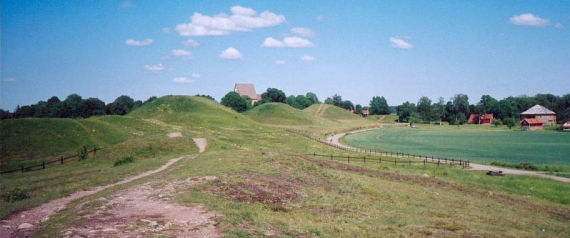
Pre-Viking Age Monuments Unearthed Near Burial Ground In Sweden


Archaeologists in Sweden said Thursday they have unearthed the remains of unusually large wooden monuments near a pre-Viking Age burial ground.
As archaeologists dug in preparation for a new railway line, they found traces of two rows of wooden pillars in Old Uppsala, an ancient pagan religious center. One stretched about 1,000 yards (1 kilometer) and the other was half as long.
Archaeologist Lena Beronius-Jorpeland said the colonnades were likely from the 5th century but their purpose is unclear. She called it Sweden's largest Iron Age construction and said the geometrical structure is unique.
"It is a completely straight line and they have dug postholes every 20 feet (6 meters)," she said. "They have had an idea of exactly where this line is going and where to build it. It is a fairly modern way of thinking and we don't have many traces of these sorts of constructions from that time."
Read the rest of this article...

More on lead coffin found at Greyfriars dig


The mysterious lead coffin found yards from the grave of Richard III has delivered another twist in the tale of the Greyfriars excavation.

More on lead coffin found at Greyfriars dig
Archaeologists expose the lead casket found inside a stone coffin at
Greyfriars [Credit: This is Leicestershire]
Archaeologists had thought the 600-year-old metal casket, which was found in a stone tomb at Greyfriars in August, might belong to knight Sir William de Moton.

The University of Leicester team – which uncovered Richard III a year earlier – also identified two other potential candidates, in Peter Swynsfeld, who died in 1272, and William of Nottingham, who died in 1330 – both former leaders of the Franciscan friars.


Read the rest of this article...

Jersey's place in Neanderthal history revealed in study

A large portion of the site contains sediments dating to the last Ice Age

A study on a Jersey site that revealed a significant piece of late Neanderthal history has been published.
Scientists working on an archaeological dig in St Brelade said teeth found at La Cotte suggest Jersey was one of the last places Neanderthals lived.
The team of British archaeologists have unearthed items which show the presence of Stone Age hunters at the headland.
They said the finds were helping scientists understand more about the early relatives of modern humans.
Read the rest of this article...

Italy's fantastical farmers' sheds turned holiday homes


The latest property of choice for holiday home buyers in Southern Italy is not a rustic villa or a rambling farmhouse - it is a former farmer's shed, which would not look out of place on the set of Lord of the Rings.
Trulli are the trademark of Puglia - existing nowhere but the Valley of Itria. Round limestone buildings with conical roofs, they are as magical as they are historical. Dotted across the landscape, alone or in clusters, with one cone or even a dozen, they look like miniature rustic fairytale castles - Asterix meets Disney.
Originally nothing more than farmers' sheds used to store equipment or animals, the structure is made with the same drystone technique as the low walls that demarcate the olive groves. No cement, just local limestone cut into large, heavy slabs called chiancarelle - carefully positioned to make the perfect water-tight structure.
Read the rest of this article...

Silk Road jewel reveals more of its treasures

Restoration work at the 15th Century Khwaja Parsa Mosque in Balkh

Balkh province in northern Afghanistan is home to some of the most significant historical sites in the world - its ancient city was even known as the mother of all cities. More than a decade after her first visit, Lynne O'Donnell returns with a group of archaeologists, trying to uncover more of its treasures.
Across the far northern Afghan plain, a hot wind blows the dun-coloured dust into blinding clouds, and the women's burkas into blue billows. It is 40C in the shade, and even the small black goats being herded through the sand dunes look sapped by the heat.
Read the rest of this article...

Saturday, October 19, 2013

Uppsala unearths pagan road of old kings


Archaeologists digging in old Uppsala have discovered what appears to be a remarkable display of power of a fifth century Swedish chieftain. Massive posts marked the ancient road in perfect alignment for more than a kilometre. 

"It's exciting because we’ve never seen anything like it in these parts before," Robin Lucas, archaeologist at Uppland Museum, told The Local.

The archaeologists, who were excavating the area in preparation for a new railroad line, discovered 144 post-holes two metres wide and a metre deep in a perfectly straight line spanning a kilometre in Old Uppsala. The post holes are placed precisely six metres from each other.

"It appears to be a processional road leading to Old Uppsala, which was the seat of the early Swedish kings," Lucas said. 


Read the rest of this article...

Roman villa found near Devizes

The villa was discovered on land next to Lay Wood near Devizes

The remains of what is believed to be a 2,000-year-old Roman villa have been discovered near Devizes in Wiltshire.
Archaeologists uncovered the remains on land near Lay Wood, between the Kennet and Avon Canal and Horton Road, as part of a survey ahead of a new housing development.
Wessex Archaeology is now examining what has been found.
Steve Melligan, from the Crown Estate, which manages the land, said it was an "exciting find".
Read the rest of this article...

Neanderthals used toothpicks to alleviate gum disease


Removing food scraps trapped between the teeth one of the most common functions of using toothpicks, thus contributing to our oral hygiene. This habit is documented in the genus Homo, as early as Homo habilis, a species that lived between 1.9 and 1.6 million years ago.

Neanderthals used toothpicks to alleviate gum disease
In the left image, the arrow shows the interproximal groove of the upper Pm3. The right image is a groove detail view as seen with an Environmental Chamber Electron Microscope [Credit: Universitat AutĂ²noma de Barcelona]
New research based on the Cova ForadĂ  Neanderthal fossil shows that this hominid also used toothpicks to mitigate pain caused by oral diseases such as inflammation of the gums (periodontal disease). It is the oldest documented case of palliative treatment of dental disease done with this tool.

This research is based on toothpicking marks on the Neanderthal teeth related to periodontal disease. The chronology of the fossil is not clear, but the fossil remains were associated with a Neanderthal Mousterian lithic industry (about 150,000 to 50,000 years).


Read the rest of this article...

Pre-Viking Age monuments uncovered in Sweden


Archaeologists in Sweden said Thursday they have unearthed the remains of unusually large wooden monuments near a pre-Viking Age burial ground.

Pre-Viking Age monuments uncovered in Sweden
Archaeologists in Sweden have uncovered this 1km-long row of wooden poles which is
believed to be from the 5th Century, but their purpose is unclear [Credit: flygfoto]
As archaeologists dug in preparation for a new railway line, they found traces of two rows of wooden pillars in Old Uppsala, an ancient pagan religious center. One stretched about 1,000 yards (1 kilometer) and the other was half as long.

Archaeologist Lena Beronius-Jorpeland said the colonnades were likely from the 5th century but their purpose is unclear. She called it Sweden's largest Iron Age construction and said the geometrical structure is unique.


Read the rest of this article...

Finding, studying and sharing the ‘treasure’ beneath our feet


Last year, the ITV television series Britain’s Secret Treasures was a welcome hit, averaging 3.5 million viewers every evening for six programmes over the course of a week. It featured stories about 50 archaeological finds made by members of the public throughout Britain.
The majority of the finds had either been recorded with the Portable Antiquities Scheme (PAS) or reported as ‘Treasure’ under the Treasure Act 1996 (or both!). The series culminated with the story of the Happisburgh Handaxe, a discovery which eventually led to the understanding that humans have inhabited Britain for hundreds of thousands of years longer than previously thought.
Read the rest of this article...

Friday, October 18, 2013

International Archaeology Day


International Archaeology Day is a celebration of archaeology and the thrill of discovery. Every October the AIA and archaeological organizations across the United States, Canada, and abroad present archaeological programs and activities for people of all ages and interests. Whether it is a family-friendly archaeology fair, a guided tour of a local archaeological site, a simulated dig, a lecture or a classroom visit from an archaeologist, the interactive, hands-on International Archaeology Day programs provide the chance to indulge your inner Indiana Jones.

Visit the site...

Slave Tunnels Found Under Hadrian’s Villa


Amateur cavers have discovered a network of tunnels underneath the Villa Adriana (Hadrian’s Villa) at Tivoli, near Rome. 

Experts suggest that the subterranean world of tunnels and roads was used to house slaves, oxen, carts and food supplies. The network includes streets wide enough to allow for the passage of carts in both directions as well as narrow passageways. Hadrian’s Villa covers approximately 618 acres but the extent of the underground network is not known yet and excavations are ongoing. 

The Roman Emperor Hadrian built the villa as a summer retreat between 38 AD and 118 AD. After his death in 138 AD, his successors used and enlarged the complex. A decade ago, experts realised that there were tunnels beneath the complex, and a team of Italian archaeo-speleologists led by amateur caver Marco Placidi mapped more than a mile of the vast network this year. 

Read the rest of this article...

5200 BC House Discovered in Romania


Recently , we shared with you some recent discoveries in Romania, from various periods. Apparently there is room for more, as the biggest house from the pre-Cucuteni period, 5200-5100 BC was just found in Baia, Suceava. Experts from the Cambridge University support this research, seeking to identify how the grain trade between China and Europe was made at that time.

The discovery is extremely important, as it confirms the existence of the pre-Cucuteni first phase. A similar archaeological discovery, from the same period, was made in 1951.

Emil Ursu, Bucovina’s Museum Director, said that the site will be dated using Carbon 14 into a laboratory in Germany.

Read the rest of this article...