Monday, October 07, 2013

Engraved Penises Reveal Birth Date of Italian City


Two penises engraved on a 2,000 year old stone may shed light on the foundation of the city of Aosta in northern Italy, revealing its deep connection with the Roman emperor Augustus.

Named Augusta Praetoria Salassorum by the Romans -- who captured it from the local Salassi people in 25 B.C. to control strategic mountain passes -- Aosta boasts several monuments dedicated to Augustus.

Read the rest of this article...

1500 YEAR OLD SWEDISH FORTRESS MASSACRE REVEALED

Archaeologists at Lund University have found what they describe as a moment frozen in time by a brutal massacre, leaving a fort untouched since the 5th century.

Excavation of the Iron Age Sandby borg (ringfort) on Öland, an island off the southeastern coast of Sweden,  has revealed a number of bodies, lying where they fell, in one case, it seems that a couple were cut down from behind as they ran through the house, another body lies in a doorway. The project has been running since 2010 and is directed by Helene Victor for the Department of Archaeology in the local Kalmar Läns museum. It was initially reported last year that the site contained the remains of the unfortunate inhabitants.

Migration period

During what is termed the Migration Period in Scandinavia it was customary to cremate the dead, and it is rare to find uncremated remains. The archaeological site therefore offers important clues about the period, and although five bodies have been discovered in one house alone, human bones have been found in other parts of the fort, making it highly likely that many more bodies are yet to be uncovered.
Read the rest of this article...

Gamers take aim at ancient Pictish stone puzzle

Jigsaw from 800AD: screenshot of the software program that allows gamers and others to play with 3,000 fragments in 3D. Picture: Contributed

ONLINE gaming fans are to be recruited by Scotland’s national museum to harness their technical skills to help piece together more than 3,000 recently discovered fragments depicting the Cross on a Pictish slab.

The project, the first of its kind in the archaeological world, will see participants use a unique 3D programme developed by a Scottish technology firm to try to solve the mystery of the Hilton of Cadboll Stone.

Computer experts believe people who play computer games are more adept at manipulating objects on screen. Nasa has already made use of citizen astronomers who use home computers to sift through time-lapsed data from the Kepler space telescope to search for habitable exo-planets, planets outside the solar system.

Read the rest of this article...

Evidence unearthed of Richard III's lost chapel

Filming for Medieval Dead, where archaeologists believe they found proof of Richard III's lost chapel

ARCHAEOLOGISTS believe they have found a chapel built by Richard III to commemorate the Yorkist victory in one of the bloodiest battles ever fought on English soil.
As the row continues to rage over whether the Plantagenet king’s remains should be laid to rest in Leicester or York, a new discovery in a peaceful field on the outskirts of York has unearthed more of his legacy.
The land was where the Battle of Towton was fought; the bloody clash between the Lancastrians and Yorkists in the War of the Roses. According to accounts at the time, it left 28,000 soldiers dead, causing rivers to have run red with blood and survivors fleeing across “bridges of bodies”.
Read the rest of this article...

1,500 year old massacre found in Sweden


Archaeologists at Lund University have found what they describe as a moment frozen in time by a brutal massacre, leaving a fort untouched since the 5th century.
1,500 year old massacre found in Sweden
An archaeologist works to uncover one of the skeletons found lying within the
5th-century fort on the Swedish island of Öland [Credit: Lund University]
“There are so many bodies, it must have been a very violent and well organized raid”, says Helene Wilhelmson, a PhD student in historical osteology, who was astounded when the skeletons kept emerging from the Sandby fort site on Öland, an island just off the Swedish coast.

During the Migration Period in Scandinavia it was customary to burn the dead, and very few uncremated remains have previously been recovered. The archaeological site therefore offers important clues about the period, and five bodies have been discovered in one house alone. Human bones have been found in other parts of the fort, making it highly likely that many more bodies are yet to be dug out.


Read the rest of this article...

Wednesday, October 02, 2013

Roman skulls washed down lost river

About 20 Roman skulls were dug up from an old river bed near Liverpool Street station in London

Archaeologists working with London's Crossrail project have uncovered 20 skulls believed to be from the Roman period.
It is likely the bones were washed from a nearby burial site along one of London's "lost" rivers - the Walbrook.
Since the Crossrail project began, about 10,000 Roman items have been discovered.
These latest finds could give new insights into the lives of Roman people.
Near-intact pottery artefacts were also found which likely travelled along the same route as the skulls. Other bone fragments would not have been washed as easily down the river.
Read the rest of this article...

Museums 'ditching staff for volunteers'

More than 120 museums took part in the survey about changes over the past year

More than a third of museums and galleries cut staff last year, while nearly half increased the number of interns and volunteers, according to a survey by the Museums Association.
The annual review also found that school visits were down by 31%.
"Interns and volunteers have plenty to offer but can never replace skilled, experienced staff," said Mark Taylor, director of the Museums Association.
The government said museum visits were at record highs.
The Museums Association said staff cuts were primarily due to a reduction in public investment, which had continued to affect half of all museums in the past year.
Read the rest of this article...

Mystery 13th Century eruption traced to Lombok, Indonesia


Scientists think they have found the volcano responsible for a huge eruption that occurred in the 13th Century.
The mystery event in 1257 was so large its chemical signature is recorded in the ice of both the Arctic and the Antarctic.
European medieval texts talk of a sudden cooling of the climate, and of failed harvests.
In the PNAS journal, an international team points the finger at the Samalas Volcano on Lombok Island, Indonesia.
Little remains of the original mountain structure - just a huge crater lake.
Read the rest of this article...

Monday, September 30, 2013

Huge Chichester stone could be head of Roman Emperor Nero, say archaeologists


A 26-stone head found in a flower bed in a Hampshire vicarage garden could represent Nero, the rarely-glimpsed Emperor whose first century rule over the Roman Empire began when he was a 14-year-old.

Known as the Bosham Head, the spectacular cranium imposes itself within the Collections Discovery Centre at Fishbourne. Archaeologists have been using 3D scanning in a bid to determine whether it was carved seperately from its body.


“The Jupiter Stone found beneath the post office on West Street depicts the iconic image of the three graces, although only two women are shown,” says Anooshka Rawden, the Collections Officer at Chichester’s Novium museum.

Read the rest of this article...

VIKINGS: LIFE AND LEGEND

Roskilde 6 - VIKING exhibition at the National Museum of Denmark 
© The National Museum of Denmark

A mighty warship that sailed nearly 1,000 years ago during the reign of Cnut the Great, will stand at the centre of the British Museum’s Viking exhibition in 2014.
The Viking expansion from their Scandinavian homelands during this era created a cultural network with contacts from the Caspian Sea to the North Atlantic and from the Arctic Circle to the Mediterranean. The culture of the Scandinavians can be viewed in a global context which will highlight the multi-faceted influences arising from extensive cultural contacts. The exhibition will capitalise on new research and thousands of recent discoveries by both archaeologists and metal detectorists.

Masterpiece of ship technology

These new finds have changed our understanding of the nature of Viking identity, trade, magic and belief and the role of the warrior.  Above all, it was the maritime character of Viking society and the extraordinary shipbuilding skills that were key to their achievements. In order to highlight this, the centre of the exhibition will house the surviving timbers of a 37-metre-long Viking warship, the longest ever found and never before seen in the UK.
Read the rest of this article...

Stonehenge prepares to open visitor centre after decades of rows and delays


Construction of museum, cafe and shop 1.5 miles from stones follows series of scrapped plans and missed deadlines

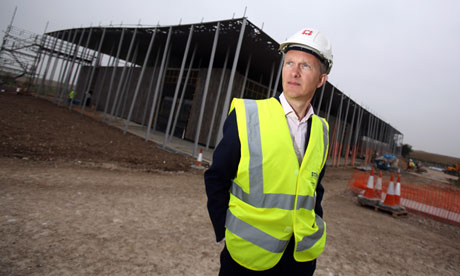
The English Heritage chief executive, Simon Thurley, outside the soon-to-be-completed Stonehenge visitor centre. Photograph: Matt Cardy/Getty Images
On 18 December, a mere 24 years after the parliamentary public accounts committee denounced the visitor facilities at one of the world's most famous ancient monuments as "a national disgrace", and 85 years after the idea was first mooted, a new £27m visitor centre will open atStonehenge.
For the first time there will be a museum-quality gallery interpreting the site and displaying original finds, as well as a cafe and shop. There was a distinct air of incredulity among many of the English Heritage staff, bruised and battered survivors of decades of debate, funding rows, public inquiries and planning consultations, sites identified and then abandoned, grandiose plans announced and promptly cancelled, landmark dates including the millennium and the Olympics missed, even as they stood in hard hats and hi-vis jackets in the shadow of the almost completed building.
Read the rest of this article...

Listen here: Our ancestors may have sounded like this


Recording studios were hard to find 6,500 years ago, but thanks to centuries of scholarship, we may now be able to get a sense of how our ancient ancestors sounded.

A linguist at the University of Kentucky has recorded a short story in Proto-Indo-European, or PIE, a language probably spoken across Europe and Asia from about 4,500 BCE to 2,500 BCE. Professor Andrew Byrd used Latin, Greek, and Sanskrit to deduce what PIE might have sounded like, the Huffington Post reports.

It's "a very educated approximation," Byrd says.

Read the rest of this article...

New Finds Uncovered at Ancient Greek Site of Argilos

With a team of 50 students and additional help from workmen, archaeologists have uncovered the remains of structures at the site of ancient Argilos on the coast of Macedonia, reporting that the finds will help open an additional window on the development and economy of one of the earliest Greek colonies in an area that was previously settled by the Thracians.

Among the discoveries was a large portico consisting of at least seven storerooms.
"The building is in a remarkable state of preservation, and five rooms have been partially excavated this year," report excavation co-directors Zizis Bonias of Greece's 18th Ephorate of Prehistoric and Classical Antiquities and Jacques Perreault of the University of Montreal. "In its early state, the building probably dates back to the 6th century BC."
Read the rest of this article...

Anthropologists confirm link between cranial anatomy and two-legged walking


Comparison of the skeletons of three bipedal mammals: 
an Egyptian jerboa, an eastern gray kangaroo and a human.


Anthropology researchers from The University of Texas at Austin have confirmed a direct link between upright two-legged (bipedal) walking and the position of the foramen magnum, a hole in the base of the skull that transmits the spinal cord.
The study, published in a forthcoming issue of the Journal of Human Evolution, confirms a controversial finding made by anatomist Raymond Dart, who discovered the first known two-legged walking (bipedal) human ancestor, Australopithecus africanus. Since Dart's discovery in 1925, physical anthropologists have continued to debate whether this feature of the cranial base can serve as a direct link to bipedal .
Chris Kirk, associate professor of anthropology and co-author of the study, says the findings validate foramen magnum position as a  for fossil research and sheds further insight into human evolution.
Read the rest of this article...

Sunday, September 29, 2013

The Vikings are coming...British Museum to launch Vikings: Life and Legend in March 2014

Silver-inlaid axehead in the Mammen style, AD 900s. Bjerringhøj, Mammen, Jutland, Denmark. Iron, silver, brass. L 17.5 cm. © The National Museum of Denmark.

LONDON.- In March 2014 the British Museum will open the Sainsbury Exhibitions Gallery with a major exhibition on the Vikings, supported by BP. The exhibition has been developed with the National Museum of Denmark and the Staatliche Museen zu Berlin (National Museums in Berlin) and focuses on the core period of the Viking Age from the late 8th century to the early 11th century. The extraordinary Viking expansion from the Scandinavian homelands during this era created a cultural network with contacts from the Caspian Sea to the North Atlantic, and from the Arctic Circle to the Mediterranean. The Vikings will be viewed in a global context that will highlight the multi-faceted influences arising from extensive cultural contacts. The exhibition will capitalise on new research and thousands of recent discoveries by both archaeologists and metal-detectorists, to set the developments of the Viking Age in context. These new finds have changed our understanding of the nature of Viking identity, trade, magic and belief and the role of the warrior in Viking society. Above all, it was the maritime character of Viking society and their extraordinary shipbuilding skills that were key to their achievements. At the centre of the exhibition will be the surviving timbers of a 37-metre-long Viking warship, the longest ever found and never seen before in the UK. Due to its scale and fragility it would not have been possible to display this ship at the British Museum without the new facilities of the Sainsbury Exhibitions Gallery. 

The ship, known as Roskilde 6, was excavated from the banks of Roskilde fjord in Denmark during the course of work undertaken to develop the Roskilde Viking Ship Museum in 1997. Since the excavation, the timbers have been painstakingly conserved and analysed by the National Museum of Denmark. The surviving timbers – approximately 20% of the original ship - have now been re-assembled for display in a specially made stainless steel frame that reconstructs the full size and shape of the original ship. The construction of the ship has been dated to around AD 1025, the high point of the Viking Age when England, Denmark, Norway and possibly parts of Sweden were united under the rule of Cnut the Great. The size of the ship and the amount of resources required to build it suggest that it was almost certainly a royal warship, possibly connected with the wars fought by Cnut to assert his authority over this short-lived North Sea Empire. 

Read the rest of this article...

Yorkshire Museum appeals to public to help save Iron Age jewellery of pre-Roman torc


Curators at The Yorkshire Museum are warning that a 2,000-year-old torc, described as having a rarer and more intricate style than its sister treasure, which was saved in 2012, could be sold at auction if they cannot raise £30,000 by October.

The precious bracelets became the first examples of Iron Age gold jewellery to have been found in the north of England when they were discovered by metal detectorists near Tadcaster in 2010 and 2011.

Despite being unearthed separately, curators say they were “almost certainly” buried together, having once belonged to a member of the ruling Brigantes whose extreme wealth could have indicated Royal status.


Read the rest of this article...

Mildenhall Museum ready for Anglo-Saxon warrior & horse

The warrior and his horse are being displayed as they were found in the grave at RAF Lakenheath

A Suffolk museum has taken delivery of the skeletal remains of an Anglo-Saxon warrior and his horse.
The remains were found in 1997 at RAF Lakenheath and they are going on display at nearby Mildenhall Museum.
The warrior is thought to have died in about AD 500 and the find included a bridle, sword and shield.
The bones are being displayed under glass in the same position they were found in and the public will be able to see them next month.
Suffolk Archaeological Service has been in charge of the skeletons, which were part of a cemetery containing 427 graves.
The warrior is believed to have been born locally and was about 30 years old when he died.
Read the rest of this article...

British Museum to show Viking treasures from North Yorkshire

The Vale of York viking hoard, which is going on show at the British Museum

A MAJOR new exhibition featuring Viking finds from North Yorkshire will take place at the British Museum next year.
Vikings: Life And Legend is the first major exhibition on Vikings to be held at the London museum for more than 30 years, and will include artefacts from the Vale of York alongside items from around the UK and Ireland, and the museum’s own collection.
The Vale of York Hoard, which was found by metal detectorists near Harrogate in 2007, will be shown in its entirety for the first time since it was found and jointly acquired by the British Museum and York Museums Trust.
The hoard includes 617 coins, six arm rings and a quantity of bullion and hack-silver, and is considered the largest and most important Viking hoard to be found since 1840’s Cuerdale Hoard, part of which will also will also be included in the exhibition.
Read the rest of this article...

Volunteer will spend winter in the medieval era

Pavel Sapozhnikov decided to spend the winter without modern technology. Source: Dmitry Vinogradov / RIA Novosti

Reenactment performers and history fanatics have decided to conduct a great experiment in Moscow Region: A 24-year-old man is going to stop using all modern technology and spend six months as if he was living in the Middle Ages, without Internet, electricity, or modern clothing. The goal is to see how medieval instruments work and how the mental state of the volunteer may change over the course of the experiment.

A day before the start of the experiment, Pavel Sapozhnikov sets aside all the modern things that he will not be able to use for the next six months. An iPad, an iPhone, scotch tape — all these things will have to wait to be used.
Instead, Pavel takes different essentials of the ninth century: a flint, a steel to strike sparks from flint, a fibula, a rake-comb to get rid of lice.
Read the rest of this article...

Ancient Greek site threatened amid celebration


Greece—While world leaders and top athletes lit the Olympic flame with pageantry drawn from antiquity, another important ancient site of athletic prowess sat overlooked and endangered.

Some 200 kilometers (125 miles) east of Ancient Olympia where the flame lighting for the 2014 Winter Games in Sochi went off without a hitch Sunday, the Nemea stadium and its humbler games are in danger of closing to the public because of crisis-hit Greece's harsh budget cuts, according to a renowned American archaeologist who led excavations there for decades.
Stephen G. Miller, professor emeritus of classical archaeology at the University of California, Berkeley, arrived at Nemea in 1973, when the ancient site still lay buried beneath a highway and vineyards used by raisin farmers. Excavations there unearthed the temple and stadium, one of the four major sites where Ancient Greek games were held: Olympia, Delphi, Isthmia and Nemea.
Read the rest of this article...