Thursday, August 01, 2013

Roman skeletons discovered in Gloucester

The discovery has been called one of the most significant in recent years

About 40 skeletons have been uncovered by archaeologists at the site of a Roman cemetery in Gloucester.
The discovery was made during a dig at the former Gloscat site at Greyfriars in Brunswick Road, ahead of a housing development being built.
It has been described as one of the most significant archaeological finds in the city in the past 30 years.
The skeletons could end up in the care of Gloucester museum after scientific tests have been carried out.
Read the rest of this article...


Archaeology: The milk revolution


When a single genetic mutation first let ancient Europeans drink milk, it set the stage for a continental upheaval.

In the 1970s, archaeologist Peter Bogucki was excavating a Stone Age site in the fertile plains of central Poland when he came across an assortment of odd artefacts. The people who had lived there around 7,000 years ago were among central Europe's first farmers, and they had left behind fragments of pottery dotted with tiny holes. It looked as though the coarse red clay had been baked while pierced with pieces of straw.

Looking back through the archaeological literature, Bogucki found other examples of ancient perforated pottery. “They were so unusual — people would almost always include them in publications,” says Bogucki, now at Princeton University in New Jersey. He had seen something similar at a friend's house that was used for straining cheese, so he speculated that the pottery might be connected with cheese-making. But he had no way to test his idea.

Read the rest of this article...

Diocletian’s palace gets laser facelift


Conservators in Croatia have completed a ten-year project to remove more than 1,700 years of grime from the courtyard of the palace of the Roman Emperor Diocletian (AD244-311), in the coastal city of Split. Lasers were used as the primary method to clean the peristyle of the fourth-century imperial residence—an innovative technique that is normally reserved for cleaning individual sculptures or details of larger architectural elements, as opposed to whole structures. According to the architect Goran Niksic, who works for the city, this is the first time lasers have been used on this scale in Croatia to clean stone.

Diocletian’s palace gets laser facelift
Emperor Diocletian’s palace in Split, Croatia underwent treatment by laser
during the ten-year project [Credit:Art Newspaper]
The peristyle was covered not only in soot, but also in cement dust from a nearby plant that was active in the late 19th and the first half of the 20th centuries. In some parts, the build-up of grime was up to a centimetre thick. 

Read the rest of this article...

The Day of Archaeology


On Tuesday, 30 July Lorna Richardson gave an extremely interesting talk entitled “The Day of Archaeology: using Internet technology to provide a window on the profession” to the Oxford Experience summer school.

The Day of Archaeology is a project that lets archaeologists post stories about a day in their work.  The purpose is to inform the general public about the sort of work that archaeologists do.

The main web site is at:


Looking through the posts shows how varied archaeological work can be.  Here are just a few of the more unusual posts:

Lyminge Archaeological Project: Anglo-Saxons in Kent

Wednesday, July 31, 2013

Two Neolithic-Era Burial Halls Discovered in UK Countryside


Archaeologists from the University of Manchester and the Herefordshire Council have unearthed the remains of two large halls that were constructed more than 6,000 years ago. The burned and buried halls, which were discovered atop Dorstone Hill, near Peterchurch in Herefordshire, are believed to have been constructed between 4000 and 3600 BC.
Some of the charred wood at the site shows the character of the structure of the buildings as they may have looked above ground. The researchers suggest these buildings were used by entire communities, but do not have enough information to determine how large each structure was. However, based on the length of theNeolithic-era barrows beneath each of the buildings, the researchers estimate the halls to have been 100 and 230 feet long, respectively.
The team also believes the buildings were deliberately burned down after construction and the remains of the buildings were incorporated into two unique burial mounds on the hilltop. Even though the halls were burned, much detail is still preserved in the larger barrow. The team has found carbonized structural timbers, postholes that offer positions of original uprights and the burnt remains of stakes of the internal partitions. Also, the burial mounds are composed of burnt clay, which implies the daub from the walls of the buildings was used in the burial process.
Read the rest of this article...

2 6,000-year-old 'halls of the dead' unearthed, in UK first


The remains of two large 6000-year-old halls, each buried within a prehistoric burial mound, have been discovered by archaeologists from The University of Manchester and Herefordshire Council -- in a UK first.

The sensational finds on Dorstone Hill, near Peterchurch in Herefordshire, were thought to be constructed between 4000 and 3600 BC.

Some of the burnt wood discovered at the site shows the character of the building's structure above ground level -- in another UK first.

The buildings, probably used by entire communities, are of unknown size, but may have been of similar length to the Neolithic long barrows beneath which they were found – 70metres and 30m long.
They were, say the team, deliberately burnt down after they were constructed and their remains incorporated into the two burial mounds.

However -- much detail has been preserved in the larger barrow: structural timbers in carbonized form, postholes showing the positions of uprights, and the burnt remains of stakes forming internal partitions..

Read the rest of this article...

Find helps scientists map waves of migration across the continents


The discovery of an “early modern human” dating from 40,000 years ago in a cave outside Beijing, and a comparison of the individual’s DNA with that of populations around the globe, are providing new pieces in the puzzle of how Homo sapiens left their African origins to expand across the continents.

Find helps scientists map waves of migration across the continents
Scientists from Germany’s Max Planck Institute for Evolutionary Anthropology extracted DNA from the Tianyuan early modern human and compared it with genetic profiles of people living around the world [Credit: Qiaomei Fu]
DNA extracted from the Tianyuan Cave dweller indicated he was genetically related to today’s Amerindians, said FU Qiaomei,  Institute of Vertebrate Paleontology and Paleoanthropology (IVPP), Chinese Academy of Sciences in Beijing, one of the scientists who led the study at Germany’s Max Planck Institute for Evolutionary Anthropology. This Tianyuan fisher-gatherer is one of the earliest H. sapiens ever uncovered in China, she said in an interview.

Read the rest of this article...

Monday, July 29, 2013

COFFIN-WITHIN-A-COFFIN FOUND AT RICHARD III SITE


Archaeologists have unearthed a mysterious coffin-within-a-coffin near the final resting place of Richard III.
The University of Leicester team lifted the lid of a medieval stone coffin this week – the final week of their second dig at the Grey Friars site, where the medieval king was discovered in September.
This is the first fully intact stone coffin to be discovered in Leicester in controlled excavations – and is believed to contain one of the friary’s founders or a medieval monk.

Inner lead coffin

Within the stone coffin, they found an inner lead coffin – and will need to carry out further analysis before they can open the second box.
Archaeologists have taken the inner lead coffin to the University’s School of Archaeology and Ancient History, and will carry out tests to find the safest way of opening it without damaging the remains within.

Read the rest of this article...

3D Virtual Dig: a 3D Application for Teaching Fieldwork in Archaeology


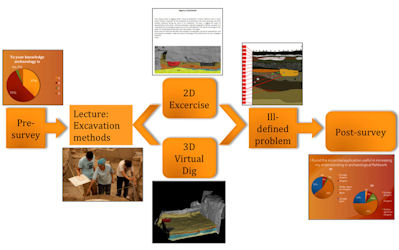
Archaeology is a material, embodied discipline; communicating this experience is critical to student success. In the context of lower-division archaeology courses, the present study examines the efficacy of 3D virtual and 2D archaeological representations of digs. This presentation aims to show a 3D application created to teach the archaeological excavation process to freshmen students. An archaeological environment was virtually re-created in 3D, and inserted in a virtual reality software application that allows users to work with the reconstructed excavation area. The software was tested in class for teaching the basics of archaeological fieldwork. The application interface is user-friendly and especially easy for 21st century students. The study employed a pre-survey, post-test, and post-survey design, used to understand the students' previous familiarity with archaeology, and test their awareness after the use of the application.

Read the rest of this article...

Medieval Mansion Found at U.K. Construction Site


It sounds like a case for Sherlock Holmes: a 900-year-old medieval manor mysteriously vanishes, only to be uncovered later by British archaeologists.
How were the Vikings such remarkable mariners? Scientists have found the answer buried deep in a 16th-century shipwreck.
DCI
The ancient site has been stripped of its materials except for the foundation -- and there is no record of it ever existing.
Got chills? So do the archaeologists who discovered it.
"This is a significant find and therefore very exciting, particularly as there are no documentary records that such a site ever existed here," said Wessex Archaeology's senior buildings archaeologist Bob Davis, who participated in the excavation.
Read the rest of this article...

10,000 year old mesolithic hut recreated


Archaeologists from University College Dublin have built a replica of a Mesolithic or Middle Stone Age house on the Belfield campus to better understand how humans lived at the time.

10,000 year old mesolithic hut recreated
Replica of 10,000 year old mesolithic dwelling built by UCD experimental
archaeologists on campus [Credit: UCD]
The circular dwelling, with a six-metre diameter, is based on archaeological evidence from a site at Mount Sandel in Northern Ireland which dates from 7900-7600BC – this site is the earliest known evidence of human settlement on the Island of Ireland.

During the Mesolithic or Middle Stone Age humans made and used a variety of wooden and stone tools (including stone axes for carpentry), and lived a hunter gatherer lifestyle.

“Our reconstruction of this Mesolithic house is part of the UCD Centre for Experimental Archaeology,” says Dr Graeme Warren, UCD School of Archaeology.


Read the rest of this article...

Search for link between mammoth bones and early hunters


Researchers at the University of Kansas have been digging for clues that would tie the remains of a 15,500-year-old mammoth discovered in west-central Kansas with prehistoric human artifacts found nearby.

Search for link between mammoth bones and early hunters
Researchers excavating the remains of a 15,500-year-old mammoth in west-central Kansas
with prehistoric human artifacts found nearby [Credit: University of Kansas]
The bones and a knapping pile — stone flakes accumulated from tool-making activities —were unearthed in 2011 by heavy equipment terracing a field northeast of Scott City. Found about 50 yards apart, the bones and flakes were in the same shallow layer of sediment.

“It was intriguing to find a knapping pile and mammoth bones close together in the same geologic layer,” said Rolfe Mandel, geoarchaeologist at the Kansas Geological Survey and professor in the KU anthropology department. “If we can determine that the people who created the flakes also killed the mammoth, it will prove that humans were in the Central Plains much earlier than currently proven.”


Read the rest of this article...

Saturday, July 27, 2013

Traces of 'lost village' found in Nottinghamshire

Experts say the presence of Medieval pottery suggests the presence a community that possibly dates from before the Norman conquest

Remains of what archaeologists believe is a "lost village" have been found beneath a Nottinghamshire town.
Experts say the presence of cobbled surfaces and Medieval pottery found in the Burgage area of Southwell suggests the presence a community that possibly dates from before the Norman conquest.
Archaeologist Matt Beresford said the work was ongoing and they hoped to find more conclusive evidence.
The dig was backed by a £5,800 Heritage Lottery grant.
Read the rest of this article...

Possible Saxon bread oven found in Norfolk


A 1,300-year-old bread oven could have been discovered by a group of volunteer archaeologists in Norfolk.

Possible Saxon bread oven found in Norfolk
The suspected oven could have been used to provide bread for the community [Credit: BBC]
The annual dig in Sedgeford, near Hunstanton, has had about 100 people a week looking for signs of the village's past.

Supervisor Dr John Jolleys said the clay object, which he believes to be a Saxon bread oven, was found about 4ft 11in (1.5m) underground.

"It's rare and very exciting," Dr Jolleys said.

Excavation of the object will continue for the remainder of the dig, which finishes on 16 August.


Read the rest of this article...

Friday, July 26, 2013

Dig at Kent university's Iron Age site


A site which experts believe could be an Iron Age settlement is being excavated on land where the new Turing College at the University of Kent will be built.
An open day on Thursday allowed the public to see items such as a gold coin, a bronze bell and some of 2,500-year-old pottery uncovered so far by the team of 40.
The new college is being named after World War II codebreaker Alan Turing, who grew up in Guildford, Surrey.
Read the rest of this article...

During a recent excavation beneath the streets of London, archaeologists found a total of 1,500 human bodies, many buried hastily in a wave of epidemics that struck the quickly expanding city more than 150 years ago. 

In one coffin, archaeologists came across a grisly mix of bones from at least eight human bodies, many of them cut up and showing evidence of autopsy. But nine of the bone fragments were decidedly not human. They were walrus.

"It came as something of a shock," said Phil Emery, an archaeologist with a company called Ramboll UK, who led the excavation. The nine bone fragments came from a Pacific walrusthat was likely 13 feet (4 meter) long, Emery told LiveScience.

Read the rest of this article...
Roman mosaic may lie beneath Chester’s Dewa Experience building


ARCHAEOLOGISTS says there is the tantalising prospect of a Roman mosaic beneath the Dewa Roman Experience premises in the city centre.

A ongoing dig Pierpoint Lane site, off Bridge Street, has so far exposed an eight metres section of Roman wall next to a courtyard along with the remains of a flue.

The wall would have formed part of a building, of unknown purpose, leading to speculation about what may lie behind the wall in the centre of the former premises.

Archaeologist Mike Emery has been told by building owner Peter Dentith that someone who helped construct the 1960s building on the site insists a Roman mosaic was found at the time “but quickly covered up”.

Read the rest of this article...

Viking Jewelry Unearthed in Denmark

A copper alloy piece of jewelry found at a Viking-age site in Denmark shows an animal figure with a beadlike chain around its neck.

Several pieces of Viking jewelry, some of which contain gold, have been uncovered at a farm site in Denmark that dates as far back as 1,300 years.

Although the Vikings have a popular reputation as being raiders, they were also farmers, traders and explorers, and the craftsmanship seen in this jewelry demonstrates their artistic skills.

Archaeologists working with volunteers used metal detectors to find the jewelry in different spots throughout a farmstead on Zealand, the largest island in Denmark. The remains of the site, which is now called Vestervang, date from the late seventh to the early 11th centuries.

Read the rest of this article...

Archaeologists Excavate Ancient Roman Capital in Macedonia


Although the ancient site known as Stobi in central Macedonia has been the subject of numerous excavations and research over the past century, only 15- 20 percent of its remains have been uncovered. Since 2008, however, renewed excavations under the auspices of the Balkan Heritage Foundation have been busy opening a new window on an ancient Roman city that, for a time, was a major center of trade and commerce.

Now, a team of archaeologists, students and volunteers will be returning to the site in August of 2013 to continue unearthing the northern residential section of the city, near a center that has already yielded such remains as a large theater, a city wall, a forum, a synagogue, a baptistry and a water supply system. During recent excavation seasons archaeologists have uncovered evidence of a necropolis (in use from the 1st century BC to the 5th century AD) and an ancient temple dated to the 2nd and 3rd centuries  AD.  Write the project directors about their plans: "The excavations in 2011 and 2012 were focused on the Northern Residential Area of Ancient Stobi, inhabited from the Late Hellenistic till the Late Roman period. Further excavations at the same area are planned for next season in conjunction with the efforts of the National Institute (NI) Stobi in order to preserve and display this part of the site. The layers to be studied in 2013 mainly include the Roman and Late Roman periods of the existing ancient neighborhood."*
Read the rest of this article...

Archaeological finds reveal prehistoric civilization along Silk Road


Archaeologists have unearthed relics that suggest prehistoric humans lived along the Silk Road long before it was created about 2,000 years ago as a pivotal Eurasian trade network.

An excavation project that started in 2010 on ruins in northwest China's Gansu Province has yielded evidence that people who lived on the west bank of the Heihe River 4,100 to 3,600 years ago were able to grow crops and smelt copper, the researchers said.

The site is believed to date back to the Han Dynasty (202 BC - AD 220).

Over the past three years, archaeologists have discovered a variety of copper items, as well as equipment used to smelt metal, said Chen Guoke, a researcher with the Gansu Provincial Institute of Archaeology.

"People back then mainly dealt with red metal. They also began to make alloys," said Chen, who is in charge of the excavation project.


Read the rest of this article...