Tuesday, January 22, 2013

Colosseum restorers uncover old frescos, graffiti


A restoration in the Italian most famous and historical monument Colosseum has yielded ancient traces of colorful frescoes as well as graffiti and drawings.

The restorers cleaning the Colosseum discovered the artworks in the internal passageway, between the second and third levels of the first Century Colosseum of the building.

The frescoes remains located under decades of calcified rock and grime of the 2,000-year old arena were uncovered in vivid red, blue, green and white colors.

The team also found ancient sketches of crowns and palm trees as symbols of victory painted by the spectators who celebrated success of gladiators they supported.


Read the rest of this article...

Monday, January 21, 2013

Archeologists revise image of ancient Celts


The Celts were long considered a barbaric and violent society. But new findings from a 2,600-year-old grave in Germany suggest the ancient people were much more sophisticated than previously thought.

The little Bettelbühl stream on the Danube River was completely unknown, except to local residents. But that changed in the summer of 2010 when a spectacular discovery was made just next to the creek.

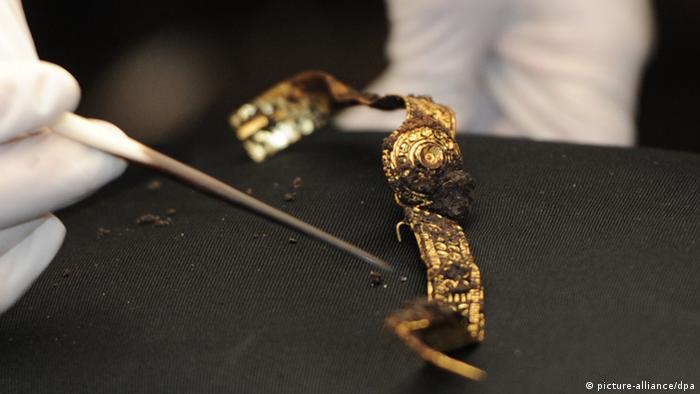
Not far from the Heuneburg, the site of an early Celtic settlement, researchers stumbled upon the elaborate grave of a Celtic princess. In addition to gold and amber, they found a subterranean burial chamber fitted with massive oak beams. It was an archeological sensation that, after 2,600 years, the chamber was completely intact.

The wooden construction was preserved by the constant flow of water from the Bettelbühl stream. "In dry ground, the wood wouldn't have had a chance to survive over so many centuries," said Nicole Ebinger-Rist, the director of the research project handling the find.

Read the rest of this article...

Roman man's face finally revealed at Caerleon museum

The portrait was painted following a forensic reconstruction of the face

The face of a wealthy Roman citizen who lived in south Wales has been revealed nearly two millennia after he died.

Using the latest technology, experts have produced a portrait of the man whose skeleton was uncovered 18 years ago in Caerleon, near Newport.

Archaeologists are trying to fill in more details using forensic techniques employed by police.

The image of the man was unveiled at the National Roman Legion Museum in Caerleon on Thursday.
The remains from around AD200 were uncovered by builders who were working on the nearby Newport university campus in November 1995.

Analysis showed the skeleton was that of a well-preserved man of about 40.

Read the rest of this article...

Archaeologists Excavate Ancient Greek Trade Center in Bulgaria


Archaeologist and professor Mieczysław Domaradzki likely made one of the great discoveries of his life when, in 1990, he and his colleagues uncovered, at a site along the banks of the Maritsa River in Bulgaria, an ancient stone Greek inscription.  The inscription, today known as the Vetren Inscription (named after the nearby town of Vetren), revealed the site as the location of the ancient Greek trading center, or emporion, of Pistiros.

But the inscription revealed more than this. It afforded a rare glimpse into the special relationship that the Pistiros Greeks had with their Thracian hosts, as Pistiros sat deep within the territory of the 5th - 3rd century B.C. Thracian Odryssian kings:
If a merchant brings suit against another merchant (in Pistiros) they shall be judged among their kinsmen and with regard to whatever is owed to the merchants by Thracians, there shall be no cancellation of these debts. All land and pasture owned by the merchants shall not be taken away from them. He shall not send holders of estates(?) to the merchants.
Read the rest of this article...

More on Ancient graffiti found inside the Colosseum

A restorer stands in front a wall with remains of frescoes and graffiti in Rome's ancient Colosseum [Credit: Reuters/Tony Gentile]

Italian restorers cleaning the Colosseum have discovered remains of frescoes indicating the interior of one of the world's most famous monuments may have been colorfully painted in Roman times.

The 2,000-year old arena, where gladiators fought bloody battles for the entertainment of crowds, originally looked far different from the stone ring that has become one of the symbols of Rome.

Working in a passage closed to the public for decades, restorers scraped off years of limescale and black pollution from car exhaust to discover remains of the frescoes, their vivid red, blue, green and white colors still visible.


Read the rest of this article...

BALKAN HERITAGE FIELD SCHOOL


the BALKAN HERITAGE FIELD SCHOOL is accepting EARLY BIRD APPLICATIONS* through January 31st 2013 for 9 field school projects in the following areas: Archeology, Art History, Restoration and Conservation of Artifacts and Monuments (Please refer to the list below and the promo flier attached). Thank to the partnership with New Bulgarian University, Sofia, Bulgaria 6 academic credits (for two-week projects) and 9 academic credits (for four-week projects) will be granted upon request to students who attend to these projects.

Go to the Website...

Thursday, January 17, 2013

Experts discover new Roman graves


GRAVES dating back to Roman times have been excavated by archaeologists in Colchester.

The experts from the Colchester Archaeological Trust have been digging on the site of the new car park in Napier Road, part of the former Colchester Garrison.


They found eight Roman graves dating back to the third and fourth centuries.


Read the rest of this article...

The Algorithms That Automatically Date Medieval Manuscripts


Today, more than a million charters survive either as originals or more often as ancient copies. They provide a remarkable insight into the pressures at work in medieval politics, economics and society between the tenth and fourteenth centuries in England. 

For example, historians can use these documents to study the rise and fall of military and religious organisations. A good example is the Order of the Hospital of Saint John of Jerusalem, a religious and military organisation set up after the western conquest of Jerusalem in the 11th century (the First Crusade). 

Historians say the charters clearly show how the organisation became militarised in response to the call for a Second Crusade in 1145, triggered by Muslim forces recapturing various towns in the region.
Clearly, these documents have huge historical value but there is a problem: most charters are not dated, particularly during the period of Norman rule between 1066 and 1307.

Read the rest of this article...

Archaeologists in West Bromwich find grave robbing evidence

Archaeologists carried out the dig while work on the nearby A41 underpass and Providence Place was going on.

Archaeologists have found evidence of grave robbing while digging at a 19th Century burial ground in West Bromwich.

A team working at the former Providence Baptist Chapel site found a mortsafe - a metal cage fixed around a coffin to stop people stealing the body. 

Empty coffins and one filled with scrap metal were also discovered which archaeologists said was evidence of attempts to deter body snatchers.

Sandwell Council museum staff are now planning an exhibition of the finds.

Read the rest of this article...

Video News from TAC


The latest installment of the Video News from TAC features the following stories: 

* Lay volunteers catalog artifacts through the Forest Service Passport In Time (PIT) program at the Edge of the Cedars State Park Museum in Blanding, Utah. 
 
* The rocky island of Inishark, off the west coast of Ireland, was inhabited for thousands of years and then abandoned in 1960. Archaeologists fortunately can bring three former residents to the island to help them document the very visible ruins. 
 
* An imaginative film brings to life a Native American tale from the Amazon rain forest about a young girl who falls in love with the moon.

Warch the videos...

Wednesday, January 16, 2013

Archaeological feast: Heap of ancient cattle bones discovered

Archaeologists pulled a metric ton of cattle bones from an ancient Corinth theater, perhaps representing yearly feasts in the 4th and 5th centuries A.D.

A metric ton of cattle bones found in an abandoned theater in the ancient city of Corinth may mark years of lavish feasting, a new study finds. 

The huge amount of bones — more than 1,000 kilograms (2,205 pounds) — likely represent only a tenth of those tossed out at the site in Peloponnese, Greece, said study researcher Michael MacKinnon, an archaeologist at the University of Winnipeg. 

"What I think that they're related to are episodes of big feasting in which the theater was reused to process carcasses of hundreds of cattle," MacKinnon told LiveScience. He presented his research last Friday at the annual meeting of the Archaeological Institute of America in Seattle.

Read the rest of this article...

Archaeology: Where is it going?


Where is archaeology going? As archaeologists, it’s not exactly in our nature to postulate about the future. Written by James Spry


The past, of course, is kind of our thing. “Learning about our past will guide our future” – or other such anecdotes, are the bread and butter of any discussion between an archaeologist and an inquisitive member of the public.  Yes, this is true and it’s what archaeology is all about. It’s the passionate plea to learn about the world our ancestors lived in instead of dawning too much on the scary and ever changing present. Let’s be honest, every time we turn on the news or, heaven-for-bid, accidentally witness the  homepage of the Daily Mail website, with its too-fat-too-thin celebrity updates, we are hardly inspired by thoughts of the future.

It’s all too understandable why we inadvertently reminisce about a past life we never lived or engross ourselves in a material culture and that we will never full understand. And it’s such a drive to immerse ourselves in the past that has made archaeology so damn popular, why thousands of people donate their weekends to walking up and down muddy fields and why millions of us are now terrified what we will soon have to watch ‘I’m a Celebrity Pop Idol’ on a Sunday night instead of letting Phil Harding show us his unique X-Factor.

Read the rest of this article...

To Save a Cathedral, Marinate in Olive Oil

York Minster, a Gothic masterpiece is crumbling due to a relatively recent enemy: acid rain.

One of the most beautiful and revered cathedrals in Christendom, York Minster in northern England has survived war, looting, fire, pillaging and other threats over the centuries. But the Gothic masterpiece is crumbling due to a relatively recent enemy: acid rain. Preservationists, however, may have found a way to protect it using a common kitchen item.

The limestone rock used to build the church is vulnerable to acids, and has been under attack since the Industrial Revolution began filling the skies of England with acidic pollution, according to Gizmag.com. The result is acid rain that can wreak havoc on earthly structures.

And despite their best efforts, preservationists have found no protective coating that could keep the towering spires of York Minster safe, until they hit upon a novel treatment: olive oil.

Read the rest of this article...

New Online Israel Archaeology Archive

From the new Israel Archaeology Archive

Israel’s Antiquities Authority (IAA) has launched a new Israel Archaeological Archive, to be accessible on the Internet in English, with a general explanation also available in Hebrew.        
                    
A Heritage Program jointly initiated by the Prime Minister’s Office and the IAA, the digital archive will feature tens of thousands of documents, photos, maps and plans from the period of British Mandate (1919-1948), ranging from Akko to Jerusalem.

“The archive is an invaluable project, a site that will consolidate some 30,000 Israeli antiquities web sites into one location for worldwide access,” explained Dr. Uzi Dahari, deputy director of the Antiquities Authority. “The scientific importance of the archive is invaluable; it is the only one of its kind in Israel and in the world. In Israel there are approximately 30,000 known and declared antiquities sites that constitute our heritage – the largest and most important asset of the State of Israel.”

Read the rest of this article...

Report: Vikings ‘abandoned Greenland due to loneliness and limited foods’


Researchers have a new theory on why the Vikings ultimately decided to abandon Greenland after five centuries. The news comes via a report recently published in the Journal of the North Atlantic, in which scientists claim that the infamous group of explorers may have simply got tired of the isolation of Greenland and having to survive almost exclusively on seal meat.

The theory is the result of a new Danish-Canadian project, for which scientists carried out isotope analysis on the bone remnants of Vikings and the animals that were living beside them.

Longstanding theories as to why the Vikings chose to leave the icy landmass suggested that starvation amid a mini ice age and ongoing battles with the local Inuit population were the central causes of the uprooting.

Research leader Niels Lynnerup, an anthropologist from the University of Copenhagen, told the media that he believes they may have had a wealth of food, but added, “perhaps they were just sick and tired of living at the ends of the earth and having almost nothing but seals to eat,” The Daily Mail reports.

Read the rest of this article...

Mesolithic people adapted their environment in Severn Estuary

Mesolithic footprint from Goldcliff. Image: Reading University

New and exciting evidence has been found at a threatened archaeological site on the Severn Estuary that seems to show Mesolithic  people knew how to adapt their environment to suit their needs.

Encouraging specific plants

Researchers from the University of Reading found 7500 year-old worked flint tools, bones, charcoal and hazelnut shells while working at Goldcliff, near Newport, south Wales, in September 2012.

Charcoal remains discovered on the site suggest these people used fire to encourage the growth of particular plants, such as hazelnuts, crab apples and raspberries. This evidence may indicate that Mesolithic people were deliberately manipulating the environment to increase their resources, thousands of years before farming began.

Read the rest of this article...

War was central to Europe’s first civilisation - contrary to popular belief

Dr Barry Molloy

Research from the University of Sheffield has discovered that the ancient civilisation of Crete, known as Minoan, had strong martial traditions, contradicting the commonly held view of Minoans as a peace-loving people.
 
The research, carried out by Dr Barry Molloy of the University of Sheffield’s Department of Archaeology, investigated the Bronze Age people of Crete, known by many as the Minoans, who created the very first complex urban civilisation in Europe.

“Their world was uncovered just over a century ago, and was deemed to be a largely peaceful society,” explained Molloy. “In time, many took this to be a paradigm of a society that was devoid of war, where warriors and violence were shunned and played no significant role.

“That utopian view has not survived into modern scholarship, but it remains in the background unchallenged and still crops up in modern texts and popular culture with surprising frequency.

“Having worked on excavation and other projects in Crete for many years, it triggered my curiosity about how such a complex society, controlling resources and trading with mighty powers like Egypt, could evolve in an egalitarian or cooperative context. Can we really be that positive about human nature? As I looked for evidence for violence, warriors or war, it quickly became obvious that it could be found in a surprisingly wide range of places.”

Read the rest of this article...

Storms expose iron age skeleton

2,000 years old human remaions were exposed by the storms - Photos: Shetland Amenity Trust

SHETLAND’S pre-Christmas storms have revealed remains of an iron age building and a human skeleton believed to be 2,000 years old.
 
Archaeologists said a structure was briefly exposed at Channerwick before being buried again by a rockfall over the festive period.

Before it disappeared from view, police officers and archaeologists were able to investigate the site and take a bone sample for radiocarbon dating.

Shetland Amenity Trust assistant archaeologist Chris Dyer said: “The skeleton, initially reported by a local resident, looked as if it were contemporary with the Iron Age remains.

“The original burial now lies under several tons of fallen bank and the Iron Age structures have also disappeared from view.”

County archaeologist Val Turner added that during the investigation she and freelance colleague Samantha Dennis discovered evidence of at least one, and possibly two other burials.

Read the rest of this article...

Tuesday, January 15, 2013

Ancient Rome's hairdo for vestal virgins re-created

A modern woman models the Roman vestal virgin hairstyle and headdress.

For the first time, the hairstyle of the Roman vestal virgins has been re-created on a modern head. 

The vestal virgins were priestesses who guarded the fire of Vesta, the goddess of the hearth, among other sacred tasks. Chosen before puberty and sworn to celibacy, they were free from many of the social rules that limited women in the Roman era. Their braided hairstyle, the "sini crenes," symbolized chastity and was known in ancient texts as the oldest hairstyle in Rome. 

"These were the six most important women in Rome, with the possible exception of the emperor's wife," said Janet Stephens, the Baltimore hairdresser and amateur archaeologist who unraveled the secrets of the Vestals' trademark braids. [See Video of the Braiding Process]

Read the rest of this article...

Archaeological finds reveal ancient Balkan civilizations

Numerous gold items have been recovered at archeological sites in Bulgaria. [AFP]

Bulgarian archaeologists announced two major finds at the close of the 2012 excavation season, and hope to obtain state and other financial support to shed more light on the life and culture of the early Balkan civilisations. 

Vasil Nikolov, former head of the country's National Archaeology Institute, unearthed Europe's oldest urban settlement near Provadia, 50 kilometres west of Varna on the Black Sea, which is dated between 4700 and 4200 BC. 

The site is more than 100 metres in diameter, is encompassed by a 3-meter high stone wall and has two-story structures housing nearly 350 residents. 

The settlement is one part of a much larger complex from the same period, which includes a salt production unit, a sanctuary and a necropolis.

Read the rest of this article...