Wednesday, December 12, 2012
Archaeology: Basilica from the time of Constantine the Great found at Sofia’s Serdica West Gate
Archaeologists in Bulgaria’s capital city Sofia have found a basilica said to date from the time of emperor Constantine the Great in the area of the West Gate of Serdica, as the city was known in Roman times.
The basilica is 27 metres wide and about 100m long, according to Yana Borissova-Katsarova, head of research at the site. It featured multi-coloured mosaics. Further exploration of the find will be difficult because of its location under the modern city.
Sofia deputy mayor in charge of culture, Todor Chobanov, said that the discovery of the basilica may be proof that Constantine intended to establish the city as a centre of Christianity.
Constantine, who ruled from 306 to 337 CE, was the first Roman emperor to convert to Christianity. Sofia, as Serdica, was under Roman rule from 29 BCE and remained under Roman and later Byzantine rule, with some interruptions because of Hun invasions and destruction, for a number of centuries.
Read the rest of this article...
Gallic elite prospered from Roman occupation
In 2010 French archaeologists carried out excavations on a 3.5 hectares site in Bassing, Moselle. Over a period of one thousand years – 200 BCE to 800 CE – this site had been occupied by a Gallic aristocratic establishment, a Gallo-Roman villa and several medieval buildings.
Elite farmer and warrior
Between 150 and 120 BCE, a large rural settlement was built at Bassing. A 3 metre wide ditch with sloping sides and palisade surrounded the habitation area (1 hectare in size). Inside this stood wooden farm buildings and a farmhouse. This group lasted until 14 CE.The size of the farm and its ditches and the richness of the excavated materials has reveal the privileged status of the occupants. The jewellery featured bracelets of cobalt blue glass along with a piece of Baltic amber and123 fibulae, some of which had been produced on-site. In fact, the site produced evidence for foundry activities, spinning, weaving and shoemaking. It is also apparent from the discovery of many amphorae and Italian drink strainers that wine imported from the Mediterranean was drunk in large quantities.
Read the rest of this article...
First Harbor of Ancient Rome Rediscovered
Aerial view of Ostia and the position of its filled in ancient
harbour basin (in the foreground). On the left of the picture, the Tiber
flows along the Imperial Palace. In red, the coring sites.
(Credit: ©
S. Keay)
Archaeologists have unearthed the great ancient monuments of Ostia, but the location of the harbour which supplied Rome with wheat remained to be discovered. Thanks to sedimentary cores, this " lost " harbour has eventually been located northwest of the city of Ostia, on the left bank of the mouth of the Tiber. Stratigraphy has revealed that at its foundation, between the 4th and 2nd century BC, the basin was deeper than 6.5 m, the depth of a seaport.
his research was carried out by a French-Italian team of the Maison de l'Orient et de la Méditerranée (CNRS / Université Lumière Lyon 2), the Ecole Française de Rome and Speciale per i Beni Soprintendenza Archeologici di Roma -- Sede di Ostia* and will be published in the Chroniques des Mélanges de l'Ecole Française de Rome in December 2012.
According to ancient texts, Ostia was founded by Ancus Marcius, the 4th king of Rome. This new settlement is supposed to have aimed three goals: to give Rome an outlet to the sea, to ensure its supply of wheat and salt and finally, to prevent an enemy fleet to ascend the Tiber. Archeological excavations showed that the original urban core (castrum) dates back to the turn of the 4th and 3th centuries BC. Major ancient buildings and main roads were progressively revealed, but the location of the Ostia river mouth harbour remained unknown to this day. For some, it was considered as lost forever.
Read the rest of this article...
Winter of discontent as we await the truth
In the New Year we’ll learn if bones from a city car park really are those of Richard III. Michael Hickling reports on the future for the last King of the House of York.
History is written by the victors, or most memorably in this case by one of the inheritors of the victors’ story, William Shakespeare.
He created the Richard III we know, with a hump and a limp and a shrivelled arm, a character who gleefully confides to the theatre audience that he’s so ugly dogs bark at him. He’s a child murderer, a sexual predator, a psychopath crippled in mind and body. It’s a magnificent creation. But Shakespeare had no first-hand knowledge of the man he wrote about.
His play Richard III was published just over a century after the naked body of this last Plantagenet monarch, newly-slain in battle at nearby Market Bosworth, was displayed at Leicester in the summer of 1485. To create his monstrous character, the playwright drew on unreliable sources which put a spin on scarce facts to suit the outlook of the victor of Bosworth, Henry Tudor and his successors.
Read the rest of this article...
Roman road uncovered in York
This is the 10,000th post on the
Archaeology in Europe News Blog!
Ian Milstead Lead Archaeologist from YAT cleaning Roman Road beneath York Minster.
A SECTION of Roman Road has been discovered beneath York Minster.
Archaeologists from York Archaeological Trust unearthed it during construction work on the new visitor development in the Undercroft, a Minster spokeswoman said today.
The archaeologists believe the road was a backstreet, part of the Via Quintana, and believe it ran behind the Roman basilica that once stood on the Minster site.
A Minster spokeswoman said: "The backstreet was used for hundreds of years and was frequently patched and repaired, falling into disuse at the same time as the Basilica itself."
Read the rest of this article...
Saturday, December 08, 2012
Lottery grant could help buy Bath Roman coin hoard
A coin from 32 BC similar to the one pictured was the oldest identified so far
A £50,000 lottery grant could help keep a hoard of Roman coins in Bath.
Some of the coins date back as far as 32BC and are currently being cleaned at the British Museum.
The initial support from the Heritage Lottery Fund could lead to a further £480,000 grant in 2013.
Bath and North East Somerset Council said it wanted to develop learning and community activities around the hoard.
Read the rest of this article...
European Romani Exodus Began 1,500 Years Ago, DNA Evidence Shows
Europe's widespread Romani population shares a common, if complex,
past, beginning in northwestern India about 1,500 years ago, according
to a new study that offers the first genome-wide perspective on Romani
origins and demographic history.
(Credit: © seewhatmitchsee / Fotolia)
Despite their modern-day diversity of language, lifestyle, and religion, Europe's widespread Romani population shares a common, if complex, past. It all began in northwestern India about 1,500 years ago, according to a study reported on December 6th in Current Biology, a Cell Press publication, that offers the first genome-wide perspective on Romani origins and demographic history.
The Romani represent the largest minority group in Europe, consisting of approximately 11 million people. That means the size of the Romani population rivals that of several European countries, including Greece, Portugal, and Belgium.
"We were interested in exploring the population history of European Romani because they constitute an important fraction of the European population, but their marginalized situation in many countries also seems to have affected their visibility in scientific studies," said David Comas of the Institut de Biologia Evolutiva at Universitat Pompeu Fabra in Spain.
Read the rest of this article...
Classics professor unearths archaeological clues about ancient Roman vineyards
They may not look like much
to the untrained eye, but these ancient Roman grape seeds, believed to
back to the 1st century A.D., could provide “a real breakthrough” in the
understanding of the history of Chianti vineyards in the area, de
Grummond says.
(Phys.org)—Call it a toast to the past. A Florida State University
classics professor whose decades of archaeological work on a remote
hilltop in Italy have dramatically increased understanding of the
ancient Etruscan culture is celebrating yet another find.
Read more at: http://phys.org/news/2012-12-classics-professor-unearths-archaeological-clues.html#jCp
They may not look like much
to the untrained eye, but these ancient Roman grape seeds, believed to
back to the 1st century A.D., could provide “a real breakthrough” in the
understanding of the history of Chianti vineyards in the area, de
Grummond says.
(Phys.org)—Call it a toast to the past. A Florida State University
classics professor whose decades of archaeological work on a remote
hilltop in Italy have dramatically increased understanding of the
ancient Etruscan culture is celebrating yet another find.
Read more at: http://phys.org/news/2012-12-classics-professor-unearths-archaeological-clues.html#jCp
They may not look like much
to the untrained eye, but these ancient Roman grape seeds, believed to
back to the 1st century A.D., could provide “a real breakthrough” in the
understanding of the history of Chianti vineyards in the area, de
Grummond says.
Read more at: http://phys.org/news/2012-12-classics-professor-unearths-archaeological-clues.html#jCp
They may not look like much to the untrained eye, but these ancient Roman grape seeds, believed to back to the 1st century A.D., could provide “a real breakthrough” in the understanding of the history of Chianti vineyards in the area, de Grummond says. Read more at: http://phys.org/news/2012-12-classics-professor-unearths-archaeological-clues.html#jCp
(Phys.org)—Call it a toast to the past. A Florida State University classics professor whose decades of archaeological work on a remote hilltop in Italy have dramatically increased understanding of the ancient Etruscan culture is celebrating yet another find.
This time around it's not the usual shards of pottery and vessels, remnants of building foundations or other ancient artifacts unearthed in past years, but rather a treasure that's far more earthy: grape seeds.
Actually, Nancy Thomson de Grummond has discovered some 150 waterlogged grape seeds that have some experts in vineyard-grape DNA sequencing very excited.
Read the rest of this article...
Maori stones hold magnetic clues
Scientists are studying the Earth's magnetic field using the stones that line Maori steam ovens.
The cooking process generates so much heat that the magnetic
minerals in these stones will realign themselves with the current field
direction.An archaeological search is under way in New Zealand to find sites containing old ovens, or hangi as they are known.
Abandoned stones at these locations could shed light on Earth's magnetic behaviour going back hundreds of years.
"We have very good palaeomagnetic data from across the world recording field strength and direction - especially in the Northern Hemisphere," said Gillian Turner from Victoria University, Wellington, New Zealand.
Read the rest of this article...
Resurrecting the ancient city of Laodicea
Cranes, excavators, teams of workmen in hard-hats and foremen shouting into their mobile phones are a ubiquitous feature of today's Turkey, a country where, in spite of a global economic slowdown, new buildings continue to be erected at a staggering rate. Take a trip to Laodicea, however, and you'll see a “building site” with a twist. For here a long abandoned Greek-Roman city is being resurrected wholesale from its ruins by … construction cranes and teams of workmen in hard-hats!
Sprawling across a low hill between the prosperous textile town of Denizli and the iconic travertine formations of Pamukkale in western Turkey, ancient Laodicea is generally overlooked by the vast majority of visitors, who tend to be drawn instead to Pamukkale and its associated site of Hierapolis, or the wonderful remains at Aphrodisias, not too much further away. Only bible groups, attracted to Laodicea because it is one of the Seven Churches mentioned in the New Testament's Revelation of John, buck the trend.
That Laodicea is relatively little visited is hardly surprising given its press. The current edition of Lonely Planet Turkey says “there's not much of interest left,” the Rough Guide to Turkey doesn't even mention the site. A late 1980s version of the more specialist, archaeology and history-orientated Blue Guide writes of Laodicea, “Much of its worked stone has been removed for building purposes and, unfortunately, little is being done to preserve its remaining structures from further damage.”
Read the rest of this article...
Greek island to be declared an archaeological site
The 'chora' or main town on the Aegean island of Serifos is to be declared an archaeological site, according to a decision of Greece's Central Archaeological Council (KAS) that was announced on Thursday.
The island has a rich history, featured in ancient myth and legend as the home of the hero Perseus, and has been settled since prehistoric times. Its chora, situated high on a hill overlooking the island's main harbour, is notable for its dramatic views and is classic example of traditional Cycladic architecture.
Included in the archaeological site are the town's medieval settlement, the 'Kastro' or fort, its post-Byzantine churches, a large segment of open land where mosaic floors have been discovered and the Church of the Nativity of the Virgin. Excluded from the site is the neighbourhood Lakka, where no archaeological remains have been found.www.amna.gr
Read the rest of this article...
New way to protect historic limestone buildings
Buildings and statues constructed of limestone can be protected from pollution by applying a thin, single layer of a water-resistant coating, new research suggests.
That's the word from a University of Iowa researcher and her colleagues from Cardiff University in a paper published in the journal Scientific Reports, from the publishers of Nature. In the study, the researchers report a new way to minimize chemical reactions that cause buildings to deteriorate, according to Vicki Grassian, F. Wendell Miller professor in the UI departments of chemistry and chemical and biochemical engineering.
The coating includes a mixture of fatty acids derived from olive oil and fluorinated substances that increase limestone's resistance to pollution.
Read the rest of this article...
Gypsies arrived in Europe 1,500 years ago, genetic study says
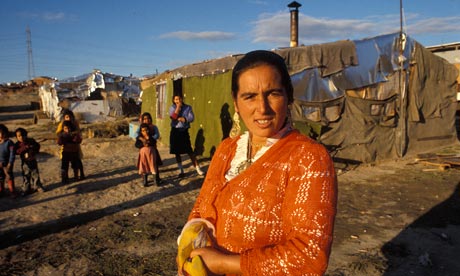
Gypsies in a shanty town in Madrid, Spain. Photograph: Navia/Cover/Getty Images
Migrants from India came to continent much earlier than previously thought, analysis suggests, and arrived in the Balkans
In parts of Europe they are still shunned as disruptive outsiders or patronised as little more than an exotic source of music and dance, but Gypsies have ancient roots that stretch back more than a millennium, scientists have proved.
A genetic analysis of 13 Gypsy groups around Europe, published in Current Biology journal, has revealed that the arrival on the continent of their forebears from northern India happened far earlier than was thought, about 1,500 years ago.
The earliest population reached the Balkans, while the spread outwards from there came nine centuries ago, according to researchers at Spain's Institute of Evolutionary Biology and elsewhere.
Read the rest of this article...
Norwich Castle Museum set to acquire 'curious' treasure
A gold earring disc,
found in Norfolk by a metal detector enthusiast, has left treasure
experts baffled as to the exact meaning of its decoration.
It features a scorpion, phallus, snake and crab, but the meaning of the combination "is lost" an expert said.
The Norwich museum hopes to acquire the disc for its collection.
The value of the item will now be determined by experts at the British Museum.
Read the rest of this article...
Thursday, December 06, 2012
Archaeologist of the Year – Nominees
We always look forward to escaping from the office to meet archaeologists working in the field: their hard work and dedication is inspiring. This year we would like to put forward the following individuals for special recognition of their work.
Vote now!
Read the rest of this article...
Researchers find evidence of early man in caves near Naples
Remains of both Neanderthals and Homo sapiens in same caves
Rome, December 4 - Researchers are poring over
thousands of tiny artifacts - including a child's milk tooth -
found in a southern Italian cave that appears to have been
shared by both Neanderthals and early man.
The caves of Roccia San Sebastiano, which overlook the
Tyrrhenian Sea north of Naples, are being combed for traces of
those who once lived there.
On the slopes of the medieval fortress of Montis Dragonis,
near Mondragone in Caserta province, researchers say they've
uncovered layers of history, rich in early historical finds.
The discovery is telling them "a story of the evolution
that goes from 40,000 to 20,000 years ago, when the cave was
used for uninterrupted time by Neanderthals and Sapiens," says
prehistoric archaeologist Carmine Collina.
Read the rest of this article...
Experts uncover medieval moat in Havel Library's future seat
Experts have uncovered a medieval trench filled with ground layers coming from a cemetery and containing a number of human bones during research into the courtyard of a Prague building that is to host the Vaclav Havel Library after reconstruction, Jana Marikova Kubkova told CTK.
Marikova Kubkova is the spokeswoman for the Archaeological Institute carrying out the research.
The planned reconstruction of the historical house, built in the 16th century near Prague Castle, has stirred up stormy discussions.
A couple of years ago, the house was bought by businessman Zdenek Bakala, whose foundation sponsors the Vaclav Havel Library. The reconstruction design was presented by Spanish architect Ricardo Bofill.
Apart from publicly accessible premises, the building is to offer accommodation capacities and a private flat.
Read the rest of this article...
Tracing Wine's "Turkish" Roots
Do French merlots or German rieslings have Turkish ancestors? That's the intriguing proposition raised by a Swiss botanist, who, using DNA analysis, is arguing that many of the wine grapes used today in western Europe and other parts of the world descend from wild grape varieties domesticated by Stone Age farmers in what is now Turkey. Reports AFP:
Today Turkey is home to archaeological sites as well as vineyards of ancient grape varieties like Bogazkere and Okuzgozu, which drew the curiosity of the Swiss botanist and grape DNA sleuth Jose Vouillamoz, for the clues they may offer to the origin of European wine.
Together with the biomolecular archaeologist Patrick McGovern, Vouillamoz has spent nearly a decade studying the world's cultivated and wild vines.
"We wanted to collect samples from wild and cultivated grape vines from the Near East -- that means southeastern Anatolia, Armenia and Georgia -- to see in which place the wild grape was, genetically speaking, linked the closest to the cultivated variety."
"It turned out to be southeastern Anatolia," the Asian part of modern Turkey, said Vouillamoz, speaking at the EWBC wine conference in the Turkish city of Izmir this month. "We propose the hypothesis that it is most likely the first place of grape vine domestication."
Read the rest of this article...
Genome of the Black Death reveals evidence for an antique bubonic plague pandemic
Black death: Scanning electron
micrograph depicting a mass of Yersinia pestis in the foregut of a flea
vector
[Credit: Rocky Mountain Laboratories, NIAID, NIH]
In a comparison of more than 300 contemporary strains of Yersinia pestis, the bacterium that causes bubonic plague, with ancient bacterial DNA isolated from victims of the Black Death (1347 -- 1351), a team led by researchers at University of Tuebingen obtained evidence suggestive of a bubonic plague outbreak in the late antique period (8th to 10th centuries AD). The study published online November 30 in PLoS ONE raises strong suspicion that the plague of Justinian, a massive pandemic that is thought to be in part responsible for the collapse of the East Roman Empire, may have been caused by the same bacterium implicated in the Black Death.
After the initial reconstruction of the complete medieval genome of Y.pestis from a Black Death cemetery in London last year, the researchers from the University of Tuebingen used a published genome wide dataset from more than 300 modern Y.pestis strains to reconstruct the relationship of ancient and modern plague bacteria. Due to the well-established age of the ancient remains they were able to date major radiation events in the history of this pathogen that are likely linked to major pandemics in the human population.
Read the rest of this article...
Gladiator's Tomb to Be Reburied
The tomb of the ancient Roman hero believed to have inspired the Russell Crowe blockbuster "Gladiator," might be returned to oblivion four years after its discovery in Rome.
A lack of fundings is forcing Italian archaeologists to bury again the large marble monument of Marcus Nonius Macrinus, a general and consul who achieved major victories in military campaigns for Antoninus Pius, the Roman emperor from 138 to 161 A.D., and Marcus Aurelius, emperor from 161 to 180 A.D.
Unearthed in 2008 on the banks of the Tiber near the via Flaminia, north of Rome, the tomb, complete with the dedicatory inscription, was hailed as "the most important ancient Roman monument to come to light for 20 or 30 years."
Read the rest of this article...
Subscribe to:
Posts (Atom)


