Monday, October 08, 2012

Archaeological site secures funding from Lottery fund


A project that will reveal thousands of years of Northamptonshire’s archaeology and heritage has taken a major step forward following an announcement by the Heritage Lottery Fund today.

The Chester Farm project has been successful in securing a grant of £135,800 development funding, the initial support for a £4.1m HLF bid, following an application submitted by Northamptonshire County Council. 

The project aims to open up the county council-owned site to the public so that everyone can benefit and learn from this hugely significant historical and archaeological site.

The initial funding will enable detailed development work to be undertaken. This will include comprehensive planning for the approach to interpretation of the site, including the innovative use of IT, together with an education and learning activities plan.

It will also fund a study into the feasibility of locating a countywide archaeological archives store and public access point on the site.

Read the rest of this article...

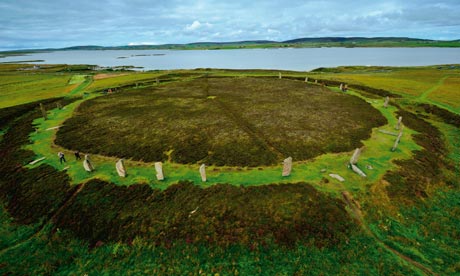
Neolithic discovery: why Orkney is the centre of ancient Britain


Long before the Egyptians began the pyramids, Neolithic man built a vast temple complex at the top of what is now Scotland. Robin McKie visits the astonishing Ness of Brodgar

Circle of life: the Ring of Brodgar – a stone circle, or henge – is a World Heritage Site.
Photograph: Adam Stanford
 
Drive west from Orkney's capital, Kirkwall, and then head north on the narrow B9055 and you will reach a single stone monolith that guards the entrance to a spit of land known as the Ness of Brodgar. The promontory separates the island's two largest bodies of freshwater, the Loch of Stenness and the Loch of Harray. At their furthest edges, the lochs' peaty brown water laps against fields and hills that form a natural amphitheatre; a landscape peppered with giant rings of stone, chambered cairns, ancient villages and other archaeological riches.

This is the heartland of the Neolithic North, a bleak, mysterious place that has made Orkney a magnet for archaeologists, historians and other researchers. For decades they have tramped the island measuring and ex- cavating its great Stone Age sites. The land was surveyed, mapped and known until a recent chance discovery revealed that for all their attention, scientists had completely overlooked a Neolithic treasure that utterly eclipses all others on Orkney – and in the rest of Europe.

Read the rest of this article...
'Significant' finds at Crossrail site


Excavations at Tottenham Court Road [Credit: Crossrail]

 The UK’s largest archaeology programme has uncovered its first Bronze Age find as it continues a search for remains of a 3,500 year old Bronze Age transport pathway along the same route that London’s newest railway, Crossrail, will follow in east London.

The first Bronze Age artefacts for Crossrail come as Europe’s largest construction project opens a month long exhibition in London to showcase its archaeology finds to-date. Among the exhibits are medieval human bones found at Liverpool Street, the UK’s largest rare amber find and a piece of mammoth jaw bone. The items have been found during archaeology digs at Crossrail worksites across London.

The Bronze Age finds include two wooden stakes that have been cut by early London hunters with an axe, and which may have been used to build a timber pathway, and a hammer stone used as a tool. The discovery has been made during excavations at the Plumstead tunnel entrance in east London where two tunnel boring machines will begin constructing Crossrail’s Thames Tunnels early next year. Excavations of the site are continuing this week.


Read the rest of this article...

Divers return to ancient Greek 'computer' wreck site


Main Antikythera mechanism fragment. The mechanism consists of a complex system of 32 wheels and plates with inscriptions relating to the signs of the zodiac and the months [Credit: National Archaeological Museum, Athens, No. 15987]

A new search has begun at a Greek island where an ancient device known as the world's "oldest computer" was found over a century ago, an official said, adding that other discoveries were possible.

Archaeologists this week returned to Antikythera, the Aegean Sea island where sponge divers in 1900-1901 found the so-called Antikythera Mechanism, a remarkable 2nd-century BCE device that tracked the cycles of the solar system.

"These are unexplored sea depths beneath a trade route known since antiquity," said Angeliki Simosi, head of Greece's ephorate of underwater antiquities. "This is virgin territory."


Read the rest of this article...

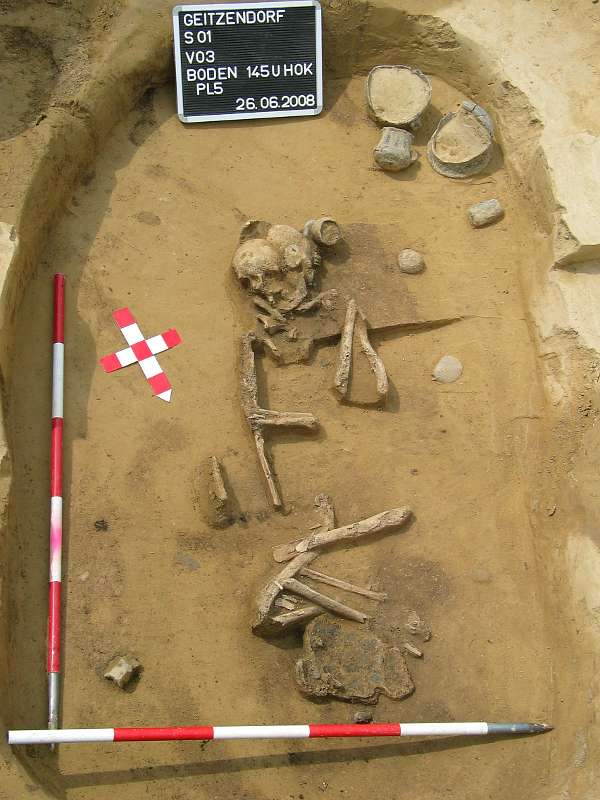
Das Grab "V3" aus dem frühbronzezeitlichen Gräberfeld von Geitzdendorf, NÖ (Foto: Urgeschichtemuseum Niederösterreich)

Eine archäologische Überraschung verbarg sich im bronzezeitlichen Gräberfeld in Geitzendorf. Das Grab einer Metallverarbeiterin wurde gefunden – es könnte der erste Beleg einer Frau in diesem historischen Beruf sein.

Die Ausgrabungen fanden bereits in den Sommermonaten 2008 und 2009 statt. 15 Gräber wurden ergraben. Dass eines davon die Vorstellungen der Geschlechterrollen in der Bronzezeit verändern kann, ahnte damals niemand. Nach den anthropologischen Untersuchungen in den letzten Jahren wurde festgestellt: es könnte dabei das erste bekannte Grab einer Metallverarbeiterin der Feinschmiedetechnik darunter sein. 

Read the rest of this article...

Mammoth carcass found in Siberia


A well-preserved mammoth carcass has been found by an 11-year-old boy in the permafrost of northern Siberia.

The remains were discovered at the end of August in Sopochnaya Karga, 3,500km (2,200 miles) northeast of Moscow.

A team of experts from St Petersburg then spent five days in September extracting the body from frozen mud.

The mammoth is estimated to have been around 16 years old when it died; it stood 2m tall and weighed 500kg.

It has been named Zhenya, after Zhenya Salinder, the 11-year-old who found the carcass while walking his dogs in the area.

Read the rest of this article...

Friday, October 05, 2012

Who Mastered Fire?

Mannequin of a Tautavel Man—would he have had known how to make fire?
Photo credit by Eric Cabanis/AFP/Getty Images.

The heated archaeological debate about which hominids first started cooking.

Richard Wrangham, an anthropologist at Harvard, claims that hominids became people—that is, acquired traits like big brains and dainty jaws—by mastering fire. He places this development at about 1.8 million years ago. This is an appealing premise no matter who you are. For those who see cooking as morally, culturally, and socially superior to not cooking, it is scientific validation of a worldview: proof that cooking is literally what makes us human. For the rest of us, it means we have a clever retort the next time one of those annoying raw-food faddists starts going on about how natural it is never to eat anything heated above 115 degrees Fahrenheit.

There’s one problem with Wrangham’s elegant hypothesis: It’s hardly the scientific consensus. In fact, since 2009, when Wrangham explained his theory in the book Catching Fire, several archaeologists have come forward with their own, wildly divergent opinions about what is arguably the oldest intellectual property debate in the world. Who really mastered fire, in the sense of being able to create it, control it, and cook with it regularly? Was it Homo erectus, Neanderthals, or modern humans?

Read the rest of this article...

Bronze Age transport route 'found during Crossrail dig'


Wood found during excavation work for Crossrail could be evidence of a 3,500-year-old Bronze Age transport route through London, experts believe.

Archaeologists examining a site in Plumstead have been searching for the pathway, which ran along the same route of the new rail link in east London.

They have unearthed wooden stakes which they say may have been used in the construction of the transport link.

Crossrail archaeologist Jay Carver said it was a "very significant find".

Read the rest of this article...

Byzantine coins found at Bulgarian monastary site


Some of the 101 Byzantine coins found at the monastery in Veliki Preslav [Credit: Sofia Globe]

 Archaeologists working at the site of a medieval monastery in Veliki Preslav, one of the former capitals of Bulgaria, have found 101 copper coins said to date from the late 12th to early 13th centuries CE.

Preslav was the capital of the First Bulgarian Kingdom from 893 to 972 CE. The site is about 20km from the town of Shoumen in north-eastern Bulgaria.

The coins bear the images of Byzantine emperors Isaac II Angelos, who reigned from 1185 to 1195, and Alexios III Angelos, whose reign was from 1195 to 1203.


Read the rest of this article...

Early Byzantine pithos found by Turkish farmer


The early Byzantine pithos was unearthed by a farmer while picking melons [Credit: Hurriyet/AA]

A farmer who was picking watermelons in the northwestern province of Düzce’s Çilimli district found an ancient pot thought to date back to the early Byzantine period. 

Farmer Servet Akyüz, who lives in the village of Topçular, noted when picking melons that the soil was soft and, after digging further, he uncovered the large pot.


Read the rest of this article...

The Greyfriars Project


The University of Leicester and Leicester City Council, in association with the Richard III Society, have joined forces to search for the mortal remains of King Richard III. 
 
Latest News
On Saturday 25 August 2012 – five hundred years after King Richard III was buried in Leicester - the historic archaeological project began with the aim of discovering whether Britain’s last Plantagenet King lies buried in Leicester City Centre.

The project represents the first ever search for the lost grave of an anointed King of England.
In 1485 King Richard III was defeated at the battle of Bosworth. His body, stripped and despoiled, was brought to Leicester where he was buried in the church of the Franciscan Friary, known as the Greyfriars. Over time the exact whereabouts of the Greyfriars became lost.

Read the rest of this article and watch the videos...

You may also be interested in this Oxford summer school course on Richard III ...

Thursday, October 04, 2012

Vikings Project Curator

Job Description: The British Museum
Prehistory and Europe Department
Project Curator: Vikings
Full-time
Fixed-term for 18 months
£22,907 per annum pro rata
Ref: 1283403


Read the rest of this advert...

Oxford Experience on Facebook


The Oxford Experience - an Oxford University summer school that offers many courses in archaeology and history - now has a Facebook site.

You can find the site at: www.facebook.com/OxfordExperience


You can find out more about the Oxford Experience here...

Stonehenge life-sized Neolithic homes to be built


A contract to build three life-sized Neolithic homes at Stonehenge in Wiltshire has been put out to tender. 

English Heritage is inviting contractors to bid for the £60,000 project, which is part of a £27m scheme to improve the setting of the monument.

Using authentic materials, the prehistoric homes will be based on those excavated at Durrington Walls.
English Heritage said the buildings will provide a "real and tangible link for visitors to the distant past".

The £27m scheme to build a new visitor centre and close the road alongside the ancient monument, was begun in July.

Read the rest of this article...

Project exposes dark past of city buildings

Project officer Jane Harrison 

THE Kassam Stadium is no stranger to the prayers of pleading football fans. 

But for hundreds of years, the site was actually the home of a more dedicated place of worship – a priory. 

The murky history of the building, along with tales of the Knights’ Templar and “naughty nuns”, will be explored in a major excavation project starting next week. 

The Archaeology of East Oxford project (Archeox) is running its biggest excavation to date right next to the Kassam Stadium and volunteers are being urged to get involved.

Read the rest of this article...

Conservation work suggested for Lochindorb Castle


The ruined stronghold of a notorious 14th Century lord who was known as the Wolf of Badenoch could be in line for conservation work.

From Lochindorb Castle in the Highlands, Alexander Stewart and his forces made a raid across Moray and destroyed Elgin Cathedral in 1390.

A scheduled ancient monument, the fortification was built on a small island on a loch.
A wind farm developer said it could fund work to the castle's walls.

Infinergy has proposed constructing a 17-turbine wind farm at Tom nan Clach, near Tomatin, seven miles (11.2km) away from the castle.

The project is a joint venture with Cawdor Estates, which owns Lochindorb.

Read the rest of this article...
War of the Roses experts hope to commission historic hunt for location of Battle of Barnet


Local historian Mike Noronha (right) inspects a model renactment of the Battle of Barnet

A medieval battle that took place in Barnet more than 500 years ago could hold the key to saving the economic prosperity of the modern borough. 

Historians are hunting for the exact location of the Battle of Barnet, a significant clash during the War of the Roses that shaped the country, and the borough, as it is known today. 

Its discovery, say trustees at the Barnet Museum, could put the area on the map in terms of historical interest and reinvigorate its dwindling high streets. 

The project is being commissioned by War of the Roses experts at the University of Huddersfield but digging will not commence unless money can be provided by the Heritage Lottery Fund.

Read the rest of this article...

Neolithic dentists?


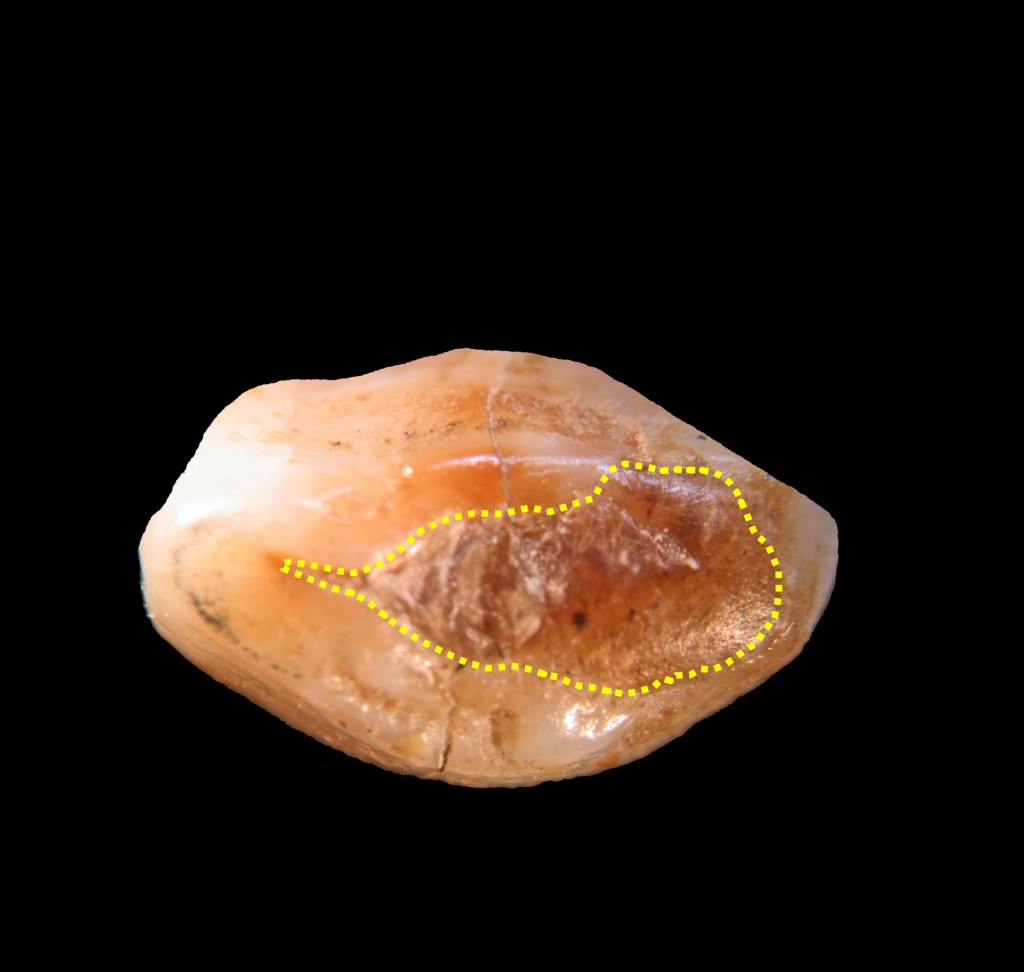
A 6,500-year-old tooth packed with beeswax could represent the earliest evidence of a dental filling, newly-published research has announced.
 
Found in part of a human jaw excavated in a cave near Lonche, Slovenia, the tooth is a left canine, thought to have belonged to a man aged between 24 and 30.

Research led by Federico Bernardini and Claudio Tuniz of the Abdus Salam Centre for Theoretical Physics in Italy examined a vertical crack in the tooth, which had been filled with a resinous substance.
Now analysis published in the journal PLOS ONE has revealed this to be beeswax, possibly used to alleviate pain and sensitivity when chewing on the broken tooth.

Read the rest of this article...

Methane Emissions Can Be Traced Back to Roman Times


The isotope curve shows that the emissions of the greenhouse gas methane had several peaks in the last 2,100 years. 1: During Roman times, where a lot of wood was burned for heating and for the processing of metals. 2: During the warm Middle Ages, where forests caught on fire. 3: In the "Little Ice Age", which was a very cold and dry period. 4: The methane concentration has increased dramatically since approx. the year 1800, when industrialization took off and triggered energy and food production, for example, rice fields. (Credit: NBI)

 Emissions of the greenhouse gas methane into the atmosphere can be traced back thousands of years in the Greenland ice sheet. Using special analytical methods, researchers from the Niels Bohr Institute, among others, have determined how much methane originates from natural sources and how much is due to human activity. The results go all the way back to Roman times and up to the present, where more than half of the emissions are now human-made.

The results are published in the scientific journal, Nature.

Methane is an important greenhouse gas, which today is partly emitted from natural sources and partly from human activities. The emissions from natural sources varies due to the climate variations. For example, bacteria in wetlands release methane and less is emitted in dry periods as the wetlands shrink.

Read the rest of this article...

Return to Antikythera: Divers revisit wreck where ancient computer found


Site where oldest computer lay for thousands of years may yield other treasures and even another Antikythera mechanism

In 1900, Greek sponge divers stumbled across "a pile of dead, naked women" on the seabed near the tiny island of Antikythera. It turned out the figures were not corpses but bronze and marble statues, part of a cargo of stolen Greek treasure that was lost when the Roman ship carrying them sank two thousand years ago on the island's treacherous rocks.

It was the first marine wreck to be studied by archaeologists, and yielded the greatest haul of ancient treasure that had ever been found. Yet the salvage project – carried out in treacherous conditions with desperately crude equipment – was never completed. So this month, armed with the latest diving technology, scientists are going back.

Between 1900 and 1901, the sponge divers retrieved a string of stunning antiquities, including weapons, jewellery, furniture and some exquisite statues. But their most famous find was a battered lump that sat unnoticed for months in the courtyard of Athens' National Archaeological Museum, before it cracked open to reveal a bundle of cogwheels, dials and inscriptions.

Read the rest of this article...